
Global Gluten-Free Pasta Market Size, Share, Growth Analysis Report - Forecast 2034

Gluten-Free Pasta Market By Raw Material (Chickpeas, Brown Rice, Multigrain, Lentil, and Others), By Distribution Channel (Supermarkets/Hypermarkets, Specialty Stores, Convenience/Grocery Stores, and E-commerce), and By Region: Global and Regional Industry Overview, Market Intelligence, Comprehensive Analysis, Historical Data, and Forecasts 2025 - 2034
| Market Size in 2024 | Market Forecast in 2034 | CAGR (in %) | Base Year |
|---|---|---|---|
| USD 1254.75 Million | USD 2610.24 Million | 7.60% | 2024 |
Gluten-Free Pasta Market Industry Perspective
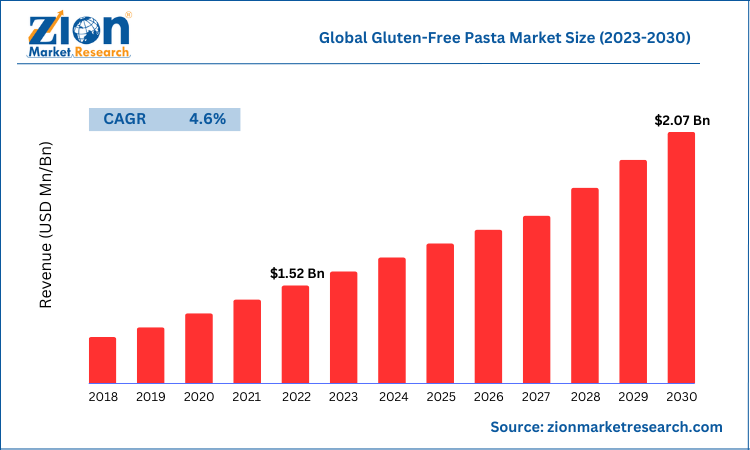
The global gluten-free pasta market size was worth around USD 1254.75 million in 2024 and is predicted to grow to around USD 2610.24 million by 2034 with a compound annual growth rate (CAGR) of roughly 7.60% between 2025 and 2034.
The report analyzes the global gluten-free pasta market's drivers, restraints/challenges, and the effect they have on demand during the projection period. In addition, the report explores emerging opportunities in the gluten-free pasta industry.
Gluten-Free Pasta Market: Overview
Gluten-free pasta is different from regular pasta. It is made from corn, millet, rice, and amaranth. Therefore, it is considered a healthy meal. Gluten-free pasta helps increase energy levels, lower cholesterol levels, and improving the digestive system. It contains glucomannan, fiber, folic acid, and others. However, there are different types of gluten-free pasta available in the market, like chickpea pasta, brown rice pasta, and others. Gluten-free food products are crucial for people suffering from celiac disease and gluten allergies. Celiac disease causes small intestine damage. However, it also helps with weight loss with a healthy combination and a proportion of other food products. Gluten-free pasta does not include the protein gluten, which is present in a wide range of grains like rye, barley, and wheat.
Key Insights
- As per the analysis shared by our research analyst, the global gluten-free pasta market is estimated to grow annually at a CAGR of around 7.6% over the forecast period (2025-2034).
- Regarding revenue, the global gluten-free pasta market size was valued at around USD 1254.75 million in 2024 and is projected to reach USD 2610.24 million by 2034.
- The gluten-free pasta market is projected to grow at a significant rate due to rising prevalence of celiac disease and gluten sensitivity, increasing health consciousness and demand for healthier food options, growing popularity of vegan and flexitarian diets, and continuous product innovation in taste and texture.
- Based on Raw Material, the Chickpeas segment is expected to lead the global market.
- On the basis of Distribution Channel, the Supermarkets/Hypermarkets segment is growing at a high rate and will continue to dominate the global market.
- Based on region, North America is predicted to dominate the global market during the forecast period.
Gluten-Free Pasta Market: Growth Drivers
The growing prevalence of obesity and celiac disease will drive the growth of the global market.
The high prevalence of obesity among people all across the globe is one of the major factors impacting the growth trajectory of the global gluten-free pasta market. Gluten-free pasta is low in calories; therefore, it helps in sustainable weight reduction. As per the World Health Organization, around 38.3 million children were suffering from obesity and overweight issues in 2019. Those children were aged under five, and this number is likely to grow with time. Additionally, the growth in the cases of celiac disease globally is another reason augmenting the demand for gluten-free food products.
Celiac disease is also referred to as gluten enteropathy, which is an autoimmune illness. This disease can only be monitored and treated with a gluten-free diet. Also, in order to compensate for the nutrient shortages in diet, more proteins, vitamins, and minerals are added to food products. The fast-proliferating food and beverage sector globally is another key reason for pushing up the demand and scaling the growth of the global market during the forecast period.
Gluten-Free Pasta Market: Restraints
The bland taste of gluten-free pasta is likely to impede the growth of the global market.
Gluten-free pasta is full of nutrition but lacks taste. Therefore, the unpleasant taste of gluten-free pasta is a major restraining factor in the global gluten-free pasta industry. However, manufacturers are innovating different products to overcome taste issues in the product portfolio.
Gluten-Free Pasta Market: Opportunities
The surging trend of 'free from' foods is likely to create new growth avenues in the global market.
There has been significant growth in the 'free from' food trend in recent years in the global market. 'Free from' food is gaining immense importance among consumers due to the evolving lifestyle that demands specific foods which are free from certain ingredients. There is high popularity of healthy versions of ready-to-eat and ready-to-cook food products due to the busy lifestyle of people.
The increasing prevalence of celiac disease, allergies, and gluten intolerance among people is propelling the requirement for gluten-free meals, which is contributing immensely to the growth of the global gluten-free pasta market. The product development activities and constantly increasing product innovation are expected to foster growth opportunities in the global gluten-free pasta market.
Traditionally, one key reason behind the surge in demand for gluten-free food was medical conditions like allergies, but in recent times, consumers are now looking forward to 'free from' food products as they prefer healthier alternatives to conventional products. In addition, the growing health awareness and benefits of gluten-free products are primarily attracting a large customer base, thereby offering new growth opportunities in the global market.
Gluten-Free Pasta Market: Challenges
Maintaining product consistency throughout the gluten-free product line is a major challenge in the global market.
Manufacturers are finding difficulty in maintaining product consistency throughout the product portfolio. Therefore, it is a major challenge faced by vendors in the global market.
Gluten-Free Pasta Market: Segmentation
The global gluten-free pasta market can be segmented based on raw material, distribution channel, and region.
By Raw Material, the global gluten-free pasta market is segmented into chickpeas, brown rice, multigrain, lentils, and others. Chickpeas lead the market, driven by high protein content and strong demand from health-conscious and plant-based consumers seeking nutrient-dense, premium alternatives. Brown rice forms a major secondary segment, favored for its mild flavor, familiar chewy texture, and digestive benefits.
By Distribution Channel, the market is divided into supermarkets/hypermarkets, specialty stores, convenience/grocery stores, e-commerce, and others. Supermarkets and hypermarkets dominate and continue to expand rapidly, benefiting from dedicated dietary aisles, diverse product selections, competitive bulk pricing, and convenient one-stop access that together drive large-scale volume sales.
Gluten-Free Pasta Market: Report Scope
| Report Attributes | Report Details |
|---|---|
| Report Name | Gluten-Free Pasta Market |
| Market Size in 2024 | USD 1254.75 Million |
| Market Forecast in 2034 | USD 2610.24 Million |
| Growth Rate | CAGR of 7.6% |
| Number of Pages | 205 |
| Key Companies Covered | Barilla G. e R. F.lli S.p.A. (Italy), Jovial Foods Inc. (U.S.), Banza LLC (U.S.), Doves Farm Foods Ltd (U.K.), Quinoa Corporation (U.S.), Rummo S.p.A (China), The Kraft Heinz Company (U.S.), LE VENEZIANE SRL (Italy), ZENB (U.K.), Cappello's (U.S.), and others. |
| Segments Covered | By Raw Material, By Distribution Channel, and By Region |
| Regions Covered | North America, Europe, Asia Pacific (APAC), Latin America, The Middle East and Africa (MEA) |
| Base Year | 2024 |
| Historical Year | 2020 to 2023 |
| Forecast Year | 2025 - 2034 |
| Customization Scope | Avail customized purchase options to meet your exact research needs. Request For Customization |
Gluten-Free Pasta Market: Regional Landscape
North America to dominate the global market
North America held the largest market share in 2024 and is projected to continue leading the global Gluten-Free Pasta market. Growth is supported by the increasing number of consumers with celiac disease and gluten intolerance, rising adoption of healthier lifestyles, strong awareness of the benefits of gluten-free products, and broad availability through supermarkets and online platforms. The United States represents the largest national market within the region due to high disease prevalence and the presence of major manufacturers. This regional leadership accelerates overall market growth by establishing mature distribution networks, fostering continuous product innovation, influencing global standards for quality and labeling, and encouraging further investment in gluten-free pasta development and marketing.
Recent Developments
- Barilla Group, in May 2019, extended its pasta plant, including whole wheat pasta and gluten-free in Iowa, U.S. It has enhanced the facility's dry pasta production capacity to 200,000 metric tonnes per year.
- Annie's Inc, in August 2018, announced the launch of a crispy cracker snack with cheddar cheese products named gluten-free cheddar bunny tails.
- In 2020, RP's Pasta Company, a US-based manufacturer of fresh pasta products, launched a new line of gluten-free pasta products made from brown rice flour. The new range of products is designed to cater to consumers with gluten intolerance and celiac disease, while also offering a high-quality and nutritious alternative to traditional pasta products.
- In 2021, Explore Cuisine, a US-based manufacturer of plant-based pasta products, announced the launch of its new gluten-free chickpea fusilli. The new product is made from 100% chickpea flour and is designed to offer consumers a healthy and protein-rich alternative to traditional wheat-based pasta products.
Gluten-Free Pasta Market: Competitive Analysis
The global gluten-free pasta market is dominated by players like:
- Barilla G. e R. F.lli S.p.A. (Italy)
- Jovial Foods Inc. (U.S.)
- Banza LLC (U.S.)
- Doves Farm Foods Ltd (U.K.)
- Quinoa Corporation (U.S.)
- Rummo S.p.A (China)
- The Kraft Heinz Company (U.S.)
- LE VENEZIANE SRL (Italy)
- ZENB (U.K.)
- Cappello's (U.S.)
The global gluten-free pasta market is segmented as follows;
By Raw Material
- Chickpeas
- Brown Rice
- Multigrain
- Lentil
- Others
By Distribution Channel
- Supermarkets/Hypermarkets
- Specialty Stores
- Convenience/Grocery Stores
- E-commerce
By Region
- North America
- The U.S.
- Canada
- Mexico
- Europe
- France
- The UK
- Spain
- Germany
- Italy
- Rest of Europe
- Asia Pacific
- China
- Japan
- India
- Australia
- South Korea
- Rest of Asia Pacific
- The Middle East & Africa
- Saudi Arabia
- UAE
- Egypt
- Kuwait
- South Africa
- Rest of the Middle East & Africa
- Latin America
- Brazil
- Argentina
- Rest of Latin America
Table Of Content
Methodology
FrequentlyAsked Questions
Gluten-free pasta is different from regular pasta. It is made in combination with corn, millet, rice, and amaranth. Therefore, it is considered a healthy meal. Gluten-free pasta helps in increasing energy levels, lowering cholesterol levels, and improving the digestive system. It contains glucomannan, fiber, folic acid, and others.
The global gluten-free pasta market is expected to grow due to increasing health-conscious consumers, rising prevalence of celiac disease, demand for dietary alternatives, and innovation in ingredient formulations.
According to a study, the global gluten-free pasta market size was worth around USD 1254.75 Million in 2024 and is expected to reach USD 2610.24 Million by 2034.
The global gluten-free pasta market is expected to grow at a CAGR of 7.6% during the forecast period.
North America is expected to dominate the gluten-free pasta market over the forecast period.
Leading players in the global gluten-free pasta market include Barilla G. e R. F.lli S.p.A. (Italy), Jovial Foods Inc. (U.S.), Banza LLC (U.S.), Doves Farm Foods Ltd (U.K.), Quinoa Corporation (U.S.), Rummo S.p.A (China), The Kraft Heinz Company (U.S.), LE VENEZIANE SRL (Italy), ZENB (U.K.), Cappello's (U.S.), among others.
The report explores crucial aspects of the gluten-free pasta market, including a detailed discussion of existing growth factors and restraints, while also examining future growth opportunities and challenges that impact the market.

HappyClients

