
Frozen Breakfast Foods Market Size, Share, Trends, Growth 2034

Frozen Breakfast Foods Market By Product Type (Frozen Waffles, Frozen Pancakes, Frozen Breakfast Burritos, Frozen Breakfast Sandwiches, Frozen Smoothies), By Preparation Method (Microwave, Oven, Toaster, Stovetop, Ready-to-Eat), By Consumer Demographics (Families, Young Professionals, Students, Health-Conscious Consumers, Busy Professionals), By Distribution Channel (Supermarkets, Convenience Stores, Online Retail, Specialty Stores, Wholesale), and By Region - Global and Regional Industry Overview, Market Intelligence, Comprehensive Analysis, Historical Data, and Forecasts 2025 - 2034
| Market Size in 2024 | Market Forecast in 2034 | CAGR (in %) | Base Year |
|---|---|---|---|
| USD 19 Billion | USD 36.38 Billion | 8.46% | 2024 |
Frozen Breakfast Foods Industry Perspective:
What will be the size of the global frozen breakfast foods market during the forecast period?
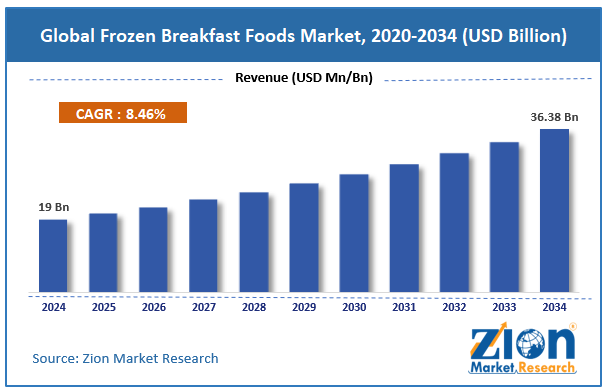
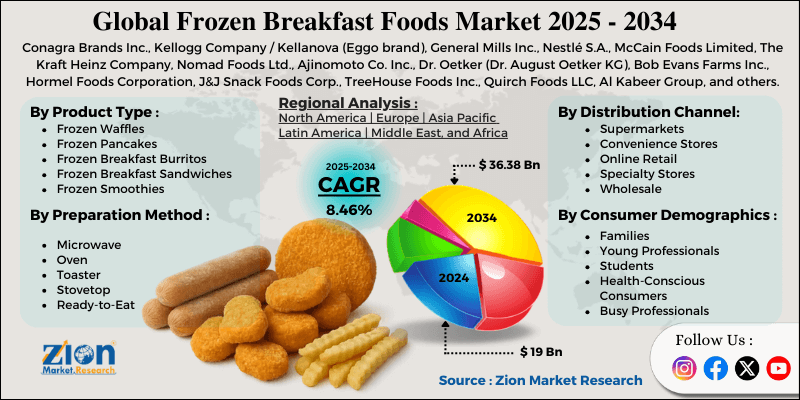
The global frozen breakfast foods market size was around USD 19 billion in 2024 and is projected to reach USD 36.38 billion by 2034, with a compound annual growth rate (CAGR) of roughly 8.46% between 2025 and 2034.
Key Insights:
- As per the analysis shared by our research analyst, the global frozen breakfast foods market is estimated to grow annually at a CAGR of around 8.46% over the forecast period (2025-2034)
- In terms of revenue, the global frozen breakfast foods market size was valued at around USD 19 billion in 2024 and is projected to reach USD 36.38 billion by 2034.
- The frozen breakfast foods market is projected to grow significantly, driven by urbanization, the expansion of retail and e-commerce channels, and health and wellness trends.
- Based on product type, the frozen breakfast sandwiches segment is expected to lead the market, while the frozen waffles segment is poised for significant growth.
- Based on the preparation method, the microwave segment is the dominant segment, while the ready-to-eat segment is projected to record sizeable revenue over the forecast period.
- Based on consumer demographics, the families segment leads the market, while the health-conscious consumers segment is the fastest-growing.
- Based on distribution channel, the supermarkets segment is expected to lead the market, followed by convenience stores.
- By region, North America is projected to dominate the global market during the forecast period, followed by Europe.
Frozen Breakfast Foods Market: Overview
Frozen breakfast foods are time-saving, convenient meal options that can be prepared quickly, making them popular for busy mornings. They include pancakes, waffles, burritos, ready-made egg dishes, breakfast sandwiches, and hash browns. These foods are usually flash-frozen and pre-cooked to preserve freshness, nutrients, and flavor. The global frozen breakfast foods market is likely to expand rapidly, fueled by busy lifestyles and convenience, growth in dual-income households, and retail and distribution growth. The increasing pace of modern life has notably increased demand for convenient, quick meal solutions. Frozen breakfast foods offer ready-to-heat options that require less preparation time, making them more suitable for hectic mornings. This strong convenience continues to fuel consistent industry growth.
Moreover, the growth of dual-income families has lowered the time available for traditional home-cooked breakfasts. Frozen breakfast offers a practical option that balances time efficiency with meal satisfaction. This demographic move plays a vital role in sustaining industry growth. Furthermore, the growth of hypermarkets, supermarkets, and online grocery stores has enhanced product accessibility. Elevated freezer space and improved supply chain networks promise broader product availability. Widening distribution channels directly contributes to higher sales volumes.
Despite growth, the global market is constrained by factors such as an unhealthy perception of frozen foods and barriers to the development of cold chain infrastructure. A majority of consumers perceive frozen breakfast foods as less nutritious and overly processed; concerns persist regarding sodium levels, preservatives, and artificial additives. This negative perception may hamper adoption among health-conscious users. Likewise, the frozen food market relies on efficient cold storage and transportation systems. Maintaining consistent temperatures throughout supply chains requires major investment. Infrastructure gaps may increase the risk of product loss and associated costs.
Nonetheless, the global frozen breakfast foods industry stands to benefit from several key opportunities, including the expansion of functional and health products and the growth of e-commerce channels. There is a strong potential for growth in gluten-free, plant-based, and protein-enriched frozen breakfasts. Individuals are now choosing functional foods that support dietary goals. Brands that prioritize health advancement can capture fresh market domains. Additionally, home delivery services and online grocery platforms are rapidly growing. Enhanced cold-chain logistics allow safe transportation of frozen goods directly to end consumers. Digital retail offers major growth prospects for the category.
Frozen Breakfast Foods Market: Dynamics
Growth Drivers
How is the worldwide frozen breakfast foods market driven by expanding variety & flavor innovation?
Manufacturers are expanding frozen breakfast options to match changing tastes, offering items from products from pancakes and breakfast burritos to international breakfast bowls. Ethnic-inspired recipes and new flavors attract repeat buyers and support premium pricing. This variety helps frozen breakfasts compete with restaurants and fresh options by combining convenience with appealing taste. Continuous innovation keeps products engaging and drives retail sales.
How is the growth of urbanization & on-the-go consumption positively impacting the development of the frozen breakfast foods market?
Speedy urbanization and busier lifestyles are driving demand for portable, convenient frozen breakfast foods such as handheld and sandwich meals, thereby fueling the frozen breakfast market. Smaller households and long-distance commuters prefer on-the-go eating to traditional meals and breakfasts. Growing middle-class populations and the adoption of Western breakfast habits further support worldwide growth in this category, fueling the global frozen breakfast foods market.
Restraints
Price sensitivity among consumers unfavorably impacts the market progress
Frozen breakfast products are usually high-priced, which makes them less appealing in price-sensitive regions. Most of the consumers view simple ingredients like fruit, bread, and eggs as more nutritious and cheaper substitutes. This price resilience is majorly seen in emerging economies and among low-income households. Hence, cost concerns may limit adoption and slow down overall growth, despite the high convenience of these products.
Opportunities
How does innovative, sustainable & eco‑friendly packaging create promising avenues for the growth of the frozen breakfast foods industry?
Responding to regulatory and consumer pressure for sustainability, brands can invest in biodegradable, reduced-waste packaging, and recyclable solutions. These innovations improve brand reputation and appeal to eco-conscious buyers. Communicating sustainability commitments through marketing to build trust and differentiate. Sustainability is not only ethical but also a competitive advantage that can drive premium and loyalty pricing. This opportunity supports the broader frozen breakfast foods industry's trend toward environmental responsibility.
Challenges
Supply chain & cold chain vulnerabilities restrict the market growth
The frozen breakfast industry relies on strict temperature control, thereby increasing its vulnerability to cold chain failures, infrastructure issues, and logistical delays. These disturbances may cause financial loss, spoilage, and reduced consumer trust. These risks are much higher during peak transport times and in regions with unreliable power. Manufacturers should invest in backup and monitoring systems, but the complexities of the cold chain remain a major operational barrier.
Frozen Breakfast Foods Market: Report Scope
| Report Attributes | Report Details |
|---|---|
| Report Name | Frozen Breakfast Foods Market |
| Market Size in 2024 | USD 19 Billion |
| Market Forecast in 2034 | USD 36.38 Billion |
| Growth Rate | CAGR of 8.46% |
| Number of Pages | 218 |
| Key Companies Covered | Conagra Brands Inc., Kellogg Company / Kellanova (Eggo brand), General Mills Inc., Nestlé S.A., McCain Foods Limited, The Kraft Heinz Company, Nomad Foods Ltd., Ajinomoto Co. Inc., Dr. Oetker (Dr. August Oetker KG), Bob Evans Farms Inc., Hormel Foods Corporation, J&J Snack Foods Corp., TreeHouse Foods Inc., Quirch Foods LLC, Al Kabeer Group, and others. |
| Segments Covered | By Product Type, By Preparation Method, By Consumer Demographics, By Distribution Channel, and By Region |
| Regions Covered | North America, Europe, Asia Pacific (APAC), Latin America, Middle East, and Africa (MEA) |
| Base Year | 2024 |
| Historical Year | 2019 to 2023 |
| Forecast Year | 2025 - 2034 |
| Customization Scope | Avail customized purchase options to meet your exact research needs. Request For Customization |
Frozen Breakfast Foods Market: Segmentation
The global frozen breakfast foods market is segmented based on product type, preparation method, consumer demographics, distribution channel, and region.
Why is the Frozen Breakfast Sandwiches segment projected to dominate the frozen breakfast foods market?
Based on product type, the global frozen breakfast foods industry is divided into frozen waffles, frozen pancakes, frozen breakfast burritos, frozen breakfast sandwiches, and frozen smoothies. The frozen breakfast sandwich segment accounts for nearly 38.2% of the total market, driven by portability, convenience, and complete-meal appeal. Commuters and busy adults are the main buyers.
On the other hand, the frozen waffles segment ranks second in the market, with a 40% share. They are usually categorized with pancakes, contributing to a remarkable market. Their versatility, familiarity, and family-friendly appeal fuel steady demand.
Which key reasons support the dominance of the Microwave segment in the frozen breakfast foods market?
Based on preparation method, the global market is segmented into microwave, oven, toaster, stovetop, and ready-to-eat. The microwave segment accounts for nearly 50% of the total market, indicating a strong preference for the simplest heating method and the fastest option. The majority of products in the category are designed for microwave use, making them convenient for individuals with busy schedules. This ease-of-use benefit keeps the segment dominant.
Conversely, the ready-to-eat segment holds the second-largest share in the market at 25%. It attracts consumers who prefer no or minimal preparation. The demand backs segmental growth for ultra-convenient breakfast options and on-the-go lifestyles. Its growing prominence denotes shifting preferences towards immediate consumption without heating.
What factors help the Families segment lead the frozen breakfast foods market?
Based on consumer demographics, the global frozen breakfast foods market is segmented into families, young professionals, students, health-conscious consumers, and busy professionals. The families segment captures 50% share of the total market. The segment largely seeks frozen meals for better convenience that suit different age gaps. Their need for versatile products that feed multiple household members fuels strong sales.
However, the health-conscious consumer segment accounts for 25% of the overall market. This demographic prefers frozen breakfasts with improved nutritional quality, such as plant-based options, low-calorie items, and whole grains. This segment is also augmented by healthier lifestyles preferred by the majority of the population.
What are the key reasons for the leadership of the Supermarkets segment in the frozen breakfast foods market?
Based on distribution channel, the global market is segmented into supermarkets, convenience stores, online retail, specialty stores, and wholesale. The supermarkets segment leads with 40% of the market share. This is supported by a broad product range, robust retail infrastructure, and one-stop convenience, which together fuel frequent purchases.
Nonetheless, convenience stores lead supermarkets in market share, at 37%. It offers quick access for time-pressed users in high-traffic areas, making on-the-go breakfast purchases more suitable.
Frozen Breakfast Foods Market: Regional Analysis
What gives North America a competitive edge in the global Frozen Breakfast Foods Market?
North America is anticipated to retain its leading role in the global frozen breakfast foods market, with a 6.8% CAGR, driven by its largest market share, established demand, robust retail infrastructure, busy lifestyles, and a convenience culture. North America accounts for nearly 45% of the global market, driven by strong consumer acceptance of convenience meals. The sophisticated frozen food culture promises wide integration of these products into daily eating habits. High demand is strengthened by foodservice and deep retail penetration in Canada and the U.S.
Moreover, the United States alone accounts for billions in sales of frozen breakfast products, supported by hypermarkets, supermarkets, and online channels. Broader distribution networks promise frequent purchases and easy access. Effective cold-chain logistics help maintain product quality in the region. Furthermore, fast-paced lifestyles and high prevalence of dual-income households make ready-to-heat frozen breakfasts important in the region. Consumers depend on quick meal solutions, driving demand for convenience foods. This culture sets the region apart from others, with comparatively slow adoption of frozen breakfast.
What factors make Europe rank second in the global Frozen Breakfast Foods Market?
Europe ranks second in the global frozen breakfast foods industry, with a 6.1% CAGR, driven by strong market share, consumer preference for quality and convenience, advanced retail infrastructure, and supportive policies. Europe accounts for nearly 30% of the global market, with high adoption in countries such as France, the UK, and Germany. Urban and working households increasingly choose frozen breakfast options, maintaining the region's second position after North America.
Moreover, busy lifestyles and the rising emphasis on food safety and nutrition are fueling demand for frozen breakfasts. Europeans value ready-to-eat, high-quality food products, thereby supporting steady industry growth. Additionally, well-established hypermarkets, supermarkets, and online grocery channels promise broad availability of frozen breakfast foods. EU food regulations and advancement initiatives also motivate consumer trust and product development.
Frozen Breakfast Foods Market: Competitive Analysis
The leading players in the global frozen breakfast foods market are:
- Conagra Brands Inc.
- Kellogg Company / Kellanova (Eggo brand)
- General Mills Inc.
- Nestlé S.A.
- McCain Foods Limited
- The Kraft Heinz Company
- Nomad Foods Ltd.
- Ajinomoto Co. Inc.
- Dr. Oetker (Dr. August Oetker KG)
- Bob Evans Farms Inc.
- Hormel Foods Corporation
- J&J Snack Foods Corp.
- TreeHouse Foods Inc.
- Quirch Foods LLC
- Al Kabeer Group
What are the key trends in the global Frozen Breakfast Foods Market?
Healthier & functional product innovation:
Brands are introducing frozen foods with better nutritional profiles, including high-protein, whole-grain, plant-based, and low-sugar options. Consumers are increasingly seeking products that support dietary lifestyles and wellness. This inclination pushes manufacturers to diversify and reformulate offerings.
Variety & global flavor innovation:
Manufacturers are launching international flavors and new formats, such as breakfast burritos with fusion frozen waffles or global spice profiles. This variety attracts young consumers and adventurous eaters. Flavor innovation helps sustain interest and fuel category growth.
The global frozen breakfast foods market is segmented as follows:
By Product Type
- Frozen Waffles
- Frozen Pancakes
- Frozen Breakfast Burritos
- Frozen Breakfast Sandwiches
- Frozen Smoothies
By Preparation Method
- Microwave
- Oven
- Toaster
- Stovetop
- Ready-to-Eat
By Consumer Demographics
- Families
- Young Professionals
- Students
- Health-Conscious Consumers
- Busy Professionals
By Distribution Channel
- Supermarkets
- Convenience Stores
- Online Retail
- Specialty Stores
- Wholesale
By Region
- North America
- The U.S.
- Canada
- Europe
- France
- The UK
- Spain
- Germany
- Italy
- Rest of Europe
- Asia Pacific
- China
- Japan
- India
- South Korea
- Southeast Asia
- Rest of Asia Pacific
- Latin America
- Brazil
- Mexico
- Rest of Latin America
- Middle East & Africa
- GCC
- South Africa
- Rest of Middle East & Africa
Table Of Content
Methodology
FrequentlyAsked Questions

HappyClients

