
Global Forage Seed Market Size, Share, Growth Trends, And Forecast 2032

Forage Seed Market By Type (Alfalfa, Ryegrass, Chicory, and Clover), By Livestock (Poultry, Cattle, and Swine), By Origin (Organic and Inorganic), By Species (Legumes and Grasses), By Form (Green and Dry), and By Region - Global and Regional Industry Overview, Market Intelligence, Comprehensive Analysis, Historical Data, and Forecasts 2024 - 2032
| Market Size in 2023 | Market Forecast in 2032 | CAGR (in %) | Base Year |
|---|---|---|---|
| USD 4.40 Billion | USD 10.06 Billion | 9.74% | 2023 |
Forage Seed Industry Perspective
What will be the global forage seed market size during the forecast period?
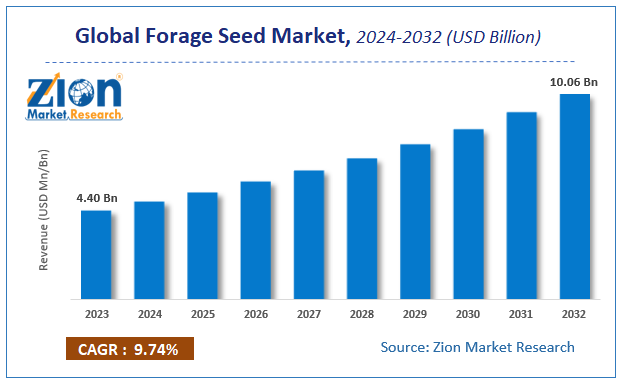
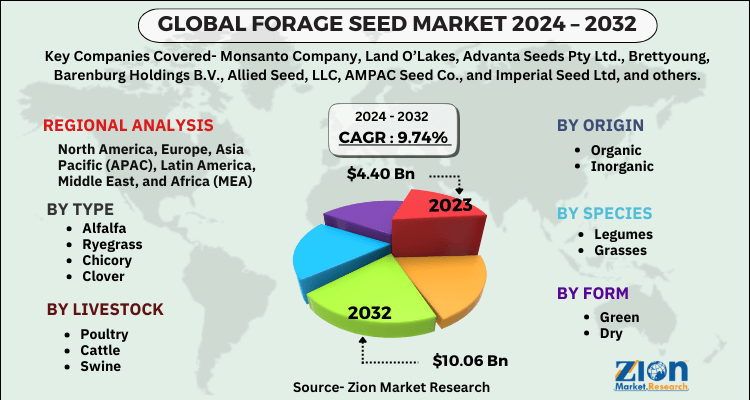
The global forage seed market size was worth around USD 4.40 billion in 2023 and is predicted to grow to around USD 10.06 billion by 2032, with a compound annual growth rate (CAGR) of roughly 9.74% between 2024 and 2032.
The report provides a comprehensive analysis of the growth drivers, restraints, and challenges shaping demand across the global forage seed market throughout the forecast period, while highlighting high-potential emerging opportunities within the industry.
Key Insights
- As per the analysis shared by our research analyst, the global forage seed market is estimated to grow annually at a CAGR of around 9.74% over the forecast period (2024-2032).
- In terms of revenue, the global forage seed market size was valued at around USD 4.40 billion in 2023 and is projected to reach USD 10.06 billion by 2032.
- The forage seed market is projected to grow at a significant rate due to rising demand for animal feed, increased demand for dairy products, reduction in available grazing land, and growing awareness of the health benefits of quality forage among farmers.
- Based on the type segment, alfalfa holds a leading position owing to its high protein content, nutritional value, and widespread use in feeding cattle, dairy cows, and other livestock.
- Based on the livestock segment, cattle represent a dominant application area driven by the large scale of dairy and beef production and the direct link between forage quality and milk and meat output.
- Based on the origin segment, inorganic forage seeds currently account for the larger share due to established production systems, cost advantages, and broad commercial availability, while organic options are gaining traction.
- Based on the species segment, grasses play essential roles, with grasses supporting volume feed requirements and legumes contributing higher protein content.
- Based on the form segment, dry forms serve distinct needs in livestock feeding systems, with dry forms offering storage and handling advantages.
- Based on region, North America is expected to dominate the forage seed market over the forecast period, with the United States occupying the largest market share due to advanced livestock production systems and strong adoption of improved forage varieties.
Forage Seed Market: Overview
Forage seeds are seeds specifically selected for planting crops intended as animal feed rather than for human consumption. These crops are typically high in fiber and essential nutrients and are used to support the growth, health, and productivity of livestock including cattle, horses, dairy cows, goats, and other animals. The quality of meat and milk products is closely linked to the nutritional value of the feed provided, and forage seeds play a central role in delivering proteins and other important nutrients that improve animal health and can enhance milk yield.
Forage Seed Market: Growth Factors
What factors are propelling the expansion of the forage seed market?
Forage seeds are extensively used for feeding cattle, horses, dairy cows, goats, etc. The quality of meat & milk products mostly depends upon the quality of what is fed to the cattle. The quantity of milk can also be improved by better cattle feeding. Forage seeds provide proteins & other important nutrients, thereby improving the health of the animals. The Asia Pacific is the fastest-growing market for forage seeds. The rising demand for animal feed from the region is one of the major driving factors for the forage seeds market.
Increased demand for dairy products coupled with a reduction in the available grazing land is another major driving factor for the market. Increasing awareness about the health benefits among farmers worldwide has made forage seed a preference. As of now, North America is the largest market for forage seed, of which the U.S. occupies the largest market share. Also, major acquisitions are being made along with heavy investments so as to develop new products in the forage seed category. The low cost of forage seeds as compared to wheat, oilseed, etc. has been the reason for the huge demand for them.
Forage Seed Market: Restraints
What factors are limiting the growth of the forage seed market?
Challenges related to seed production in developing regions, including limited availability of quality planting materials, drought conditions, and overgrazing pressures, can constrain supply and limit market expansion in certain geographies. Variability in climatic conditions and the need for region-specific adapted varieties also add complexity to breeding and distribution efforts.
Price sensitivity among smaller livestock producers and competition from alternative feed sources may moderate uptake in some markets. Ensuring consistent seed quality and performance across diverse growing environments remains an ongoing operational challenge for suppliers.
Forage Seed Market: Report Scope
| Report Attributes | Report Details |
|---|---|
| Report Name | Forage Seed Market |
| Market Size in 2023 | USD 4.40 Billion |
| Market Forecast in 2032 | USD 10.06 Billion |
| Growth Rate | CAGR of 9.74% |
| Number of Pages | 230 |
| Key Companies Covered | Monsanto Company, Land O’Lakes, Advanta Seeds Pty Ltd., Brettyoung, Barenburg Holdings B.V., Allied Seed, LLC, AMPAC Seed Co., Imperial Seed Ltd., and others. |
| Segments Covered | By Type, By Livestock, By Origin, By Species, By Form, By Region |
| Regions Covered | North America, Europe, Asia Pacific (APAC), Latin America, The Middle East and Africa (MEA) |
| Base Year | 2023 |
| Historical Year | 2018 - 2022 |
| Forecast Year | 2024 - 2032 |
| Customization Scope | Avail customized purchase options to meet your exact research needs. Request For Customization |
Forage Seed Market: Segmentation Analysis
The study provides a decisive view of the forage seed market by segmenting the market based on type, livestock, origin, species, form, and region. All the segments of the forage seed market have been analyzed based on present and future trends and the market is estimated from 2024 to 2032.
Based on Type Segment, the forage seed market is divided into alfalfa, ryegrass, chicory, and clover. Alfalfa holds a leading position within the type segment. It is valued for its high crude protein content, rich vitamin profile, and suitability for feeding cattle, dairy cows, goats, horses, and sheep. Its established role in improving livestock nutrition and supporting milk and meat production underpins strong and sustained demand. This dominance helps drive overall market growth by anchoring volume in core livestock systems and encouraging continued breeding improvements focused on yield, persistence, and nutritional quality.
Based on Livestock Segment, the forage seed market is divided into poultry, cattle, and swine. Cattle represent the dominant livestock segment. Large-scale dairy and beef production systems rely heavily on high-quality forage to support milk yield, animal health, and meat quality. The direct relationship between forage nutrition and livestock productivity sustains substantial seed demand in this segment and helps drive overall market revenue. Poultry and swine applications contribute additional volume, particularly where specialized forage or complementary feeding strategies are employed, further broadening the addressable market.
Based on Origin Segment, the forage seed market is divided into organic and inorganic. Inorganic forage seeds currently account for the larger commercial share due to established production infrastructure, cost efficiency, and widespread availability. Organic forage seeds are gaining interest as livestock producers and consumers place greater emphasis on sustainable and chemical-free production systems. The interplay between these two origin categories supports both volume growth in conventional systems and premium opportunities in the organic segment, contributing to overall market development.
Based on Species Segment, the forage seed market is divided into legumes and grasses. Grasses play essential and complementary roles. Grasses often support high-volume feed production, while legumes such as alfalfa and clover contribute higher protein content and soil nitrogen benefits. Their combined use in mixed swards enhances nutritional balance and system resilience, helping drive adoption of improved forage seed packages and supporting broader market expansion.
Based on Form Segment, the forage seed market is divided into green and dry. Dry forms offer practical advantages in storage, transport, and year-round availability, supporting consistent feeding programs. Green forms are valued for freshness and immediate nutritional contribution in certain production systems. The availability of both forms allows producers to match forage supply with seasonal and operational needs, reinforcing overall market flexibility and growth.
Forage Seed Market: Regional Analysis
Why will North America continue to dominate the global market during the projection period?
North America is expected to dominate the forage seed market over the forecast period. The United States occupies the largest market share within the region, supported by advanced dairy and beef production systems, strong research infrastructure, and widespread adoption of improved forage varieties. High awareness of the link between forage quality and livestock productivity, combined with ongoing investment in seed breeding and product development, sustains robust demand. This regional leadership drives overall market growth by setting performance standards, supporting innovation in nutrient-enriched and resilient varieties, and maintaining a mature commercial ecosystem for forage seed distribution and agronomic support.
Asia Pacific is the fastest-growing market for forage seeds. Rising demand for animal feed, expanding livestock populations, and increasing focus on dairy and meat production are key factors supporting rapid expansion across countries such as China, India, and others in the region. Europe maintains a significant presence through established forage systems and continued emphasis on sustainable livestock production. Latin America and the Middle East and Africa are expected to register steady progress as livestock industries develop and access to improved seed genetics improves.
Forage Seed Market: Competitive Analysis
The global forage seed market is dominated by players like:
- Monsanto Company
- Land O’Lakes
- Advanta Seeds Pty Ltd.
- Brettyoung
- Barenburg Holdings B.V.
- Allied Seed, LLC
- AMPAC Seed Co.
- Imperial Seed Ltd.
This report segments the global forage seed market as follows:
By Type
- Alfalfa
- Ryegrass
- Chicory
- Clover
By Livestock
- Poultry
- Cattle
- Swine
By Origin
- Organic
- Inorganic
By Species
- Legumes
- Grasses
By Form
- Green
- Dry
By Region
- North America
- The U.S.
- Canada
- Mexico
- Europe
- France
- The UK
- Spain
- Germany
- Italy
- Rest of Europe
- Asia Pacific
- China
- Japan
- India
- Australia
- South Korea
- Rest of Asia Pacific
- The Middle East & Africa
- Saudi Arabia
- UAE
- Egypt
- Kuwait
- South Africa
- Rest of the Middle East & Africa
- Latin America
- Brazil
- Argentina
- Rest of Latin America
Table Of Content
Methodology
FrequentlyAsked Questions
Forage seeds are seeds specifically chosen for planting to cultivate crops that will be used as animal feed. These crops are not meant for human consumption and are typically high in fiber and nutrients to support the growth and health of livestock.
According to a study, the global forage seed market size was worth around USD 4.40 billion in 2023 and is expected to reach USD 10.06 billion by 2032.
The global forage seed market is expected to grow at a CAGR of 9.74% during the forecast period.
North America is expected to dominate the forage seed market over the forecast period.
Leading players in the global forage seed market include Monsanto Company, Land O’Lakes, Advanta Seeds Pty Ltd., Brettyoung, Barenburg Holdings B.V., Allied Seed, LLC, AMPAC Seed Co., and Imperial Seed Ltd, among others.
Key growth drivers include rising demand for animal feed, increased demand for dairy products, reduction in available grazing land, growing awareness of the health benefits of quality forage among farmers, and the relatively low cost of forage seeds compared with alternative crops.

HappyClients

