
Energy Product Sales Market Size, Share, Trends, Growth and Forecast 2034

Energy Product Sales Market By Product Type (Solar Energy Products, Wind Energy Products, Battery Storage Systems, Fuel and Combustion Based Products), By Application (Residential, Commercial, Industrial, Utility Scale Power Generation), By End-User (Individual Consumers, Businesses and Enterprises, Government and Public Sector, Utility Companies), By Distribution Channel (Direct Sales, Retail and Dealership Networks, Online Procurement Platforms, Government and Institutional Tender Procurement), and By Region - Global and Regional Industry Overview, Market Intelligence, Comprehensive Analysis, Historical Data, and Forecasts 2026 - 2034
| Market Size in 2025 | Market Forecast in 2034 | CAGR (in %) | Base Year |
|---|---|---|---|
| USD 3.15 Billion | USD 4.80 Billion | 4.79% | 2025 |
Energy Product Sales Industry Perspective:
What will be the size of the energy product sales market during the forecast period?
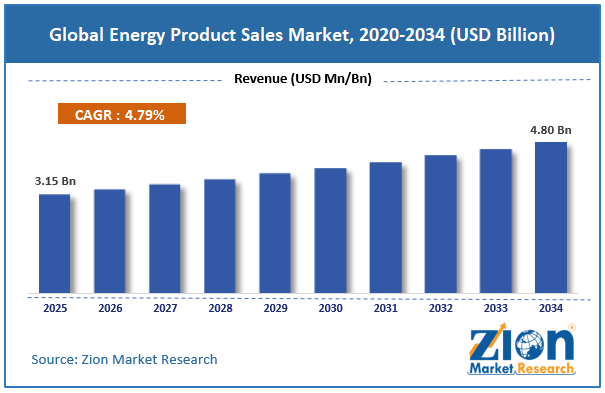
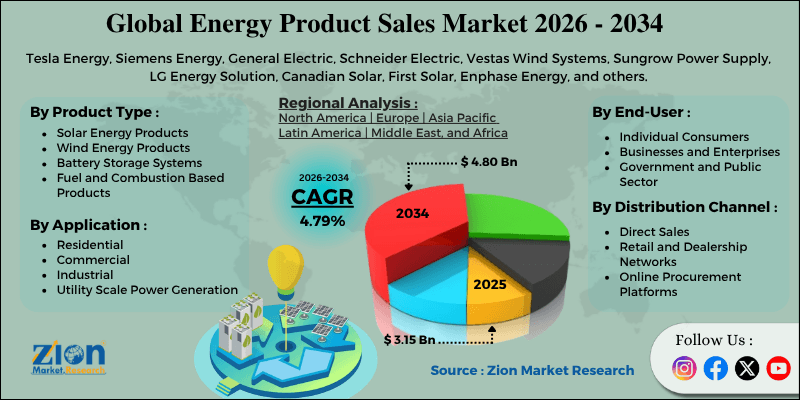
The global energy product sales market size was approximately USD 3.15 billion in 2025 and is projected to reach USD 4.80 billion by 2034, growing at a compound annual growth rate of approximately 4.79% between 2026 and 2034.
Key Insights
- According to our research team's analysis, the global energy product sales market is expected to grow at a compound annual growth rate of approximately 4.79% over the forecast period from 2026 to 2034.
- In terms of revenue, the global energy product sales market was valued at approximately USD 3.15 billion in 2025 and is projected to reach USD 4.80 billion by 2034.
- The energy product sales market is expected to grow steadily due to rising electricity demand, increasing adoption of renewable energy solutions, growing awareness of energy independence, and continuous government support for clean energy investments.
- Based on product type, solar energy products hold the largest market share, as households and businesses increasingly install solar systems to reduce electricity costs, while battery storage systems are growing the fastest due to rising demand for backup power and energy independence.
- Based on application, utility-scale power generation leads the market as large energy providers continue to expand renewable capacity, while residential applications are growing steadily as more homeowners invest in solar panels and battery systems.
- Based on end-user, businesses and enterprises hold the largest market share due to high energy consumption, while individual consumers are growing rapidly as more households adopt solar and battery products.
- Based on distribution channel, direct sales lead the market because large buyers prefer working directly with manufacturers, while retail and dealership networks are expanding steadily to serve residential and small-business customers.
- Based on region, North America leads the global energy product sales market due to strong renewable energy investment and growing demand for energy independence, followed by Europe, where supportive government policies and rising clean energy targets are driving further growth.
Energy Product Sales Market: Overview
Energy product sales refer to the buying and selling of equipment and technologies used to generate, store, distribute, and manage electricity for homes, businesses, industries, and utility companies. These products include solar panels, wind turbine components, battery energy storage systems, generators, inverters, and other power equipment that help provide a reliable and efficient energy supply. As electricity demand continues to grow, more people and businesses are investing in energy products to reduce power costs, improve energy efficiency, and ensure backup power during outages. Solar panels and battery storage systems are becoming increasingly popular because they allow users to generate and store their own electricity while reducing dependence on the traditional power grid.
At the same time, generators and other fuel-based energy products remain essential in areas where renewable energy infrastructure is still limited. Governments around the world are encouraging the adoption of clean energy through subsidies, tax incentives, and supportive policies, making renewable energy products more affordable and accessible. Rapid urbanization, industrial growth, rising energy prices, and growing awareness of environmental sustainability are further increasing demand. These trends continue to drive energy product sales, making the market an important part of the global transition toward reliable, efficient, and cleaner energy solutions.
The energy product sales industry is growing steadily as households, businesses, and governments worldwide invest in smarter, cleaner, and more reliable ways to power their everyday activities.
Impact of the USA-Israel War on Iran on the Energy Product Sales Market
Growing tensions between the United States, Israel, and Iran may temporarily increase fuel prices and disrupt the supply of some raw materials used to make energy products. However, the demand for reliable energy solutions remains strong because homes, businesses, and governments need a steady power supply regardless of global events. As more people adopt renewable energy and backup power systems, the energy product sales market is expected to continue growing despite short-term disruptions.
Energy Product Sales Market: Technology Roadmap 2025–2034
What is the projected development roadmap of the energy product sales market over the forecast period?
The energy product sales market is advancing through improved solar panel efficiency, smarter battery storage technology, better grid integration systems, and the growing use of artificial intelligence to manage energy consumption more effectively. The market is expected to grow at a compound annual growth rate of approximately 4.79% during the forecast period, driven by rising adoption of clean energy, growing consumer awareness, and continuous innovation in energy storage and generation technologies.
The following roadmap outlines key development phases expected through 2034.
2025–2027: Renewable Expansion and Affordability Phase
- More efficient and affordable solar panels are expected to see wider adoption as households and businesses look for cost-effective ways to reduce electricity bills.
- Improved battery storage products are expected to make it easier for homes and businesses to store extra energy and use it during peak hours or outages.
- Expanding retail and online distribution networks are expected to make it easier for consumers to purchase energy products directly and conveniently.
2028–2031: Smart Energy Management Phase
- Artificial intelligence-powered energy management systems are expected to help households and businesses automatically optimize their energy usage and reduce waste.
- Smart inverters and connected battery systems are expected to allow real-time monitoring and control of energy production and storage.
- Hybrid energy products that combine solar, battery, and backup generator systems are expected to offer more comprehensive and reliable energy solutions.
2032–2034: Integrated Grid and Sustainability Phase
- Advanced grid integration technology is expected to help homes and businesses sell excess energy back to power companies more efficiently.
- Next-generation battery technology with longer life and faster charging is expected to improve the overall value of energy storage products.
- Stronger recycling and sustainable manufacturing practices are expected to reduce the environmental impact of energy product production.
Energy Product Sales Market: Dynamics
Growth Drivers
The energy product sales market is growing, driven by rising electricity demand and clean energy adoption.
The energy product sales market is growing as more homes, businesses, and governments seek reliable, cost-effective ways to meet their growing electricity needs. Rising population, rapid urbanization, expanding industries, and the growing use of electronic devices are driving higher electricity consumption worldwide. To reduce electricity bills and avoid power outages, many consumers are investing in solar panels, battery storage systems, generators, and other energy products. Governments in many countries are supporting this shift by offering subsidies, tax benefits, and financial incentives that make clean energy products more affordable. Businesses are also adopting renewable energy systems and backup power solutions to reduce operating costs and maintain a stable electricity supply during grid outages.
At the same time, growing awareness of climate change and the need to reduce carbon emissions is encouraging more people to choose cleaner energy options. Continuous improvements in energy technologies are making these products more efficient, reliable, and easier to use. These factors are driving the growth of the energy product sales market and supporting the global transition toward cleaner, smarter, and more sustainable energy solutions.
How is the growing demand for energy independence and backup power solutions driving the energy product sales market?
The energy product sales industry is growing as more homes and businesses want greater control over their electricity supply. Rising electricity prices, frequent power outages, and concerns about unreliable power grids are encouraging people to invest in solar panels, battery storage systems, and backup generators. These products help provide a steady power supply during blackouts, reduce electricity costs, and improve energy security. They are especially useful in areas that experience extreme weather or frequent grid failures. As awareness of energy independence continues to grow, more consumers are choosing renewable energy and backup power solutions for their homes and businesses. Flexible financing options, installment plans, and leasing programs are also making these energy products more affordable for a wider range of customers.
At the same time, ongoing improvements in battery technology and product efficiency are increasing performance and reducing maintenance needs. These factors are driving steady growth in the energy product sales market and creating new opportunities for manufacturers and energy solution providers worldwide.
Restraints
How are high upfront costs and installation complexity affecting the energy product sales market?
The energy product sales market faces several challenges that may affect its growth. One of the biggest barriers is the high initial cost of buying and installing solar panels, battery storage systems, generators, and other energy products. This can be difficult for many households and small businesses with limited budgets. Installing these systems also requires skilled technicians and proper integration with existing electrical systems, which can increase costs and installation time. Many consumers are still unfamiliar with the long-term benefits of renewable energy and may hesitate to make such a large investment. In some countries, changing government policies, subsidies, and financial incentives also create uncertainty for both buyers and manufacturers. Limited awareness and lack of access to financing further slow the adoption of clean energy products, especially in developing regions. These challenges continue to hinder growth in the energy product sales market. However, improving technology, lower product costs, and stronger government support are expected to encourage wider adoption in the future.
Opportunities
Emerging markets, smart technology, and government support are driving opportunities in the energy product sales market.
The energy product sales market offers strong growth opportunities as more countries invest in clean energy and reduce their dependence on fossil fuels. Developing regions across Asia Pacific, Latin America, the Middle East, and Africa are building new power infrastructure, creating higher demand for solar panels, battery storage systems, generators, and other energy products. The increasing use of smart technologies, including artificial intelligence-based energy management systems, is helping consumers monitor and use electricity more efficiently while creating new opportunities for manufacturers. Flexible financing options, installment plans, and leasing programs are also making energy products more affordable and accessible to households and businesses.
Utility companies are working closely with manufacturers to develop large-scale renewable energy projects and improve the electricity supply. Governments around the world are introducing supportive policies, clean energy targets, and financial incentives to encourage the adoption of renewable energy solutions. Investments in smart grids and modern power infrastructure are further supporting market growth. These trends are creating new business opportunities, improving energy access, and driving the long-term expansion of the energy product sales industry across both developed and emerging economies.
Challenges
What challenges does the energy product sales market face in achieving broad adoption and delivering long-term value?
The energy product sales market faces several challenges that may slow its growth. One major challenge is ensuring that new energy products, such as solar panels and battery storage systems, work properly with existing electrical systems, which can differ from one region to another. Another concern is maintaining a stable supply of raw materials needed to manufacture these products, especially during global disruptions. Many consumers and businesses also need better information about the long-term cost savings and environmental benefits of investing in clean energy solutions.
In addition, manufacturers must keep pace with evolving government regulations, safety standards, and subsidy programs, which can complicate business operations. Increasing competition among energy technology companies is also putting pressure on prices, encouraging businesses to develop more efficient, reliable, and affordable products. Despite these challenges, ongoing technological improvements, growing demand for clean energy, and supportive government policies are expected to help the energy product sales market continue expanding over the coming years.
Energy Product Sales Market: Report Scope
| Report Attributes | Report Details |
|---|---|
| Report Name | Energy Product Sales Market |
| Market Size in 2025 | USD 3.15 Billion |
| Market Forecast in 2034 | USD 4.80 Billion |
| Growth Rate | CAGR of 4.79% |
| Number of Pages | 230 |
| Key Companies Covered | Tesla Energy, Siemens Energy, General Electric, Schneider Electric, Vestas Wind Systems, Sungrow Power Supply, LG Energy Solution, Canadian Solar, First Solar, Enphase Energy, and others. |
| Segments Covered | By Product Type, By Application, By End-User, By Distribution Channel, and By Region |
| Regions Covered | North America, Europe, Asia Pacific (APAC), Latin America, Middle East, and Africa (MEA) |
| Base Year | 2025 |
| Historical Year | 2020 - 2024 |
| Forecast Year | 2026 - 2034 |
| Customization Scope | Avail customized purchase options to meet your exact research needs. Request For Customization |
Energy Product Sales Market: Segmentation
The global energy product sales market is segmented by product type, application, end user, distribution channel, and region.
What makes solar energy products the dominant product type in the energy product sales market?
Based on product type, the global energy product sales industry is segregated into solar energy products, wind energy products, battery storage systems, and fuel and combustion-based products. Solar energy products lead with about a 55% share because they offer an affordable, widely accessible way for households and businesses to generate their own electricity. The battery storage systems segment holds around 27% of the market share. It is growing rapidly due to increasing demand for backup power and energy independence.
How does utility-scale power generation maintain its leading position in the energy product sales market?
Based on application, the energy product sales market is classified into residential, commercial, industrial, and utility-scale power generation. Utility-scale power generation accounts for about 52% of the market share, as large energy providers continue to build larger renewable energy projects to meet growing electricity demand. The residential segment holds around 29% share. It is growing steadily as more homeowners invest in solar panels and battery systems.
What makes businesses and enterprises the dominant end-user group in the energy product sales market?
Based on end-user, the market is segmented into individual consumers, businesses and enterprises, government and public sector, and utility companies. Businesses and enterprises hold around a 60% share because they consume large amounts of energy and increasingly invest in their own generation and storage solutions. The individual consumers segment accounts for about 23% of the market share. It is growing rapidly due to the rising adoption of solar and battery products by households.
How do direct sales lead the distribution landscape of the energy product sales market?
Based on distribution channel, the energy product sales market is divided into direct sales, retail and dealership networks, online procurement platforms, and government and institutional tender procurement. Direct sales account for about 45% of market share because large buyers, such as utility companies and other businesses, prefer to purchase directly from manufacturers. The retail and dealership networks segment holds around 31% share. It continues expanding by serving residential customers and small businesses across various regions.
Energy Product Sales Market: Regional Analysis
What factors are driving the growth of the energy product sales market in North America?
North America accounts for around 37% of the global energy product sales market, making it the largest regional market. The region leads because more households, businesses, and utility companies are investing in renewable energy and reliable backup power solutions. The United States holds the largest market share due to strong government incentives, high consumer awareness, and increasing demand for energy independence.
Many homeowners and businesses are installing solar panels, battery storage systems, generators, and other energy products to lower electricity bills and ensure an uninterrupted power supply during outages. Businesses are also adopting energy-efficient solutions to reduce operating costs and improve sustainability. Canada is supporting regional growth through investments in clean energy projects, modern power infrastructure, and government programs that encourage the adoption of renewable energy. Mexico is becoming an important market as affordable solar energy systems and battery storage solutions become more widely available for homes and businesses. The region also benefits from the presence of leading energy technology companies, strong distribution networks, advanced manufacturing capabilities, and continuous innovation in energy products. Rising electricity demand, growing environmental awareness, expanding smart grid infrastructure, and increasing investments in clean energy continue to strengthen North America's leadership in the energy product sales market.
Why are renewable energy investments accelerating the European energy product sales market?
Europe accounts for around 30% of the global energy product sales market, making it the second-largest regional market. The region is growing as more households, businesses, and industries adopt clean energy products to reduce electricity costs and meet environmental goals. Germany, the United Kingdom, France, the Netherlands, and the Nordic countries are investing heavily in renewable energy projects, smart grids, and modern power infrastructure. Germany and the United Kingdom lead the regional market because of their strong renewable energy industries, high demand for solar panels and battery storage systems, and continued government support for clean energy.
Many consumers are also choosing energy-efficient products to lower electricity bills and reduce dependence on traditional power sources. Governments across Europe are promoting renewable energy through financial incentives, clean energy policies, and carbon reduction programs. Leading energy technology companies are continuously developing more efficient and affordable products, helping increase market adoption. Growing awareness of energy independence, expanding electric vehicle charging infrastructure, rising investments in smart energy solutions, and ongoing improvements in renewable energy technology are expected to support the long-term growth of the energy product sales market across Europe.
Recent Market Developments
- In February 2026, Schneider Electric published its 2026 Global Energy Outlook, highlighting increased investments in grid modernization, digital energy management, and resilient energy infrastructure to support the global energy transition.
- In June 2026, Enphase Energy increased its focus on advanced power conversion technologies for data center energy infrastructure, expanding opportunities beyond residential solar and energy storage solutions.
- In June 2026, SolarEdge Technologies expanded its focus on power conversion technologies for AI-driven data centers, strengthening its energy management and power infrastructure portfolio beyond traditional solar applications.
Energy Product Sales Market: Competitive Analysis
The leading players in the global energy product sales market are:
- Tesla Energy
- Siemens Energy
- General Electric
- Schneider Electric
- Vestas Wind Systems
- Sungrow Power Supply
- LG Energy Solution
- Canadian Solar
- First Solar
- Enphase Energy
The global energy product sales market is segmented as follows:
By Product Type
- Solar Energy Products
- Wind Energy Products
- Battery Storage Systems
- Fuel and Combustion Based Products
By Application
- Residential
- Commercial
- Industrial
- Utility Scale Power Generation
By End-User
- Individual Consumers
- Businesses and Enterprises
- Government and Public Sector
- Utility Companies
By Distribution Channel
- Direct Sales
- Retail and Dealership Networks
- Online Procurement Platforms
- Government and Institutional Tender Procurement
By Region
- North America
- The U.S.
- Canada
- Mexico
- Europe
- France
- The UK
- Spain
- Germany
- Italy
- Rest of Europe
- Asia Pacific
- China
- Japan
- India
- Australia
- South Korea
- Rest of Asia Pacific
- The Middle East & Africa
- Saudi Arabia
- UAE
- Egypt
- Kuwait
- South Africa
- Rest of the Middle East & Africa
- Latin America
- Brazil
- Argentina
- Rest of Latin America
Table Of Content
Methodology
FrequentlyAsked Questions
The energy product sales refer to the buying and selling of equipment and technologies used to generate, store, distribute, and manage electricity for homes, businesses, industries, and utility companies. These products include solar panels, wind turbine components, battery energy storage systems, generators, inverters, and other power equipment that help provide a reliable and efficient energy supply.
The global energy product sales market is expected to grow, driven by rising electricity demand worldwide, increasing adoption of renewable energy solutions, growing government support for clean energy investments, expanding consumer interest in energy independence, and continuous improvement in battery storage and solar technology.
According to research, the global energy product sales market was valued at approximately USD 3.15 billion in 2025 and is projected to reach approximately USD 4.80 billion by 2034.
The compound annual growth rate of the energy product sales market is expected to be approximately 4.79% from 2026 to 2034.
North America is expected to lead the global energy product sales market throughout the forecast period, driven by strong investment in renewable energy, growing consumer demand for energy independence, and supportive government policies.
The major players in the global energy product sales market include Tesla Energy, Siemens Energy, General Electric, Schneider Electric, Vestas Wind Systems, Sungrow Power Supply, LG Energy Solution, Canadian Solar, First Solar, and Enphase Energy.
The report examines key aspects of the energy product sales market, including growth drivers, adoption barriers, emerging opportunities, competitive dynamics, detailed regional performance, and a forward-looking outlook across all major product types, applications, end-user segments, and geographic regions through 2034.
Advancements in solar panel efficiency, battery storage technology, artificial intelligence-powered energy management, and smart grid integration are transforming the energy product sales market. These technologies help consumers and businesses reduce energy waste, lower costs, and achieve greater energy independence.
The energy product sales market is shifting toward renewable energy, battery storage systems, smart energy management, and energy-efficient products. Consumers increasingly prefer reliable, affordable, and sustainable energy solutions that reduce electricity costs, improve energy independence, and support environmentally friendly lifestyles.
The energy product sales market will see strong growth in residential, commercial, and industrial applications, as well as in utility-scale renewable energy, electric vehicle charging infrastructure, backup power systems, and smart grid applications, as demand for clean, reliable, and efficient energy solutions continues to increase worldwide.

HappyClients

