Global Electronic Display Market Size, Share, Industry Analysis Report 2034

Electronic Display Market By Technology (LCD, LED, OLED, and Others), By Application (Consumer Electronics, Digital Signage, Automotive Display, and Others), By End-Use (Retail, Entertainment, Corporate, Healthcare, and Government), and By Region - Global and Regional Industry Overview, Market Intelligence, Comprehensive Analysis, Historical Data, and Forecasts 2025 - 2034
| Market Size in 2024 | Market Forecast in 2034 | CAGR (in %) | Base Year |
|---|---|---|---|
| USD 163.61 Billion | USD 226.45 Billion | 3.7% | 2024 |
Electronic Display Market: Industry Perspective
What will be the global electronic display market size during the forecast period?
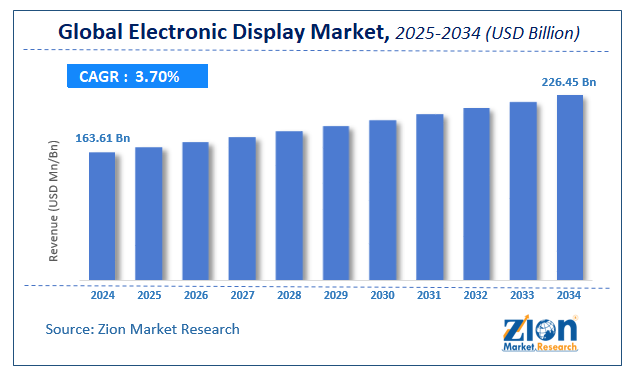
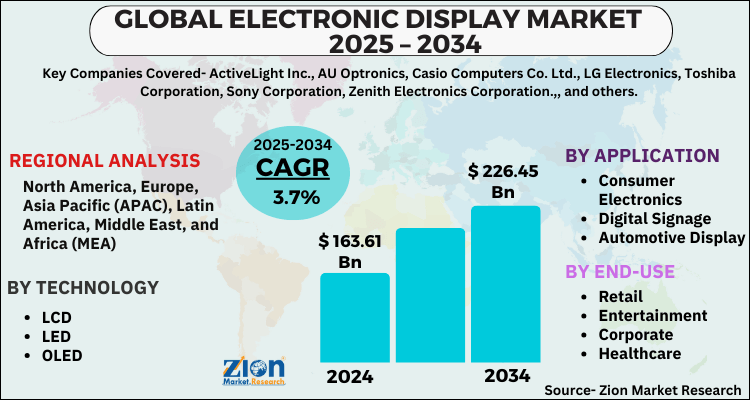
The global electronic display market size was worth around USD 163.61 billion in 2024 and is predicted to reach around USD 226.45 billion by 2034, with a compound annual growth rate (CAGR) of roughly 3.7% between 2025 and 2034.
The report examines the primary drivers, challenges, and restraints shaping global demand for the electronic display market throughout the forecast period and identifies high-growth opportunities across the industry.
Key Insights
- As per the analysis shared by our research analyst, the global electronic display market is estimated to grow annually at a CAGR of around 3.7% over the forecast period (2025-2034).
- Regarding revenue, the global electronic display market size was valued at around USD 163.61 Billion in 2024 and is projected to reach USD 226.45 Billion by 2034.
- The electronic display market is projected to grow at a significant rate due to increasing adoption of OLED, LED, and flexible displays in consumer electronics, automotive, and healthcare sectors.
- Based on technology, the LCD segment is expected to lead the global market.
- By application, the consumer electronics segment is growing at a high rate and will continue to dominate the global market.
- Based on the end-use, the retail segment is projected to swipe the largest market share.
- Based on region, Asia-Pacific is predicted to dominate the global market during the forecast period.
Electronic Display Market: Overview
Electronic displays are visual output technologies used across consumer electronics, digital signage, automotive systems, and other applications. They include LCD, LED, OLED, and related panel technologies that present information, entertainment, and interactive content on devices and fixed installations.
LED displays are a popular sort of display technology for a variety of applications. Compared with other technologies, they have a larger market share. The LED display business has grown in recent years. One of the most recent breakthroughs in LED displays is the shrinking of the components required to construct an LED screen. LED screens have become ultra-thin and large due to miniaturization, allowing them to be placed on any surface, indoors or outdoors.
LED applications have grown largely due to technological developments such as improved resolution, increased brightness, product diversity, and the creation of toughened surface LEDs and tiny LEDs. LED displays are also commonly used in digital signage applications such as advertising and digital billboards, which help firms stand out from the crowd.
Electronic Display Market: Growth Drivers
What factors are primarily accelerating demand in the electronic display market?
The market is being driven by the increasing use of OLED displays in various applications, the increasing use of LED displays for video walls, TVs, and digital signage applications, the growing demand for interactive displays in various applications, and the rising demand for display-based medical equipment, including ventilators and respirators, as a result of the COVID-19 pandemic. In addition, the growing need for on-the-go information, the increase in electronic readers, and the development of simple-to-use display devices are all boosting demand in the electronic display market.
Because 3G and 4G communications technology is low-cost and Wi-Fi is available in both private and public settings, video streaming has grown in popularity, creating new business opportunities. The introduction of technologically advanced consumer electronics goods like smartphones, smart tablets, and smart television sets is expected to propel the electronic display industry forward. Moreover, increased digitization in developed countries would generate additional business opportunities for the electronic display industry during the projection period.
Electronic Display Market: Restraint
What factors are limiting the expansion of the electronic display market?
Digital advertising is now more intelligent, tailored, and relevant than ever. Consumers spend more time online than ever, and digital advertising is an excellent way to reach them across multiple devices and channels. As a result, online advertising has grown in popularity in recent years. Furthermore, the Internet's widespread availability has driven explosive growth in digital advertising.
Increased investment in online advertising by large firms such as Facebook and Google is also a major factor driving its increased use. Programmatic advertising is also gaining traction. As a result, demand for displays, previously used to advertise items and brands in shops and commercial establishments, has declined dramatically.
Electronic Display Market: Opportunity
Where do significant growth opportunities lie for the electronic display market?
In recent years, foldable displays have grown popular in tablets, smartphones, and notebook computers. Because they use flexible substrates, flexible display panels can bend. Flexible display technology, centered on OLED panels, underpins foldable phones. Companies such as Samsung and LG are mass-producing flexible OLED display panels for smartphones, television sets, and smartwatches.
Electronic Display Market: Challenge
COVID-19 creates a stumbling block in the supply chain and production operations.
Many countries have adopted or continue to enforce lockdowns in order to halt the spread of COVID-19. As a result, the supply chains of several markets, including the display market, have been affected. Display makers are struggling to manufacture and supply products because of supply chain issues.
Due to COVID-19, China is the most affected country in display manufacturing. Due to manpower scarcity, a lack of logistics support, and quarantine processes, the company's overall display production has decreased.
Electronic Display Market: Report Scope
| Report Attributes | Report Details |
|---|---|
| Report Name | Electronic Display Market |
| Market Size in 2024 | USD 163.61 Billion |
| Market Forecast in 2034 | USD 226.45 Billion |
| Growth Rate | CAGR of 3.7% |
| Number of Pages | 210 |
| Key Companies Covered | ActiveLight Inc., AU Optronics, Casio Computers Co. Ltd., LG Electronics, Toshiba Corporation, Sony Corporation, Zenith Electronics Corporation, and others. |
| Segments Covered | By Technology, By Application, By End-Use, and By Region |
| Regions Covered | North America, Europe, Asia Pacific (APAC), Latin America, The Middle East and Africa (MEA) |
| Base Year | 2024 |
| Historical Year | 2020 - 2023 |
| Forecast Year | 2025 - 2034 |
| Customization Scope | Avail customized purchase options to meet your exact research needs. Request For Customization |
Electronic Display Market: Segmentation
The electronic display market is segmented by technology, application, end-use, and region. All the segments of the electronic display market have been analyzed based on present and future trends and the market is estimated from 2025 to 2034.
By Technology, the market is classified into LCD, LED, OLED, and Others. LCD displays have dominated the market in recent years. As applications expand in consumer electronics such as TVs and personal computers, this category dominates the overall industry revenue share. Advanced LED and OLED display technologies, on the other hand, are gaining popularity because of their strong operating stability and broad applicability. These electronic technologies are commonly employed in digital signage applications as well as smart devices like phones, tablets, and wearables. To differentiate their product offerings from rigid LCD and AMOLED displays used in various device applications, manufacturers are progressively migrating from rigid OLED displays to flexible AMOLED displays.
By Application, the market is classified into Consumer Electronics, Digital Signage, Automotive Display, and Others. The consumer electronics application category accounted for more than half of total revenue and is expected to expand steadily over the projection period. The industry is likely to benefit from the widespread adoption of digital signage across various end-use segments. Key advances such as sophisticated digital signage 2.0, which displays data through moving infographics, are widely used in the retail industry, enriching the business plan and brand through outstanding aesthetics.
By End-Use, the electronic display market is divided into retail, entertainment, corporate, healthcare, and government. The retail segment is projected to hold the largest market share as digital signage and in-store displays support advertising, brand presentation, and customer engagement. This leadership helps drive overall market expansion through commercial display installations, while entertainment, corporate, healthcare, and government end uses sustain demand for specialized and professional display solutions.
Electronic Display Market: Regional Landscape
Why will Asia-Pacific continue to dominate the global market during the projection period?
APAC is expected to hold the largest share throughout the projection period. Other factors driving the region's market growth include an increase in display panel production plants and the rapid adoption of OLED displays. APAC has low labor costs, which lower overall display panel manufacturing costs. This has enticed many corporations to set up new OLED and LCD panel manufacturing units in the region. Consumer electronics, retail, BFSI, healthcare, transportation, and sports and entertainment industries are likely to contribute significantly to APAC display market growth. Furthermore, the increased use of display devices in many industries, particularly in countries such as China, India, and South Korea, is a key factor supporting the market.
North America is expected to be the most lucrative regional market, with growth anticipated throughout the forecast period. As disposable incomes rise and living standards improve, demand for advanced display-based applications is expected to climb gradually. Another driver of adoption in the region is rising smartphone shipments. This will drive growth in the United States in the coming years, and value will continue to rise as technology advances.
Recent Developments
-
In January 2022, LG Display showcased its next-generation flexible and transparent OLED display prototypes at international trade events, demonstrating rollable display panels designed for modern smart home furniture and automated commercial retail showcases.
Electronic Display Market: Competitive Landscape
The global electronic display market is dominated by players:
- ActiveLight Inc.
- AU Optronics
- Casio Computers Co. Ltd.
- LG Electronics
- Toshiba Corporation
- Sony Corporation
- Zenith Electronics Corporation
Electronic Display Market: Key Trends
What are the key trends in the electronic display market?
LCD leadership with rising LED and OLED adoption
LCD is expected to lead technology demand through broad use in TVs and PCs, while LED and OLED gain traction in digital signage, smart devices, and flexible form factors that expand product differentiation.
Consumer electronics and flexible display innovation
Consumer electronics continues to dominate application demand, and foldable and flexible OLED displays are creating new opportunities in smartphones, tablets, notebooks, and wearables.
Segments Covered
The global electronic display market is segmented as follows:
By Technology
- LCD
- LED
- OLED
- Others
By Application
- Consumer Electronics
- Digital Signage
- Automotive Display
- Others
By End-Use
- Retail
- Entertainment
- Corporate
- Healthcare
- Government
By Region
- North America
- The U.S.
- Canada
- Mexico
- Europe
- France
- The UK
- Spain
- Germany
- Italy
- Rest of Europe
- Asia Pacific
- China
- Japan
- India
- Australia
- South Korea
- Rest of Asia Pacific
- The Middle East & Africa
- Saudi Arabia
- UAE
- Egypt
- Kuwait
- South Africa
- Rest of the Middle East & Africa
- Latin America
- Brazil
- Argentina
- Rest of Latin America
Table Of Content
Methodology
FrequentlyAsked Questions
The electronic display market covers technologies such as LCD, LED, and OLED used to present visual information and content in consumer electronics, digital signage, automotive systems, and professional environments across retail, entertainment, corporate, healthcare, and government end uses.
Key growth drivers include increasing use of OLED displays, LED displays for video walls, TVs, and digital signage, demand for interactive displays, growth in consumer electronics such as smartphones and smart TVs, and adoption of display-based solutions in healthcare and other sectors.
The global electronic display market was valued at approximately USD 163.61 billion in 2024 and is projected to reach around USD 226.45 billion by 2034.
The global electronic display market is expected to expand at a compound annual growth rate of approximately 3.7% between 2025 and 2034.
Asia-Pacific is predicted to dominate the global market during the forecast period, supported by panel manufacturing capacity, cost advantages, and strong demand in China, India, and South Korea.
Major players include ActiveLight Inc., AU Optronics, Casio Computers Co. Ltd., LG Electronics, Toshiba Corporation, Sony Corporation, and Zenith Electronics Corporation.
The report provides comprehensive analysis of market size, growth drivers, restraints, opportunities, segmentation by technology, application, and end-use, regional dynamics, competitive landscape, and future outlook for the period 2025-2034.

HappyClients