
Core Banking Software Market Size, Share, Value and Forecast 2034

Core Banking Software Market By Type (Cloud-Based Platforms, On-Premise Solutions, Hybrid Solutions, Component-Based Modular Systems, and Integrated Suite Solutions), By Deployment Mode (Public Cloud, Private Cloud, On-Premise Infrastructure, Hybrid Infrastructure, and Managed Hosting), By Application (Retail Banking, Corporate and Commercial Banking, and Wealth and Asset Management), By Distribution Channel (Direct Sales, System Integrators and Consulting Partners, Value-Added Resellers, Cloud Marketplace Platforms, and Managed Service Providers), and By Region - Global and Regional Industry Overview, Market Intelligence, Comprehensive Analysis, Historical Data, and Forecasts 2026 - 2034
| Market Size in 2025 | Market Forecast in 2034 | CAGR (in %) | Base Year |
|---|---|---|---|
| USD 17.94 Billion | USD 64.65 Billion | 15.31% | 2025 |
Core Banking Software Industry Perspective:
What will be the size of the core banking software market during the forecast period?
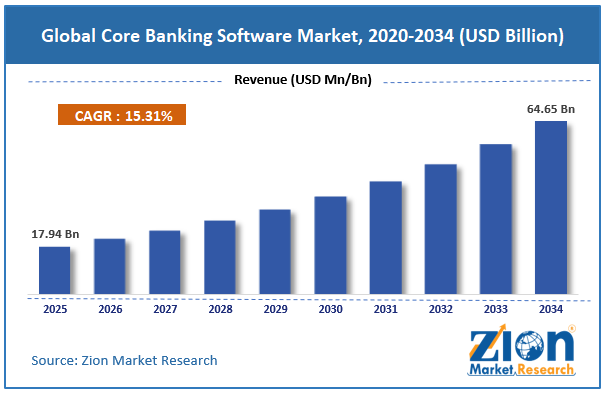
The global core banking software market size was valued at approximately USD 17.94 billion in 2025 and is projected to reach around USD 64.65 billion by 2034, growing at a compound annual growth rate of approximately 15.31% between 2026 and 2034.
Key Insights
- As per the analysis shared by our research team, the global core banking software market is estimated to grow at a compound annual growth rate of approximately 15.31% during the forecast period from 2026 to 2034.
- In terms of revenue, the global core banking software market was valued at approximately USD 17.94 billion in 2025 and is projected to reach USD 64.65 billion by 2034.
- The core banking software market is expected to expand steadily as banks retire aging legacy systems, invest in cloud migration, and prioritize faster, more personalized digital banking experiences.
- Based on type, cloud-based platforms are gaining the widest adoption because of lower upfront investment and quicker deployment, while integrated suite solutions are attracting large banks that want every function connected under one system.
- Based on deployment mode, public cloud infrastructure is becoming the preferred choice for many mid-sized banks. In contrast, private cloud infrastructure remains popular among larger institutions that handle sensitive customer data and strict regulatory obligations.
- Based on application, retail banking continues to drive the largest share of demand as banks digitize everyday consumer services, while wealth and asset management is growing quickly as more people seek digital investment and advisory tools.
- Based on distribution channel, system integrators and consulting partners play the biggest role in bringing these platforms to banks, while cloud marketplace platforms are emerging as a fast-growing channel for smaller financial institutions.
- Based on region, North America continues to lead the global core banking software market, while Asia Pacific is registering the fastest growth as banks across the region accelerate their digital transformation programs.
Core Banking Software Market: Overview
Core banking software is a digital system that helps banks manage activities such as customer accounts, deposits, loans, payments, transactions, and records from one connected platform. It acts as the central system behind banking operations and helps financial institutions deliver services faster and more efficiently. Modern core banking software connects banking departments in real time, reducing work, paperwork, and delays. It also supports digital services such as mobile banking, internet banking, ATMs, and self-service platforms, allowing customers to access services without visiting a branch. Banks are increasingly replacing legacy systems because they can be difficult to update and may not support high transaction volumes. Cloud-based core banking solutions are gaining attention because they can lower infrastructure costs, increase flexibility, and help banks launch new services more quickly. Security and compliance features are also important, helping institutions manage data protection, fraud monitoring, anti-money laundering requirements, and regulatory reporting. Smaller banks, credit unions, and financial institutions are also adopting modern platforms to improve customer experience and compete with larger banks.
Overall, digital transformation, cloud adoption, stronger security, and rising demand for convenient banking services are shaping the future of the core banking software industry.
Core Banking Software Market: Strategic Perspective
Where is the core banking software market heading?
The core banking software market is moving from old, complex systems toward flexible platforms that banks can update easily without replacing their entire technology setup. As open banking rules expand across more countries, software providers are expected to offer better tools that help banks securely connect and share data with fintech companies, insurance firms, and payment networks.
Where should businesses invest in the core banking software market?
The core banking software market offers investment opportunities in cloud-based platforms, artificial intelligence tools for fraud detection and routine banking tasks, and APIs that help banks connect with third-party financial services. Companies that build strong cybersecurity features into their software from the start can earn greater trust from banks and other financial institutions.
What will reshape competition in the core banking software market?
Competition in the core banking software market will depend on how quickly providers can help banks replace outdated systems without affecting daily operations. Vendors offering faster implementation, clear pricing, reliable customer support, strong security, and smooth data migration can attract more banks than providers that depend mainly on brand recognition.
Core Banking Software Market: Technology Roadmap 2026–2034
What is the projected development roadmap of the core banking software market over the forecast period?
The market is advancing through greater automation, wider cloud adoption, tighter security frameworks, and deeper integration with outside financial applications. The market is expected to grow at a compound annual growth rate of approximately 15.31% over the forecast period, supported by rising digital banking adoption, tightening data regulations, and continuous upgrades in banking technology infrastructure.
The following roadmap outlines key development phases expected through 2034.
2026–2028: Modernization and Cloud Migration Phase
- Legacy system replacement: Banks are expected to accelerate the retirement of decades-old mainframe systems in favor of modern, cloud-ready core platforms.
- Real-time transaction processing: Software providers are likely to strengthen real-time payment and settlement capabilities to match rising customer expectations for instant banking.
- Regulatory reporting automation: Platforms are expected to include built-in tools that automatically generate compliance reports, reducing manual work for bank staff.
2029–2031: Intelligent Automation and Open Banking Expansion Phase
- Artificial intelligence-driven fraud detection: Providers are likely to embed smarter fraud monitoring tools directly into core banking software to catch suspicious activity earlier.
- Open application programming interface ecosystems: Banks are expected to rely more heavily on open banking connections that allow secure data sharing with fintech applications and third-party service providers.
- Personalized digital banking tools: Software is likely to include features that let banks offer tailored product recommendations and spending insights based on individual customer behavior.
2032–2034: Fully Connected and Predictive Banking Phase
- Predictive financial modeling: Core platforms are expected to use historical data to help banks anticipate customer needs, credit risks, and cash flow patterns.
- Autonomous compliance monitoring: Systems could increasingly flag and correct compliance issues automatically, reducing dependence on manual audits.
- Flexible banking systems: Banks may increasingly build their technology stack from independent, interchangeable software components rather than relying on a single rigid platform.
Core Banking Software Market: Dynamics
Growth Drivers
What factors are driving changing customer expectations in the core banking software market?
Rising customer expectations are driving growth in the core banking software industry as people increasingly expect banking services to be as fast, simple, and convenient as other digital services. Customers want instant payments, quick account opening, easy loan applications, and 24/7 support through mobile apps and chatbots. Many people now manage their finances online without visiting bank branches, pushing banks to upgrade outdated backend systems and provide smoother digital experiences. Growing smartphone use in developing countries is also bringing more people into digital banking and increasing the need for software that can reliably process high transaction volumes. At the same time, customers are becoming more concerned about data privacy and expect banks to protect their personal and financial information. This is encouraging financial institutions to select core banking software with built-in security features such as encryption, fraud detection, identity verification, and secure data management. As digital banking becomes part of everyday life, banks are investing in core banking technology that can deliver secure, reliable, convenient, and personalized services while meeting evolving customer expectations across digital channels.
Cloud adoption is creating opportunities in the core banking software market.
Growing cloud adoption is creating new opportunities in the core banking software market by helping banks modernize infrastructure without major hardware investments. Cloud-based systems reduce spending on physical servers, lower maintenance needs, and allow software updates with less disruption. This is especially useful for smaller banks and credit unions with limited technology budgets. Meanwhile, partnerships between traditional banks and fintech companies are driving demand for software that connects smoothly with external applications for payments, lending, budgeting, and investment services. Rather than developing every feature internally, banks can work with fintech providers to launch new services faster and expand their digital capabilities. This trend is encouraging software vendors to build open, flexible platforms with stronger integration capabilities. Open banking initiatives are also supporting demand for solutions that enable secure data sharing while helping banks meet regulatory requirements. As cloud computing, fintech collaboration, and open banking expand, providers can develop scalable platforms that support faster integration, lower infrastructure costs, and broader digital banking services, creating additional growth opportunities across the market.
Restraints
High implementation costs and migration risks are limiting growth in the core banking software market.
High costs and technical challenges remain key restraints in the core banking software market. Many banks hesitate to replace existing systems because new platforms require high upfront spending, long implementation periods, and careful migration of sensitive financial data. Moving to a new system also requires employee training, data checks, and testing to prevent service interruptions. Smaller banks and credit unions may struggle to make such investments because of limited budgets. Strict rules for data protection, financial reporting, and regulatory compliance can further delay adoption, as banks must ensure that new software meets all required standards before implementation. Cybersecurity is another major concern because core banking systems handle sensitive customer and financial information that cyberattacks can target. A shortage of skilled technology professionals can also make system management more difficult. To reduce these challenges, providers are offering phased migration, better technical support, flexible pricing, and easier implementation options to encourage adoption across the market.
Opportunities
AI and automation are opening new opportunities in the core banking software market.
Artificial intelligence is creating new opportunities in the core banking software industry as banks seek faster, smarter, and more efficient ways to manage operations. AI can automate repetitive activities such as loan processing, document verification, customer onboarding, and data entry, allowing employees to focus on more complex responsibilities. AI-powered systems can also analyze transaction patterns and flag potential fraud, helping banks respond faster to suspicious activity. Chatbots and virtual assistants can handle routine customer questions around the clock, improving service availability while reducing pressure on support teams. Another opportunity comes from modular, subscription-based software, which lets banks choose specific features instead of replacing entire systems. This approach can help smaller banks and neobanks access modern technology with lower upfront costs. Growing financial inclusion in developing countries is also driving demand for affordable, scalable banking platforms. Mobile-first core banking solutions can help financial institutions serve underserved populations with limited access to traditional branches, expand digital banking access, and create further growth opportunities.
Challenges
How are legacy systems and cybersecurity concerns affecting the core banking software market?
A major challenge in the core banking software market is the continued use of legacy systems, especially among large, established banks. These systems are deeply connected to daily banking operations, making replacement expensive, complex, and time-consuming. Cybersecurity is another key challenge because core banking platforms store sensitive customer and financial data and are frequent targets for cyberattacks. Software providers must regularly improve security features to protect systems from new threats, which increases development and maintenance costs. Different regulatory rules across countries also make software development harder, as providers must build platforms that meet various compliance requirements. In addition, a shortage of skilled professionals in areas such as cloud technology, cybersecurity, and financial data management can delay implementation and system upgrades. To address these challenges, companies are focusing on stronger security, flexible compliance tools, easier system integration, and reliable technical support to help banks modernize safely and efficiently.
Core Banking Software Market: Report Scope
| Report Attributes | Report Details |
|---|---|
| Report Name | Core Banking Software Market |
| Market Size in 2025 | USD 17.94 Billion |
| Market Forecast in 2034 | USD 64.65 Billion |
| Growth Rate | CAGR of 15.31% |
| Number of Pages | 227 |
| Key Companies Covered | Temenos, Finastra, Fiserv, FIS, Oracle Financial Services Software, Infosys Finacle, Tata Consultancy Services BaNCS, SAP, Jack Henry and Associates, nCino, and others. |
| Segments Covered | By Type, By Deployment Mode, By Application, By Distribution Channel, and By Region |
| Regions Covered | North America, Europe, Asia Pacific (APAC), Latin America, Middle East, and Africa (MEA) |
| Base Year | 2025 |
| Historical Year | 2020 - 2024 |
| Forecast Year | 2026 - 2034 |
| Customization Scope | Avail customized purchase options to meet your exact research needs. Request For Customization |
Core Banking Software Market: Segmentation
The global core banking software market is segmented by type, deployment mode, application, distribution channel, and region.
Which type of solution holds the largest share of the core banking software market?
Based on type, the global core banking software market is divided into cloud-based platforms, on-premise solutions, hybrid solutions, component-based modular systems, and integrated suite solutions. Cloud-based platforms hold about 42% of the market share, leading because of lower setup costs, faster deployment timelines, and the flexibility to scale services as banks grow. Integrated suite solutions hold around 23% market share. This segment continues to attract larger banks that prefer to manage every core function, from deposits to lending, within a single connected system.
Which deployment mode dominates the core banking software market?
Based on deployment mode, the market is classified into public cloud, private cloud, on-premises infrastructure, hybrid infrastructure, and managed hosting. Public cloud infrastructure accounts for about 34% of the global market share, driven by its cost efficiency and ability to scale rapidly without heavy capital investment. Private cloud infrastructure holds around 26% market share. This option remains preferred among larger banks that require greater control over sensitive customer data and stricter internal security policies.
Which application segment leads the core banking software market?
By application, the market is segmented into retail banking, corporate and commercial banking, and wealth and asset management. Retail banking leads with about a 54% share as banks prioritize digitizing everyday consumer services such as savings accounts, personal loans, and mobile banking. Wealth and asset management holds around 18% market share. This segment is growing steadily as more individuals seek accessible digital tools for managing investments and long-term savings.
Which distribution channel leads the core banking software market?
Based on distribution channel, the core banking software industry is categorized into direct sales, system integrators and consulting partners, value-added resellers, cloud marketplace platforms, and managed service providers. System integrators and consulting partners account for about 37% of the market, leading because banks often rely on their expertise to customize and implement complex software deployments. Cloud marketplace platforms hold around 19% market share. This channel is expanding quickly as smaller banks look for simpler, subscription-based purchasing options.
Core Banking Software Market: Regional Analysis
What factors are strengthening North America's position in the core banking software market?
North America holds a strong position in the global core banking software market and is expected to grow at a CAGR of around 6.2% during the forecast period. The region benefits from a well-developed banking industry, high smartphone use, and rising customer demand for fast, convenient digital banking services. The United States and Canada offer major growth opportunities because they have many financial institutions, including large banks, regional banks, and credit unions, that are investing in modernizing their banking systems. Strict rules for data protection, financial reporting, and regulatory compliance are also encouraging banks to adopt software that can manage these requirements more efficiently. Rising competition from fintech companies and digital-only banks is further pushing traditional banks to improve their digital services and retain customers. Strong cloud infrastructure and the presence of major technology providers are also supporting software adoption across the region. In addition, growing use of artificial intelligence for fraud detection, customer service, and banking automation is creating new opportunities for software providers. Continued spending on cybersecurity, cloud technology, and digital transformation is expected to support steady growth and strengthen North America's role in the market throughout the forecast period.
How is digital transformation driving growth in the Asia Pacific core banking software market?
The Asia Pacific core banking software market is expected to grow at a volume CAGR of around 8.4% during the forecast period, supported by rapid digital banking adoption, expanding financial infrastructure, and growing efforts to improve financial inclusion. China, India, Japan, and Southeast Asian countries are key markets, as more people in unbanked and underbanked communities gain access to banking through smartphones and mobile applications. Government programs promoting digital payments and supportive banking regulations are encouraging financial institutions to upgrade their core systems and offer faster digital services. Rising smartphone use and greater customer trust in online banking are also driving demand for secure, reliable banking platforms. Local banks are increasingly working with global software providers to access advanced technology while adapting solutions to local languages, currencies, customer needs, and regulatory rules. The rapid growth of digital-only banks, mobile wallets, and online financial services is further driving demand for flexible, scalable core banking software. Banks are also investing in cloud technology, cybersecurity, artificial intelligence, and automated services to improve efficiency and customer experience. Continued development of banking infrastructure and strong government support for financial technology are expected to drive strong regional growth and make Asia Pacific a major growth region for the market.
Recent Market Developments
- In August 2026, Infosys Finacle announced the successful deployment of its Wealth Management Solution at HDFC Bank, replacing legacy systems with an API-driven platform designed to improve integration, automation, and personalized financial services.
- In June 2026, Finastra highlighted AI adoption, core platform modernization, and stronger fintech collaboration at its Innovating Finance Together Summit in Sydney, reflecting the industry's shift toward more connected banking technology.
- In May 2026, Temenos expanded its SaaS offering on Amazon Web Services (AWS), allowing banks to deploy core banking, digital banking, and payments capabilities through a cloud-based platform.
Core Banking Software Market: Competitive Analysis
The leading players in the global core banking software market are:
- Temenos
- Finastra
- Fiserv
- FIS
- Oracle Financial Services Software
- Infosys Finacle
- Tata Consultancy Services BaNCS
- SAP
- Jack Henry and Associates
- nCino
The global core banking software market is segmented as follows:
By Type
- Cloud-Based Platforms
- On-Premise Solutions
- Hybrid Solutions
- Component-Based Modular Systems
- Integrated Suite Solutions
By Deployment Mode
- Public Cloud
- Private Cloud
- On-Premise Infrastructure
- Hybrid Infrastructure
- Managed Hosting
By Application
- Retail Banking
- Corporate and Commercial Banking
- Wealth and Asset Management
By Distribution Channel
- Direct Sales
- System Integrators and Consulting Partners
- Value-Added Resellers
- Cloud Marketplace Platforms
- Managed Service Providers
By Region
- North America
- The U.S.
- Canada
- Mexico
- Europe
- France
- The UK
- Spain
- Germany
- Italy
- Rest of Europe
- Asia Pacific
- China
- Japan
- India
- Australia
- South Korea
- Rest of Asia Pacific
- The Middle East & Africa
- Saudi Arabia
- UAE
- Egypt
- Kuwait
- South Africa
- Rest of the Middle East & Africa
- Latin America
- Brazil
- Argentina
- Rest of Latin America
Table Of Content
Methodology
FrequentlyAsked Questions
Core banking software is a digital system that helps banks manage activities such as customer accounts, deposits, loans, payments, transactions, and records from one connected platform. It acts as the central system behind banking operations and helps financial institutions deliver services faster and more efficiently.
The global core banking software market is expected to grow due to rising demand for digital banking, increasing adoption of cloud technology, growing regulatory pressure around data security, and expanding financial inclusion efforts worldwide.
According to research, the global core banking software market was valued at approximately USD 17.94 billion in 2025 and is projected to reach approximately USD 64.65 billion by 2034.
The core banking software market is expected to grow at a compound annual growth rate of approximately 15.31% from 2026 to 2034.
North America is expected to lead the global core banking software market throughout the forecast period, supported by its mature banking sector, strong technology infrastructure, and continuous investment in digital transformation.
The major players in the global core banking software market include Temenos, Finastra, Fiserv, FIS, Oracle Financial Services Software, Infosys Finacle, Tata Consultancy Services, BaNCS, SAP, Jack Henry and Associates, and nCino.
The report examines key aspects of the core banking software market, including research and development drivers, adoption barriers, application opportunities, competitive landscape dynamics, detailed regional market performance analysis, and a comprehensive forward-looking outlook across all major types, deployment modes, applications, distribution channels, and geographic regions through 2034.
Rising investment in digital infrastructure and growing government support for financial technology are supporting demand in the core banking software market, particularly across emerging economies. However, economic slowdowns and tighter banking budgets may cause some institutions to delay large-scale system upgrades.
The core banking software market offers opportunities in artificial intelligence integration, cloud infrastructure development, cybersecurity innovation, and partnerships between traditional banks and fintech companies. Collaborations between software vendors, system integrators, and regulatory bodies can further support market expansion.
Stakeholders in the core banking software market should focus on secure, scalable, and easy-to-integrate platforms while improving customer support and implementation services. Investing in AI, cloud technology, cybersecurity, and open banking capabilities can help providers meet changing bank requirements and remain competitive over the long term.

HappyClients

