
Cardiac Tissue Engineering Market Size, Trend, Growth, Industry Analysis 2034

Cardiac Tissue Engineering Market By Product Type (Injectable Hydrogels, Cardiac Patches, Bioprinted Tissues, Others), By Application (Heart Failure, Ischemic Heart Disease, Congenital Defects, and Others), By End-User (Specialized Cardiac Centers, Academic and Research Institutes, Pharmaceutical and Biotech Companies, General Hospitals, and Others), and By Region - Global and Regional Industry Overview, Market Intelligence, Comprehensive Analysis, Historical Data, and Forecasts 2026 - 2034
| Market Size in 2025 | Market Forecast in 2034 | CAGR (in %) | Base Year |
|---|---|---|---|
| USD 735.59 Million | USD 2,942.99 Million | 16.64% | 2025 |
Cardiac Tissue Engineering Industry Perspective:
What is the anticipated size of the cardiac tissue engineering market during the projection period?
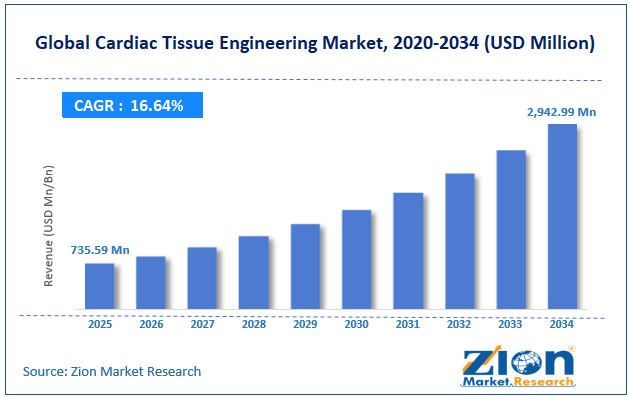
The global cardiac tissue engineering market size was worth around USD 735.59 million in 2025 and is predicted to grow to around USD 2,942.99 million by 2034, with a compound annual growth rate (CAGR) of roughly 16.64% between 2026 and 2034.
Key Insights:
- As per the analysis shared by our research analyst, the global cardiac tissue engineering market is estimated to grow annually at a CAGR of around 16.64% over the forecast period (2026-2034)
- In terms of revenue, the global cardiac tissue engineering market size was valued at around USD 735.59 million in 2025 and is projected to reach USD 2,942.99 million, by 2034.
- The cardiac tissue engineering market is projected to grow at a significant rate due to the rising prevalence of cardiovascular diseases, increasing investments in regenerative medicine, and advancements in 3D bioprinting.
- Based on the product type, during the forecast period, the bioprinted tissues segment is anticipated to record the fastest CAGR.
- Based on the application, the ischemic heart disease segment is anticipated to command the largest market share.
- Based on the end-user, the academic & research institutes segment is expected to lead the market growth trends.
- Based on region, North America is projected to dominate the global market during the forecast period.
Cardiac Tissue Engineering Market: Overview
Cardiac tissue engineering is part of novel tissue engineering and regenerative medicine and aims to regenerate, replace, or repair damaged heart tissue through biomaterials, cells, and biological signals. Cardiac tissue engineering has several applications, including repairing fibrotic tissue resulting from adverse remodeling or creating a whole heart. Replacement and repair procedures generally involve developing tissue scaffolds. Cardiac tissue engineering aims to shortcomings of traditional heart disease treatments. During the forecast period, demand for cardiac tissue engineering is expected to be driven by rising prevalence of cardiovascular diseases, increasing investments in regenerative medicine, and advancements in 3D bioprinting. Furthermore, government support and a surge in biotechnology investments will further help the market thrive. However, cost barriers, competition from traditional techniques, limited skilled workforce, and lack of infrastructure may affect market growth during the projection period.
Impact of the USA-Israel and Iran war on the Cardiac Tissue Engineering Market:
The USA-Israel and Iran war is expected to have a short-term negative impact on the cardiac tissue engineering market. The ongoing conflict may increase the cost of medical equipment and accessories and disrupt the supply chain. It may also influence medical tourism trends. However, investments in cardiac tissue engineering solutions will continue to grow as an essential part of broader regenerative medicine and a critical component of next-generation healthcare infrastructure.
Cardiac Tissue Engineering Market: Dynamics
Growth Drivers
How will the growing prevalence of cardiovascular diseases drive cardiac tissue engineering market growth?
The global cardiac tissue engineering market is expected to be driven by the growing prevalence of cardiac diseases such as heart failure, myocardial infarction, and coronary artery disease, among others. Cardiovascular diseases are among the leading reasons for medical deaths worldwide. According to the World Health Organization, more than 19.8 million deaths were reported worldwide in 2022 due to cardiovascular conditions. The higher prevalence of these conditions is influenced by unhealthy lifestyles, poor eating habits, an aging population, and environmental pollution. Additionally, the growing obesity rate and number of diabetic patients have further propelled demand for treatments for heart-related disorders. Cardiac tissue engineering is gaining attention as a way to overcome shortcomings of conventional treatments, especially by regenerating damaged cardiac tissue for improved results.
Advancements in 3D printing technology to benefit market players in the coming years
Cardio tissue engineering companies are actively investing in 3-dimensional printing solutions to develop personalized, complex cardiac tissues and scaffolds that resemble native heart tissues. 3D printing applications allow precise control over cell placement and tissue architecture while reducing variability in engineered cardiac tissues and shortening the fabrication process. In December 2025, researchers at the Center for Heart Lung Innovation (HLI) developed a novel 3D printer that produces living human heart tissue from patient-derived stem cells. The 3D-printed heart will enable cheaper, faster testing of novel treatments for heart diseases, propelling growth in the global cardiac tissue engineering market.
Restraints
Cost constraints to emerge as leading growth barrier for cardiac tissue engineering industry
The global cardiac tissue engineering industry is expected to be restricted due to high investment costs. The industry leverages next-generation technologies such as stem cell therapies and advanced biomaterials for desired performance. In addition, developing 3D bioprinting systems is a time-consuming process. The use of specialized, technologically equipped laboratories further increases production costs.
Opportunities
How will investments in regenerative medicine generate growth opportunities for the cardiac tissue engineering market players?
The global cardiac tissue engineering market is expected to grow as investments in regenerative medicine surge. According to the World Economic Forum, regenerative medicine is essential to address the impact of age-related conditions and strengthen global prosperity. Regenerative medicine not only helps manage symptoms of serious conditions but also restores organ functions. In September 2026, Lithuania launched the Baltic region’s first-of-its-kind dedicated Innovative Cell Therapy and Personalized Medicine Center by Northway Biotech. The move has strengthened the company’s Contract Development and Manufacturing Organization (CDMO) capabilities for advanced therapies. Stem cell therapy investments have reached new heights in recent years due to promising results in reducing healthcare burdens in developed and developing economies. In June 2026, the California Institute for Regenerative Medicine (CIRM) announced a record USD 662 million research budget for the year 2027, showcasing its commitment to advancing next-generation medical therapies.
Challenges
What are the leading challenges in the cardiac tissue engineering industry?
The cardiac tissue engineering industry faces limited clinical research, a lack of supportive infrastructure in developing economies, regulatory complexities, and technical limitations. For instance, achieving adequate vascularization and electrical integration is extremely difficult and requires a skilled workforce. In addition, large-scale manufacturing of engineered cardiac tissues remains difficult, further affecting industry revenue.
Cardiac Tissue Engineering Market: Report Scope
| Report Attributes | Report Details |
|---|---|
| Report Name | Cardiac Tissue Engineering Market |
| Market Size in 2025 | USD 735.59 Million |
| Market Forecast in 2034 | USD 2,942.99 Million |
| Growth Rate | CAGR of 16.64% |
| Number of Pages | 229 |
| Key Companies Covered | Artivion Inc., Fujifilm Holdings Corporation, Terumo Corporation, ReproCELL Inc, Baxter International Inc., Meril Lifesciences Pvt. Ltd., Teijin Limited, BICO Group AB, Medtronic plc, Elutia Inc., Boston Scientific Corporation, Vascudyne Inc., W. L. Gore & Associates Inc., Merck KGaA, Abbott Laboratories, and others. |
| Segments Covered | By Product Type, By Application, By End-User, and By Region |
| Regions Covered | North America, Europe, Asia Pacific (APAC), Latin America, Middle East, and Africa (MEA) |
| Base Year | 2025 |
| Historical Year | 2020 - 2024 |
| Forecast Year | 2026 - 2034 |
| Customization Scope | Avail customized purchase options to meet your exact research needs. Request For Customization |
Cardiac Tissue Engineering Market: Segmentation
The global cardiac tissue engineering market is segmented based on product type, application, end-user, and region.
Why will the bioprinted tissues segment lead the cardiac tissue engineering industry revenue during the forecast period?
Based on product type, the global market is segmented into injectable hydrogels, cardiac patches, bioprinted tissues, and others. In 2025, the highest growth was listed in the cardiac patches segment. It accounted for 44.01% of the global revenue. During the forecast period, the bioprinted tissues segment is expected to record the fastest CAGR as demand for 3D-printed heart tissues rises. Growing focus on affordable testing for novel treatments for heart diseases will fuel segmental growth in the future.
Which will be the fastest-growing application during the forecast period in the cardiac tissue engineering market?
Based on application, the global cardiac tissue engineering industry is fragmented into heart failure, ischemic heart disease, congenital defects, and others. In 2025, ischemic heart disease accounted for 48.02% of the total market share. It will continue to lead market growth due to the growing prevalence of myocardial infarction. Investments in regenerative medicine for heart diseases will help fuel segmental growth in the future.
Which factors drive demand in the academic & research institutes segment in the cardiac tissue engineering industry?
Based on end-user, the global market divisions are specialized cardiac centers, academic & research institutes, pharmaceutical and biotech companies, general hospitals, and others. The academic & research institutes segment showed the highest growth, contributing up to 46.7% of the total market share. The rising prevalence of cardiovascular diseases, growing healthcare burden, and increasing focus on stem cell research will drive segmental revenue in the coming years.
Cardiac Tissue Engineering Market: Regional Analysis
Why will North America lead the cardiac tissue engineering market in the coming years?
The global cardiac tissue engineering market is currently led by North America. In 2025, it accounted for 31% of the global revenue and will grow at a CAGR of 9.71% during the forecast period. The US will emerge as the leading regional market revenue generator. Existing research infrastructure, growing government funding for next-generation medical therapies, and a skilled workforce will propel regional growth in the coming years.
Why will Asia-Pacific generate the fastest CAGR in the cardiac tissue engineering market during the forecast period?
Asia-Pacific is expected to emerge as the fastest-growing region in the cardiac tissue engineering market with a CAGR of 13.51% during the forecast period. In 2025, it accounted for 18.8% of the global revenue. A mounting healthcare burden, a rising geriatric population, favorable government policies encouraging research, and expanding innovation capabilities are key regional growth drivers. China, India, South Korea, and Japan will emerge as leading players. Asian economies are focusing on self-reliance for advanced medical therapies, opening new growth avenues for cardiac tissue engineering solution providers.
Cardiac Tissue Engineering Market: Competitive Analysis
The global cardiac tissue engineering market is led by players like:
- Artivion Inc.
- Fujifilm Holdings Corporation
- Terumo Corporation
- ReproCELL Inc
- Baxter International Inc.
- Meril Lifesciences Pvt. Ltd.
- Teijin Limited
- BICO Group AB
- Medtronic plc
- Elutia Inc.
- Boston Scientific Corporation
- Vascudyne Inc.
- W. L. Gore & Associates Inc.
- Merck KGaA
- Abbott Laboratories
What are the latest key trends in the cardiac tissue engineering market?
Advancements in biomaterials and biolinks
Market players are investing in developing effective combinations of synthetic materials such as Gelatin Methacryloyl and Methacrylated Hyaluronic Acid with natural counterparts, including fibrin and collagen, for better results. Mechanical and electrical integration of engineering cardiac tissue will be enabled by these materials.
Artificial Intelligence (AI) applications
The ongoing use of AI in cardiac tissue engineering is a prominent market trend. The technology can help design, develop, and test, accelerating growth in personalized engineered cardiac tissues.
The global cardiac tissue engineering market is segmented as follows:
By Product Type
- Injectable Hydrogels
- Cardiac Patches
- Bioprinted Tissues
- Others
By Application
- Heart Failure
- Ischemic Heart Disease
- Congenital Defects
- Others
By End-User
- Specialized Cardiac Centers
- Academic and Research Institutes
- Pharmaceutical and Biotech Companies
- General Hospitals
- Others
By Region
- North America
- The U.S.
- Canada
- Mexico
- Europe
- France
- The UK
- Spain
- Germany
- Italy
- Rest of Europe
- Asia Pacific
- China
- Japan
- India
- Australia
- South Korea
- Rest of Asia Pacific
- The Middle East & Africa
- Saudi Arabia
- UAE
- Egypt
- Kuwait
- South Africa
- Rest of the Middle East & Africa
- Latin America
- Brazil
- Argentina
- Rest of Latin America
Table Of Content
Methodology
FrequentlyAsked Questions
Cardiac tissue engineering is a part of the novel tissue engineering and regenerative medicine that aims to regenerate, replace, or repair damaged heart tissue through biomaterials, cells, and biological signals.
The global cardiac tissue engineering market is expected to be driven by the growing prevalence of cardiac diseases such as heart failure, myocardial infarction, and coronary artery disease, among others.
According to study, the global cardiac tissue engineering market size was worth around USD 735.59 million in 2025 and is predicted to grow to around USD 2,942.99 million by 2034.
The CAGR value of the cardiac tissue engineering market is expected to be around 16.64% during 2026-2034.
The cardiac tissue engineering industry is expected to be challenged by limited clinical research, lack of supportive infrastructure in developing economies, regulatory complexities, and technical limitations.
Advancements in biomaterials and biolinks and artificial Intelligence (AI) applications are the emerging trends and innovations impacting the cardiac tissue engineering market.
The global cardiac tissue engineering market has performed well so far and will offer similar trends in the coming years.
North America will contribute notably towards the cardiac tissue engineering market value.
The global cardiac tissue engineering market is led by players like Artivion Inc., Fujifilm Holdings Corporation, Terumo Corporation, ReproCELL Inc, Baxter International Inc., Meril Lifesciences Pvt. Ltd., Teijin Limited, BICO Group AB, Medtronic plc, Elutia Inc., Boston Scientific Corporation, Vascudyne Inc., W. L. Gore & Associates Inc., Merck KGaA, and Abbott Laboratories.
The report explores crucial aspects of the cardiac tissue engineering market, including a detailed discussion of existing growth factors and restraints, while also browsing future growth opportunities and challenges that impact the market.

HappyClients

