
Global Biopreservation Market Size, Share, Analysis, Trends, Growth, and Forecast 2032

Biopreservation Market By Product (Equipment, LIMS, and Media) By Application (Bio-Banking, Regenerative Medicine, And Drug Discovery) and By Region: Global Industry Perspective, Comprehensive Analysis and Forecast, 2024 - 2032
| Market Size in 2023 | Market Forecast in 2032 | CAGR (in %) | Base Year |
|---|---|---|---|
| USD 2.24 Billion | USD 2.85 Billion | 2.72% | 2023 |
What is the size of the biopreservation industry?
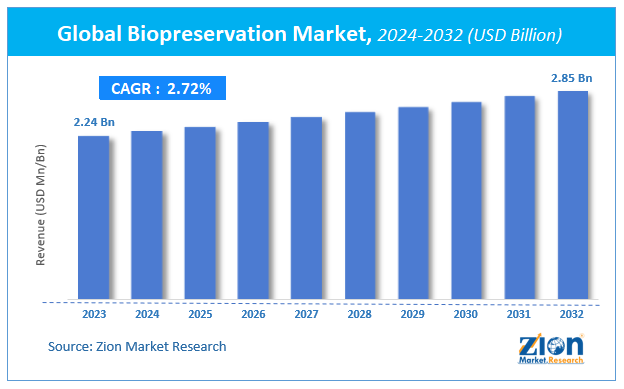
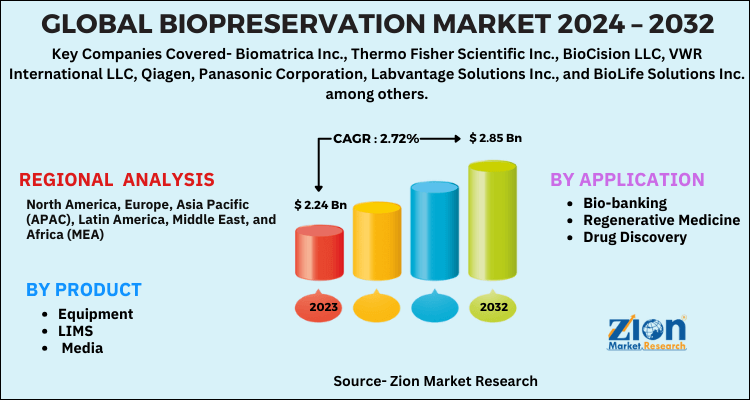
According to Zion Market Research, the global Biopreservation Market was worth USD 2.24 Billion in 2023. The market is forecast to reach USD 2.85 Billion by 2032, growing at a compound annual growth rate (CAGR) of 2.72% during the forecast period 2024-2032. The report offers a comprehensive analysis of the market, highlighting the factors that will determine growth, potential challenges, and opportunities that could emerge in the Biopreservation Market industry over the next decade.
Biopreservation Market: Overview
Biopreservation is the practise of maintaining cells, tissues, or organs for long periods of time outside of their natural habitat. It has proven to be an efficient long-term storage preservation technique. As a result, biopreservation has become important for the viability of a wide range of therapeutic and industrial applications of emerging cell-based technologies. Biopreservation is used in a variety of healthcare facilities to preserve the functionality and integrity of clinical trial materials, eggs, sperm, embryos, and other biological materials.
Biopreservation preserves the purity and sustainability of biospecimens while also extending their shelf life. Biobanking, a form of biopreservation, is commonly used in medical research related to precision medicine and genomics research. The basic role of biobanks is to collect, process, and store samples and associated records. Increasing demand for organ transplantation, along with the emergence of biomedical innovation for modern treatments and medicines, are two vital motivating factors for the growth of the biopreservation market.
Key Insights
- As per the analysis shared by our research analyst, the global biopreservation market is projected to expand annually at a CAGR of around 2.72% over the forecast period (2024-2032).
- In terms of revenue, the global biopreservation market size was valued at nearly USD 2.24 billion in 2023 and is set to reach USD 2.85 billion by 2032.
- The market is driven by the growing prevalence of chronic diseases requiring advanced therapies and the expansion of the pharmaceutical industry’s R&D activities in emerging economies.
- Based on the Product, the Media segment dominated the market with a share of approximately 45% because of the recurring need for specialized preservative solutions in every cryopreservation cycle and the shift toward chemically defined, serum-free media.
- Based on the Application, the Biobanking segment held the largest market share of over 38% due to the massive increase in the storage of cord blood, DNA samples, and stem cells for future therapeutic and research use.
- North America dominated the global biopreservation market with a revenue share of 41% in 2025, owing to its robust healthcare infrastructure, high concentration of pharmaceutical companies, and significant government funding for stem cell research.
Biopreservation Market: Dynamics
Growth Factors
Advancements in Regenerative Medicine and Cell Therapy
Factors such as increased research and development investments, developments in bio banking, and the rising trend of preserving newborns' cord blood stem cells, as well as increased investments in regenerative medicine science and the need for personalised medicine, are projected to propel the bio preservation market. The advancement of regenerative medicine for treating and managing multiple chronic diseases, such as heart failure and diabetes, as well as degenerative disorders affecting the nerves, muscles, and joints, is one of the major factors driving demand for biopreservation. Over the last decade, chronic conditions have become even more prevalent. The healthcare industry is under pressure to use improved biospecimen preservation methods as the number of patients increases. This has resulted in widespread acceptance and use of biopreservation methods, as well as industry expansion. In addition, the biopreservation market is expected to grow as a result of increased mergers and acquisitions among market players.
Biopreservation also has significant durability problems, with tissue fractures occurring during freezing and thawing. Furthermore, the advancement of low-cost and efficient preservation methods, such as room-temperature preservation processes, would restrain market growth.
Restraints
High Costs of Advanced Cryopreservation Equipment
A significant restraint for the biopreservation market is the substantial capital investment required for ultra-low temperature freezers and automated storage systems. Small and medium-sized research laboratories or biobanks in developing regions often find the procurement and maintenance costs of these sophisticated systems prohibitive. The high cost of liquid nitrogen and the electricity required for 24/7 operation of cryogenic systems add to the long-term operational burden, potentially slowing adoption in cost-sensitive markets.
Additionally, the technical complexity involved in maintaining a stable "cold chain" presents logistical challenges. Any equipment failure or power outage can lead to the loss of priceless biological samples, which act as a deterrent for organizations with limited infrastructure. The high price of specialized, high-purity preservation media also contributes to the overall cost of biopreservation, forcing some entities to opt for traditional, less efficient methods.
Opportunities
Emergence of Personalized Medicine and Genomic Research
The shift toward personalized medicine offers a massive opportunity for the biopreservation market. As healthcare moves toward tailoring treatments based on an individual's genetic profile, the demand for long-term storage of genomic samples and patient-specific cells is increasing. Biobanks are expanding their capacities to store millions of samples for longitudinal studies, which requires advanced LIMS for data management and high-throughput biopreservation equipment.
Moreover, the expansion of biopreservation into the animal health and agricultural sectors represents a new growth frontier. The preservation of rare animal breeds, high-yield livestock semen, and endangered species' genetic material is gaining traction globally. Developing specialized preservation protocols for non-human biological materials allows market players to diversify their portfolios beyond clinical healthcare.
Challenges
Stringent Regulatory Standards and Quality Control
One of the major challenges in the biopreservation industry is navigating the complex and ever-evolving regulatory landscape. Regulatory bodies like the FDA and EMA have stringent requirements regarding the safety and purity of preservation media, especially those used in clinical applications. Manufacturers must ensure that their media are free from contaminants and that equipment meets rigorous validation standards. Achieving and maintaining these certifications requires significant R&D and quality control expenditure.
Furthermore, the lack of standardization in biopreservation protocols across different laboratories can lead to inconsistent results. Variation in cooling rates, thawing procedures, and media concentrations can affect cellular viability. Developing universally accepted standards that ensure reproducibility in biological research remains a technical challenge that the industry must address to facilitate global collaborations and clinical trials.
Biopreservation Market: Report Scope
| Report Attributes | Report Details |
|---|---|
| Report Name | Biopreservation Market |
| Market Size in 2023 | USD 2.24 Billion |
| Market Forecast in 2032 | USD 2.85 Billion |
| Growth Rate | CAGR of 2.72% |
| Number of Pages | 120 |
| Key Companies Covered | Biomatrica Inc., Thermo Fisher Scientific Inc., BioCision LLC, VWR International LLC, Qiagen, Panasonic Corporation, Labvantage Solutions Inc., and BioLife Solutions Inc. among others |
| Segments Covered | By Product, By Application, and By Region |
| Regions Covered | North America, Europe, Asia Pacific (APAC), Latin America, the Middle East, and Africa (MEA) |
| Base Year | 2023 |
| Historical Year | 2018 - 2022 |
| Forecast Year | 2024 - 2032 |
| Customization Scope | Avail customized purchase options to meet your exact research needs. Request For Customization |
Biopreservation Market Segmentation
The biopreservation market is segmented by product, application, cell provider, and region.
Based on Product Segment, the market is divided into Equipment, Media, and LIMS. The Media segment is the most dominant in the market as these are consumable products required for every single sample preservation process. The constant demand for pre-formulated, home-brew, and specialty media for different cell types ensures high revenue generation. The second most dominant segment is Equipment, which includes freezers, refrigerators, and liquid nitrogen tanks, driven by the establishment of new biobanks and the expansion of existing research facilities.
Based on Application Segment, the market is divided into Regenerative Medicine, Biobanking, and Drug Discovery. The Biobanking segment is the most dominant due to the global rise in cord blood banking and the storage of biological samples for chronic disease research. It helps drive the market by creating a continuous demand for long-term storage solutions. The second most dominant is Regenerative Medicine, which is growing at the fastest rate as more cell-based therapies move from the laboratory to the hospital bedside, requiring sophisticated point-of-care preservation.
Biopreservation Market: Competitive Landscape
Some of the major players of the global Biopreservation market include
- Biomatrica Inc.
- Thermo Fisher Scientific Inc.
- BioCision LLC
- VWR International LLC
- Qiagen
- Panasonic Corporation
- Labvantage Solutions Inc.
- BioLife Solutions Inc.
- among others.
The global Biopreservation Market is segmented as follows:
By Product
- Equipment
- Refrigerators
- Freezers
- Liquid nitrogen
- Consumables
- LIMS
- Media
- Home-brew Media
- Pre-formulated Media
By Application
- Bio-banking
- Regenerative Medicine
- Drug Discovery
By Region
- North America
- The U.S.
- Canada
- Mexico
- Europe
- France
- The UK
- Spain
- Germany
- Italy
- Rest of Europe
- Asia Pacific
- China
- Japan
- India
- Australia
- South Korea
- Rest of Asia Pacific
- The Middle East & Africa
- Saudi Arabia
- UAE
- Egypt
- Kuwait
- South Africa
- Rest of the Middle East & Africa
- Latin America
- Brazil
- Argentina
- Rest of Latin America
Table Of Content
Methodology
FrequentlyAsked Questions
Biopreservation is the process of maintaining the viability and functional integrity of biological materials, such as cells and tissues, by using ultra-low temperatures or chemical media to stop biological aging.
The key drivers include the rising demand for regenerative medicines, the growth of biobanking facilities, and the increasing focus on personalized medicine and drug discovery.
The market was estimated at USD 2.24 billion in 2023 and is expected to reach a value of USD 2.85 billion by 2032.
The biopreservation market is projected to grow at a CAGR of 2.72% during the forecast period of 2024 - 2032.
High capital costs for cryogenic equipment and the technical difficulties associated with maintaining a strict cold chain are the primary challenges.
Trends include the development of serum-free and chemically defined media, the use of automated robotic storage systems, and the integration of IoT in sample monitoring.
The value chain includes raw material supply, media formulation, equipment manufacturing, distribution to biobanks and hospitals, and the end-use in clinical therapies or research.
North America is the leading contributor, while Asia Pacific is expected to be the fastest-growing region due to expanding R&D in China and India.
Major players include Biomatrica Inc., Thermo Fisher Scientific Inc., BioCision LLC, VWR International LLC, Qiagen, Panasonic Corporation, Labvantage Solutions Inc., and BioLife Solutions Inc. among others.
The report provides a deep analysis of market trends, size, share, and competitive dynamics, offering insights into growth opportunities across various biological applications.

HappyClients

