
Automotive Tailgate Market Size, Growth, Global Trends, Forecast 2034

Automotive Tailgate Market By Type (Manual Tailgate, Power Tailgate, Gesture Controlled Tailgate, Hands Free Tailgate), By Vehicle Type (Passenger Cars, Sport Utility Vehicles, Light Commercial Vehicles, Heavy Commercial Vehicles), By Material (Steel Tailgate, Aluminum Tailgate, Composite Tailgate, Carbon Fiber Tailgate), By Sales Channel (Original Equipment Manufacturers, Aftermarket Retailers, Online Automotive Parts Stores, Authorized Service Centers), and By Region - Global and Regional Industry Overview, Market Intelligence, Comprehensive Analysis, Historical Data, and Forecasts 2026 - 2034
| Market Size in 2025 | Market Forecast in 2034 | CAGR (in %) | Base Year |
|---|---|---|---|
| USD 15.7 Billion | USD 23 Billion | 4.35% | 2025 |
Automotive Tailgate Industry Perspective:
What will be the size of the automotive tailgate market during the forecast period?
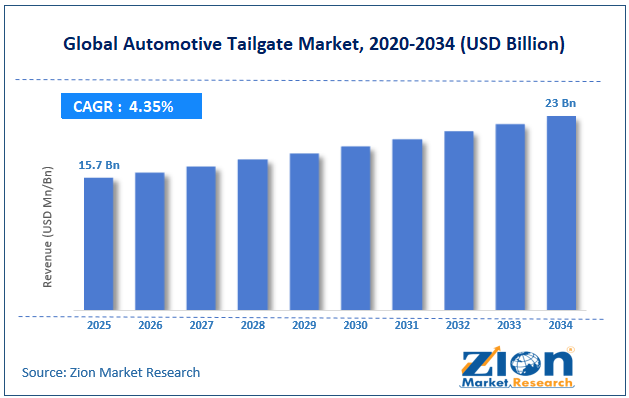
The global automotive tailgate market size was valued at approximately USD 15.7 billion in 2026 and is projected to reach around USD 23 billion by 2034, growing at a compound annual growth rate of approximately 4.35% between 2026 and 2034.
Key Insights
- As per the analysis shared by our research team, the global automotive tailgate market is estimated to grow at a compound annual growth rate of approximately 4.35% during the forecast period from 2026 to 2034.
- In terms of revenue, the global automotive tailgate market was valued at approximately USD 15.7 billion in 2026 and is projected to reach USD 23 billion by 2034.
- The automotive tailgate market is expected to grow steadily, driven by rising demand for convenience features, increasing SUV and pickup truck sales, growing use of lightweight materials, and expanding adoption of hands-free technology.
- Based on type, power tailgate leads the market because of its growing standard fitment across mid-range and premium vehicles, while gesture-controlled tailgate is gaining strong momentum as one of the fastest-growing types among tech-focused buyers.
- Based on vehicle type, sport utility vehicles lead the market due to their spacious cargo areas and premium feature packages. In contrast, light commercial vehicles are the fastest-growing segment as logistics and delivery fleets modernize their vehicles.
- Based on material, steel tailgates lead the market because of their low cost and continued use in entry-level vehicles, while aluminum tailgates are seeing rapid adoption because of their weight-saving benefits and better corrosion resistance.
- Based on sales channel, original equipment manufacturers lead the market because they install tailgates during vehicle assembly, while online automotive parts stores are steadily growing as more vehicle owners shop for replacement parts online.
- Based on region, Asia Pacific leads the global automotive tailgate market. At the same time, North America is the fastest-growing region due to strong pickup truck demand and rising adoption of power-operated features.
Automotive Tailgate Market: Overview
An automotive tailgate is the rear door or panel of a vehicle that opens to provide access to the trunk, boot, or cargo area. Traditionally operated by hand, automotive tailgates have evolved into advanced systems that offer greater convenience, safety, and ease of use. Modern tailgates are available in manual, power-assisted, and hands-free versions, with power tailgates opening and closing at the push of a button and hands-free systems responding to a foot movement under the rear bumper. Rising demand for vehicle convenience features is driving the adoption of power tailgates across cars, SUVs, crossovers, and pickup trucks. Features once mainly available in luxury vehicles are now becoming common in mainstream models as consumers seek greater comfort and convenience. Automakers are also increasingly using lightweight materials such as aluminum and composites to reduce vehicle weight, improve fuel efficiency, and lower emissions. Lightweight tailgates are especially important for electric vehicles (EVs) because lower vehicle weight can help extend driving range. Meanwhile, manufacturers are improving safety systems to reduce pinch-point injuries and limit battery consumption. As automotive design increasingly focuses on convenience, smart technology, and user experience, advanced automotive tailgates are becoming an important feature in modern vehicles.
The automotive tailgate industry continues to expand as manufacturers, suppliers, and technology developers work together to build smarter, lighter, and more convenient rear-access systems for vehicles worldwide.
Automotive Tailgate Market: Strategic Perspective
Where is the automotive tailgate market heading?
The automotive tailgate market is steadily shifting away from purely mechanical tailgate systems toward electronically controlled, sensor-equipped panels that offer touchless operation and smoother closing mechanisms. Future growth will likely be shaped less by basic manual tailgate sales and more by suppliers that can deliver integrated systems combining lightweight construction, smart sensors, and seamless connectivity with a vehicle's onboard software.
Where should businesses invest in the automotive tailgate market?
In the automotive tailgate market, the strongest opportunities are expected to come from companies investing in lightweight material engineering, motor and actuator miniaturization, and closer collaboration with vehicle electronics teams to integrate tailgates into broader smart-car ecosystems. As automakers demand proof of long-term reliability under repeated daily use, investment is likely to favor suppliers that can demonstrate rigorous durability testing and extended component life.
What will reshape competition in the automotive tailgate market?
Competitive advantage in the automotive tailgate market will increasingly depend on more than just building a functional opening mechanism. Companies that combine dependable manufacturing quality with faster development cycles, strong relationships with automakers, and proven integration with vehicle software are expected to pull ahead of rivals that focus solely on hardware.
Automotive Tailgate Market: Technology Roadmap 2026–2034
What is the projected development roadmap of the automotive tailgate market over the forecast period?
The automotive tailgate market is advancing through improved actuator design, more reliable sensor technology, expanded use of lightweight materials, and growing integration of smart connectivity features, making vehicles more convenient and efficient for everyday drivers. The market is expected to grow at a compound annual growth rate of approximately 4.35% over the forecast period, driven by rising vehicle production, developing safety standards, and continuous refinement of tailgate automation technology.
The following roadmap outlines key development phases expected through 2034.
2026–2028: Component Refinement and Safety Standards Phase
- Suppliers are expected to develop improved anti-pinch sensors that help power tailgates stop or reverse instantly when they detect an obstruction, reducing the risk of injury.
- Stricter vehicle safety standards are expected to push automakers toward better fail-safe mechanisms and backup manual release systems for power tailgates.
- Greater cooperation between tailgate suppliers, automakers, and safety regulators is expected to make advanced tailgate systems easier to certify and deploy across more vehicle models.
2029–2031: Cost Reduction and Broader Adoption Phase
- Improved manufacturing methods are expected to help suppliers produce lightweight tailgates more consistently, reduce assembly defects, and better manage production costs.
- The use of combination systems is expected to increase, with power tailgates paired with smartphone app controls or voice command activation to improve driver convenience.
- Better testing equipment is expected to help suppliers compare motor and actuator designs more accurately and develop tailgates that perform reliably in extreme temperatures.
2032–2034: Next Generation Smart Tailgate Phase
- Automotive tailgates are expected to advance, with suppliers focusing on lower production costs, quieter operation, and longer-lasting mechanical components.
- Ultra-lightweight composite and carbon fiber designs are expected to gain attention as electric vehicle makers look for every possible way to extend driving range.
- Tailgates combined with predictive sensors and adaptive automation are expected to help vehicles automatically adjust opening height and speed based on the surrounding environment, such as low-ceiling garages.
Automotive Tailgate Market: Dynamics
Growth Drivers
What is driving growth in the automotive tailgate market as demand for smarter vehicle features rises?
The automotive tailgate market is growing as vehicle buyers increasingly look for convenience, comfort, and smart features once limited to luxury cars. Rising SUV and crossover sales, stricter fuel efficiency standards, and advances in sensors and actuators are supporting market growth worldwide. Power tailgates and hands-free systems let drivers open the rear door without putting down groceries, luggage, or heavy items, making them especially useful for families and delivery professionals. Automakers are improving safety with pinch detection and automatic stop features to reduce injury risk. At the same time, manufacturers are developing stronger motors, better weather sealing, and more reliable components for everyday use. Growing vehicle production, higher disposable incomes in emerging markets, and rising awareness of automotive features are further increasing demand. The growing popularity of connected vehicles is also encouraging manufacturers to integrate tailgate controls with mobile apps, keyless entry, and other smart vehicle functions. Rising demand for personalized driving experiences is further pushing automakers to offer tailgates with adjustable opening heights and customized operating settings. As consumers continue to value convenience and easy vehicle access, tailgate systems are becoming a common feature in passenger cars, SUVs, and commercial vehicles worldwide.
Lightweight materials are creating new opportunities in the automotive tailgate market.
The automotive tailgate market is creating new opportunities as automakers look for lightweight components that reduce vehicle weight without compromising strength or safety. Advanced tailgate materials provide strong structural support while reducing unnecessary weight, improving fuel economy and, in electric vehicles, extending driving range. Lighter tailgates also reduce stress on hinges, motors, and actuators, supporting smoother and more reliable operation. Passenger vehicle makers, commercial fleet operators, and aftermarket suppliers are adopting lightweight tailgates for new vehicles and replacement parts. Manufacturers are also developing custom-shaped and reinforced tailgates for trucks, SUVs, and off-road vehicles, creating new applications. Growing electric vehicle production, material innovation, and investment in sustainable manufacturing are supporting wider adoption. Stricter emissions targets and fuel economy standards are further encouraging automakers to use advanced lightweight materials across vehicle bodies, including tailgates. As consumers increasingly value fuel efficiency, convenience, and smart vehicle features, demand for lightweight automotive tailgates is expected to grow steadily across passenger and commercial vehicles worldwide.
Restraints
High production costs are challenging the growth of the automotive tailgate market.
The automotive tailgate market faces several challenges that can slow market growth. Power-operated and gesture-controlled tailgates require advanced sensors, reliable actuators, strong weather sealing, and strict quality testing, making them costly and technically complex to produce. Smaller suppliers may struggle to invest in the research and development needed to compete with larger automotive companies. Long-term reliability is another concern, as frequent opening and closing can gradually wear out motors, sensors, hinges, and other components. Manufacturers must also conduct extensive testing to ensure tailgates work safely and reliably in different temperatures, weather conditions, and road environments. A shortage of skilled automotive electronics engineers and quality professionals can further affect production and system integration. In developing markets, limited manufacturing facilities and technical expertise may also slow adoption. However, better production technologies, improved component designs, and stronger partnerships between automakers and suppliers can reduce manufacturing costs, improve reliability, and support wider global adoption of advanced automotive tailgate systems.
Opportunities
Expanding vehicle applications are creating growth opportunities in the automotive tailgate market.
The automotive tailgate industry offers strong growth opportunities as automakers and suppliers develop flexible, feature-rich rear-access solutions. Advanced tailgate systems provide greater convenience without adding unnecessary weight, making them suitable for passenger cars, SUVs, pickup trucks, and commercial vehicles. They improve everyday usability while supporting modern, technology-focused vehicle designs. Growing adoption in electric vehicles and commercial delivery fleets is creating additional market opportunities. Rising demand for connected and convenient vehicle features is encouraging automakers, fleet operators, and aftermarket suppliers to adopt advanced tailgate systems. Emerging markets such as China, India, Brazil, and Southeast Asia are expanding vehicle production and consumer spending on feature-rich automobiles, supporting market growth.
Manufacturers are also improving production methods to make these systems more affordable, durable, lightweight, and easier to install. Growing commercial vehicle fleets and stricter safety requirements are driving further demand. Rising vehicle sales, continuous technology innovation, and greater awareness of smart automotive features are expected to support steady market expansion. Growing interest in connected vehicles is also encouraging automakers to integrate advanced tailgate technology earlier in vehicle design.
Challenges
What challenges does the automotive tailgate market face in sustaining growth and achieving widespread adoption?
The automotive tailgate market faces several challenges that may slow market growth. Developing advanced power and gesture-controlled systems requires high research costs, specialized testing equipment, and extensive durability testing, making it harder for smaller suppliers to compete. Strict vehicle safety standards also require manufacturers to prove reliable, safe operation before installing systems in production vehicles, which can delay product launches. Different regulations across countries may further increase development costs and timelines. The industry also needs skilled automotive electronics engineers, technicians, and quality control professionals to support manufacturing and system integration. Maintaining a steady supply of specialized sensors, motors, actuators, and other precision components is another challenge, as shortages can disrupt production. Advanced tailgates also compete with simpler and cheaper manual systems, which remain attractive to budget-conscious vehicle buyers.
However, improvements in manufacturing technology, stronger automaker-supplier partnerships, better component availability, and continued research into automotive electronics can help reduce costs, improve reliability, and support long-term market growth.
Automotive Tailgate Market: Report Scope
| Report Attributes | Report Details |
|---|---|
| Report Name | Automotive Tailgate Market |
| Market Size in 2025 | USD 15.7 Billion |
| Market Forecast in 2034 | USD 23 Billion |
| Growth Rate | CAGR of 4.35% |
| Number of Pages | 227 |
| Key Companies Covered | Magna International, Continental AG, Brose Fahrzeugteile, Hi-Lex Corporation, Stabilus GmbH, Aisin Corporation, Mitsuba Corporation, Inteva Products, Kiekert AG, U-Shin Ltd., and others. |
| Segments Covered | By Type, By Vehicle Type, By Material, By Sales Channel, and By Region |
| Regions Covered | North America, Europe, Asia Pacific (APAC), Latin America, Middle East, and Africa (MEA) |
| Base Year | 2025 |
| Historical Year | 2020 - 2024 |
| Forecast Year | 2026 - 2034 |
| Customization Scope | Avail customized purchase options to meet your exact research needs. Request For Customization |
Automotive Tailgate Market: Segmentation
The global automotive tailgate market is segmented by type, vehicle type, material, sales channel, and region.
What makes power tailgate the dominant type in the automotive tailgate market?
Based on type, the global automotive tailgate market is classified into manual, power, gesture-controlled, and hands-free tailgates. Power tailgates hold about 41% market share, leading because they are increasingly included as a standard feature in mid-range and premium vehicles, are moderately priced, and strongly preferred for convenience. Gesture-controlled tailgate holds around 24% market share. It is the fastest-growing segment because younger, tech-savvy vehicle buyers increasingly demand touchless technology.
How does the sport utility vehicle segment maintain its leading position in the automotive tailgate market?
Based on vehicle type, the automotive tailgate industry is segregated into passenger cars, sport utility vehicles, light commercial vehicles, and heavy commercial vehicles. Sport utility vehicles account for approximately 37% of the global market share, driven by their spacious cargo compartments and buyers' preference for feature-loaded models. Light commercial vehicles hold around 22% market share. This segment is the fastest-growing, driven by the expanding use of smart tailgate systems in delivery and logistics fleets.
What makes steel tailgates the dominant material in the automotive tailgate market?
Based on material, the market is categorized into steel, aluminum, composite, and carbon fiber tailgates. Steel tailgate leads with about a 39% share because of their low manufacturing cost and continued widespread use in entry-level and budget vehicles. Aluminum tailgate holds around 26% market share. It is growing steadily as automakers prioritize weight reduction to meet fuel efficiency and emissions targets.
How does the original equipment manufacturer channel shape the automotive tailgate sales landscape?
Based on sales channel, the automotive tailgate market is divided into original equipment manufacturers, aftermarket retailers, online automotive parts stores, and authorized service centers. Original equipment manufacturers account for about 46% of the market, leading because most tailgates are installed directly during vehicle assembly. Online automotive parts store holds around 19% market share. This channel is expanding quickly as more vehicle owners prefer the convenience of ordering replacement parts through digital platforms.
Automotive Tailgate Market: Regional Analysis
How is vehicle production driving growth in the Asia Pacific automotive tailgate market?
The Asia Pacific automotive tailgate market holds a 43.50% market share globally and is expected to maintain its leading position during the forecast period. Asia Pacific leads the automotive tailgate market because it is the world’s largest vehicle manufacturing hub, with China, Japan, South Korea, and India producing millions of passenger and commercial vehicles each year. Rising disposable incomes and growing demand for feature-rich vehicles are encouraging automakers to offer power and hands-free tailgates in mid-range models. Local component suppliers are also expanding production, helping make advanced tailgate systems more affordable and widely available. Government support for electric vehicle adoption in China and South Korea is encouraging lightweight, smart tailgate systems that improve vehicle efficiency and driving range.
Rapid urbanization and a growing middle class across Southeast Asia are increasing demand for SUVs and crossovers, which often include advanced tailgate features. Automakers are also investing in smart vehicle technologies, including sensor-based and connected tailgate systems. Growing e-commerce and logistics activity is increasing commercial vehicle fleets, creating additional demand for durable tailgate solutions. Strong manufacturing capacity, rising vehicle production, consumer demand, and technology investment are expected to keep Asia Pacific at the forefront of the automotive tailgate market.
What factors are accelerating expansion in the North America automotive tailgate market?
The North America automotive tailgate market holds a 23.69% market share globally and is expected to maintain strong growth during the forecast period. North America is a key regional market for automotive tailgates, supported by strong SUV and pickup truck sales, high consumer spending, and rising demand for convenient vehicle features. The United States and Canada strongly prefer larger vehicles with spacious cargo areas, and buyers are increasingly willing to pay for power-operated and hands-free tailgates. These features make it easier for families and commercial users to load groceries, luggage, tools, and other heavy items.
Growing adoption of electric pickup trucks is also encouraging automakers to use lightweight tailgate materials that help reduce vehicle weight and improve efficiency. Fuel economy standards are further supporting the use of aluminum and composite materials across vehicle bodies, including tailgates. Growing delivery services and commercial fleets are creating additional demand for reliable tailgate systems. North American suppliers are also expanding local production to strengthen supply chains. Rising vehicle sales, EV adoption, demand for smart features, and continued manufacturing investment are expected to support strong growth in the regional automotive tailgate market.
Recent Market Developments
- In August 2026, Mahindra & Mahindra introduced the BE 6 SPORTEQ electric SUV in India with a personalized tailgate messaging feature, allowing owners to display customized messages.
Automotive Tailgate Market: Competitive Analysis
The leading players in the global automotive tailgate market are:
- Magna International
- Continental AG
- Brose Fahrzeugteile
- Hi-Lex Corporation
- Stabilus GmbH
- Aisin Corporation
- Mitsuba Corporation
- Inteva Products
- Kiekert AG
- U-Shin Ltd.
The global automotive tailgate market is segmented as follows:
By Type
- Manual Tailgate
- Power Tailgate
- Gesture Controlled Tailgate
- Hands-Free Tailgate
By Vehicle Type
- Passenger Cars
- Sport Utility Vehicles
- Light Commercial Vehicles
- Heavy Commercial Vehicles
By Material
- Steel Tailgate
- Aluminum Tailgate
- Composite Tailgate
- Carbon Fiber Tailgate
By Sales Channel
- Original Equipment Manufacturers
- Aftermarket Retailers
- Online Automotive Parts Stores
- Authorized Service Centers
By Region
- North America
- The U.S.
- Canada
- Mexico
- Europe
- France
- The UK
- Spain
- Germany
- Italy
- Rest of Europe
- Asia Pacific
- China
- Japan
- India
- Australia
- South Korea
- Rest of Asia Pacific
- The Middle East & Africa
- Saudi Arabia
- UAE
- Egypt
- Kuwait
- South Africa
- Rest of the Middle East & Africa
- Latin America
- Brazil
- Argentina
- Rest of Latin America
Table Of Content
Methodology
FrequentlyAsked Questions
An automotive tailgate is the rear door or panel of a vehicle that opens to provide access to the trunk, boot, or cargo area. Modern tailgates are available in manual, power-assisted, and hands-free versions, with power tailgates opening and closing at the push of a button and hands-free systems responding to a foot movement under the rear bumper.
The global automotive tailgate market is expected to grow due to rising demand for convenience features, increasing SUV and pickup truck sales, growing use of lightweight materials, and expanding adoption of hands-free technology worldwide.
According to research, the global automotive tailgate market was valued at approximately USD 15.7 billion in 2026 and is projected to reach approximately USD 23 billion by 2034.
The compound annual growth rate of the automotive tailgate market is expected to be approximately 4.35% from 2026 to 2034.
Asia Pacific is expected to lead the global automotive tailgate market throughout the forecast period, driven by its position as the world's largest vehicle production hub and rising consumer demand for feature-rich vehicles.
The major players in the global automotive tailgate market include Magna International, Continental AG, Brose Fahrzeugteile, Hi-Lex Corporation, Stabilus GmbH, Aisin Corporation, Mitsuba Corporation, Inteva Products, Kiekert AG, and U-Shin Ltd.
The report examines key aspects of the automotive tailgate market, including research and development drivers, adoption barriers, application opportunities, competitive landscape dynamics, detailed regional market performance analysis, and a comprehensive forward-looking outlook across all major types, vehicle types, materials, sales channels, and geographic regions through 2034.
The OEM segment holds the largest share in the automotive tailgate market, supported by increasing installation of power-operated and hands-free tailgate systems directly into new passenger vehicles, SUVs, and commercial vehicles during vehicle manufacturing. Growing vehicle production and rising demand for factory-fitted smart features are expected to strengthen the OEM sales channel further.
Pricing in the automotive tailgate market is gradually increasing as manufacturers adopt advanced power-operated, hands-free, sensor-based, and lightweight systems. At the same time, higher production volumes and improved manufacturing efficiency help control costs.
Stakeholders in the automotive tailgate market should focus on lightweight materials, smart sensors, hands-free technology, product durability, cost-efficient manufacturing, and strong partnerships with automakers to meet changing consumer expectations. Investing in research and development and improving system reliability can also help companies differentiate their products and strengthen their market position.

HappyClients

