
Global Assistive Technology Market Size, Growth, Trends, and Forecast 2034

Assistive Technology Market By Age Group (Children and Adolescents, Senior Citizens, and Adults), By Application (Mobility Assistance, Cognitive Assistance, Communication Assistance, Sensory Assistance, and Environmental Control), By Type of Device (Mobility Aids, Cognitive Aids, Communication Aids, Sensory Aids, and Environmental Control Devices), By Disability Type (Mobility Impairments, Communication Impairments, Visual Impairments, Hearing Impairments, and Cognitive Impairments), and By Region - Global and Regional Industry Overview, Market Intelligence, Comprehensive Analysis, Historical Data, and Forecasts 2026 - 2034
| Market Size in 2025 | Market Forecast in 2034 | CAGR (in %) | Base Year |
|---|---|---|---|
| USD 36.5 Billion | USD 88.2 Billion | 10.3% | 2025 |
Assistive Technology Industry Perspective:
What will be the size of the global assistive technology market during the forecast period?
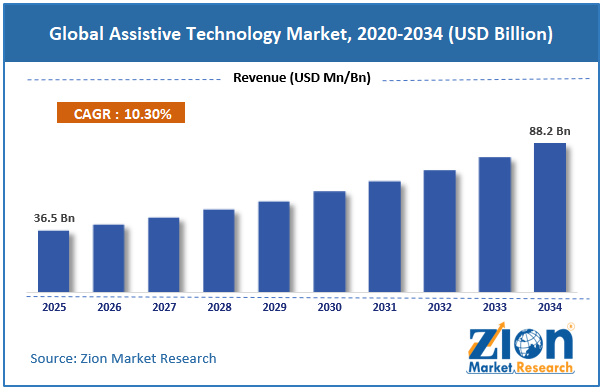
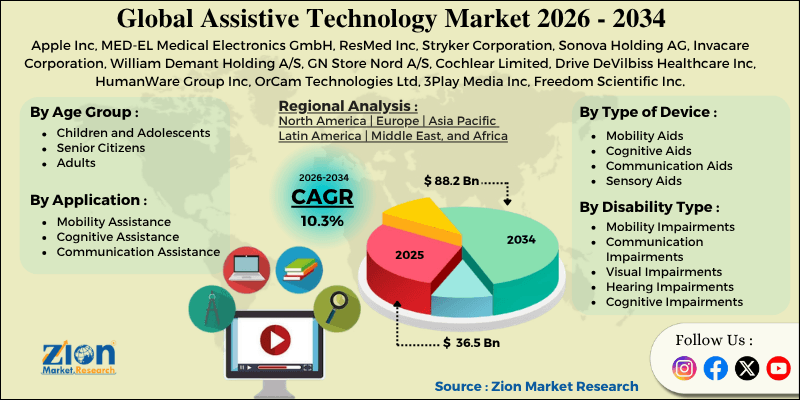
The global assistive technology market size was worth around USD 36.5 billion in 2025 and is predicted to grow to around USD 88.2 billion by 2034, with a compound annual growth rate (CAGR) of roughly 10.3% between 2026 and 2034.
Key Insights
- As per the analysis shared by our research analyst, the global assistive technology market is estimated to grow annually at a CAGR of around 10.3% over the forecast period (2026-2034).
- In terms of revenue, the global assistive technology market size was valued at around USD 36.5 billion in 2025 and is projected to reach USD 88.2 billion by 2034.
- Expansion of home healthcare and independent living is expected to propel the assistive technology market over the projected period.
- Based on the age group, the children and adolescents segment held the largest revenue share in 2025.
- Based on the application, the mobility assistance segment held a prominent market share of 25% in 2025.
- Based on the type of device, the mobility aids segment captures a prominent revenue share in 2025 of 26%.
- Based on the disability type, the mobility impairments segment captures a prominent revenue share in 2025 of 28%.
- Based on region, North America dominates the Assistive Technology market with a revenue share of 45% in 2025.
Assistive Technology Market: Overview
Assistive technology is generally defined as a device, equipment, software, or any other tool or system that helps to enhance the capability and functionality of physically and mentally ill or injured people. It also includes devices that help the elderly and people with temporary conditions. Examples of assistive devices range from the simplest, like walking sticks, magnifying glasses, and specially designed eating instruments, to the most complicated pieces of technology, including screen readers, speech recognition systems, hearing aids, wheelchairs, and smart wearable devices. These tools enable people to engage in day-to-day activities, function at home or work, communicate with others, pursue an education, access healthcare, and participate in the community. The scope of assistive technology is growing daily due to technological advances and the introduction of innovations, including artificial intelligence, Internet of Things, speech recognition, and sensors.
Impact of the USA-Israel War on Iran on the Assistive Technology Market
The USA-Israeli dispute over Iran indirectly affects the global market for assistive technologies, as global supply chains are disrupted and transportation and logistics costs increased. The price of raw materials, such as plastic, electronics, and metal, used in the production of mobility equipment, hearing aids, prosthetics, and communication devices, is also projected to rise. Regional geopolitical uncertainty and restricted transportation of goods in the Middle East will disrupt supply chains and increase prices in the short term. Still, the global assistive technologies market will continue to grow due to an aging population, rising prevalence of disabilities, and investment in healthcare.
Assistive Technology Market: Dynamics
Growth Drivers
Does the rising prevalence of disabilities and chronic health conditions drive the assistive technology market?
The growing prevalence of disabilities and chronic illnesses is a key driver in the development of the assistive technology market as people with limited physical or mental abilities opt for devices that help them move, speak, hear, and see. According to research released in April 2025 by the US Centers for Disease Control and Prevention (CDC), 61 million US adults (or 25%) have some form of disability, with disabilities affecting 43.9% of Americans aged 65 years and older. The report also indicates that disability prevalence increases with age and that chronic disease is strongly associated with disability.
For instance, arthritis, stroke, diabetes, heart disease, and neurological conditions are some of the most common diseases and conditions that require wheelchairs, hearing aids, cochlear implants, communication devices, and home modifications. In addition, as more governments worldwide commit to providing services and supports for people with disabilities to lead independent lives, an increasing number of people with chronic diseases and disabilities will contribute to market growth.
Restraints
How does the high cost of assistive technology act as a major restraint to the assistive technology industry's growth?
The high cost of advanced technologies has become a major restraint to the growth of the assistive technology market, especially in low- and middle-income countries, limiting the accessibility and affordability of devices, as well as reimbursement. Products such as AI hearing aids, robotic prosthetics, powered wheelchairs, and augmentative communication devices are complex and often require recurring maintenance and adaptation costs. According to the WHO and UNICEF Global Report on Assistive Technology, over 2.5 billion people need at least one form of an assistive product.
In comparison, approximately one billion people do not have access to them, and affordability is cited as a key challenge. The report also states that two-thirds of people who need assistive technologies pay for them, and only 3% of people in need in low-income countries can access them. At the same time, demand far exceeds supply, indicating that high prices make such equipment unaffordable and restrain market growth.
Opportunities
Why do the technological advancements in AI, IoT, and wearable devices offer a lucrative opportunity for the assistive technology market?
Technological advances in areas such as artificial intelligence (AI), the Internet of Things (IoT), and wearable electronics represent opportunities for the assistive technology market to meet growing demand for intelligent, intuitive solutions by making them more connected, personalized, and capable. For instance, AI can enable real-time speech recognition, predictive analytics, computer vision, and self-learning functions that lead to better hearing aids, smart prosthetics, communication devices, and vision-reading systems. In addition, IoT connectivity can enable greater smartphone and smart home interoperability, fall detection, remote patient monitoring, and data sharing with caregivers and clinicians, while enabling new models of care delivery and management.
Finally, bringing products, such as smart glasses, sensor-equipped exoskeletons, wearables for detecting falls and other health issues, and connected medical devices, into the home can empower patients, enable medical and home care services, and promote aging in place. These developments will benefit patients and open up new markets for manufacturers of assistive technologies by enabling them to participate in the development of connected, empowering, and intelligent products for use in clinical settings, at home, and at work.
Challenges
Social stigma and reluctance to adopt assistive devices pose a significant challenge to the growth of the assistive technology industry
Social stigma and reluctance to use certain kinds of walking, hearing, communication, and prosthetic devices are major challenges to the development of the assistive technology market. These factors constitute barriers to people acquiring such equipment, primarily due to the fear of social discrimination on the grounds that such devices depict the user as disabled and reliant on the assistance of others. In many societies, a negative attitude toward the physically or mentally impaired person has been deeply ingrained in the minds of people, discouraging individuals from embracing such technologies despite their potential to improve their quality of life.
For instance, young people may refrain from using hearing devices and other mobility equipment due to their unesthetic appeal. On the other hand, older folks may view such technologies as a sign of weakness and frailty and consequently reject them. Such challenges hinder the rate at which people embrace assistive technologies, thus slowing down market growth. The situation can be addressed by increasing public awareness of such technologies and ensuring products are designed to fit within general culture and social norms.
Assistive Technology Market: Report Scope
| Report Attributes | Report Details |
|---|---|
| Report Name | Assistive Technology Market |
| Market Size in 2025 | USD 36.5 Billion |
| Market Forecast in 2034 | USD 88.2 Billion |
| Growth Rate | CAGR of 10.3% |
| Number of Pages | 229 |
| Key Companies Covered | Apple Inc, MED-EL Medical Electronics GmbH, ResMed Inc, Stryker Corporation, Sonova Holding AG, Invacare Corporation, William Demant Holding A/S, GN Store Nord A/S, Cochlear Limited, Drive DeVilbiss Healthcare Inc, HumanWare Group Inc, OrCam Technologies Ltd, 3Play Media Inc, Freedom Scientific Inc, Karma Medical Products Co. Ltd, Enabling Devices LLC, Ossenberg GmbH, ZYGO-USA, Tobii Dynavox AB, Tobii Technology AB, AbleNet Inc., Prentke Romich Company, and others. |
| Segments Covered | By Age Group, By Application, By Type of Device, By Disability Type, and By Region |
| Regions Covered | North America, Europe, Asia Pacific (APAC), Latin America, Middle East, and Africa (MEA) |
| Base Year | 2025 |
| Historical Year | 2020 to 2024 |
| Forecast Year | 2026 - 2034 |
| Customization Scope | Avail customized purchase options to meet your exact research needs. Request For Customization |
Assistive Technology Market: Segmentation
Age Group Insights
Why does the children and adolescents segment hold a prominent position in the assistive technology market?
The children and adolescents segment held the largest revenue share of the assistive technology market in 2025. The growth is attributed to the rising prevalence of developmental disabilities, congenital diseases, hearing or visual impairments, autism spectrum disorder (ASD), cerebral palsy, and learning disabilities among the young population. Early identification and intervention programs promote the adoption of augmentative and alternative communication (AAC) devices, hearing aids, cochlear implants, and specialized computer software, as well as mobility and vision support devices, to improve the quality of education and socialization.
Application
How does the mobility assistance segment capture the largest share in the assistive technology market?
The mobility assistance segment held a prominent share of the assistive technology industry of 25% in 2025. The growth is attributed to the rise in physical disabilities, musculoskeletal disorders, spinal cord injuries, stroke, Parkinson’s disease, arthritis, and age-related disabilities. There is an increased need for manual and power wheelchairs, walkers, rollators, mobility scooters, crutches and canes, stair lifts, patient lift equipment, prosthetics, orthotics, and robotic exoskeletons.
Type of Device Insights
Does the mobility aids segment capture the largest share in the assistive technology market?
The mobility aids segment captures a prominent revenue share of the assistive technology market in 2025 of 26%. The growth is attributed to the rising prevalence of disabilities brought about by aging and chronic illnesses, neurological disorders, muscular conditions, and accidents. With a rise in spinal cord injury cases, strokes, arthritis, osteoporosis, and lower limb disabilities, there are more people acquiring mobility devices, including manual and power wheelchairs, walkers, rollators, canes, crutches, scooters, and transfers to enhance their quality of life.
Disability Type Insights
How does the mobility impairments segment capture the largest share in the assistive technology market?
The mobility impairments segment captures a prominent revenue share of the assistive technology industry in 2025 of 28%. The growth is attributed to the rising prevalence of ailments such as stroke, spinal injury, multiple sclerosis, Parkinson’s disease, cerebral palsy, arthritis, osteoporosis, and other mobility problems. In addition, demand for wheelchairs, walkers, mobility scooters, prosthetics, orthotics, and related equipment such as robotic exoskeletons and transfer devices is high in hospitals, rehabilitation centers, nursing facilities, and home healthcare settings.
Regional Insights
What factors drive the North America region in the assistive technology market?
North America dominates the assistive technology market with a revenue share of 45% in 2025. The market's growth is attributed to the region's developed healthcare infrastructure, high healthcare spending, and reimbursement policies, along with a rising aging population, disabilities, and the prevalence of chronic illness. In addition, the market is benefiting from widespread government support in North America for the inclusion of people with disabilities. The region is also witnessing the rapid adoption of digital health technologies and the presence of key companies engaged in R&D activities in assistive technology. Moreover, a surge in revenues is supported by the commercialization of AI-enabled, connected, and wearable-assistive technologies that enhance mobility, communication, hearing, and vision.
One of the significant innovations launched in North America in the assistive technology market is the ReSound Vivia ™ hearing aids by GN, announced in February 2025. The company launched the world’s smallest receiver-in-ear hearing aid with an innovative deep neural network to enhance speech understanding, offer superb sound quality, and support Bluetooth LE Audio and Auracast technologies. In addition, the ReSound Vivia ™ hearing aids became available in the U.S Department of Veterans Affairs (VA) Audiology Clinics in May 2025. These new product launches and developments, along with high healthcare adoption rates and technological advancements, are critical factors propelling the North American assistive technologies market and driving overall market growth.
Assistive Technology Market: Competitive Analysis
The global assistive technology market is dominated by players like:
- Apple Inc
- MED-EL Medical Electronics GmbH
- ResMed Inc
- Stryker Corporation
- Sonova Holding AG
- Invacare Corporation
- William Demant Holding A/S
- GN Store Nord A/S
- Cochlear Limited
- Drive DeVilbiss Healthcare Inc
- HumanWare Group Inc
- OrCam Technologies Ltd
- 3Play Media Inc
- Freedom Scientific Inc
- Karma Medical Products Co. Ltd
- Enabling Devices LLC
- Ossenberg GmbH
- ZYGO-USA
- Tobii Dynavox AB
- Tobii Technology AB
- AbleNet Inc.
- Prentke Romich Company
The global assistive technology market is segmented as follows:
By Age Group
- Children and Adolescents
- Senior Citizens
- Adults
By Application
- Mobility Assistance
- Cognitive Assistance
- Communication Assistance
- Sensory Assistance
- Environmental Control
By Type of Device
- Mobility Aids
- Cognitive Aids
- Communication Aids
- Sensory Aids
- Environmental Control Devices
By Disability Type
- Mobility Impairments
- Communication Impairments
- Visual Impairments
- Hearing Impairments
- Cognitive Impairments
By Region
- North America
- The U.S.
- Canada
- Mexico
- Europe
- France
- The UK
- Spain
- Germany
- Italy
- Rest of Europe
- Asia Pacific
- China
- Japan
- India
- Australia
- South Korea
- Rest of Asia Pacific
- The Middle East & Africa
- Saudi Arabia
- UAE
- Egypt
- Kuwait
- South Africa
- Rest of the Middle East & Africa
- Latin America
- Brazil
- Argentina
- Rest of Latin America
Table Of Content
Methodology
FrequentlyAsked Questions
Assistive technology is generally defined as a device, equipment, software, or any other tool or system that helps to enhance the capability and functionality of physically and mentally ill or injured people. It also includes devices that help the elderly and people with temporary conditions.
The assistive technology market is primarily driven by the rising prevalence of disabilities and chronic diseases, the rapidly growing aging population, and increasing demand for independent living and home healthcare solutions. Continuous advancements in artificial intelligence (AI), the Internet of Things (IoT), robotics, wearable technologies, and smart connected devices are enhancing the functionality and accessibility of assistive products, accelerating their adoption.
The assistive technology market faces several challenges, including the high cost of advanced assistive devices, limited reimbursement coverage, and affordability issues that restrict adoption, particularly in developing economies. Additional restraints include low awareness of available assistive solutions, inadequate access to rehabilitation and support services, shortages of trained healthcare professionals, and compatibility issues with digital healthcare systems.
Based on the type of device, the mobility aids segment is expected to dominate the assistive technology market growth during the projected period.
Emerging trends and innovations in the assistive technology market include the integration of artificial intelligence (AI), the Internet of Things (IoT), robotics, wearable technologies, and cloud-connected digital health platforms to create smarter, more personalized assistive solutions. AI-powered hearing aids, smart prosthetics, robotic exoskeletons, voice-controlled communication devices, and sensor-enabled mobility aids are improving user independence, safety, and quality of life.
According to the report, the global assistive technology market size was worth around USD 36.5 billion in 2025 and is predicted to grow to around USD 88.2 billion by 2034.
The global assistive technology market is expected to grow at a CAGR of 10.3% during the forecast period.
The global assistive technology industry growth is expected to be led by North America over the forecast period.
The global assistive technology market is dominated by players like Apple Inc, MED-EL Medical Electronics GmbH, ResMed Inc, Stryker Corporation, Sonova Holding AG, Invacare Corporation, William Demant Holding A/S, GN Store Nord A/S, Cochlear Limited, Drive DeVilbiss Healthcare Inc, HumanWare Group Inc, OrCam Technologies Ltd, 3Play Media Inc, Freedom Scientific Inc, Karma Medical Products Co. Ltd, Enabling Devices LLC, Ossenberg GmbH, ZYGO-USA, Tobii Dynavox AB, Tobii Technology AB, AbleNet Inc., and Prentke Romich Company, among others.
The assistive technology market report covers the geographical market along with a comprehensive competitive landscape analysis. It also includes cash flow analysis, profit ratio analysis, market basket analysis, market attractiveness analysis, sentiment analysis, PESTLE analysis, trend analysis, SWOT analysis, trade area analysis, demand & supply analysis, Porter’s five forces analysis, and value chain analysis.

HappyClients

