
Global 3D Technical Textile Market Size, Share, Report 2034

3D Technical Textile Market By Product Type (Woven, Knitted, and Non-Woven), By Application (Automotive, Aerospace, Medical, Construction, Sports, and Others), By Material (Polyester, Polyamide, Aramid, Composite, and Others), By End-User (Industrial, Consumer Goods, Defense, and Others), and By Region - Global and Regional Industry Overview, Market Intelligence, Comprehensive Analysis, Historical Data, and Forecasts 2025 - 2034
| Market Size in 2024 | Market Forecast in 2034 | CAGR (in %) | Base Year |
|---|---|---|---|
| USD 4.9 Billion | USD 13.2 Billion | 10.3% | 2024 |
What is Market Size of 3D Technical Textile Industry?
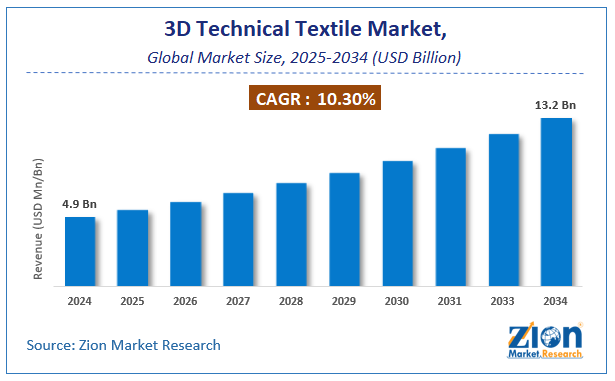
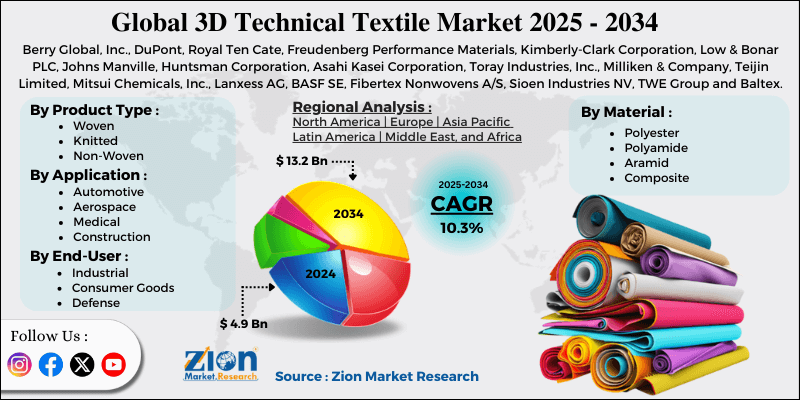
The global 3D technical textile market size was worth around USD 4.9 billion in 2024 and is predicted to grow to around USD 13.2 billion by 2034, with a compound annual growth rate (CAGR) of roughly 10.3% between 2025 and 2034.
Key Insights
- As per the analysis shared by our research analyst, the global 3D Technical Textile market is estimated to grow annually at a CAGR of around 10.3% over the forecast period (2025-2034).
- In terms of revenue, the global 3D Technical Textile market size was valued at around USD 4.9 billion in 2024 and is projected to reach USD 13.2 billion by 2034.
- The growing demand from the end-use sector is expected to drive the 3D Technical Textile market over the forecast period.
- Based on the product type, the woven segment is expected to capture the largest market share over the projected period.
- Based on the application, the automotive segment is expected to capture the largest market share over the projected period.
- Based on the material, the polyester segment is expected to capture the largest market share over the projected period.
- Based on the end-user, the industrial segment is expected to capture the largest market share over the projected period.
- Based on region, the Asia Pacific is expected to dominate the market during the forecast period.
3D Technical Textile Market: Overview
Thick, high-tech materials are called 3D technical textiles. They are not like regular two-dimensional fabrics because they have threads or fibers that run in three planes, all at right angles to each other: warp, weft, and binder. The yarns are arranged in the order X, Y, and Z. These are specialized technical textiles that prioritize functionality over aesthetics. They can be used in composites, aerospace, automotive, and medical applications, including prosthetics, as they exhibit improved mechanical properties, such as greater resistance to delamination, impact resistance, and higher structural strength. They make shapes such as solids, hollows, shells, and nodals by weaving, knitting, braiding, and not-weaving in 3D. These methods often save money on production by minimizing post-processing, such as cutting or stitching, while creating preforms that resemble nets.
3D Technical Textile Market Dynamics
Growth Drivers
How does the rising demand for lightweight & high-performance materials propel the 3D technical textile industry growth?
The 3D technical textile sector is growing as more consumers seek lightweight, high-performance materials. This is because businesses are prioritizing strength, durability, and weight loss. The automotive, aerospace, defense, and sports equipment industries are continually under pressure to make their products safer while simultaneously improving performance, using less fuel, and emitting less pollution. 3D textile technologies manufactured with advanced weaving, knitting, and braiding techniques exhibit better mechanical properties than conventional 2D textiles and materials. For instance, they have higher strength-to-weight ratios, greater impact resistance, and better structural integrity. Their three-dimensional design helps distribute weight more evenly and reduces waste, making them ideal for complex, high-stress applications. The market has taken off as more businesses use 3D textile technology to source materials that meet high-performance standards and to make items lighter.
Restraints
The complex production process is impeding the growth of the market
Complicated production processes make it much harder to grow the 3D textile technology business, as they increase manufacturing complexity, lengthen lead times, and raise costs. To produce 3D technical textiles, complex methods such as 3D weaving, knitting, and braiding are required. These methods need precise control over fiber orientation, layer integration, and structural geometry. Even small changes in production can cause machines to work less well, leading to higher rejection rates and more wasted materials. Also, these procedures require highly skilled operators and costly equipment, making it hard to scale up and mass-produce. The complexity also slows the transition from concept to production, making it harder for manufacturers to quickly adjust to changes in demand. Because of this, excessive production complexity makes things less cost-effective, reduces people's willingness to use them in applications where price is important, and, in the end, slows the growth of the entire sector.
Opportunities
How does the growing product launch offer a potential opportunity for the 3D technical textile industry growth?
The growing number of product launches is expected to create opportunities for the 3D technical textile market over the projected period. For instance, in November 2025, Getzner Textil AG, a world leader in technical textiles, announced the launch of its revolutionary getzspace® three-dimensional weave technology. Getzspace® wants to change how performance and protective gear are made. It will let companies make next-generation technical apparel by eliminating seams in pockets and reinforcing them. The getzspace® method produces new clothes that are more comfortable and last longer, and it also reduces waste from the cut-and-sew process.
Challenges
Why does the high cost of raw material pose a major challenge to the 3D technical textile market expansion?
The high cost of raw materials is a major obstacle to the expansion of the 3D technical textile industry. This is because these textiles primarily employ advanced, high-performance fibers, such as carbon, aramid, and glass fibers, as well as specialized polymer yarns. These materials cost much more than regular textile fibers, and their prices often fluctuate because there aren't many suppliers, the production process consumes a lot of energy, and the global supply chain is constantly changing. The rising costs of raw materials increase production costs, which in turn raise the prices of final products. This makes it harder for people to use, especially in businesses where cost is more important than sophisticated performance and in applications with many users. High material costs also erode producers' profits and make it less likely that new companies will enter the market, slowing capacity development and innovation. Because of this, the need for expensive raw materials makes it hard to sell many products and slows the business's overall expansion.
3D Technical Textile Market: Report Scope
| Report Attributes | Report Details |
|---|---|
| Report Name | 3D Technical Textile Market |
| Market Size in 2024 | USD 4.9 Billion |
| Market Forecast in 2034 | USD 13.2 Billion |
| Growth Rate | CAGR of 10.3% |
| Number of Pages | 260 |
| Key Companies Covered | Berry Global, Inc., DuPont, Royal Ten Cate, Freudenberg Performance Materials, Kimberly-Clark Corporation, Low & Bonar PLC, Johns Manville, Huntsman Corporation, Asahi Kasei Corporation, Toray Industries, Inc., Milliken & Company, Teijin Limited, Mitsui Chemicals, Inc., Lanxess AG, BASF SE, Fibertex Nonwovens A/S, Sioen Industries NV, TWE Group and Baltex, among others. |
| Segments Covered | By Product Type, By Application, By Material, By End-User, and By Region |
| Regions Covered | North America, Europe, Asia Pacific (APAC), Latin America ,The Middle East and Africa (MEA) |
| Base Year | 2024 |
| Historical Year | 2019 - 2023 |
| Forecast Year | 2025 - 2034 |
| Customization Scope | Avail customized purchase options to meet your exact research needs. Request For Customization |
3D Technical Textile Market: Segmentation
Product Type Insights
The woven segment dominates the market, capturing over 35% of the market share. The segment's growth is driven by its outstanding structural performance and its use across many high-value end-use sectors. 3D woven textiles are well-suited for aerospace, automotive, defense, and construction applications because they offer a high strength-to-weight ratio, are stable in size, can withstand heavy loads, and can withstand impacts. As these industries focus on making products lighter, more fuel-efficient, and safer, the need for 3D-woven reinforcements in composite structures such as aviation parts, automotive crash structures, and industrial panels grows.
Application Insights
The automotive segment is expected to hold the largest revenue share over the projected period. The industry's focus on making things lighter, safer, and more fuel-efficient is driving growth. Automakers are under considerable pressure to meet stringent emissions standards and build cars that perform better, which has led to the adoption of strong yet lightweight materials. 3D technical textiles, especially those woven or knitted, are great for applications such as seat construction, airbags, interior panels, crash management systems, and composite-reinforced materials, as they are strong, light, energy-absorbing, and durable.
Material Insights
The polyester segment is expected to capture a substantial market share of more than 38%. The segment's rise is attributed to its advantageous combination of performance, cost efficiency, and widespread availability. Polyester has high tensile strength, dimensional stability, abrasion resistance, and chemical resistance, making it ideal for 3D textile constructions seen in automobile interiors, industrial fabrics, building reinforcements, and protective applications. Polyester is a more cost-effective choice than high-cost fibers like carbon or aramid, encouraging wider adoption in high-volume, price-sensitive applications.
End-User Insights
The industrial segment is expected to dominate the industry over the projected period due to increasing demand for durable, high-strength, and functionally efficient materials across a wide range of industrial applications. 3D technical textiles are widely used in filtration systems, conveyor belts, insulation materials, sealing components, reinforcement structures, and protective industrial fabrics, where mechanical stability and long service life are critical. Their three-dimensional structure provides superior load distribution, abrasion resistance, and structural integrity compared to conventional 2D textiles, driving higher adoption in demanding industrial environments.
3D Technical Textile Market: Regional Analysis
The Asia Pacific is expected to capture the largest market share of more than 38% over the forecast period. The regional revenue growth is driven by rapid industrialization, expanding manufacturing capacity, and the increasing adoption of advanced materials across multiple end-use industries. Countries such as China, India, Japan, South Korea, and Southeast Asian nations are emerging as key contributors due to strong growth in automotive, industrial, construction, aerospace, and healthcare sectors.
Does the automotive sector offer a major opportunity for the Indian 3D Technical Textile market?
India's 3D technical textile market is growing rapidly in the automotive industry due to changes in manufacturing processes, restrictions on materials permitted for use, and the adoption of more advanced materials. India's car sector is increasingly emphasizing lighter, more fuel-efficient cars and compliance with strict environmental rules. 3D technical textiles, such as woven and knitted materials, are well-suited for cars because they are strong relative to their weight, can absorb energy, and can be produced in various configurations. They can be used to make seat frames, interior panels, airbags, crash-absorption components, insulation, and composite reinforcements. The demand for more innovative textile solutions is growing because people want lighter, higher-performance fabrics.
3D Technical Textile Market: Competitive Analysis
The global 3D Technical Textile market is dominated by players like-
- Berry Global
- DuPont
- Royal Ten Cate
- Freudenberg Performance Materials
- Kimberly-Clark Corporation
- Low & Bonar PLC
- Johns Manville
- Huntsman Corporation
- Asahi Kasei Corporation
- Toray Industries
- Milliken & Company
- Teijin Limited
- Mitsui Chemicals
- Lanxess AG
- BASF SE
- Fibertex Nonwovens A/S
- Sioen Industries NV
- TWE Group and Baltex
- among others.
The global 3D Technical Textile market is segmented as follows:
By Product Type
- Woven
- Knitted
- Non-Woven
By Application
- Automotive
- Aerospace
- Medical
- Construction
- Sports
- Others
By Material
- Polyester
- Polyamide
- Aramid
- Composite
- Others
By End-User
- Industrial
- Consumer Goods
- Defense
- Others
By Region
- North America
- The U.S.
- Canada
- Mexico
- Europe
- France
- The UK
- Spain
- Germany
- Italy
- Rest of Europe
- Asia Pacific
- China
- Japan
- India
- Australia
- South Korea
- Rest of Asia Pacific
- The Middle East & Africa
- Saudi Arabia
- UAE
- Egypt
- Kuwait
- South Africa
- Rest of the Middle East & Africa
- Latin America
- Brazil
- Argentina
- Rest of Latin America
Table Of Content
Methodology
FrequentlyAsked Questions
Thick, high-tech materials are called 3D technical textiles. They are not like regular two-dimensional fabrics because they have threads or fibers that run in three planes, all at right angles to each other: warp, weft, and binder.
The growth of the 3D Technical Textile market is primarily driven by increasing demand from end-use industries such as automotive, healthcare, and others.
High manufacturing and capital costs hamper the 3D Technical Textile market.
Based on the material, the polyester segment is expected to dominate the 3D Technical Textile market growth during the projected period.
One of the most significant trends is the advancement in 3D textile manufacturing technologies, such as automated 3D weaving, knitting, and braiding integrated with computer-aided design (CAD) and simulation tools.
According to the report, the global 3D Technical Textile market size was worth around USD 4.9 billion in 2024 and is predicted to grow to around USD 13.2 billion by 2034.
The global 3D Technical Textile market is expected to grow at a CAGR of 10.3% during the forecast period.
The global 3D Technical Textile industry growth is expected to be led by the Asia Pacific over the forecast period.
The global 3D Technical Textile market is dominated by players like Berry Global, Inc., DuPont, Royal Ten Cate, Freudenberg Performance Materials, Kimberly-Clark Corporation, Low & Bonar PLC, Johns Manville, Huntsman Corporation, Asahi Kasei Corporation, Toray Industries, Inc., Milliken & Company, Teijin Limited, Mitsui Chemicals, Inc., Lanxess AG, BASF SE, Fibertex Nonwovens A/S, Sioen Industries NV, TWE Group and Baltex, among others.
The market report covers the geographical market along with a comprehensive competitive landscape analysis. It also includes cash flow analysis, profit ratio analysis, market basket analysis, market attractiveness analysis, sentiment analysis, PESTLE analysis, trend analysis, SWOT analysis, trade area analysis, demand & supply analysis, Porter’s five forces analysis, and value chain analysis.

HappyClients

