
Wireless Power Transmission Market Size, Share, Growth Report 2032

Wireless Power Transmission Market By Technology (Non-Radioactive Techniques And Radioactive Techniques), By Application (Automotive, Consumer Electronics (Wearable Electronics, Mobile Phones, Laptops, And Tablets), Defense, Healthcare, And Automotive), By Transmission Types (As Devices With Battery And Devices Without Battery), By Transmission Range (Long, Short, And Medium Range), By Region - Global And Regional Industry Overview, market Intelligence, Comprehensive Analysis, Historical Data, And Forecasts 2024-2032
| Market Size in 2023 | Market Forecast in 2032 | CAGR (in %) | Base Year |
|---|---|---|---|
| USD 12.26 Billion | USD 21.43 Billion | 6.4% | 2023 |
Description
What is the Market size of the Wireless Power Transmission Industry?
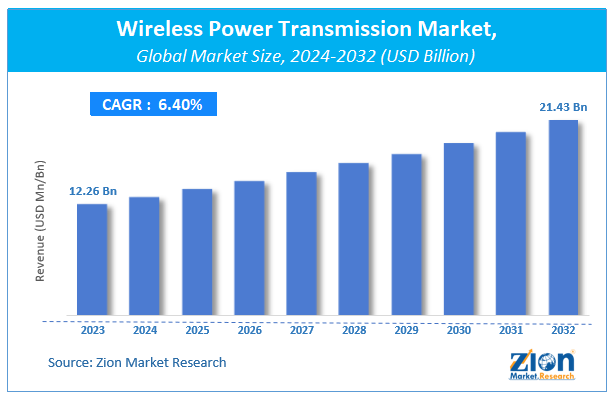
The global wireless power transmission market size was worth around USD 12.26 billion in 2023 and is predicted to grow to around USD 21.43 billion by 2032 with a compound annual growth rate (CAGR) of roughly 6.4% between 2024 and 2032. The study provides historical data from 2018 to 2022 along with a forecast from 2024 to 2032 based on revenue (USD billion). The report covers a forecast and an analysis of the wireless power transmission market on a global and regional level.
Global Wireless Power Transmission Market: Overview
Wireless power transmission is the wireless technology through which power is transmitted from one place to another. In this, electromagnetic energy is transferred from power sources to electric loads. It is widely used mode of transmission for the electrical energy. The main drawback of this mode is that certain amount of energy is lost during transmission. Wireless power transmission is fast and consistent in nature; apart from this, it uses both short and long-range transmissions. However, it requires low maintenance cost. Wireless power transmission is usually used to transfer energy to remote areas. It is extensively used in the consumer electronics goods applications such as smartphones, laptops, and tablets. Whereas, largest application of the wireless power transmission is the solar-power satellites. It is used in robots and fuel-free rockets, fuel-free aircraft, and fuel-free electric automobiles.
Global Wireless Power Transmission Market: Growth Factors
Poor transmission tools are replaced with the latest technology, and wireless power transmission is largely adopted; this is the major driving factor of the global wireless power transmission market. Technological advancements and innovations have opened up new growth opportunities in the global market. Increasing demand for functioned devices may foster the global market growth. Important companies focusing on investing on product development and research & development activities is expected to fuel the global wireless power transmission market growth. Moreover, emerging need for new wireless power transmission applications such as solar-power satellites also boosts the global market growth. However, the high initial cost required for implementation of the wireless power transmission, interference of microwaves with current communication systems and loss of energy during transmission are major challenges faced by global wireless power transmission market.
Key Insights
- As per the analysis shared by our research analyst, the global Wireless Power Transmission Market is estimated to grow annually at a CAGR of around 6.4% over the forecast period (2024-2032).
- In terms of revenue, the global Wireless Power Transmission Market size was valued at around USD 12.26 Billion in 2023 and is projected to reach USD 21.43 Billion by 2032.
- Based on the technology, the Near-Field Technologies these technologies, which include inductive and magnetic resonance methods, dominate the market due to their prevalent use in consumer electronics like smartphones and wearables. Their efficiency and ease of integration make them highly popular among manufacturers.
- Based on the application, the Receiver Applications this segment leads the market, driven by the integration of wireless power receivers in devices such as smartphones, tablets, and wearable electronics, reflecting the growing consumer demand for convenient charging solutions.
- Based on the transmission types, the coupling method this method, encompassing inductive and resonant inductive coupling, holds the largest market share due to its widespread application in charging devices like smartphones and electric vehicles, offering high power transmission efficiency.
- Based on the transmission range, Near-field communication (NFC) technology dominates this segment, extensively used in consumer electronics for short-range wireless power transfer, enhancing user convenience in devices like smartphones and smartwatches.
- Based on the region, Asia-Pacific this region leads the market, supported by a strong consumer electronics manufacturing base in countries like China, Japan, and South Korea, and a growing electric vehicle market, driving the demand for wireless power transmission solutions.
Wireless Power Transmission Market: Dynamics
Key Growth Drivers
The wireless power transmission market is primarily driven by the increasing adoption of wireless charging solutions across consumer electronics, such as smartphones, wearables, and electric vehicles (EVs). The demand for convenience and the elimination of tangled cables have accelerated the adoption of wireless charging technology. Advancements in resonant and inductive charging technologies have improved efficiency, range, and charging speed, further driving market growth. Additionally, the rapid growth of the electric vehicle market and the need for efficient, contactless charging infrastructure are key contributors to the expansion of wireless power transmission solutions. Supportive government regulations and investments in smart city projects also stimulate market growth.
Restraints
Despite its advantages, the wireless power transmission market faces challenges related to high implementation and maintenance costs. The development of wireless charging infrastructure requires significant capital investment, which can be a barrier for widespread adoption. Additionally, energy loss during transmission and lower efficiency compared to traditional wired charging remain concerns. Limited compatibility and interoperability between different devices and charging standards can further restrain market growth. Potential health and safety concerns related to electromagnetic radiation exposure may also hinder the acceptance of wireless power transmission in specific applications.
Opportunities
The growing emphasis on electric vehicles and the development of autonomous transportation systems create significant opportunities for the wireless power transmission market. Wireless EV charging stations, particularly for fleet management and public transportation systems, offer convenience and operational efficiency. Moreover, the increasing adoption of Internet of Things (IoT) devices and smart home technology further expands opportunities for wireless charging applications. Technological advancements in long-range wireless power transfer, using radiofrequency and microwave technologies, present new possibilities in sectors like healthcare, aerospace, and industrial automation. Partnerships and collaborations between technology companies and automotive manufacturers will also unlock new market growth avenues.
Challenges
One of the primary challenges in the wireless power transmission market is the need for standardization. The lack of a unified global standard for wireless charging technologies creates compatibility issues and limits consumer choices. Technical limitations, including reduced charging speeds for larger devices and energy losses over longer distances, present significant hurdles. Additionally, competition from established wired charging infrastructure, which offers higher efficiency and lower costs, remains a challenge. Overcoming public perception regarding the safety of electromagnetic fields and ensuring regulatory compliance further complicates market growth. Addressing these challenges will be crucial for the widespread adoption of wireless power transmission systems.
Wireless Power Transmission Market: Report Scope
| Report Attributes | Report Details |
|---|---|
| Report Name | Wireless Power Transmission Market |
| Market Size in 2023 | USD 12.26 Billion |
| Market Forecast in 2032 | USD 21.43 Billion |
| Growth Rate | CAGR of 6.4% |
| Number of Pages | 214 |
| Key Companies Covered | WiTricity, Qualcomm, ConvenientPower HK, Leggett & Platt, Energizer Holdings, Inc., and Plugless Power. Other players influencing the global market include Powermat Technologies Ltd., Murata Manufacturing Co., Ltd., Integrated Device Technology, Inc., and Texas Instruments |
| Segments Covered | By Technology, By Application, By Transmission Types, By Transmission Range, And By Region |
| Regions Covered | North America, Europe, Asia Pacific (APAC), Latin America, Middle East, and Africa (MEA) |
| Base Year | 2023 |
| Historical Year | 2018 - 2022 |
| Forecast Year | 2024 - 2032 |
| Customization Scope | Avail customized purchase options to meet your exact research needs. Request For Customization |
Global Wireless Power Transmission Market: Segmentation
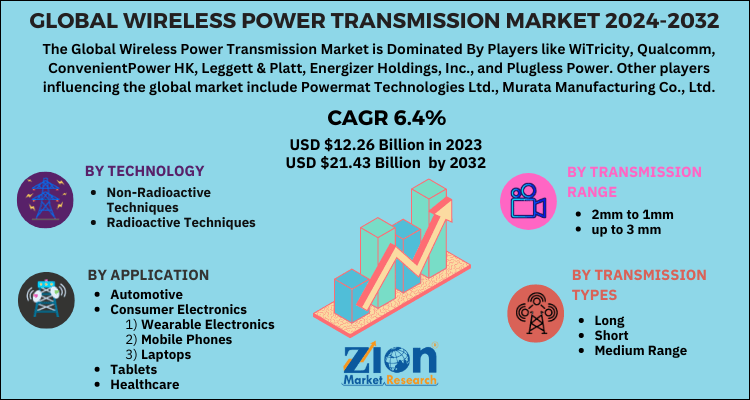
The study provides a decisive view of the Patient Controlled Injectors Market by segmenting the market based on by technology, by application, by transmission types, by transmission range and by region. All the segments have been analyzed based on present and future trends and the market is estimated from 2024 to 2032.
Based on technology, the global wireless power transmission market is divided as non-radioactive techniques and radioactive techniques.
Based on the application, the global market is classified as automotive, consumer electronics, defense, healthcare, and automotive. Consumer electronics is further sub-segmented as wearable electronics, mobile phones, laptops, and tablets.
On the basis of transmission types, the global market is segmented as devices with battery and devices without battery.
Based on transmission range, the global market is categorized as long, short, and medium range.
The regional segment includes the current and forecast demand for North America, Europe, Asia Pacific, Latin America, and the Middle East and Africa.
Global Wireless Power Transmission Market: Regional Analysis
The wireless power transmission market demonstrates varied growth patterns across different regions, influenced by technological advancements, consumer demand, and industry-specific applications.
Asia-Pacific
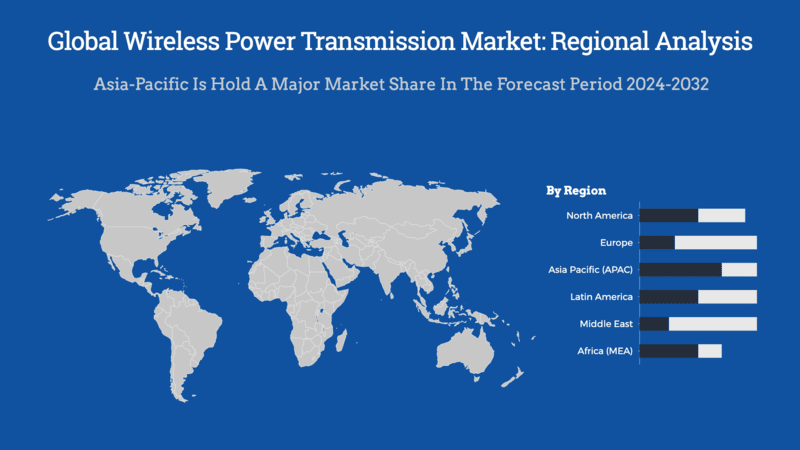
Asia-Pacific leads the global wireless power transmission market, accounting for approximately 35% of the market share in 2023. This dominance is primarily due to the region's robust manufacturing base in countries like China, Japan, and South Korea, which are major producers of consumer electronics and electric vehicles. Rapid urbanization and a growing middle class have further amplified the demand for wireless charging technologies. Government initiatives promoting electric mobility and infrastructure development also contribute significantly to market expansion in this region.
North America
North America holds a substantial share of the wireless power transmission market, driven by a strong presence of key industry players and a culture of technological innovation. The region's early adoption of wireless charging in consumer electronics, electric vehicles, and medical devices fuels market growth. Stringent environmental regulations and supportive policies for clean energy further encourage the development and adoption of wireless power solutions.
Europe
Europe stands as a significant market for wireless power transmission, with increasing adoption of electric vehicles and the presence of major automotive manufacturers integrating wireless charging solutions. Countries such as Germany, the UK, and France are at the forefront, driven by stringent emission regulations and a push towards sustainable energy solutions. The region's focus on innovation and sustainability supports the integration of wireless power technologies across various sectors.
Middle East & Africa
The Middle East and Africa are experiencing growing interest in wireless power transmission, particularly due to increasing investments in renewable energy projects and the need for advanced charging solutions in remote areas. Countries like Saudi Arabia, the UAE, and South Africa are leading this adoption, leveraging wireless power technologies to enhance infrastructure and energy distribution.
Latin America
Latin America is witnessing gradual growth in the wireless power transmission market, driven by the rising adoption of electric vehicles and advancements in consumer electronics. Nations such as Brazil, Mexico, and Argentina are contributing to this trend, supported by governmental initiatives aimed at promoting sustainable technologies and improving energy efficiency.
Global Wireless Power Transmission Market: Competitive Players
Major players operating in the global wireless power transmission market are:
- WiTricity
- Qualcomm
- ConvenientPower HK
- Leggett & Platt
- Energizer Holdings Inc.
- Plugless Power
- Powermat Technologies Ltd.
- Murata Manufacturing Co. Ltd.
- Integrated Device Technology Inc.
- Texas Instruments
The Global Wireless Power Transmission Market is segmented as follows:
By Technology
- Non-Radioactive Techniques
- Radioactive Techniques
By Application
- Automotive
- Consumer Electronics
- Wearable Electronics
- Mobile Phones
- Laptops
- Tablets
- Healthcare
- Automotive
By Transmission Types
- As Devices With Battery
- Devices Without Battery
By Transmission Range
- Long
- Short
- Medium Range
By Region
- North America
- The U.S.
- Canada
- Mexico
- Europe
- France
- The UK
- Spain
- Germany
- Italy
- Rest of Europe
- Asia Pacific
- China
- Japan
- India
- Australia
- South Korea
- Rest of Asia Pacific
- The Middle East & Africa
- Saudi Arabia
- UAE
- Egypt
- Kuwait
- South Africa
- Rest of the Middle East & Africa
- Latin America
- Brazil
- Argentina
- Rest of Latin America
What Report Provides
- Full in-depth analysis of the parent market
- Important changes in market dynamics
- Segmentation details of the market
- Former, on-going, and projected market analysis in terms of volume and value
- Assessment of niche industry developments
- Market share analysis
- Key strategies of major players
- Emerging segments and regional markets
- Testimonials to companies in order to fortify their foothold in the market.
Table Of Content

FrequentlyAsked Questions
Wireless power transmission transfers electrical energy without physical connectors. It is used for charging electronic devices wirelessly.
The global Wireless Power Transmission market is expected to be driven by the Growth is supported by rising adoption of wireless charging in consumer electronics, increasing EV charging innovation, and demand for cable-free industrial IoT power. Advances in resonant and RF technologies accelerate commercialization.
According to study, the global Wireless Power Transmission market size was worth around USD 12.26 Billion in 2023 and is predicted to grow to around USD 21.43 Billion By 2032.
The global Wireless Power Transmission market is expected to grow at a Compound Annual Growth Rate (CAGR) of around CAGR 6.4% during the forecast period from 2024-2032.
The global Wireless Power Transmission industry is projected to be challenged by Challenges include efficiency losses over distance, safety and regulatory constraints, interoperability issues across standards, and high infrastructure costs for deployment.
The Opportunities include growth in EV wireless charging, adoption in consumer electronics, demand for industrial and medical wireless powering, and advances in resonant and RF-based technologies will offer significant growth opportunities in the Wireless Power Transmission market.
Resonant and magnetic-field coupling for room-scale charging; standards-driven interoperability and safety sensing; higher-efficiency power electronics (GaN/SiC) for transmitters are the emerging trends and innovations impacting the Wireless Power Transmission market.
The global Wireless Power Transmission market is expected to be led by APAC during the forecast period.
Some of the prominent players operating in the global Wireless Power Transmission market are; WiTricity, Qualcomm, ConvenientPower HK, Leggett & Platt, Energizer Holdings, Inc., and Plugless Power. Other players influencing the global market include Powermat Technologies Ltd., Murata Manufacturing Co., Ltd., Integrated Device Technology, Inc., and Texas Instruments and others.
The report explores crucial aspects of the Wireless Power Transmission market, including a detailed discussion of existing growth factors and restraints, while also browsing future growth opportunities and challenges that impact the market.
HappyClients

