
Waterborne Epoxy Resins Market Size, Share, Value and Forecast 2034

Waterborne Epoxy Resins Market By Product Type (Solid Epoxy Resins, Liquid Epoxy Resins, Waterborne Epoxy Emulsions, Waterborne Epoxy Hardeners), By Application (Paints and Coatings, Adhesives and Sealants, Flooring Systems, Composites and Structural Applications), By End-User (Construction and Infrastructure Sector, Automotive and Transportation Manufacturers, Marine and Protective Coating Applicators, Electronics and Electrical Industry), By Distribution Channel (Direct Sales to Manufacturers, Chemical Distributors, Specialty Coating Suppliers, Online Chemical Platforms), and By Region - Global and Regional Industry Overview, Market Intelligence, Comprehensive Analysis, Historical Data, and Forecasts 2025 - 2034
| Market Size in 2024 | Market Forecast in 2034 | CAGR (in %) | Base Year |
|---|---|---|---|
| USD 4.98 Billion | USD 8.51 Billion | 6.03% | 2024 |
Waterborne Epoxy Resins Industry Perspective:
What will be the size of the waterborne epoxy resins market during the forecast period?
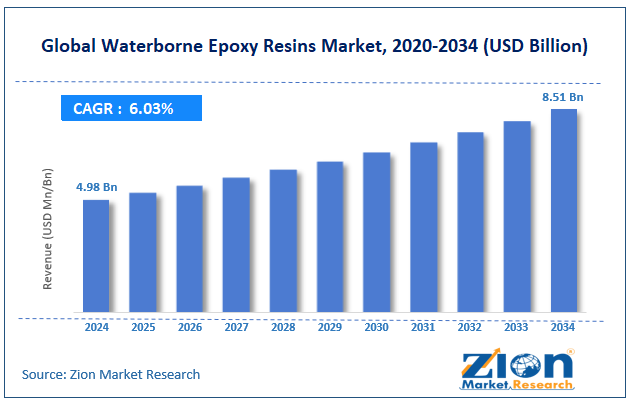
The global waterborne epoxy resins market size was worth approximately USD 4.98 billion in 2024 and is projected to grow to around USD 8.51 billion by 2034, with a compound annual growth rate of roughly 6.03% between 2025 and 2034.
 Request Free SampleRequest Free Sample
Waterborne Epoxy Resins Market: Overview
Waterborne epoxy resins are eco-friendly coating materials that use water instead of harmful solvents, making them safer for the environment and industrial use. These resins release very low levels of volatile organic compounds, helping industries meet strict environmental regulations while maintaining strong performance. Waterborne epoxy resins provide excellent adhesion to surfaces like concrete, steel, and wood, along with strong chemical resistance, durability, and mechanical strength. They are made by mixing epoxy resin particles with water using special processing methods that keep the material stable and easy to apply. These coatings can be used with standard equipment and dry under normal conditions, making them practical for many industries. Common applications include protective coatings for buildings, industrial floors, automotive primers, marine coatings, and adhesives used in construction and electronics. The growing demand for sustainable coatings, reduced environmental impact, and safer working conditions is increasing the use of waterborne epoxy resins across global industrial and commercial markets. Their ability to reduce worker exposure to toxic fumes makes them safer for application in enclosed environments such as factories and warehouses. Longer coating life and lower maintenance needs help industries reduce overall operating costs over time. Wider adoption is also supported by increasing awareness of green building standards and environmentally responsible manufacturing practices.
Key Insights
- As per the analysis shared by our research analyst, the global waterborne epoxy resins market is estimated to grow annually at a compound annual growth rate of around 6.03% over the forecast period from 2025 to 2034.
- In terms of revenue, the global waterborne epoxy resins market size was valued at approximately USD 4.98 billion in 2024 and is projected to reach USD 8.51 billion by 2034.
- The waterborne epoxy resins market is expected to grow steadily, driven by tightening volatile organic compound emission regulations in major markets, accelerating infrastructure construction and renovation activity, growing automotive production in Asia, expanding use of low-emission coatings in the marine sector, and rising consumer and industrial preference for environmentally responsible materials.
- Based on product type, waterborne epoxy emulsions are expected to lead the overall market, while waterborne epoxy hardeners are anticipated to grow steadily as formulators develop more advanced two-component waterborne systems with improved performance characteristics.
- Based on application, the paints and coatings segment is expected to lead the waterborne epoxy resins market, while the flooring systems segment is anticipated to grow rapidly, driven by strong commercial and industrial construction activity in the Asia Pacific and North America.
- Based on end-user, the construction and infrastructure sector is the largest current end-user group, while the electronics and electrical industry is anticipated to grow most rapidly during the forecast period as demand for reliable encapsulants and protective coatings in electronics manufacturing expands.
- Based on distribution channel, direct sales to manufacturers are expected to lead the market, while online chemical platforms are anticipated to grow steadily as digital procurement adoption increases among specialty coating formulators and smaller buyers.
- Based on region, Asia Pacific is projected to dominate the global waterborne epoxy resins market during the estimated period, followed by Europe.
The waterborne epoxy resins market is growing due to stricter emission rules, rising demand for durable coatings, and increasing shift toward sustainable, low-solvent alternatives.
Impact of the USA-Israel War on Iran on the Waterborne Epoxy Resins Market
Geopolitical tensions involving the United States, Israel, and Iran may affect petrochemical supply chains, increasing costs of key epoxy raw materials in the short term. Some disruptions in Middle East trade could tighten the supply of chemical intermediates, creating temporary pricing pressure for manufacturers across the global coating industries. However, strong demand from environmental regulations and infrastructure growth is expected to support long-term stability, helping the waterborne epoxy resins market continue growing despite short-term challenges.
Waterborne Epoxy Resins Market: Technology Roadmap 2025–2034
What is the projected development roadmap of the waterborne epoxy resins market over the forecast period?
The waterborne epoxy resins market is advancing through better emulsification, low-temperature curing systems, nano-additives for durability, and bio-based materials, reducing petrochemical dependence. The market is expected to grow at a compound annual growth rate of around 6.03% over the forecast period, driven by steady demand from construction and protective coating applications and accelerating regulatory-driven displacement of solvent-based alternatives.
The following roadmap outlines key development phases expected through 2034.
2025–2027: Performance Parity and Application Expansion Phase
- Resin makers are expected to improve waterborne epoxy performance, matching solvent-based coatings in durability, gloss, moisture resistance, and faster drying under real application conditions.
- New two-component waterborne epoxy systems are expected to offer longer working time and better mixing with pigments and additives for industrial coating use.
- Digital tools for color matching and coating design are expected to help companies develop products faster and reduce testing time.
2028–2031: Bio-Based Feedstocks and Circular Material Development Phase
- Producers are expected to use more plant-based raw materials to lower environmental impact and meet sustainability goals set by global buyers.
- Regional production in countries such as India, Brazil, and Southeast Asia is expected to grow as demand rises and companies reduce their import dependence.
- Standard certification systems are expected to help companies prove environmental performance and build trust with construction and industrial customers.
2032–2034: Smart Coatings and Advanced Functionality Phase
- Smart waterborne epoxy coatings are expected to detect damage or repair themselves, helping extend coating life and reduce maintenance costs.
- Fully bio-based coatings are expected to gain acceptance in niche markets as demand for sustainable and circular materials increases globally.
- Artificial intelligence tools are expected to help design better coatings faster, making customized solutions easier and more affordable for manufacturers.
Waterborne Epoxy Resins Market: Dynamics
Growth Drivers
What is driving growth in the waterborne epoxy resins market as regulations tighten and infrastructure demand rises?
The waterborne epoxy resins market is growing steadily due to stricter environmental rules and rising demand for long-lasting protective coatings across industries worldwide. Governments in regions such as the European Union, the United States, and China are imposing lower limits on volatile organic compound emissions, prompting industries to shift from solvent-based coatings to safer waterborne alternatives. Waterborne epoxy resins offer strong adhesion, chemical resistance, and durability, making them suitable for demanding industrial and construction uses. At the same time, large-scale infrastructure development is increasing the demand for protective coatings. Projects such as bridges, roads, tunnels, water treatment plants, and industrial buildings require materials that can withstand corrosion and harsh environments for extended periods. Countries in Asia, the Middle East, and Latin America are investing heavily in new construction, while older infrastructure in developed regions is being repaired and upgraded. Waterborne epoxy coatings are preferred because they provide strong protection with lower environmental impact. The growing focus on safety, sustainability, and long-term performance is driving consistent demand for waterborne epoxy resins globally.
Industrial efficiency gains and evolving end-user preferences are further strengthening the growth of the waterborne epoxy resins market.
The waterborne epoxy resins industry is growing as companies and builders increasingly prefer safer, eco-friendly materials that offer strong performance and cost efficiency. Large industries such as automotive, aerospace, and construction are setting internal goals to reduce the use of harmful chemicals in their processes, thereby increasing demand for water-based coating solutions. Waterborne epoxy resins help meet these goals while still offering durability, adhesion, and protection. Many companies are also choosing suppliers that follow environmental standards, making sustainability an important factor in purchasing decisions. The fast-growing electronics industry, especially in Asia, is creating new demand for waterborne epoxy materials used in circuit boards and electronic components. These materials provide protection and insulation while meeting strict worker safety requirements. Increasing awareness about environmental safety, along with the need for high-performance coatings, is supporting long-term demand for waterborne epoxy resins across global industrial and commercial sectors.
Restraints
Performance limitations and raw material cost sensitivity are key challenges in the waterborne epoxy resins market.
The waterborne epoxy resins market faces several restraints, including performance limitations and fluctuating raw material costs, which affect overall adoption across industries. In some demanding applications, waterborne coatings can be sensitive to humidity and temperature during drying, which may impact final strength and finish quality. Compared to solvent-based systems, they may sometimes offer slightly lower hardness or chemical resistance, leading some users to prefer traditional coatings for critical uses. Price volatility of key raw materials, such as Bisphenol A and Epichlorohydrin, also poses challenges for manufacturers. These materials are linked to petrochemical markets, which can drive cost changes based on oil prices and supply conditions. Rising input costs can increase product prices, making waterborne options less attractive in price-sensitive regions. These factors, together, slow the pace of market growth despite the strong environmental and performance advantages offered by waterborne epoxy resins.
Opportunities
How are green building, marine regulations, and emerging market construction driving opportunities in the waterborne epoxy resins market?
The waterborne epoxy resins market is creating strong opportunities due to growing demand for eco-friendly construction, marine coatings, and infrastructure development across global regions. Green building standards such as LEED, BREEAM, and WELL Building Standard are encouraging the use of low-emission coatings, increasing demand for waterborne epoxy materials that improve indoor air quality. The marine industry is also opening new opportunities as shipbuilders seek coatings that meet strict environmental and durability requirements set by the International Maritime Organization. Waterborne epoxy coatings are gaining interest for protecting ships while reducing environmental impact during application. Rapid construction growth across regions such as Southeast Asia, South Asia, and Sub-Saharan Africa is driving demand for protective coatings for concrete and steel structures. Expanding local production, competitive pricing, and better awareness among contractors can help companies capture new demand. These factors are creating long-term growth opportunities for the global waterborne epoxy resins market.
Challenges
What challenges does the waterborne epoxy resins market face in application complexity and sustaining innovation amid competition?
The waterborne epoxy resins market faces challenges related to application difficulty and increasing competition among manufacturers across global industries. These coatings require careful surface preparation and proper control of humidity and temperature during use, making application more sensitive compared to solvent-based coatings. Poor application practices or a lack of skilled workers can lead to coating failure, affecting performance and reducing trust among users and contractors. Training and technical knowledge are essential to ensure correct use and long-lasting results.
At the same time, the market includes both large global chemical companies and smaller regional producers competing on price and performance. Smaller players often struggle to invest in advanced product development, while larger companies face pressure to maintain margins amid competition. Continuous investment in innovation, product quality, and technical support is necessary to stay competitive. These challenges can slow adoption and require strong expertise and resources to overcome in the waterborne epoxy resins market.
 Request Free SampleRequest Free Sample
Waterborne Epoxy Resins Market: Report Scope
| Report Attributes | Report Details |
|---|---|
| Report Name | Waterborne Epoxy Resins Market |
| Market Size in 2024 | USD 4.98 Billion |
| Market Forecast in 2034 | USD 8.51 Billion |
| Growth Rate | CAGR of 6.03% |
| Number of Pages | 229 |
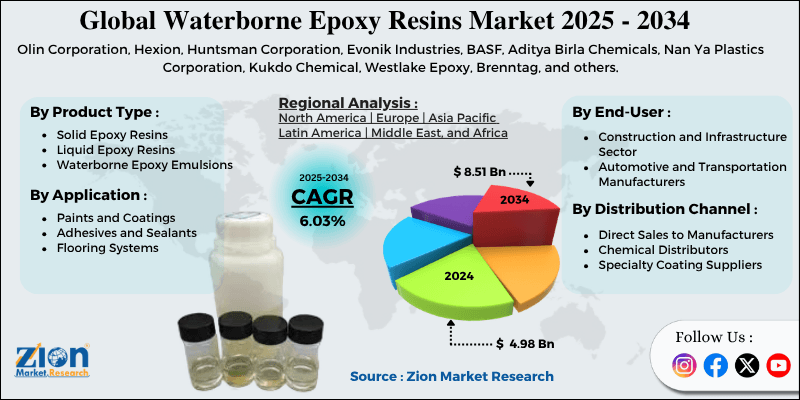
| Key Companies Covered | Olin Corporation, Hexion, Huntsman Corporation, Evonik Industries, BASF, Aditya Birla Chemicals, Nan Ya Plastics Corporation, Kukdo Chemical, Westlake Epoxy, Brenntag, and others. |
| Segments Covered | By Product Type, By Application, By End-User, By Distribution Channel, and By Region |
| Regions Covered | North America, Europe, Asia Pacific (APAC), Latin America, Middle East, and Africa (MEA) |
| Base Year | 2024 |
| Historical Year | 2019 - 2023 |
| Forecast Year | 2025 - 2034 |
| Customization Scope | Avail customized purchase options to meet your exact research needs. Request For Customization |
Waterborne Epoxy Resins Market: Segmentation
The global waterborne epoxy resins market is segmented by product type, application, end-user, distribution channel, and region.
What makes waterborne epoxy emulsions the expected leader in the waterborne epoxy resins market?
Based on product type, the global waterborne epoxy resins market is divided into solid epoxy resins, liquid epoxy resins, waterborne epoxy emulsions, and waterborne epoxy hardeners. Waterborne epoxy emulsions hold about 48% of the market share, leading due to their versatility, ease of application, and wide industry use. Waterborne epoxy hardeners hold around 20% share. It is among the fastest-growing segments, driven by the development of more sophisticated two-component waterborne systems that deliver enhanced performance for demanding industrial applications.
How does the paints and coatings application segment maintain its leading position in the waterborne epoxy resins market?
Based on application, the waterborne epoxy resins market is categorized into paints and coatings, adhesives and sealants, flooring systems, and composites and structural applications. The paints and coatings segment accounts for approximately 55% of the global waterborne epoxy resins market share, reflecting the widespread use of epoxy-based protective and decorative coatings across construction, industrial, marine, and automotive applications. The flooring systems segment holds around 18% share. It is growing rapidly due to demand for durable, chemical-resistant, easy-to-clean floor coatings in industrial and commercial spaces.
What makes the construction and infrastructure sector the leading end-user of waterborne epoxy resins?
Based on end-user, the market is classified into construction and infrastructure, automotive and transportation manufacturers, marine and protective coating applicators, and the electronics and electrical industry. The construction and infrastructure sector leads with about 45% share, driven by high demand for coatings, adhesives, and flooring in global projects. The electronics and electrical industry holds around 15% share. It is growing most rapidly as demand for reliable, low-emission encapsulants, and printed circuit board coatings expands with global electronics production growth.
How do direct sales to manufacturers dominate the distribution landscape of the waterborne epoxy resins market?
Based on distribution channel, the waterborne epoxy resins industry is segregated into direct sales to manufacturers, chemical distributors, specialty coating suppliers, and online chemical platforms. Direct sales to manufacturers account for about 42% of the market and lead, as buyers prefer reliable supply, support, and better pricing. Online chemical platforms hold around 7% share. They are growing as smaller formulators and regional buyers increasingly use digital channels to source waterborne epoxy products and compare technical specifications efficiently.
Waterborne Epoxy Resins Market: Regional Analysis
How is Asia Pacific shaping global demand for waterborne epoxy resins?
The waterborne epoxy resins market is led by Asia Pacific and is expected to grow steadily at a CAGR of around 6.2% during the forecast period. Strong growth is driven by large construction projects, rapid industrial expansion, and rising demand for eco-friendly coatings across the region. China plays a major role as the largest producer and user of epoxy resins, supported by strict environmental rules that limit solvent-based coatings in cities and industrial zones. India is also growing quickly, driven by infrastructure projects, expanding automotive production, and increasing use of modern coating technologies in construction.
Countries across Southeast Asia, including Vietnam, Thailand, Indonesia, and Malaysia, are seeing rising demand as manufacturing and urban development continue to expand. Growth in electronics production across South Korea and Taiwan is also increasing the use of waterborne epoxy materials for coatings and protective applications. Governments are promoting cleaner technologies, encouraging industries to shift toward low-emission solutions. Rising awareness of sustainability, combined with rapid urbanization and industrial growth, is driving strong, steady demand. Expanding production capacity and improving supply chains further support market growth. Asia Pacific remains the key growth engine for the waterborne epoxy resins market, supported by innovation, scale, and increasing environmental responsibility.
How does Europe maintain its strong position in the waterborne epoxy resins market?
The waterborne epoxy resins market sees Europe as the second-largest region and is expected to grow at a CAGR of around 5.4% during the forecast period. Growth is driven by strict environmental rules that limit volatile organic compound emissions and encourage the use of safer coating solutions. Countries across Europe have well-developed coatings industries that focus on quality, durability, and sustainability. Germany leads the region due to its strong automotive and industrial manufacturing base, where high-performance coatings are essential. The United Kingdom, France, and the Netherlands also contribute significantly through construction repair projects, industrial maintenance work, and marine applications. Nordic countries are supporting demand through sustainable building practices and advanced infrastructure systems. Aging buildings and transport networks across Western and Northern Europe require regular repair and protective coatings, increasing demand for durable materials. Strict regulations continue to push companies to replace solvent-based coatings with waterborne alternatives. Strong awareness of environmental safety and green building standards is encouraging adoption across industries. Continuous innovation in coating technology and strong collaboration between manufacturers and end users are helping expand the range of applications.
Recent Market Developments
- In March 2026, Hexion Inc. continued its strategic development of epoxy resins and curing technologies, focusing on low-emission, high-performance systems to meet evolving regulatory and industrial coating requirements.
Waterborne Epoxy Resins Market: Competitive Analysis
The leading players in the global waterborne epoxy resins market are:
- Olin Corporation
- Hexion
- Huntsman Corporation
- Evonik Industries
- BASF
- Aditya Birla Chemicals
- Nan Ya Plastics Corporation
- Kukdo Chemical
- Westlake Epoxy
- Brenntag
The global waterborne epoxy resins market is segmented as follows:
By Product Type
- Solid Epoxy Resins
- Liquid Epoxy Resins
- Waterborne Epoxy Emulsions
- Waterborne Epoxy Hardeners
By Application
- Paints and Coatings
- Adhesives and Sealants
- Flooring Systems
- Composites and Structural Applications
By End-User
- Construction and Infrastructure Sector
- Automotive and Transportation Manufacturers
- Marine and Protective Coating Applicators
- Electronics and Electrical Industry
By Distribution Channel
- Direct Sales to Manufacturers
- Chemical Distributors
- Specialty Coating Suppliers
- Online Chemical Platforms
By Region
- North America
- The U.S.
- Canada
- Mexico
- Europe
- France
- The UK
- Spain
- Germany
- Italy
- Rest of Europe
- Asia Pacific
- China
- Japan
- India
- Australia
- South Korea
- Rest of Asia Pacific
- The Middle East & Africa
- Saudi Arabia
- UAE
- Egypt
- Kuwait
- South Africa
- Rest of the Middle East & Africa
- Latin America
- Brazil
- Argentina
- Rest of Latin America
Table Of Content
Methodology
FrequentlyAsked Questions
Waterborne epoxy resins are eco-friendly coating materials that use water instead of harmful solvents, making them safer for the environment and industrial use. These resins release very low levels of volatile organic compounds, helping industries meet strict environmental regulations while maintaining strong performance.
The global waterborne epoxy resins market is expected to grow, driven by increasingly strict volatile organic compound emission regulations in major industrial economies, accelerating construction and infrastructure investment in developing regions, growing automotive and electronics manufacturing activity in the Asia Pacific, rising adoption of green building certification programs, and the progressive displacement of solvent-borne coating systems across all major application segments.
According to research, the global waterborne epoxy resins market size was worth around USD 4.98 billion in 2024 and is predicted to grow to around USD 8.51 billion by 2034.
The compound annual growth rate value of the waterborne epoxy resins market is expected to be around 6.03% during 2025 to 2034.
Asia Pacific is expected to lead the global waterborne epoxy resins market during the forecast period, driven by the enormous construction and manufacturing sectors of China and India, rapidly expanding electronics production across the broader region, and progressive tightening of environmental regulations in major Asian economies, which is accelerating the replacement of solvent-based coatings with waterborne alternatives.
The major players in the global waterborne epoxy resins market include Olin Corporation, Hexion, Huntsman Corporation, Evonik Industries, BASF, Aditya Birla Chemicals, Nan Ya Plastics Corporation, Kukdo Chemical, Westlake Epoxy, and Brenntag.
The report examines key aspects of the waterborne epoxy resins market, including growth drivers, restraints, emerging opportunities, challenges, a competitive landscape analysis, regional breakdowns, and a detailed future outlook across all major product types, applications, end users, and geographies.
The waterborne epoxy resins market is shifting toward low-VOC, eco-friendly coatings, with growing preference for sustainable materials, improved indoor air quality, and high-performance solutions across construction, automotive, and industrial applications worldwide.
The waterborne epoxy resins market will grow in construction coatings, industrial flooring, automotive coatings, marine protection, and electronics, driven by durability, environmental compliance, and rising global infrastructure and manufacturing demand.
The waterborne epoxy resins market is advancing through bio-based resins, nano-additives for durability, low-temperature curing systems, and smart coatings, alongside digital formulation tools improving efficiency, performance, and sustainability across industrial and commercial coating applications.

HappyClients

