
Global Water Softening Systems Market Size, Share, Trends, Growth 2032

Water Softening Systems Market By Type (Salt-Based Ion Exchange Software, Salt-Free Water Softener), By Flow Rate (05GPM to 30 GPM, 30GPM to 60GPM, 60GPM to 90GPM, Above 90GPM), By Application (Residential, Commercial, Industrial), By Distribution Channel (Online, Offline), and By Region - Global and Regional Industry Overview, Market Intelligence, Comprehensive Analysis, Historical Data, and Forecasts 2024 - 2032
| Market Size in 2023 | Market Forecast in 2032 | CAGR (in %) | Base Year |
|---|---|---|---|
| USD 2.86 Billion | USD 5.09 Billion | 6.6% | 2023 |
Water Softening Systems Industry Perspective
What will be the global water softening systems market size during the forecast period?
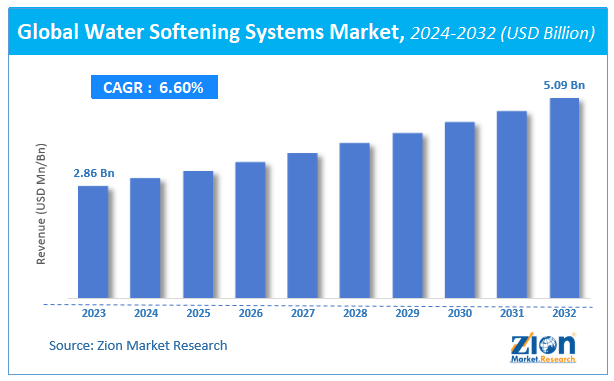
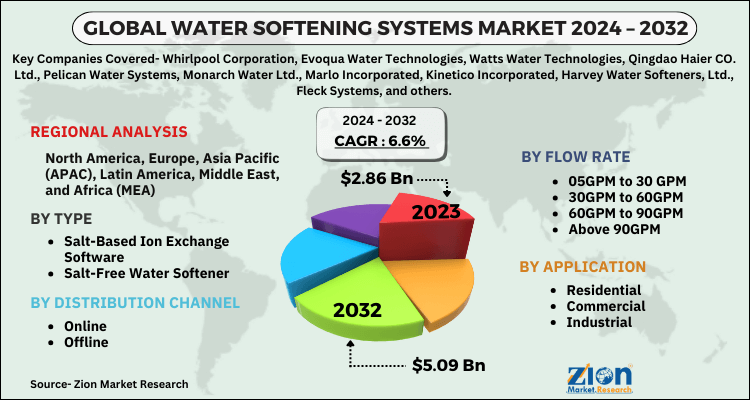
The global water softening systems market size was worth around USD 2.86 billion in 2023 and is predicted to reach around USD 5.09 billion by 2032, with a compound annual growth rate (CAGR) of roughly 6.6% between 2024 and 2032.
This report provides a comprehensive analysis of the growth drivers, restraints, and challenges shaping demand across the global water softening systems market throughout the forecast period, while highlighting high-potential emerging opportunities within the industry.
 Request Free Sample
Key Insights
- As per the analysis shared by our research analyst, the global water softening systems market is estimated to grow annually at a CAGR of around 6.6% over the forecast period (2024-2032).
- In terms of revenue, the global water softening systems market size was valued at around USD 2.86 billion in 2023 and is projected to reach USD 5.09 billion by 2032.
- The water softening systems market is driven by increasing demand for ultra-pure water in residential and commercial sectors, along with growing awareness of the problems associated with hard water.
- By type, salt-based ion exchange systems dominated the market because of their high efficiency in reducing scale formation in boilers, pipes, and tanks, along with their cost-effectiveness and easy availability.
- By flow rate segment, the 05GPM to 30 GPM range held a leading position because it suits typical residential and light commercial installations that process moderate water volumes.
- By application segment, the residential category accounted for the largest share because of the expanding residential sector and rising installations of water softener systems in homes and serviced apartments.
- By distribution channel, the offline channel remained dominant, as consumers continue to prefer professional installation guidance, in-person demonstrations, and after-sales support available through traditional retail and dealer networks.
- North America held a substantial share of the global water softening systems market, driven by the prevalence of hard water and the fact that more than half of North American households live in hard-water regions.
Water Softening Systems Market: Overview
Water softening is the process of removing hard metals such as magnesium, calcium, and other certain metal cations in hard water. The water softening system is used to eliminate or soften hard water by removing hard minerals, which are present in normal water. Soft water not only minimizes the need for extra detergents and soaps that are required for cleaning and laundry purposes, but also plays a role in extending the life of appliances such as washing machines, dishwashers, and water heaters. Increasing demand for ultra-pure water for residential and commercial sectors is driving the market growth.
Water Softening Systems Market: Growth Drivers
What factors are primarily accelerating demand in the water softening systems market?
Increasing demand for ultra-pure water in both residential and commercial sectors is a core growth driver. Soft water reduces detergent consumption, protects plumbing and appliances from scale accumulation, and improves overall cleaning effectiveness, making these systems attractive to households and businesses alike.
Growing awareness of the practical and aesthetic problems caused by hard water further supports market expansion. Concerns related to appliance longevity, soap efficiency, and personal care effects encourage consumers and facility managers to invest in reliable softening solutions that deliver measurable long-term benefits.
Water Softening Systems Market: Restraints
What factors are limiting the expansion of the water softening systems market?
Low market penetration in rural areas continues to restrain overall growth potential. Limited awareness, restricted access to specialized dealers, and infrastructure constraints in less urbanized regions slow the adoption of water softening systems outside major population centers.
Additional cost considerations and the need for regular maintenance or salt replenishment in certain system types can deter price-sensitive buyers, particularly in markets where alternative water treatment options are perceived as more convenient or economical.
Water Softening Systems Market: Report Scope
| Report Attributes | Report Details |
|---|---|
| Report Name | Water Softening Systems Market |
| Market Size in 2023 | USD 2.86 Billion |
| Market Forecast in 2032 | USD 5.09 Billion |
| Growth Rate | CAGR of 6.6% |
| Number of Pages | 245 |
| Key Companies Covered | Whirlpool Corporation, Evoqua Water Technologies, Watts Water Technologies, Qingdao Haier CO. Ltd., Pelican Water Systems, Monarch Water Ltd., Marlo Incorporated, Kinetico Incorporated, Harvey Water Softeners, Ltd., Fleck Systems, and others |
| Segments Covered | By Type, By Flow Rate, By Application, By Distribution Channel, and By Region |
| Regions Covered | North America, Europe, Asia Pacific (APAC), Latin America, Middle East, and Africa (MEA) |
| Base Year | 2023 |
| Historical Year | 2018 - 2022 |
| Forecast Year | 2024 - 2032 |
| Customization Scope | Avail customized purchase options to meet your exact research needs. Request For Customization |
Water Softening Systems Market: Segmentation
The water softening systems market is segmented by type, flow rate, application, distribution channel, and region. All the segments of the water softening systems market have been analyzed based on present and future trends and the market is estimated from 2024 to 2032.
Based on the type, the global water softening systems market has been classified into salt-based ion-exchange software and salt-free water softener. Salt-based ion exchange systems hold the dominant position because of their proven high efficiency in decreasing scale formation in boilers, pipes, and tanks. Their relatively lower cost and widespread availability further reinforce leadership and drive overall market volume by meeting the performance expectations of the majority of residential and commercial users. Salt-free water softeners represent the second major category and contribute to market development by appealing to buyers seeking alternatives that avoid salt addition and brine discharge, thereby supporting product diversification and addressing specific environmental or health-related preferences.
By flow rate segment, the water softening systems market is divided into 05GPM to 30 GPM, 30GPM to 60GPM, 60GPM to 90GPM, and above 90GPM. Systems in the 05GPM to 30 GPM range currently lead because they suit standard residential applications and light commercial settings where moderate water volumes are processed daily. This dominance supports broad market accessibility and encourages volume sales through mainstream retail and dealer channels. Mid-range capacities such as 30GPM to 60GPM follow closely and help expand the market by serving larger households and smaller commercial facilities that require greater throughput without moving into industrial-scale equipment.
By application segment, the water softening systems market is divided into residential, commercial, and industrial. The residential segment accounts for the largest share, driven by the expanding residential sector and the increasing installation of water softener systems in homes and service apartments. This leadership generates consistent demand and stimulates continuous product refinement focused on ease of use, compact design, and household appliance protection. The commercial segment ranks second and contributes to growth by addressing the needs of offices, hotels, and institutional facilities that require reliable water quality for operational efficiency and guest satisfaction.
Based on distribution channel segment, the water softening systems market is divided into online and offline. The offline channel maintains the leading position because consumers often prefer professional consultation, installation support, and after-sales service available through dealers, specialty retailers, and authorized service networks. This dominance underpins market stability and enables effective product demonstration and trust-building. The online channel forms the second key route and accelerates market reach by offering convenience, broader product comparison, and access for customers in areas with limited physical retail presence.
Water Softening Systems Market: Regional Analysis
Why will North America continue to dominate the global market during the projection period?
North America remains a primary hub for the water softening systems market because a substantial portion of households experience hard water conditions, with more than half of the regional population residing in hard-water areas. This widespread prevalence creates sustained demand for residential and commercial softening solutions that protect plumbing, appliances, and cleaning efficiency. Manufacturers have responded by locating or expanding production facilities within the region to better serve local needs and reduce lead times. The combination of high hard-water incidence, established distribution networks, and consumer awareness drives consistent volume and encourages ongoing product innovation tailored to regional water profiles. This regional strength supports overall market growth by setting performance standards, stimulating competitive advancements in efficiency and convenience, and providing a stable base for global manufacturers seeking reliable returns.
Recent Developments
- In June 2025, Watts Water Technologies acquired EasyWater, enhancing its portfolio with chemical-free and salt-free treatment options that align with evolving regulatory and environmental preferences.
- In April 2026, Kinetico Incorporated launched its first worldwide brand campaign centered on the tagline “Perfecting Water. Protecting Life,” reinforcing its positioning in residential and commercial water treatment.
Water Softening Systems Market: Competitive Landscape
The global water softening systems market is led by players like
- Whirlpool Corporation
- Evoqua Water Technologies
- Watts Water Technologies
- Qingdao Haier CO. Ltd
- Pelican Water Systems
- Monarch Water Ltd
- Marlo Incorporated
- Kinetico Incorporated
- Harvey Water Softeners, Ltd
- Fleck Systems
Segments Covered
The global water softening systems market is segmented as follows:
By Type
- Salt-Based Ion Exchange Software
- Salt-Free Water Softener
By Flow Rate
- 05GPM to 30 GPM
- 30GPM to 60GPM
- 60GPM to 90GPM
- Above 90GPM
By Application
- Residential
- Commercial
- Industrial
By Distribution Channel
- Online
- Offline
By Region
- North America
- The U.S.
- Canada
- Mexico
- Europe
- France
- The UK
- Spain
- Germany
- Italy
- Rest of Europe
- Asia Pacific
- China
- Japan
- India
- Australia
- South Korea
- Rest of Asia Pacific
- The Middle East & Africa
- Saudi Arabia
- UAE
- Egypt
- Kuwait
- South Africa
- Rest of the Middle East & Africa
- Latin America
- Brazil
- Argentina
- Rest of Latin America
Table Of Content
Methodology
FrequentlyAsked Questions
Water softening systems are intended to eliminate minerals that contribute to hardness, particularly calcium and magnesium. Hard water can result in the accumulation of scale in pipelines and appliances, a decrease in the efficacy of soap and detergents, and other complications. By replacing the hardness minerals with sodium or potassium ions, water softeners assist in the mitigation of these issues.
The demand for water softening systems is being driven by the growing awareness of the issues associated with hard water, including the reduction of appliance efficacy and the accumulation of scale. Market growth is influenced by concerns regarding the potential effects of hard water on health and safety, including the effects on hair and epidermis.
The global water softening systems market size was worth around USD 2.86 billion in 2023 and is predicted to grow to around USD 5.09 billion by 2032.
The global water softening systems market a compound annual growth rate (CAGR) of roughly 6.6% between 2024 and 2032.
North America has accounted for substantial market growth over the years. North America is a geographical hub for hard water. More than half of North American households live in hard-water areas. As a result, some manufacturers are shifting their manufacturing facilities to these regions to meet demand for water-softening systems.
The global water softening systems market is highly associated with major players including Whirlpool Corporation, Evoqua Water Technologies, Watts Water Technologies, Qingdao Haier CO. Ltd., Pelican Water Systems, Monarch Water Ltd., Marlo Incorporated, Kinetico Incorporated, Harvey Water Softeners, Ltd., Fleck Systems, and others.
The report provides comprehensive analysis of market size, growth drivers, restraints, opportunities, segmentation by type, flow rate, application and distribution channel, regional dynamics, competitive landscape, recent developments, and future outlook for the period 2024-2032, supporting informed strategic decision-making.

HappyClients

