
Global Warehouse Order Picking Market Size, Share, Growth Analysis Report - Forecast 2034

Warehouse Order Picking Market By Deployment (Cloud and On-premises), By Picking Method (Batch Picking, Single Order Picking, Zone Picking, Wave Picking, and Multi-Order Picking), By Equipment Type (Automated Guided Vehicles, Pick-to-Light Systems, Voice Picking Systems, Mobile Devices, and Robotic Picking Systems), By Technology (RFID Technology, Barcode Scanning, Artificial Intelligence, Machine Learning, and Augmented Reality), By End-use Sector (E-commerce, Retail, Manufacturing, Pharmaceutical, and Food and Beverage), and By Region: Global and Regional Industry Overview, Market Intelligence, Comprehensive Analysis, Historical Data, and Forecasts 2025 - 2034
| Market Size in 2024 | Market Forecast in 2034 | CAGR (in %) | Base Year |
|---|---|---|---|
| USD 9.03 Billion | USD 23.48 Billion | 10.03% | 2024 |
Warehouse Order Picking Market: Industry Size
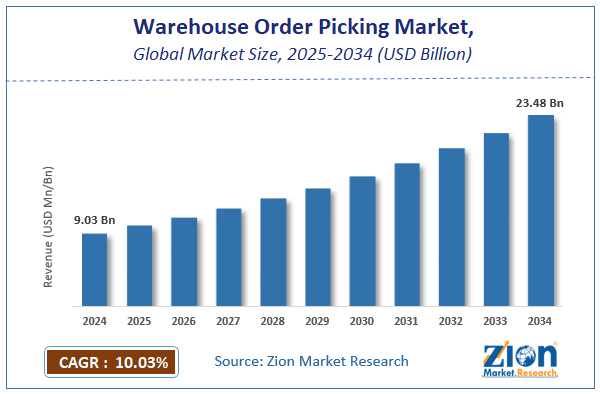
The global warehouse order picking market size was worth around USD 9.03 billion in 2024 and is predicted to grow to around USD 23.48 billion by 2034 with a compound annual growth rate (CAGR) of roughly 10.03% between 2025 and 2034. The report analyzes the drivers, restraints/challenges, and their effects on demand in the global warehouse order-picking market during the projection period. In addition, the report explores emerging opportunities in the warehouse order picking industry.
Warehouse Order Picking Market: Overview
The warehouse order picking industry deals with businesses that provide solutions or services to their clients concerning efficient packaging and picking of products stored in distribution centers or warehouses. The process of selecting the right items from a warehouse inventory to deliver to customers is known as order picking.
The industry includes a variety of products and services such as order-picking software, automated picking systems, inventory management systems, and material handling equipment. The products and services provided with warehouse order picking systems are used in several sectors including retail, e-commerce, food & beverage, pharmaceuticals, and more. During the forecast period, the industry is expected to register a high growth rate as the demand for efficient warehouse order-picking systems is on the rise.
Key Insights
- As per the analysis shared by our research analyst, the global warehouse order picking market is estimated to grow annually at a CAGR of around 10.03% over the forecast period (2025-2034).
- Regarding revenue, the global warehouse order picking market size was valued at around USD 9.03 billion in 2024 and is projected to reach USD 23.48 billion by 2034.
- The warehouse order picking market is projected to grow at a significant rate due to Growth in e-commerce and the need for faster, more accurate fulfillment, driving demand for advanced picking solutions. Automation and robotics integration further support market growth.
- Based on Deployment, the Cloud segment is expected to lead the global market with a share of approximately 58% in 2024, owing to its superior scalability, real-time data access, vendor-managed updates, and ability to adjust resource consumption according to business needs without heavy upfront infrastructure investment.
- On the basis of Picking Method, the Batch Picking segment is growing at a high rate and will continue to dominate the global market driven by its efficiency in selecting multiple orders simultaneously before sorting, which significantly improves throughput and reduces travel time in high-volume warehouse environments.
- Based on the Equipment Type, the Automated Guided Vehicles segment is projected to capture the largest market share because AGVs enhance picking speed, accuracy, and labor productivity while integrating seamlessly with modern warehouse management systems.
- By Technology, the RFID Technology segment is expected to dominate the global market due to its ability to enable real-time tracking, reduce errors, and support high-speed inventory identification compared to traditional methods.
- In terms of End-use Sector, the E-commerce segment is anticipated to command the largest market share, fueled by explosive order volumes, same-day delivery expectations, and the continuous need for highly accurate and rapid fulfillment processes.
- Based on region, North America is predicted to dominate the global market during the forecast period primarily due to early adoption of advanced automation technologies, presence of major e-commerce players, strong innovation activity, and a well-established consumer base for sophisticated warehouse systems.
Warehouse Order Picking Market: Growth Drivers
Rising application in the e-commerce segment to propel market growth
The global warehouse order picking market is projected to witness a high growth rate owing to the increasing use of tools and services in the e-commerce segment, which is a rapidly growing sector. These systems play a pivotal role in ensuring the smooth and error-free functioning of an e-commerce channel. For instance, warehouse order picking tools are used in batch picking, which refers to selecting a large number of orders at once. This assists the working professional in fulfilling orders in a more efficient way and without any errors. In this process, products are picked at once and then they are sorted out in individual orders. The growing CAGR of the e-commerce industry, along with the rising number of players and global expansion of domestic corporations, could lead to higher demand for automated versions of warehouse order picking solutions.
Warehouse Order Picking Market: Restraints
Lack of skilled labor to restrict market growth
One of the key restraints that exist in the warehouse order picking industry is the lack of skilled professionals who can use advanced warehouse order picking systems for optimum performance. Several factors lead to the higher complexity of the tools and systems used in the market. For instance, most of the warehouses are home to a diverse and vast portfolio of products that need to be picked and shipped to the right customer. In addition to this, the large volumes of products to be dispatched further add to the complexity. Not all professionals working in the logistics sector are well-versed in working with advanced tools, limiting the industry's growth.
Warehouse Order Picking Market: Opportunities
Growing adoption of automation and robotics to provide growth opportunities
The global warehouse order picking market is expected to benefit from the rising adoption of automation and robotics in the industry. These automated technologies provide several benefits. They assist in not only improving the overall efficiency of the process but also reducing labor costs. Automated systems are known to be more accurate. For companies investing in advanced automated tools for warehouse order picking, the prospects are expected to be promising as business complexities continue to rise.
Warehouse Order Picking Market: Challenges
High cost of the tools to challenge market growth
Although the cost of manual warehouse order picking systems such as basic barcode scanning systems is relatively low, the automated tools are more expensive. Manual systems may not provide the same efficiency as automated tools, but they are affordable. This is a major challenge for business players as they are forced to choose between two prime aspects of a business that are cost and accuracy. There are a limited number of tools available that justify the cost and more companies need to invest in striking the right balance between the two criteria.
Warehouse Order Picking Market: Segmentation
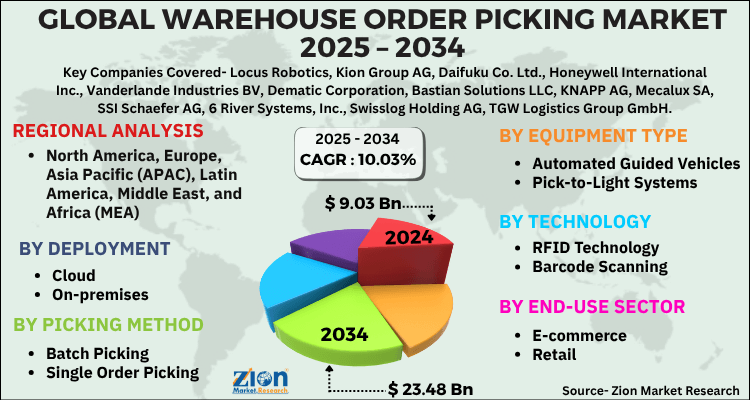
The Warehouse Order Picking market is segmented by deployment, picking method, equipment type, technology, end-use sector, and region.
Based on Deployment Segment, the Warehouse Order Picking market is divided into cloud, on-premises, and others. The cloud segment currently dominates and is expected to register the highest growth because of its inherent scalability, allowing businesses to adjust usage levels according to fluctuating demand without over-investing in fixed infrastructure. Cloud solutions also shift maintenance and update responsibilities to vendors, freeing internal resources for core operations and enabling real-time data access across locations. This dominance drives market expansion by lowering barriers to entry for mid-sized operators and supporting rapid scaling in high-growth e-commerce environments. The on-premises segment holds the second-largest position, preferred by organizations requiring maximum data control, customization, and compliance with strict internal security policies, thereby sustaining demand for hybrid and dedicated deployments.
Based on Picking Method Segment, the Warehouse Order Picking market is divided into batch picking, single order picking, zone picking, wave picking, multi-order picking, and others. Batch picking leads the market as it allows workers to collect items for multiple orders in a single pass before sorting, dramatically reducing travel time and increasing throughput in high-volume facilities. This method’s efficiency directly supports faster fulfillment cycles and lower labor costs, fueling overall market growth. Single order picking ranks as the second-most dominant approach, remaining essential for specialized, high-value, or low-volume orders that require individual attention and precision, thereby maintaining steady demand alongside more aggregated methods.
Based on Equipment Type Segment, the Warehouse Order Picking market is divided into automated guided vehicles, pick-to-light systems, voice picking systems, mobile devices, robotic picking systems, and others. Automated guided vehicles hold the largest share because they autonomously transport goods, reduce manual handling, improve accuracy, and integrate effectively with warehouse management systems to boost overall productivity. Their contribution to labor savings and continuous operation drives significant market expansion. Robotic picking systems represent the second-most prominent category, offering advanced gripping and sorting capabilities that further automate complex piece-picking tasks and support the transition toward fully lights-out warehouse environments.
Based on Technology Segment, the Warehouse Order Picking market is divided into RFID technology, barcode scanning, artificial intelligence, machine learning, augmented reality, and others. RFID technology dominates due to its capacity for real-time, non-line-of-sight identification and tracking of large volumes of items, which minimizes errors and accelerates inventory processes. This capability underpins higher accuracy and throughput, directly contributing to market growth. Barcode scanning remains the second-leading technology, valued for its reliability, lower cost, and widespread compatibility, serving as a foundational tool that continues to support both manual and semi-automated operations.
Based on End-use Sector Segment, the Warehouse Order Picking market is divided into e-commerce, retail, manufacturing, pharmaceutical, food and beverage, and others. The e-commerce sector commands the largest share, driven by surging online order volumes, expectations for rapid delivery, and the critical need for error-free fulfillment systems that can scale with demand. This dominance propels continuous investment in advanced picking technologies and overall industry growth. The retail segment holds the second position, as traditional and omnichannel retailers increasingly adopt efficient picking solutions to support store replenishment, click-and-collect services, and competitive delivery speeds.
Warehouse Order Picking Market: Report Scope
| Report Attributes | Report Details |
|---|---|
| Report Name | Warehouse Order Picking Market |
| Market Size in 2024 | USD 9.03 Billion |
| Market Forecast in 2034 | USD 23.48 Billion |
| Growth Rate | CAGR of 10.03% |
| Number of Pages | 198 |
| Key Companies Covered | Locus Robotics, Kion Group AG, Daifuku Co. Ltd., Honeywell International Inc., Vanderlande Industries BV, Dematic Corporation, Bastian Solutions LLC, KNAPP AG, Mecalux SA, SSI Schaefer AG, 6 River Systems, Inc., Swisslog Holding AG, TGW Logistics Group GmbH, Murata Machinery, Ltd., Geek+ Inc., BEUMER Group GmbH & Co. KG, I.D. Systems, Inc., System Logistics Spa, Magazino GmbH, Flexcon Company, Inc., IAM Robotics, Fetch Robotics, Inc., InVia Robotics, Inc., GreyOrange Pte. Ltd., and RightHand Robotics, Inc., and others. |
| Segments Covered | By Deployment, By Picking Method, By Equipment Type, By Technology, By End-use Sector, and By Region |
| Regions Covered | North America, Europe, Asia Pacific (APAC), Latin America, The Middle East and Africa (MEA) |
| Base Year | 2024 |
| Historical Year | 2020 to 2024 |
| Forecast Year | 2025 to 2034 |
| Customization Scope | Available customized purchase options to meet your exact research needs. Request For Customization |
Warehouse Order Picking Market: Regional Analysis
Why will North America continue to dominate the global market during the projection period?
The global warehouse order picking market is expected to witness the highest growth in North America since the region currently holds the largest part of global revenue. The high growth rate is mainly driven due to the existing consumer database of advanced technologies such as automated warehouse order picking systems.
The region is one of the early adopters of the tools, mainly driven by the excellent innovation activities undertaken by several companies, including small-scale players and larger corporations. Furthermore, the e-commerce segment is one of the crucial contributors to the regional market as it is home to some of the largest e-commerce companies across the globe. Amazon is a prime example. In the US alone, the company has more than 250 operational warehouses. A recent report suggested that it ships out more than 1.5 million packages every day.
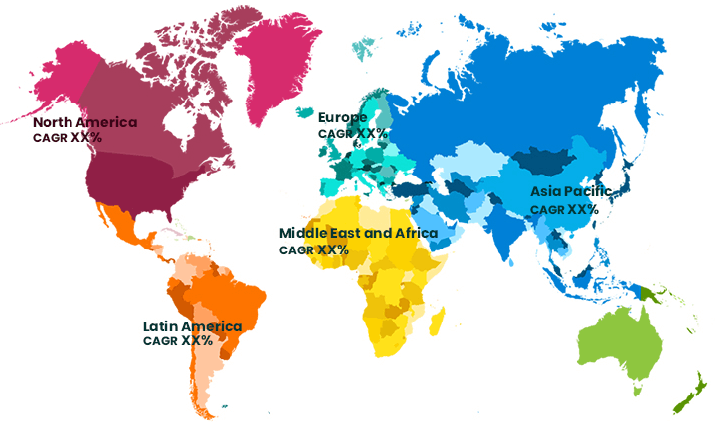
Europe represents a mature and significant market, supported by advanced manufacturing and retail sectors in Germany, the United Kingdom, France, and other key countries. Emphasis on operational efficiency, sustainability, and integration of robotics continues to encourage adoption of modern order-picking solutions across the region.
Asia Pacific is anticipated to exhibit robust growth, led by China, Japan, India, and South Korea. Rapid expansion of e-commerce, rising disposable incomes, increasing warehouse construction, and government initiatives promoting logistics modernization are accelerating the uptake of automated picking technologies.
Latin America is gradually advancing, with Brazil and Mexico emerging as primary markets as retailers and e-commerce platforms invest in improved fulfillment capabilities to meet growing consumer demand. The Middle East and Africa region is progressing steadily, particularly in the GCC countries and South Africa, where investments in modern logistics infrastructure and digital transformation are creating new opportunities for warehouse order picking solutions.
Recent Developments
- In March 2023, Autostore, a robotic technology company, announced the launch of FusionPort and FusionPort Staging. These two systems are highly advanced workstations that guarantee operator productivity, efficiency, and ergonomics. The systems are expected to maximize performance as they come with visual picking aids and two tilted order-picking Bin openings
- In November 2020, Godrej Material Handling announced its collaboration with Greendzine Technologies. The companies have jointly launched MOPTro, which is an innovative order picking trolley. The new product is an extension of the existing line of products called SKUtro by Godrej
Warehouse Order Picking Market: Competitive Analysis
The report provides a company market share analysis to give a broader overview of the key market players. In addition, the report also covers key strategic developments of the market, including acquisitions & mergers, new product launches, agreements, partnerships, collaborations & joint ventures, research & development, and regional expansion of major participants involved in the warehouse order picking market on a global and regional basis.
The global warehouse order picking market is dominated by players like:
- Locus Robotics
- Kion Group AG
- Daifuku Co. Ltd.
- Honeywell International Inc.
- Vanderlande Industries BV
- Dematic Corporation
- Bastian Solutions LLC
- KNAPP AG
- Mecalux SA
- SSI Schaefer AG
- 6 River Systems Inc.
- Swisslog Holding AG
- TGW Logistics Group GmbH
- Murata Machinery Ltd.
- Geek+ Inc.
- BEUMER Group GmbH & Co. KG
- I.D. Systems Inc.
- System Logistics Spa
- Magazino GmbH
- Flexcon Company Inc.
- IAM Robotics
- Fetch Robotics Inc.
- InVia Robotics Inc.
- GreyOrange Pte. Ltd.
- RightHand Robotics Inc
What are the key trends in the Warehouse Order Picking Market?
Rising integration of automation and robotics
Companies are increasingly deploying automated guided vehicles, robotic picking systems, and collaborative robots to improve accuracy, reduce labor costs, and handle growing order volumes. This trend is transforming traditional warehouses into highly efficient, technology-driven fulfillment centers capable of meeting modern delivery expectations.
Growing preference for cloud-based and scalable solutions
Cloud deployment models are gaining strong traction because they offer flexibility, real-time visibility, automatic updates, and the ability to scale resources according to seasonal or business demand fluctuations, enabling organizations to optimize technology spending while enhancing operational responsiveness.
The global warehouse order picking market is segmented as follows;
By Deployment
- Cloud
- On-premises
By Picking Method
- Batch Picking
- Single Order Picking
- Zone Picking
- Wave Picking
- Multi-Order Picking
By Equipment Type
- Automated Guided Vehicles
- Pick-to-Light Systems
- Voice Picking Systems
- Mobile Devices
- Robotic Picking Systems
By Technology
- RFID Technology
- Barcode Scanning
- Artificial Intelligence
- Machine Learning
- Augmented Reality
By End-use Sector
- E-commerce
- Retail
- Manufacturing
- Pharmaceutical
- Food and Beverage
By Region
- North America
- The U.S.
- Canada
- Mexico
- Europe
- France
- The UK
- Spain
- Germany
- Italy
- Rest of Europe
- Asia Pacific
- China
- Japan
- India
- Australia
- South Korea
- Rest of Asia Pacific
- The Middle East & Africa
- Saudi Arabia
- UAE
- Egypt
- Kuwait
- South Africa
- Rest of the Middle East & Africa
- Latin America
- Brazil
- Argentina
- Rest of Latin America
Table Of Content
Methodology
FrequentlyAsked Questions
The industry deals with businesses that provide solutions or services to their clients concerning efficient packaging and picking of products stored in distribution centers or a warehouse.
The global warehouse order picking market is expected to grow due to Growth in e-commerce and need for faster, more accurate fulfillment drive demand for advanced picking solutions. Automation and robotics integration further support market growth.
According to a study, the global warehouse order picking market size was worth around USD 9.03 Billion in 2024 and is expected to reach USD 23.48 Billion by 2034.
The global warehouse order picking market is expected to grow at a CAGR of 10.03% during the forecast period.
North America is expected to dominate the warehouse order picking market over the forecast period.
Leading players in the global warehouse order picking market include Locus Robotics, Kion Group AG, Daifuku Co. Ltd., Honeywell International Inc., Vanderlande Industries BV, Dematic Corporation, Bastian Solutions LLC, KNAPP AG, Mecalux SA, SSI Schaefer AG, 6 River Systems, Inc., Swisslog Holding AG, TGW Logistics Group GmbH, Murata Machinery, Ltd., Geek+ Inc., BEUMER Group GmbH & Co. KG, I.D. Systems, Inc., System Logistics Spa, Magazino GmbH, Flexcon Company, Inc., IAM Robotics, Fetch Robotics, Inc., InVia Robotics, Inc., GreyOrange Pte. Ltd., and RightHand Robotics, Inc., among others.
Major challenges include the shortage of skilled labor capable of operating advanced systems, the high cost of automated tools compared with manual alternatives, and the operational complexity associated with managing diverse product portfolios and large dispatch volumes.
Emerging trends include the growing adoption of automation and robotics for improved accuracy and efficiency, increasing preference for cloud-based scalable solutions, and the integration of technologies such as RFID, artificial intelligence, machine learning, and augmented reality to enhance real-time visibility and decision-making.
The value chain typically includes research and development of software and hardware solutions, manufacturing or system integration of automated equipment, distribution and implementation services, training and change management support, ongoing maintenance and software updates, and continuous innovation to meet evolving warehouse requirements.

HappyClients

