
Global Vacuum Insulated Glass Market Size, Share, Forecast 2034

Vacuum Insulated Glass Market By Type (Single Vacuum Insulated Glass, Double Vacuum Insulated Glass, Triple Vacuum Insulated Glass, Curved Vacuum Insulated Glass), By Application (Residential Windows and Doors, Commercial Building Facades, Refrigeration and Cold Storage, Skylights and Roof Glazing), By End User (Residential Construction Companies, Commercial Real Estate Developers, Renovation and Retrofit Contractors, Appliance Manufacturers), By Material (Low Emissivity Coated Glass, Tempered Glass, Laminated Glass, Tinted Glass), and By Region - Global and Regional Industry Overview, Market Intelligence, Comprehensive Analysis, Historical Data, and Forecasts 2026 - 2034
| Market Size in 2025 | Market Forecast in 2034 | CAGR (in %) | Base Year |
|---|---|---|---|
| USD 6.85 Billion | USD 10.52 Billion | 4.88% | 2025 |
Vacuum Insulated Glass Industry Perspective:
What will be the size of the vacuum insulated glass market during the forecast period?
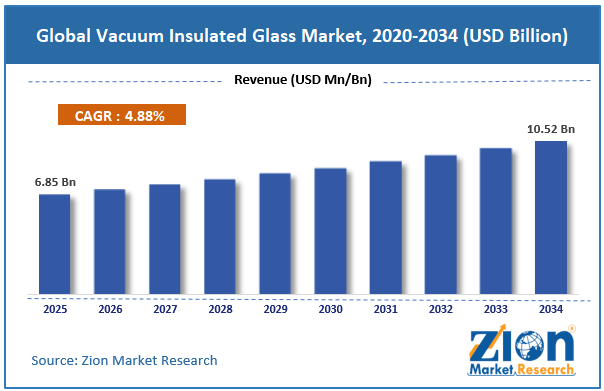
The global vacuum insulated glass market size was valued at approximately USD 6.85 billion in 2025 and is projected to reach around USD 10.52 billion by 2034, growing at a compound annual growth rate of approximately 4.88% between 2026 and 2034.
Key Insights
- As per the analysis shared by our research team, the global vacuum insulated glass market is estimated to grow at a compound annual growth rate of approximately 4.88% during the forecast period from 2026 to 2034.
- In terms of revenue, the global vacuum insulated glass market was valued at approximately USD 6.85 billion in 2025 and is projected to reach USD 10.52 billion by 2034.
- The vacuum insulated glass market is expected to grow strongly due to rising energy efficiency regulations, increasing adoption of green building standards, growing preference for slim window designs, and expanding investment in advanced glazing technology.
- Based on type, double vacuum insulated glass leads the market because of its balanced performance and wide use in residential construction, while triple vacuum insulated glass is gaining strong momentum as one of the fastest-growing types for extreme climate applications.
- Based on application, residential windows and doors lead the market due to the widespread use of vacuum insulated glass in home construction and renovation. At the same time, refrigeration and cold storage is the fastest-growing segment as more industries adopt this technology for energy-efficient cooling systems.
- Based on end-user, residential construction companies lead the market due to high demand for energy-efficient housing, while renovation and retrofit contractors are steadily growing as more property owners upgrade older buildings with modern glazing solutions.
- Based on material, low-emissivity coated glass leads the market because of its superior thermal performance and broad compatibility with vacuum insulation technology, while tempered glass is seeing rapid adoption due to its added safety and durability benefits.
- Based on region, Europe leads the global vacuum insulated glass market. At the same time, Asia Pacific is the fastest-growing region due to rapid urban construction and increasing government focus on energy-efficient buildings.
Vacuum Insulated Glass Market: Overview
Vacuum insulated glass is an energy-efficient window glass that uses a thin vacuum space between two glass panes to reduce heat transfer. Unlike traditional double- or triple-glazed windows, it provides strong insulation without making windows thick or heavy. This helps buildings stay cooler in summer, warmer in winter, and quieter by reducing outside noise. Vacuum insulated glass is used in homes, offices, commercial buildings, renovations, and some appliances to lower heating and cooling costs and improve indoor comfort. Common types include single-, double-, triple-, and curved vacuum insulated glass, designed for different building and design needs. Its slim structure makes it especially useful for renovation projects where existing window frames have limited space. It can also reduce condensation and maintain more comfortable indoor temperatures year-round. Growing interest in green buildings is encouraging architects and developers to choose advanced glazing solutions. Rising energy costs are also pushing property owners to invest in windows that can improve insulation and reduce energy use. Improvements in glass manufacturing are making vacuum insulated glass more practical, durable, and suitable for different climates and building designs.
The vacuum insulated glass industry continues to grow as architects, builders, and manufacturers work together to create more energy-efficient, comfortable spaces worldwide.
Vacuum Insulated Glass Market: Strategic Perspective
Where is the vacuum insulated glass market heading?
The market is steadily moving away from thick, bulky glazing solutions toward slimmer, high-performance glass panels that deliver strong thermal insulation without adding excess weight to window and door frames. Future growth will likely be shaped less by traditional double- and triple-glazing sales and more by manufacturers that can offer thinner panels with better insulation values at a price point closer to conventional glass.
Where should businesses invest in the vacuum insulated glass market?
The strongest opportunities are expected to come from companies investing in edge sealing technology, automated production lines, and partnerships with window and facade manufacturers that can integrate vacuum insulated glass into mainstream building projects. As construction firms and homeowners demand proof of long-term durability, investment is likely to favor firms that can back their products with strong field performance data and extended warranty coverage.
What will reshape competition in the vacuum insulated glass market?
Competitive advantage in this market will increasingly depend on more than just producing a thinner pane of glass. Companies that combine reliable manufacturing quality with faster production speeds, strong distribution networks, and proven compatibility with modern building designs are expected to pull ahead of rivals that focus solely on product development.
Vacuum Insulated Glass Market: Technology Roadmap 2026–2034
What is the projected development roadmap of the vacuum insulated glass market over the forecast period?
The vacuum insulated glass market is advancing through improved sealing methods, more precise vacuum maintenance technology, expanded manufacturing capacity, and growing use of smart glazing features, making buildings more energy efficient and comfortable for occupants. The market is expected to grow at a compound annual growth rate of approximately 4.88% over the forecast period, driven by accelerating construction investment, developing building efficiency standards, and continuous refinement of vacuum glazing technology.
The following roadmap outlines key development phases expected through 2034.
2026–2028: Manufacturing Refinement and Standards Development Phase
- Manufacturers are expected to develop better sealing methods that help vacuum-insulated glass maintain its insulating vacuum for longer, even in challenging weather conditions.
- Stricter energy efficiency standards are expected to push builders toward better insulation and glazing systems that meet newer building performance requirements.
- Greater cooperation between glass manufacturers, construction companies, and certification bodies is expected to make vacuum insulated glass easier to adopt in more construction projects.
2029–2031: Cost Reduction and Broader Adoption Phase
- Improved production methods are expected to help manufacturers make vacuum insulated glass more consistently, reduce defects, and better control production costs.
- The use of combination glazing systems is expected to increase, with vacuum insulated glass paired with smart coatings or automated shading to improve building energy performance.
- Better testing equipment is expected to help manufacturers compare sealing methods more accurately and develop vacuum insulated glass that performs reliably in different weather conditions.
2032–2034: Next Generation Smart Glazing Phase
- Vacuum insulated glass is expected to advance, with manufacturers focusing on lower production costs, stronger insulation, and longer-lasting window performance.
- Thinner and lighter glass designs are expected to gain attention as older buildings need energy-efficient windows that fit existing frames with fewer modifications.
- Vacuum insulated glass combined with smart sensors and automated climate controls is expected to help building managers track energy use and maintain comfortable indoor conditions more efficiently.
Vacuum Insulated Glass Market: Dynamics
Growth Drivers
What is driving growth in the vacuum insulated glass market as demand for energy-efficient construction rises?
The vacuum insulated glass market is growing as builders, architects, and property developers increasingly choose energy-efficient and sustainable building solutions. Rising green building projects, stricter energy standards, and advances in vacuum-sealing technology are driving strong demand worldwide. Vacuum insulated glass offers excellent thermal insulation while staying thin and lightweight, helping buildings save energy without bulky window systems. It is widely used in residential windows, commercial building facades, skylights, and refrigeration units where precise temperature control matters. Updated building codes are also encouraging developers to install advanced glazing that reduces heat loss and lowers heating and cooling costs. Manufacturers are improving sealing methods, durability, and overall glass performance to make these products more reliable for long-term use.
Meanwhile, property owners are recognizing the value of energy-efficient windows in improving indoor comfort and reducing utility expenses. Growing construction activity, renovation of older buildings, and greater awareness of sustainable materials are further strengthening the market across residential and commercial projects.
Growing demand for slim, high-performance window solutions is driving the market growth.
The vacuum insulated glass market is creating opportunities as architects and builders increasingly seek slim, high-performance window solutions. This advanced glass provides excellent insulation without the bulk of traditional multi-pane windows, allowing designers to create sleek building facades while maintaining energy efficiency. Its lightweight and space-saving design also reduces pressure on window frames and supports architectural flexibility. Residential builders, commercial developers, and renovation contractors are adopting vacuum insulated glass for both new buildings and retrofit projects. Manufacturers are also developing curved and custom-shaped options for unique architectural designs, opening new applications and expanding market opportunities. Growing renovation activity, product innovation, and investment in sustainable construction are supporting wider adoption. Stronger building certification programs and energy-efficiency initiatives are encouraging developers to use advanced glazing solutions. As more users understand its benefits, demand for vacuum insulated glass is expected to grow steadily across residential and commercial construction projects during the forecast period.
Restraints
High production costs and complex manufacturing processes are key challenges limiting the market growth.
The vacuum insulated glass industry faces several challenges that can slow market growth. Producing these advanced glass panels requires specialized equipment, precise sealing systems, vacuum chambers, and strict quality checks, making manufacturing costly and technically complex. Smaller manufacturers may struggle to afford the technology and investment needed to increase production and compete with larger companies. Maintaining a strong vacuum seal throughout the product’s lifespan is another challenge, as seal failure can reduce insulation performance. Manufacturers also need to invest in testing, research, and improved sealing methods to ensure long-term reliability. A shortage of skilled glass engineers, technicians, and quality control professionals can further limit production and installation capacity. In developing countries, limited manufacturing facilities and technical expertise can make adoption more difficult. However, improvements in production technology, growing industry knowledge, and stronger partnerships between manufacturers, builders, and research organizations can help reduce costs and make vacuum insulated glass more accessible worldwide.
Opportunities
Will expanding application areas and emerging markets drive growth opportunities in the vacuum insulated glass market?
The vacuum insulated glass industry offers strong growth opportunities as manufacturers and construction companies develop more flexible glazing solutions. This advanced glass provides excellent thermal insulation without adding bulk, making it useful for residential windows and commercial building facades. It helps improve energy performance while supporting modern, slim architectural designs. Manufacturers are also expanding its use in refrigeration units and skylights, creating additional market opportunities. Growing demand for energy-efficient and sustainable building materials is encouraging builders, developers, and appliance manufacturers to adopt this technology. Emerging markets such as China, India, Brazil, and Middle Eastern countries are increasing investment in construction, green buildings, and energy-efficiency programs, supporting market expansion. Manufacturers are improving production methods to make vacuum insulated glass more affordable, durable, and easier to install. Renovation projects and stricter building codes are also creating new demand. Rising construction activity, ongoing glazing innovation, and greater awareness of energy-saving solutions are expected to support steady market growth throughout the forecast period. Growing interest in low-energy buildings is also encouraging architects to consider advanced glazing early in the design process. At the same time, better product availability can help expand adoption across different building types.
Challenges
What challenges does the vacuum insulated glass market face in sustaining growth and achieving widespread adoption?
The vacuum insulated glass industry faces several challenges that may slow market growth. Developing these advanced glazing products requires high research costs, specialized manufacturing facilities, and extensive durability testing, making it difficult for smaller companies to compete. Strict building certification requirements also demand strong proof of thermal performance and long-term reliability before products can enter the market, which may delay launches. Different building codes across countries can further increase development time and costs. The industry also needs more trained glass engineers, installers, and quality control specialists to support production and installation.
In addition, manufacturers must maintain reliable supplies of specialized sealing materials and precision equipment to avoid production delays. Vacuum insulated glass also competes with other energy-efficient options, including traditional double- and triple-pane windows with gas fillings. Despite these challenges, better manufacturing, stronger industry partnerships, and energy-efficiency research are expected to support long-term market growth.
Vacuum Insulated Glass Market: Report Scope
| Report Attributes | Report Details |
|---|---|
| Report Name | Vacuum Insulated Glass Market |
| Market Size in 2025 | USD 6.85 Billion |
| Market Forecast in 2034 | USD 10.52 Billion |
| Growth Rate | CAGR of 4.88% |
| Number of Pages | 227 |
| Key Companies Covered | Saint-Gobain, LandVac, Guardian Glass, AGC Inc, NSG Group, Vitro Architectural Glass, Central Glass, Xinyi Glass Holdings, Sisecam Group, Taiwan Glass Industry Corporation, and others. |
| Segments Covered | By Type, By Application, By End User, By Material, and By Region |
| Regions Covered | North America, Europe, Asia Pacific (APAC), Latin America, Middle East, and Africa (MEA) |
| Base Year | 2025 |
| Historical Year | 2020 - 2024 |
| Forecast Year | 2026 - 2034 |
| Customization Scope | Avail customized purchase options to meet your exact research needs. Request For Customization |
Vacuum Insulated Glass Market: Segmentation
The global vacuum insulated glass market is segmented by type, application, end-user, material, and region.
What makes double vacuum insulated glass the dominant type in the vacuum insulated glass market?
Based on type, the global vacuum insulated glass market is divided into single, double, triple, and curved vacuum insulated glass. Double vacuum insulated glass holds about 44% of the market share, leading due to its balanced thermal performance, moderate production cost, and wide use in standard residential and commercial construction. Triple vacuum insulated glass holds around 26% market share. It is the fastest-growing segment because of its superior insulation performance in extreme cold and hot climate regions.
How does residential windows and doors application maintain its leading position in the vacuum insulated glass market?
Based on application, the vacuum insulated glass industry is classified into residential windows and doors, commercial building facades, refrigeration and cold storage, and skylights and roof glazing. Residential windows and doors account for approximately 39% of the global market share, driven by the widespread adoption of energy-efficient glazing in home construction and renovation projects. Refrigeration and cold storage holds around 21% market share. It is the fastest-growing segment due to expanding use of vacuum glazing in energy-efficient commercial refrigeration units.
What makes residential construction companies the dominant end-users in the vacuum insulated glass market?
Based on end-user, the market is segregated into residential construction companies, commercial real estate developers, renovation and retrofit contractors, and appliance manufacturers. Residential construction companies lead with about a 42% share because of strong demand for energy-efficient housing and growing consumer awareness of long-term cost savings. Renovation and retrofit contractors hold around 25% market share. They are growing steadily as more property owners choose to upgrade older windows with modern vacuum glazing technology.
How does the low emissivity coated glass material shape the performance landscape of the vacuum insulated glass market?
Based on material, the vacuum insulated glass market is categorized into low emissivity coated glass, tempered glass, laminated glass, and tinted glass. Low emissivity coated glass accounts for about 40% of the market, leading because it reflects heat while allowing natural light to pass through building windows. Tempered glass holds around 27% market share. Its strong safety and durability benefits are especially valued in commercial and high-traffic building applications.
Vacuum Insulated Glass Market: Regional Analysis
Why is Europe leading the global vacuum insulated glass market?
Europe leads the vacuum insulated glass market because of its strong focus on energy-efficient buildings, sustainable construction, and lower energy use. Countries such as Germany, the United Kingdom, France, Italy, and the Netherlands are investing in better building materials that can reduce heat loss and improve indoor comfort. Vacuum insulated glass is gaining attention because it provides excellent insulation while being thinner and lighter than traditional double- or triple-pane windows. This makes it useful for both new buildings and renovation projects, especially where window space is limited. Strict European energy efficiency rules and building standards are also encouraging developers to adopt advanced glazing solutions. Growing demand for green buildings and rising energy costs are further supporting market growth.
In addition, European glass manufacturers are investing in new production methods, improved sealing technology, and better-performing glazing products. Increasing renovation of older buildings is creating another important opportunity. Growing demand for low-energy homes is encouraging homeowners to replace older windows with more efficient glazing. Commercial property owners are also upgrading buildings to meet modern energy performance targets. Rising interest in sustainable architecture is further creating opportunities for vacuum insulated glass across the region. With strong construction activity, sustainability goals, and continued technology improvements, Europe is expected to maintain its leading position in the vacuum insulated glass market.
What makes Asia Pacific the fastest-growing region in the vacuum insulated glass market?
Asia Pacific is the fastest-growing region in the vacuum insulated glass market, supported by rapid construction, urban development, and rising demand for energy-efficient buildings. Countries such as China, India, Japan, South Korea, and Australia are investing heavily in residential buildings, commercial spaces, industrial facilities, and infrastructure projects. As cities expand, builders are looking for window solutions that can improve insulation while using less space, making vacuum insulated glass an attractive option. Growing awareness of energy savings is also encouraging property developers and homeowners to choose advanced glazing products that can reduce heating and cooling needs. Governments across the region are introducing stronger energy-efficiency targets and promoting greener construction practices, creating additional demand. The growing renovation of older buildings is another opportunity, particularly in developed markets such as Japan and South Korea.
At the same time, local glass manufacturers are improving production capabilities and introducing more affordable products, helping increase availability. Rising construction spending, expanding urban populations, increasing energy costs, and greater awareness of sustainable building materials are expected to keep Asia Pacific on a strong growth path in the vacuum insulated glass market.
Recent Market Developments
- In July 2026, LandVac secured China and European Environmental Product Declarations for its vacuum insulated glass, strengthening product transparency and supporting its use in low-carbon building projects across international markets.
- In July 2026, LandVac announced that its new one-step composite metal sealing technology for vacuum insulated glass had received an internationally advanced technical evaluation, while its manufacturing process was recognized as internationally leading for improved large-scale production.
Vacuum Insulated Glass Market: Competitive Analysis
The leading players in the global vacuum insulated glass market are:
- Saint-Gobain
- LandVac
- Guardian Glass
- AGC Inc
- NSG Group
- Vitro Architectural Glass
- Central Glass
- Xinyi Glass Holdings
- Sisecam Group
- Taiwan Glass Industry Corporation
The global vacuum insulated glass market is segmented as follows:
By Type
- Single Vacuum Insulated Glass
- Double Vacuum Insulated Glass
- Triple Vacuum Insulated Glass
- Curved Vacuum Insulated Glass
By Application
- Residential Windows and Doors
- Commercial Building Facades
- Refrigeration and Cold Storage
- Skylights and Roof Glazing
By End User
- Residential Construction Companies
- Commercial Real Estate Developers
- Renovation and Retrofit Contractors
- Appliance Manufacturers
By Material
- Low Emissivity Coated Glass
- Tempered Glass
- Laminated Glass
- Tinted Glass
By Region
- North America
- The U.S.
- Canada
- Mexico
- Europe
- France
- The UK
- Spain
- Germany
- Italy
- Rest of Europe
- Asia Pacific
- China
- Japan
- India
- Australia
- South Korea
- Rest of Asia Pacific
- The Middle East & Africa
- Saudi Arabia
- UAE
- Egypt
- Kuwait
- South Africa
- Rest of the Middle East & Africa
- Latin America
- Brazil
- Argentina
- Rest of Latin America
Table Of Content
Methodology
FrequentlyAsked Questions
Vacuum insulated glass is an energy-efficient window glass that uses a thin vacuum space between two glass panes to reduce heat transfer. Unlike traditional double- or triple-glazed windows, it provides strong insulation without making windows thick or heavy.
The global vacuum insulated glass market is expected to grow due to rising energy efficiency regulations, increasing adoption of green building standards, growing demand for slim window designs, and expanding investment in advanced glazing technology worldwide.
According to research, the global vacuum insulated glass market was valued at approximately USD 6.85 billion in 2025 and is projected to reach approximately USD 10.52 billion by 2034.
What will be the compound annual growth rate of the vacuum insulated glass market from 2026 to 2034?
The compound annual growth rate of the vacuum insulated glass market is expected to be approximately 4.88% from 2026 to 2034.
Europe is expected to lead the global vacuum insulated glass market throughout the forecast period, driven by strict energy-efficiency regulations, a strong construction research base, and significant investment in sustainable building materials.
The major players in the global vacuum insulated glass market include Saint-Gobain, LandVac, Guardian Glass, AGC Inc, NSG Group, Vitro Architectural Glass, Central Glass, Xinyi Glass Holdings, Sisecam Group, and Taiwan Glass Industry Corporation.
The report examines key aspects of the vacuum insulated glass market, including research and development drivers, adoption barriers, application opportunities, competitive landscape dynamics, detailed regional market performance analysis, and a comprehensive forward-looking outlook across all major types, applications, end-user segments, materials, and geographic regions through 2034.
Leading players in the vacuum insulated glass market focus on expanding production capacity, forming strategic partnerships, making acquisitions, launching products, and driving manufacturing innovation. These strategies help companies strengthen their product portfolios and increase their global market presence.
The vacuum insulated glass market features strong competition among global glass manufacturing and building materials companies. Leading players compete through innovation, research investments, advanced glazing platforms, and strategic collaborations.
Germany leads the global vacuum insulated glass market. It benefits from its advanced construction industry, strong glass manufacturing base, high energy efficiency standards, and ongoing investment in sustainable glazing technology.

List of Contents
Vacuum Insulated GlassIndustry Perspective:Key InsightsOverviewStrategic PerspectiveTechnology Roadmap 20262034The following roadmap outlines key development phases expected through 2034.DynamicsReport ScopeSegmentationRegional AnalysisRecent Market DevelopmentsCompetitive AnalysisThe global vacuum insulated glass market is segmented as follows:HappyClients

