
Precision Parts Market Size, Share, Growth, Opportunities 2034

Precision Parts Market By Material Type (Steel and Stainless Steel, Aluminum Alloys, Titanium Alloys, Copper and Brass, Engineering Plastics and Polymers, Ceramics and Composites), By Manufacturing Process (CNC Machining, Precision Casting, Precision Forging, Additive Manufacturing, Precision Stamping, Grinding and Honing), By End-Use Industry (Aerospace and Defense, Automotive and Electric Vehicles, Medical Devices and Healthcare Equipment, Industrial Machinery and Automation, Semiconductor and Electronics, Energy and Power Equipment), By Tolerance Class (Ultra-High Precision, High Precision, Standard Precision), and By Region - Global and Regional Industry Overview, Market Intelligence, Comprehensive Analysis, Historical Data, and Forecasts 2025 - 2034
| Market Size in 2024 | Market Forecast in 2034 | CAGR (in %) | Base Year |
|---|---|---|---|
| USD 233.84 Billion | USD 454.23 Billion | 7.69% | 2024 |
Precision Parts Industry Perspective:
What are the expected growth rate and market size of the precision parts market during the forecast period?
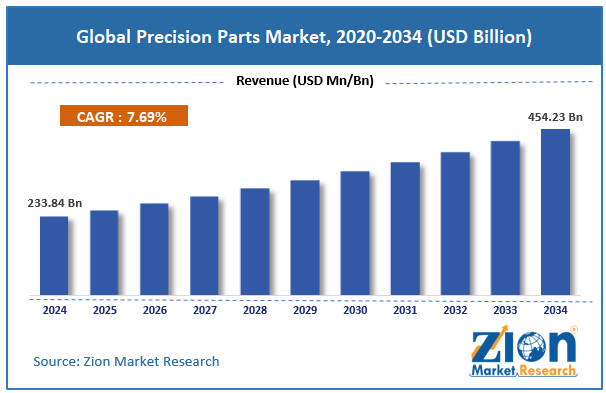
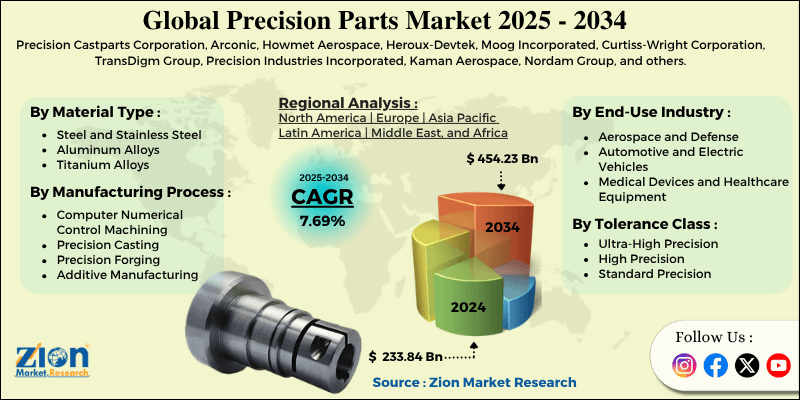
The global precision parts market size was worth approximately USD 233.84 billion in 2024 and is projected to grow to around USD 454.23 billion by 2034, with a compound annual growth rate (CAGR) of roughly 7.69% between 2025 and 2034.
Precision Parts Market: Overview
Precision parts are highly accurate components manufactured with exact measurements and carefully controlled surface finishes, where even the smallest deviation can impact performance, reliability, or safety, especially in critical applications across aerospace, medical, automotive, and electronics industries. Precision parts are not regular machine-made items. Production requires advanced machines, skilled operators, and strict quality checks to ensure every dimension is correct. Measurements are often in micrometers, which are much smaller than the width of a human hair. A wide variety of products fall under the category of precision parts. Examples include turbine blades in aircraft engines, medical implants used in surgeries, gears in industrial robots, small components inside smartphones and computers, fuel injectors in vehicles, and connectors in electronic systems. Each part must meet exact size, shape, and strength requirements to function properly. Materials used in precision parts must handle stress, heat, pressure, and wear without failing. Manufacturing methods include computer-controlled machining for high accuracy, casting and forging for shaping metals, 3D printing for complex designs, and grinding or polishing for smooth finishes. Each process is selected based on the part’s design and application. Precision parts are essential in industries where reliability, safety, and performance cannot be compromised.
The rising product complexity, growth in the aerospace and electric vehicle sectors, increasing demand for medical devices, expansion of automation and robotics, miniaturization of electronics, and a strong focus on quality are driving steady growth in the precision parts market.
Key Insights
- As per the analysis shared by our research analyst, the global precision parts market is estimated to grow annually at a CAGR of around 7.69% over the forecast period (2025 to 2034).
- In terms of revenue, the global precision parts market size was valued at approximately USD 233.84 billion in 2024 and is projected to reach USD 454.23 billion by 2034.
- The precision parts market is expected to grow, driven by rising demand across the aerospace, automotive, medical, and semiconductor sectors, increased adoption of CNC and additive manufacturing, expanding automation, and higher quality and reliability requirements.
- Based on material type, the steel and stainless steel segment is expected to lead the precision parts market, while the aluminum alloys segment is anticipated to grow rapidly due to strong demand from the aerospace and electric vehicle sectors, where lightweight strength is essential.
- Based on manufacturing process, the computer numerical control machining segment is expected to lead the precision parts market, while the additive manufacturing segment is anticipated to grow at the fastest rate as three-dimensional printing technologies become more capable and cost-effective.
- Based on end-use industry, the aerospace and defense segment is the largest, while the medical devices and healthcare equipment segment is growing rapidly and is commercially significant.
- Based on tolerance class, the high-precision segment is expected to lead the precision parts market, while the ultra-high-precision segment is anticipated to grow as semiconductor, medical imaging, and advanced optics applications push dimensional requirements to their extreme limits.
- Based on region, the Asia Pacific is projected to dominate the global precision parts market during the estimated period, followed by Europe.
Impact of the USA-Israel war on Iran on the Precision Parts Market
The ongoing USA-Israel war on Iran is projected to impact both short-term and long-term operations in the precision parts market. Increased raw material and energy costs resulting from geopolitical disruptions are expected to raise production costs in the near term. In the long term, rising investments in defense and aerospace sectors may strengthen demand for precision components.
Precision Parts Market: Technology Roadmap 2025 to 2034
What key trends and future developments will drive the precision parts market during the forecast period?
The precision parts market is shaped by advances in digital manufacturing, materials science, automation, and quality inspection technology, as well as the growing complexity of end products in the aerospace, medical, automotive, and semiconductor industries. The market is expected to grow at a CAGR of around 7.69%, driven by rising demand from industries where high-quality and precise components are essential for safety and performance.
The following roadmap outlines the key development phases expected during the forecast period.
2025 to 2027: Smart Machining and Digital Quality Control Phase
- Computer numerical control machines are expected to use real-time adaptive control systems that automatically adjust cutting settings in response to changes in material, tool wear, and heat, improving accuracy and reducing waste.
- In-process measurement systems using laser scanning and contact probes are likely to become standard.
- Digital twin technology is expected to grow in use, where a virtual model of the production process is used to test, improve, and validate machining before actual production begins.
2028 to 2031: Advanced Materials Processing and Automated Manufacturing Phase
- Multi-axis machining centers with five or more axes are expected to become more common, enabling the production of complex 3D parts in a single setup with greater accuracy.
- Additive manufacturing using metal powders and advanced polymers is likely to move from prototyping to full-scale production, especially in aerospace and medical applications.
- Automated robotic systems for part handling, loading, and inspection are expected to increase.
2032 to 2034: Fully Integrated and Intelligence-Driven Precision Manufacturing Phase
- Artificial intelligence-powered systems are expected to analyze production data in real time, detect quality issues early, and automatically adjust processes to maintain consistency.
- Quantum metrology and advanced non-destructive testing techniques are likely to enable the detection of hidden defects and the measurement of very small errors beyond current inspection limits.
- Fully closed-loop manufacturing systems, where measurement data feeds back into machines to self-correct production without human intervention, are expected to become standard in top-tier precision manufacturing facilities.
Precision Parts Market: Dynamics
Growth Drivers
The growing complexity and performance demands of aerospace and defense products are driving the precision parts market.
The precision parts market is growing strongly as the aerospace and defense industries demand extremely accurate and reliable components for critical applications. Aircraft engines, structures, avionics, missiles, and satellites all require parts made with exact measurements where even small errors are unacceptable. A jet engine turbine blade, for example, must maintain its precise shape while spinning at very high speeds and operating under extreme heat. Such requirements push manufacturers to use advanced materials, precise machining, and strict quality checks. Rising global air travel is driving demand for new aircraft, which in turn increases the need for large volumes of precision parts.
At the same time, defense modernization programs across countries such as the United States, China, India, and Europe are driving demand for advanced military equipment that relies on high-performance components. The rapid growth of the commercial space industry, including satellites and reusable rockets, is further driving demand.
What role does the global electric vehicle revolution play in driving demand for the precision parts market?
The precision parts industry is growing rapidly as the global shift toward electric vehicles drives demand for many new, highly accurate components. Electric motors, battery systems, power electronics, and high-voltage connectors all need precise dimensions and smooth finishes to ensure efficiency and long-term performance. Unlike traditional vehicles, electric vehicles depend heavily on advanced electrical and electronic systems that demand consistent quality at large production volumes. Battery modules require carefully manufactured casings, cooling parts, and electrical contacts to maintain safety and reliability. Charging infrastructure, including connectors and power units, also relies on precision parts to meet strict performance and durability standards.
As electric vehicle production continues to rise worldwide, manufacturers are focusing on improving efficiency, range, and performance, thereby increasing demand for high-quality components. Strong competition among electric vehicle companies is further pushing innovation and quality standards.
Restraints
What key challenges are slowing growth in the precision parts market?
The precision parts market faces several challenges that limit how fast companies can grow and expand production. Advanced machines such as multi-axis CNC systems and high-accuracy measuring tools are very expensive, making it difficult for small and medium manufacturers to invest in them. These machines also require costly maintenance, skilled operation, and controlled environments, which further increase overall costs. As a result, only a limited number of well-funded companies can operate at a high level, which can restrict supply when demand rises quickly. Another major challenge is the shortage of skilled workers capable of operating complex machinery and maintaining high precision. Learning these skills takes years of training and hands-on experience, and many experienced workers are retiring faster than new talent is entering the field. In developing regions, there is often a lack of proper technical education. These workforce and cost challenges are key restraints affecting growth in the precision parts market.
Opportunities
Where are the biggest growth opportunities emerging in the precision parts market?
The precision parts industry is finding strong growth opportunities in the medical devices and semiconductor industries, both of which require extremely high accuracy and quality. The medical devices sector is expanding as populations age, healthcare access improves, and new technologies increase demand for advanced treatments. Products such as implants, surgical tools, and imaging equipment depend on precision parts made from materials like titanium and medical-grade polymers, which must meet strict safety and performance standards. Smooth finishes and exact dimensions are critical to ensure compatibility with the human body. At the same time, the semiconductor industry is creating major demand for ultra-precise components used in chip manufacturing equipment. Parts such as wafer stages, optical systems, and vacuum chambers must be produced with extremely tight tolerances in clean environments. Growing investments in semiconductor production, driven by artificial intelligence, electric vehicles, and digital infrastructure, are further boosting demand. This rising demand is encouraging manufacturers to invest in advanced machining technologies and precision inspection systems to meet strict industry requirements. As innovation continues across both sectors, the need for highly reliable, complex components will further strengthen growth opportunities in the precision parts market.
Challenges
Supply chain fragility and the rising cost of precision raw materials are creating challenges in the precision parts market.
The precision parts market faces several ongoing challenges that affect costs, supply stability, and timely delivery. A major issue is reliance on specialized raw materials, such as titanium alloys, nickel-based metals, and advanced ceramics, sourced from limited global markets and subject to price fluctuations driven by geopolitical and energy factors. Sudden price increases can reduce profit margins, especially for companies working on fixed contracts. Another challenge is maintaining consistent quality at high production volumes, as even small variations can lead to product failure.
Scaling production while keeping tight tolerances requires strong process control, skilled workers, and regular equipment checks. Many manufacturers also struggle when shifting from low-volume to high-volume production, especially in fast-growing sectors like electric vehicles. In addition, protecting design data and intellectual property remains a concern in global supply chains. These combined challenges continue to impact growth and efficiency in the precision parts market.
Precision Parts Market: Report Scope
| Report Attributes | Report Details |
|---|---|
| Report Name | Precision Parts Market |
| Market Size in 2024 | USD 233.84 Billion |
| Market Forecast in 2034 | USD 454.23 Billion |
| Growth Rate | CAGR of 7.69% |
| Number of Pages | 226 |
| Key Companies Covered | Precision Castparts Corporation, Arconic, Howmet Aerospace, Heroux-Devtek, Moog Incorporated, Curtiss-Wright Corporation, TransDigm Group, Precision Industries Incorporated, Kaman Aerospace, Nordam Group, and others. |
| Segments Covered | By Material Type, By Manufacturing Process, By End-Use Industry, By Tolerance Class, and By Region |
| Regions Covered | North America, Europe, Asia Pacific (APAC), Latin America, Middle East, and Africa (MEA) |
| Base Year | 2024 |
| Historical Year | 2019 - 2023 |
| Forecast Year | 2025 - 2034 |
| Customization Scope | Avail customized purchase options to meet your exact research needs. Request For Customization |
Precision Parts Market: Segmentation
The global precision parts market is segmented based on material type, manufacturing process, end-use industry, tolerance class, and region.
What helps steel and stainless steel become the leading material types in the precision parts market?
Based on material type, the global precision parts industry is categorized into steel and stainless steel, aluminum alloys, titanium alloys, copper and brass, engineering plastics and polymers, and ceramics and composites. The steel and stainless steel segment accounts for about 37% of the global market and remains dominant due to its strength, durability, cost-effectiveness, and wide availability across industries. The aluminum alloys segment holds around 23% share. It is growing rapidly, driven by rising demand in aerospace and electric vehicle applications, where lightweight, strong materials are essential.
Why is the computer numerical control machining segment expected to lead the precision parts market?
Based on manufacturing process, the market is segregated into computer numerical control machining, precision casting, precision forging, additive manufacturing, precision stamping, and grinding and honing. The computer numerical control machining segment accounts for nearly 48% of the global market and leads due to its high accuracy, consistency, and flexibility across different materials and designs. The additive manufacturing segment holds around 14% share. It is growing quickly, supported by increasing use in the production of complex, customized components.
How does the aerospace and defense segment lead the precision parts market?
Based on end-use industry, the precision parts market is divided into aerospace and defense, automotive and electric vehicles, medical devices and healthcare equipment, industrial machinery and automation, semiconductor and electronics, and energy equipment sectors. The aerospace and defense segment accounts for about 31% of the global market and leads due to strict requirements for accuracy, quality, and reliability. The medical devices segment holds around 19% share. It is growing steadily, driven by increasing demand for high-precision implants and equipment.
What makes the high-precision tolerance segment lead the precision parts market?
Based on tolerance class, the market is classified into ultra-high precision, high precision, and standard precision. The high-precision segment holds about 46% of the global market and remains dominant due to its wide use in industries that require accurate, reliable components at controlled costs. The ultra-high-precision segment holds around a 28% share. It is growing as demand increases in advanced sectors such as semiconductor equipment and precision medical devices.
Precision Parts Market: Regional Analysis
Why does Asia Pacific lead the global precision parts market?
The precision parts market is led by Asia Pacific, which holds about 38.4% of global demand and is expected to remain the top region during the forecast period. Strong leadership comes from a large and fast-growing manufacturing base across countries such as China, Japan, South Korea, Taiwan, and India. China leads in production volume, supplying precision components for automotive, electronics, industrial machinery, and aerospace industries both domestically and globally. Japan and South Korea are known for high-quality and advanced precision manufacturing, especially in semiconductor equipment, automotive parts, and medical devices that require very high accuracy. Taiwan plays a key role in the semiconductor industry, with specialized manufacturers supporting global chip production. India is emerging quickly as a precision manufacturing hub, supported by government initiatives and increasing investments from global companies in aerospace, defense, and medical sectors. Countries in Southeast Asia, including Thailand, Malaysia, Vietnam, and Singapore, are also expanding their capabilities amid rising foreign investment and supply chain diversification. Strong industrial growth, a skilled workforce, and ongoing investment in advanced technologies make the Asia Pacific the leading region in the precision parts market.
Strong government support, favorable industrial policies, and infrastructure development are accelerating manufacturing expansion and efficiency. High production volumes combined with cost advantages enable manufacturers to remain highly competitive in global supply chains. Rapid technology adoption and strong demand from multiple industries continue to strengthen long-term market leadership.
What supports Europe's strong position in the global precision parts market?
The precision parts market ranks Europe as the second-largest region, contributing about 25.1% of global demand and showing steady growth driven by strong engineering expertise and advanced manufacturing capabilities. Europe holds a leading position due to high demand from aerospace, automotive, medical device, and industrial machinery sectors. Germany is the core of precision manufacturing in the region, with a large network of specialized manufacturers producing high-quality components for global industries. Switzerland is known for ultra-precise parts used in medical devices and fine mechanical systems, while Sweden leads in cutting tools and bearing technologies. Italy has strong capabilities in precision machining for automotive and industrial uses, and the United Kingdom plays an important role in aerospace component manufacturing.
European manufacturers focus heavily on quality, innovation, and advanced technologies such as CNC automation, additive manufacturing, and digital inspection systems. Strict regulations in aerospace and healthcare ensure high standards and reliability, supporting local manufacturers. Continuous investment in technology and strong industrial demand firmly position Europe as the second-leading region in the precision parts market. Strong emphasis on research and development supports continuous innovation in high-precision manufacturing technologies. Well-established industrial standards and certifications enhance global trust and demand for precision parts produced in the region.
Recent Market Developments
- In November 2025, DMG Mori introduced upgraded 5-axis CNC machines and automation solutions with ultrasonic-assisted machining and driverless transport systems, targeting higher accuracy and productivity in precision parts manufacturing.
- In December 2025, DMG Mori presented next-generation machining technologies, including the CTX 450 4A and LASERTEC hybrid systems, with a focus on integrated automation, additive manufacturing, and improved process reliability for precision components.
Precision Parts Market: Competitive Analysis
The leading players in the global precision parts market are Precision Castparts Corporation, Arconic, Howmet Aerospace, Heroux-Devtek, Moog Incorporated, Curtiss-Wright Corporation, TransDigm Group, Precision Industries Incorporated, Kaman Aerospace, and Nordam Group.
The global precision parts market is segmented as follows:
By Material Type
- Steel and Stainless Steel
- Aluminum Alloys
- Titanium Alloys
- Copper and Brass
- Engineering Plastics and Polymers
- Ceramics and Composites
By Manufacturing Process
- Computer Numerical Control Machining
- Precision Casting
- Precision Forging
- Additive Manufacturing
- Precision Stamping
- Grinding and Honing
By End-Use Industry
- Aerospace and Defense
- Automotive and Electric Vehicles
- Medical Devices and Healthcare Equipment
- Industrial Machinery and Automation
- Semiconductor and Electronics
- Energy and Power Equipment
By Tolerance Class
- Ultra-High Precision
- High Precision
- Standard Precision
By Region
- North America
- The U.S.
- Canada
- Mexico
- Europe
- France
- The UK
- Spain
- Germany
- Italy
- Rest of Europe
- Asia Pacific
- China
- Japan
- India
- Australia
- South Korea
- Rest of Asia Pacific
- The Middle East & Africa
- Saudi Arabia
- UAE
- Egypt
- Kuwait
- South Africa
- Rest of the Middle East & Africa
- Latin America
- Brazil
- Argentina
- Rest of Latin America
Table Of Content
Methodology
FrequentlyAsked Questions
Precision parts are highly accurate components manufactured with exact measurements and carefully controlled surface finishes, where even the smallest deviation can impact performance, reliability, or safety, especially in critical applications across aerospace, medical, automotive, and electronics industries.
The global precision parts market is expected to grow, driven by demand from aerospace, EVs, medical devices, semiconductors, automation, and the need for higher-quality components.
According to the study, the global precision parts market size was worth around USD 233.84 billion in 2024 and is predicted to grow to around USD 454.23 billion by 2034.
The CAGR value of the precision parts market is expected to be around 7.69% during 2025 to 2034.
Asia Pacific is expected to lead the global precision parts market due to strong manufacturing, high production volumes, and growing demand across key industries.
The major players profiled in the global precision parts market include Precision Castparts Corporation, Arconic, Howmet Aerospace, Heroux-Devtek, Moog Incorporated, Curtiss-Wright Corporation, TransDigm Group, Precision Industries Incorporated, Kaman Aerospace, and Nordam Group.
The report delivers a detailed analysis of the precision parts market, covering growth drivers, restraints, key trends, industry dynamics, competitive landscape, regional insights, and future outlook across major segments
Technological advancement is transforming the precision parts market through the adoption of CNC automation, digital twin simulation, AI-driven process control, and advanced inspection systems, enabling higher accuracy, reduced waste, improved efficiency, and the ability to manufacture complex components at scale.
Emerging trends in the precision parts market include additive manufacturing, multi-axis machining, smart factories, and real-time quality monitoring, all of which are improving productivity, flexibility, and the production of highly complex, high-performance components across industries worldwide.
The precision parts market offers investment opportunities in automation technologies, advanced materials, semiconductor equipment components, and partnerships with aerospace, EV, and medical device manufacturers seeking high-quality, scalable precision manufacturing solutions.

HappyClients

