
Global Upstream Bioprocessing Market Size, Share, Analysis, Growth, and Forecasts 2032

Upstream Bioprocessing Market By Product (Bioreactors/Fermenters, Cell Culture Products, Filters, Bioreactor Accessories, Bags & Containers, and Others), By Workflow (Media Preparation, Cell Culture, and Cell Separation), By Mode (In-house and Outsourced), And By Region - Global and Regional Industry Overview, Market Intelligence, Comprehensive Analysis, Historical Data, and Forecasts 2024 - 2032
| Market Size in 2023 | Market Forecast in 2032 | CAGR (in %) | Base Year |
|---|---|---|---|
| USD 9.48 Billion | USD 21.77 Billion | 9.68% | 2023 |
What is the market size of the upstream bioprocessing industry?
What will be the global upstream bioprocessing market size during the forecast period?
The global demand for upstream bioprocessing market size was valued at approximately USD 9.48 billion in 2023 and is expected to generate revenue of around USD 21.77 billion by the end of 2032, growing at a CAGR of around 9.68% between 2024 and 2032. This report provides a comprehensive analysis of the growth drivers, restraints, and challenges shaping demand across the global upstream bioprocessing market throughout the forecast period, while highlighting high-potential emerging opportunities within the industry.
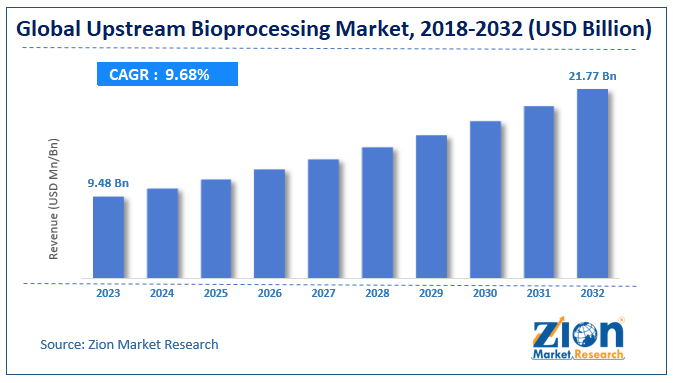
Upstream Bioprocessing Market: Overview
Upstream bioprocessing refers to the initial stages of biopharmaceutical production that involve the use of living cells or their components to generate desired products. It encompasses the complete sequence of activities from early cell isolation and cultivation, through cell banking and culture expansion, to the final harvest. This phase focuses on growing cells or microbes under controlled conditions to achieve high productivity and product quality before downstream purification begins.
Key Insights
- As per the analysis shared by our research analyst, the global Upstream Bioprocessing market is estimated to grow annually at a CAGR of around 9.68% over the forecast period (2024-2032).
- In terms of revenue, the global Upstream Bioprocessing market size was valued at around USD 9.48 billion in 2023 and is projected to reach USD 21.77 billion by 2032.
- The market is driven by increasing research for biosimilars, biomolecules, monoclonal antibodies, and therapeutic peptides, rising chronic disease prevalence, and the demand for optimized, contamination-free, and efficient biomolecule production.
- Based on the Product, the Bioreactors/Fermenters segment held the largest market share
- Based on the Workflow, the Cell Culture segment held the largest market share and is expected to retain dominance
- Based on the Mode, the In-house segment held the largest market share due to its cost-effectiveness
- Based on region, North America held the largest market share, supported by the presence of major biopharmaceutical companies
Upstream Bioprocessing Market: Dynamics
Growth Drivers
What factors are accelerating the expansion of the Upstream Bioprocessing market?
Increasing research and development activities focused on biosimilars, biomolecules, small therapeutic peptides, and monoclonal antibodies form a core growth driver. These efforts require robust upstream systems capable of reliable cell culture expansion and high-titer production. The rising global prevalence of chronic diseases further elevates demand for biopharmaceuticals, thereby increasing the need for efficient upstream processing capacity.
The industry-wide emphasis on process optimization, contamination-free manufacturing, and safe production of biomolecules also accelerates adoption of advanced bioreactors, cell culture products, and related technologies that deliver consistent performance and regulatory compliance.
Restraints
What factors are limiting the growth of the Upstream Bioprocessing market?
High overall costs associated with upstream processing and production represent a significant restraint. Capital investment in bioreactors, culture media, filtration systems, and supporting infrastructure can be substantial, particularly for smaller biopharmaceutical companies or emerging players.
These cost barriers may slow technology adoption and capacity expansion in certain market segments, limiting the pace of market growth in price-sensitive regions or organizations.
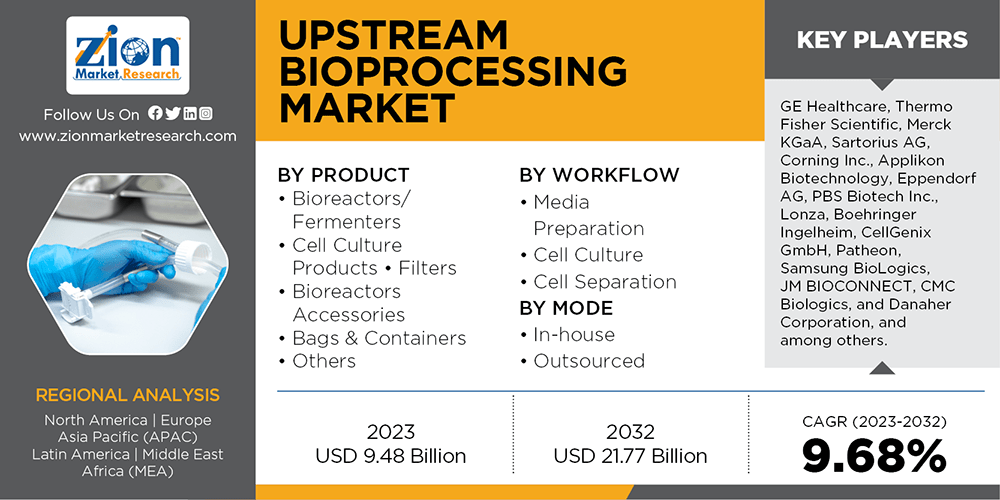
Upstream Bioprocessing Market: Report Scope
| Report Attributes | Report Details |
|---|---|
| Report Name | Upstream Bioprocessing Market |
| Market Size in 2023 | USD 9.48 Billion |
| Market Forecast in 2032 | USD 21.77 Billion |
| Growth Rate | CAGR of 9.68% |
| Number of Pages | 255 |
| Key Companies Covered | GE Healthcare, Thermo Fisher Scientific, Merck KGaA, Sartorius AG, Corning Inc., Applikon Biotechnology, Eppendorf AG, PBS Biotech Inc., Lonza, Boehringer Ingelheim, CellGenix GmbH, Patheon, Samsung BioLogics, JM BIOCONNECT, CMC Biologics, and Danaher Corporation, among others. |
| Segments Covered | By Product, By Workflow, By Mode, And By Region |
| Regions Covered | North America, Europe, Asia Pacific (APAC), Latin America, Middle East, and Africa (MEA) |
| Base Year | 2023 |
| Historical Year | 2018 - 2022 |
| Forecast Year | 2024 - 2032 |
| Customization Scope | Avail customized purchase options to meet your exact research needs. Request For Customization |
Upstream Bioprocessing Market: Segmentation
The Upstream Bioprocessing market is segmented by product, workflow, mode, and region.
Based on Product, the global upstream bioprocessing market is bifurcated into bioreactors/fermenters, cell culture products, filters, bioreactor accessories, bags & containers, and others. Bioreactors/fermenters segment held the largest market share in 2023 owing to increasing installations by small- and large-scale production. Technological advancements, process automation for cost-effective, regulatory-compliant, and safe manufacturing have contributed to the growth of the bioreactors/fermenters product type segment. The cell culture products segment is expected to grow at the highest CAGR over the forecast period owing to increasing demand for cell cultures with higher titer productivity to manufacture biosimilars and monoclonal antibodies (mAbs).
Based on Workflow, the market is segmented into media preparation, cell culture, and cell separation. The cell culture workflow segment held the largest market share in 2023 and is expected to retain its dominance over the forecast period. Technological advancements such as small-scale bioproduction using micro-bioreactors and the use of bioinformatics tools, data analysis & management solutions have contributed to the high growth of the cell culture workflow segment.
Based on Mode, the upstream bioprocessing market is segmented into in-house and outsourced. The in-house mode of bioprocessing held the largest market share due to its cost-effectiveness and the presence of a large number of firms with established in-house manufacturing. This dominance anchors market volume by reflecting the preference of many biopharmaceutical companies to retain direct control over critical upstream processes.
Upstream Bioprocessing Market: Regional Analysis
Why will North America continue to dominate the global market during the projection period?
At region level, North America held the largest market share of the global upstream bioprocessing market in 2024. The presence of major biopharmaceutical companies, increasing investment in research and development of new biomolecules & mAbs, increasing chronic disease burden, presence of developed infrastructure are major factors that propel market growth in this region.
In 2024, Europe was the second-largest regional market. The growth in Europe is attributed to increasing R&D activities on biosimilar and mAbs production, increasing collaborative research by academic and research institutes with biopharmaceutical players. Key countries including Germany, the United Kingdom, France, and Switzerland support steady demand through established biotech clusters and ongoing capacity expansion.
During the forecast period, Asia Pacific will register the highest growth rate for the upstream bioprocessing market. This is mainly due to the increasing number of players focusing on emerging market growth potential, rising biopharmaceutical manufacturing activity, and growing investment in local production capabilities across countries such as China, India, Japan, and South Korea.
Upstream Bioprocessing Market: Key Players
The global Upstream Bioprocessing market is dominated by players:
- GE Healthcare
- Thermo Fisher Scientific
- Merck KGaA
- Sartorius AG
- Corning Inc.
- Applikon Biotechnology
- Eppendorf AG
- PBS Biotech Inc.
- Lonza
- Boehringer Ingelheim
- CellGenix GmbH
- Patheon
- Samsung BioLogics
- JM BIOCONNECT
- CMC Biologics
- Danaher Corporation
The report segment of the global upstream bioprocessing market as follows:
By Product
- Bioreactors/Fermenters
- Cell Culture Products
- Filters
- Bioreactors Accessories
- Bags & Containers
- Others
By Workflow
- Media Preparation
- Cell Culture
- Cell Separation
By Mode
- In-house
- Outsourced
By Region
- North America
- The U.S.
- Canada
- Mexico
- Europe
- France
- The UK
- Spain
- Germany
- Italy
- Rest of Europe
- Asia Pacific
- China
- Japan
- India
- Australia
- South Korea
- Rest of Asia Pacific
- The Middle East & Africa
- Saudi Arabia
- UAE
- Egypt
- Kuwait
- South Africa
- Rest of the Middle East & Africa
- Latin America
- Brazil
- Argentina
- Rest of Latin America
Table Of Content
Methodology
FrequentlyAsked Questions
Upstream bioprocessing involves growing cells or microbes. It is the first stage in biopharmaceutical production
The global Upstream Bioprocessing market is expected to be driven by the rising biologics and vaccine production. Expansion of cell culture and biomanufacturing facilities boosts adoption.
According to study, the global Upstream Bioprocessing market size was worth around USD 9.48 Billion in 2023 and is predicted to grow to around USD 21.77 Billion By 2032.
The global Upstream Bioprocessing market is expected to grow at a Compound Annual Growth Rate (CAGR) of around CAGR 9.68% during the forecast period from 2024-2032.
The global Upstream Bioprocessing industry is projected to be challenged by Challenges include scale-up complexity, contamination risks, and high capital costs.
The Opportunities include biologics production growth, cell and gene therapy demand, single-use technologies, and biopharma outsourcing will offer significant growth opportunities in the Upstream Bioprocessing market.
Single-use and modular bioprocess systems; automation and PAT integration; scalability for biologics manufacturing are the emerging trends and innovations impacting the Upstream Bioprocessing market.
North America is expected to continue leading the market, supported by major biopharmaceutical presence, high R&D investment, and advanced infrastructure, while Asia Pacific is projected to register the highest growth rate.
Some of the prominent players operating in the global Upstream Bioprocessing market are; GE Healthcare, Thermo Fisher Scientific, Merck KGaA, Sartorius AG, Corning Inc., Applikon Biotechnology, Eppendorf AG, PBS Biotech Inc., Lonza, Boehringer Ingelheim, CellGenix GmbH, Patheon, Samsung BioLogics, JM BIOCONNECT, CMC Biologics, and Danaher Corporation, and among others. and others.
The report explores crucial aspects of the Upstream Bioprocessing market, including a detailed discussion of existing growth factors and restraints, while also browsing future growth opportunities and challenges that impact the market.

HappyClients

