
United States RV Rental Market Size, Share, Trends, Growth, Forecast 2034

United States RV Rental Market By Product (Motorhomes, Campervans, Conventional Travel Trailer, Fifth-Wheel Trailer, and Others), By Booking Mode (Offline and Online), By End-User (Family Trip, Couple Travel, Group, and Others), and By Region - Regional Industry Overview, Market Intelligence, Comprehensive Analysis, Historical Data, and Forecasts 2025 - 2034
| Market Size in 2024 | Market Forecast in 2034 | CAGR (in %) | Base Year |
|---|---|---|---|
| USD 410 Million | USD 720 Million | 5.8% | 2024 |
United States RV Rental Industry Perspective:
What will be the size of the United States RV rental market during the forecast period?
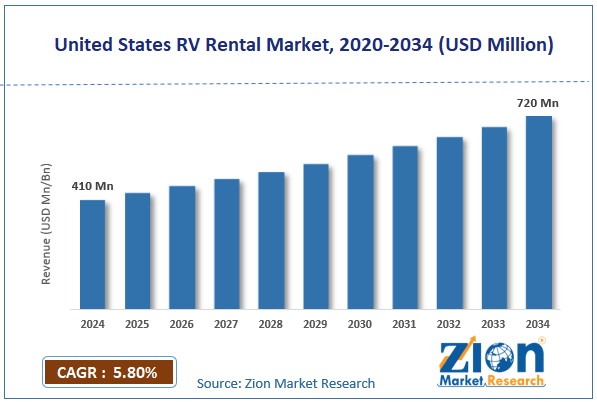
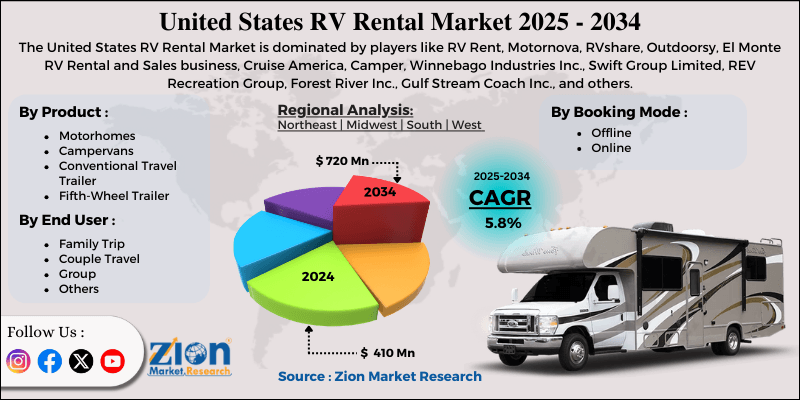
The United States RV Rental market size was worth around USD 410 million in 2024 and is predicted to grow to around USD 720 million by 2034, with a compound annual growth rate (CAGR) of roughly 5.8% between 2025 and 2034.
Key Insights
- As per the analysis shared by our research analyst, the United States RV Rental market is estimated to grow annually at a CAGR of around 5.8% over the forecast period (2025-2034).
- In terms of revenue, the United States RV Rental market size was valued at around USD 410 million in 2024 and is projected to reach USD 720 million by 2034.
- The increasing recreational activities are expected to drive the United States RV Rental market over the forecast period.
- Based on the product, the motorhomes segment captures the largest revenue share of 35% in 2024.
- Based on the booking mode, the online booking mode segment dominates the market, accounting 64% of the market share.
- Based on the end user, the family trips segment dominates the market, accounting for over 32% of revenue.
United States RV Rental Market: Overview
RV rental is the short or long-term rental of a recreational vehicle (RV) by a person or group for travel, vacation, business, or temporary accommodation. An RV is a privately or commercially owned, self-powered or towed vehicle with a motor or trailer that has built-in traveling amenities, including sleeping quarters, a kitchen, bathroom facilities, inbuilt storage compartments, and sometimes entertainment systems, thereby providing people with a combination of transport and housing within a single vehicle. The RV rental industry allows the general public to enjoy the experience of vehicle-based holidays, camping, and outdoor tourism without the financial and time commitments of RV ownership, including acquisition costs, ongoing maintenance, comprehensive insurance premiums, and storage requirements.
Rentals are generally supplied by commercial rental fleet operators and, increasingly, by peer-to-peer leasing schemes, whereby private owners rent out their own vehicles through online booking platforms. RV hire can include anything from a campervan or travel trailer to larger motorhomes (Class A, Class B, Class C), and is mostly used for family holidays, touring around the national parks, attending festivals and sports events, and traveling cross-country.
United States RV Rental Market: Dynamics
Growth Drivers
How does rising preference for flexible & experiential travel drive the US RV rental market growth?
Trends in flexible and experiential travel are fueling demand for RV rentals. Modern consumers —especially millennials, Generation Z, and young families — are less interested in fixed-itinerary attractions and more interested in customization and in engaging with the outdoors: exploring national parks, traveling along scenic coastlines, and escaping crowded airports and hotels. RV rentals accommodate adaptation, spontaneity, and more intimate immersion in the rustic landscape while affording practical advantages, such as easily altering routes, flexible starting points, and trip lengths, and localized experiences outside crowded tourist destinations.
With a concentration of the nation’s population venturing outdoors, wellness-oriented trips, and a 21st-century interpretation of “slow travel,” the types of intimate or autonomous travel afforded by RV rentals are increasingly relevant to the modern American first-time vacation.
Restraints
Why do the fuel price volatility and trip operating costs act as a major barrier to the US RV rental market development?
The declining fuel prices and rising trip operating costs pose a significant challenge for the United States RV rental market, due to increased total costs and uncertainty surrounding RV trips. Due to the high electricity needs, including heavy fuel consumption in large motorhomes, the overall travel cost varies sharply with fuel prices. When diesel or gasoline prices swamp holiday budgets, price-sensitive leisure travelers are more likely to opt for more predictable alternatives, such as flights, buses, or hotel rooms.
Apart from the fuel, the travelers are also expected to shoulder additional trip-related expenses, including park fees, insurance, tolls, refueling propane, mileage, and vehicle wear and tear. Due to the uncertainty, travelers are likely to delay booking, end up with short rental periods, or cancel the trip completely, resulting in an underutilized fleet and dissatisfied customers. Consequently, these factors have a dampening impact on demand and put mounting pressure on industry revenues.
Opportunities
Will the launch of new services offer a potential opportunity for the US RV rental industry?
The emergence of new services offers a huge scope for development. It is assumed that sustainable growth is more sustainable with the provision of added convenience and above-average revenue streams than with the liberation of a greater number of customers. New products and services will enable car rental companies to make their offerings more relevant to a wider range of customers, respond to changing consumer needs, and offer new service blends. Such as leisure vehicle hire by subscription, one-way rental services, doorstep collection/drop-off, packaged campground reservations, and flexible cancellation policies.
For instance, in January 2026, RVshare, the largest online community for RV owners and renters, revealed a suite of services aimed at taking the hassle out of RV travel for newbies and veterans alike. One-Way Rentals, RVshare Getaways, and a dedicated RV Rental Advisor team were revealed as part of the line-up, offering flexible trip planning, pre-arranged experiences at high-profile national parks, and expert trip-planning support to travelers in time for summer.
Challenges
Seasonality and demand concentration pose a significant challenge to the market
Seasonality and demand concentration are structurally problematic to the United States RV rental industry as demand is concentrated during peak travel periods—late spring through early fall—and relatively weak during the remaining months of the year. While peak season demand allows operators to achieve full fleet utilization and strong revenues, during the fall, winter, and winter holiday periods, fleet utilization drops significantly, vehicle inventory growth accelerates relative to revenue, and cash flow declines.
As capital costs such as vehicle insurance, parking, maintenance, labor, and financing payments must be incurred during the weak months of the year, this variation in demand compresses the sector's contribution margin. The concentrated demand for vacation vehicles can also restrict the utility and availability of fleet and limit price points available throughout the year.
United States RV Rental Market: Report Scope
| Report Attributes | Report Details |
|---|---|
| Report Name | United States RV Rental Market |
| Market Size in 2024 | 410 Million |
| Market Forecast in 2034 | 720 Million |
| Growth Rate | CAGR of 5.8% |
| Number of Pages | 221 |
| Key Companies Covered | RV Rent, Motornova, RVshare, Outdoorsy, El Monte RV Rental and Sales business, Cruise America, Camper, Winnebago Industries Inc., Swift Group Limited, REV Recreation Group, Forest River Inc., Gulf Stream Coach Inc., and others. |
| Segments Covered | By Product, By Booking Mode, By End User, and By Region |
| Regions Covered in U.S. | Northeast, Midwest, South, and West |
| Base Year | 2024 |
| Historical Year | 2019 to 2023 |
| Forecast Year | 2025 - 2034 |
| Customization Scope | Avail customized purchase options to meet your exact research needs. Request For Customization |
United States RV Rental Market: Segmentation
By Product Insights
Why do motorhomes hold the dominant position in the US RV rental market?
The motorhomes segment captures the largest revenue share of 35% in 2024. The increase can be attributed to increased consumer interest in convenience, comfort, and self-provisioning travel. Domestically, motorhomes have been appealing due to their multiple amenities and the fact that they serve as both a means of transportation and a place to stay, thus avoiding the purchase and towing of a separate vehicle that travel trailers require. The increasing popularity of road trips, national park visits, music festivals, and family vacations also drove demand for motorhome rentals, with larger Class C and luxurious Class A units in higher demand for their spacious, cozy living areas.
By Booking Mode Insights
Is the online booking mode growing substantially in the US RV rental industry?
The online booking mode segment dominates the market, accounting 64% of the market share. The industry's growth is attributed to the widespread digitalization of travel-related services and a notable shift in consumer purchase decisions. Modern travelers tend to appreciate the ability to browse and compare online and to lease their Motorhomes, campers, or Trailers via websites or smartphone applications. They also want access to transparent information on prices, the vehicles’ capabilities and features, availability calendars, and customer ratings, all integrated and accessible instantly. The emergence of peer-to-peer (P2P) rental websites and integrated digital marketplaces further enhanced the reach of these networks and their vehicle pools, without being limited by geographic location. Customers received cost-effective online booking systems, secure digital payment methods, flexible cancellation terms, and instant communication with the vehicle owner.
By End-User Insights
Does the family trips segment dominate the US RV rental industry?
The family trips segment dominates the market, accounting for over 32% of revenue. This growth is driven by the growing demand for cheaper, more flexible, ‘experience-focused’ vacations. Families are scheduling more RV trips because it consolidates transportation and accommodation costs, saving money compared to airfare, several hotel rooms, and eating out. Additionally, road trips are more comfortable for children and more convenient for parents, in the spacious surroundings of an RV equipped with beds, a kitchen, and entertainment systems.
United States RV Rental Market: Competitive Analysis
The United States RV Rental market is dominated by players like:
- RV Rent
- Motornova
- RVshare
- Outdoorsy
- El Monte RV Rental and Sales business
- Cruise America
- Camper
- Winnebago Industries Inc.
- Swift Group Limited
- REV Recreation Group
- Forest River Inc.
- Gulf Stream Coach Inc.
The United States RV Rental market is segmented as follows:
By Product
- Motorhomes
- Campervans
- Conventional Travel Trailer
- Fifth-Wheel Trailer
- Others
By Booking Mode
- Offline
- Online
By End User
- Family Trip
- Couple Travel
- Group
- Others
By Region
-
The U.S.
- Northeast
- Midwest
- South
- West
Table Of Content
Methodology
FrequentlyAsked Questions

HappyClients

