
Total Reflection X-Ray Fluorescence Market Size, Share, Value and Forecast 2034

Total Reflection X-Ray Fluorescence Market By Product Type (Portable and Benchtop), By Application (Contamination, Semiconductor, Pharmaceutical Quality Check, Environmental Monitoring, Food Safety, and Others), By End-User Industry (Environmental Labs, Semiconductor, Food & Beverage, Pharma & Biotech, and Academic Institutions), and By Region - Global and Regional Industry Overview, Market Intelligence, Comprehensive Analysis, Historical Data, and Forecasts 2025 - 2034
| Market Size in 2024 | Market Forecast in 2034 | CAGR (in %) | Base Year |
|---|---|---|---|
| USD 418.73 Million | USD 782.41 Million | 7.11% | 2024 |
Total Reflection X-Ray Fluorescence Industry Perspective:
What is the anticipated size of the global total reflection X-ray fluorescence market during the projection period?
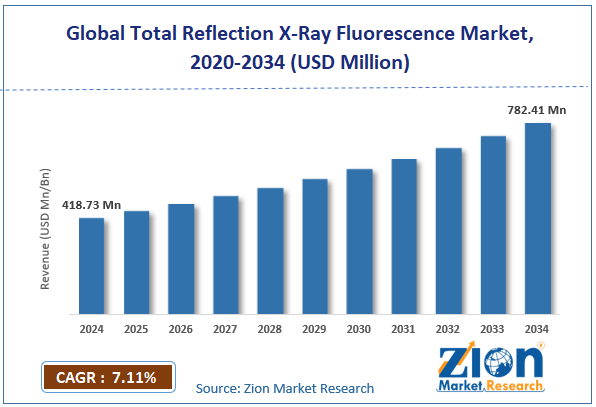
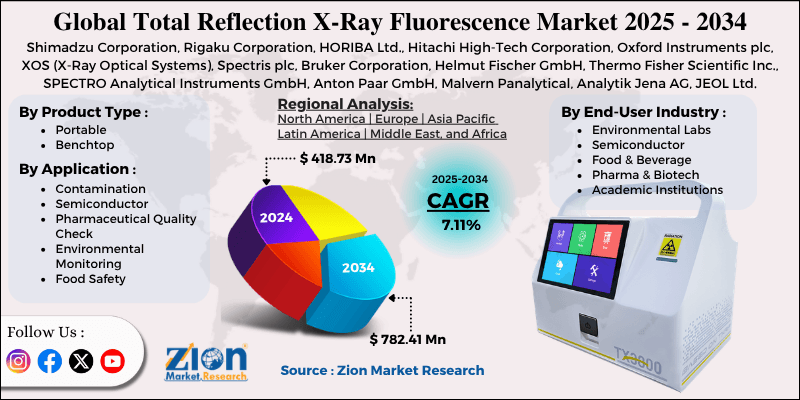
The global total reflection X-ray fluorescence market size was worth around USD 418.73 million in 2024 and is predicted to grow to around USD 782.41 million by 2034, with a compound annual growth rate (CAGR) of roughly 7.11% between 2025 and 2034.
Key Insights:
- As per the analysis shared by our research analyst, the global total reflection X-ray fluorescence market is estimated to grow annually at a CAGR of around 7.11% over the forecast period (2025-2034)
- In terms of revenue, the global total reflection X-ray fluorescence market size was valued at around USD 418.73 million in 2024 and is projected to reach USD 782.41 million by 2034.
- The total reflection X-ray fluorescence market is projected to grow at a significant rate due to the rapid expansion of the semiconductor industry.
- Based on the product type, the benchtop segment is growing at a high rate and will continue to dominate the global market, as per industry projections
- Based on the application, the semiconductor segment is anticipated to command the largest market share
- Based on the end-user industry, the semiconductor end-user industry segment is expected to lead the market growth trends
- Based on region, the Asia-Pacific is projected to dominate the global market during the forecast period
Total Reflection X-Ray Fluorescence Market: Overview
Total reflection X-ray fluorescence (TRXF) is a highly effective surface elemental analysis technique used for detecting residues, particles, and impurities on smooth surfaces. It is a dispersive XRF technique for ultra-trace analysis of unwanted elements on a given surface. Depending on its application scope, total reflection X-ray fluorescence can be classified into bulk chemical analysis, micro analysis, and surface analysis. Some of the most prominent advantages of TRXF include small sample analysis and rapid analysis compared to atomic spectroscopy. During the forecast period, demand for total reflection X-ray fluorescence is expected to continue to grow, led by rising applications in the semiconductor and environmental monitoring industries. Furthermore, growing concerns over food adulteration and an emphasis on food safety will accelerate market adoption. However, the high cost of TRXF instruments and competition from alternative techniques may impede market expansion in the long run.
Impact of the USA-Israel war on Iran on the Total Reflection X-Ray Fluorescence Market
The ongoing USA-Israel war on Iran is expected to have a direct short-term and long-term impact on the production and supply of TRXF devices. The current surge in energy prices due to risks in the Strait of Hormuz will increase TRXF manufacturing costs in the short term. However, as countries amplify defense spending on research & development, total reflection X-ray fluorescence devices may register improved revenue in the long term.
Total Reflection X-Ray Fluorescence Market: Dynamics
Growth Drivers
How will semiconductor industry expansion influence growth in the total reflection X-ray fluorescence market?
The global total reflection X-ray fluorescence market is expected to benefit from the rapid expansion of the semiconductor industry. According to official reports, the global semiconductor industry is expected to reach over USD 1.1 trillion by 2030. In addition, the chip production market is projected to witness accelerated investment in emerging markets as more countries seek to bolster regional semiconductor production and reduce dependency on traditionally dominant regions such as China and Taiwan. Total reflection X-ray fluorescence is an integral component of chip production processes, as it serves as the primary non-destructive analytical technique for detecting and quantifying metallic contamination on silicon wafer surfaces. TRXF devices have exceptionally high sensitivity, ranging between −100 dBm and −120 dBm, and are superior to their counterparts.
Increased applications in environmental monitoring are expected to remain a prominent growth driver in the industry
Total reflection X-ray fluorescence is a critical tool with extensive applications in environmental monitoring. For instance, the device is highly effective in detecting and quantifying heavy metals in the ecosystem. Moreover, it plays a crucial role in pollution monitoring. Growing concerns over the extensive environmental impact of industrialization, urbanization, and commercialization have worked in favor of total reflection X-ray fluorescence technology providers due to the device’s extreme sensitivity. Moreover, growing demand for soil and water analysis worldwide will influence the global total reflection X-ray fluorescence market growth trends.
Restraints
Why will cost constraints impact the total reflection X-ray fluorescence market growth trends?
The global total reflection X-ray fluorescence industry is expected to be restricted due to the high cost of technology ownership. The use of high-precision components such as vacuum systems, sensitive detectors, and X-ray sources, along with installation charges, makes the technology expensive to deploy in real-world situations. For instance, the average cost of an advanced TXRF can range from USD 115,000, depending on the features of the device.
Opportunities
Automated TRXF systems to generate growth opportunities for the industry players
The global total reflection X-ray fluorescence market is projected to generate growth opportunities due to rising demand for automated solutions. Researchers are actively developing miniaturized, automated TRXF systems for assessing the material composition of surfaces. These remotely controlled solutions can be beneficial in hazardous environments or areas that are difficult to access or assist with human labor. In addition, advancements in robotics and automation, along with Artificial Intelligence-powered total reflection X-ray fluorescence, will open new avenues for extended growth in the industry.
Why will concerns over food safety promote extended growth in the total reflection X-ray fluorescence market?
The last few years have witnessed an increase in food adulteration-related incidents.
According to official reports, more than 10 million deaths occur worldwide every year due to the consumption of low-grade food. War-torn nations and countries affected by geopolitical instability are at the highest risk of food adulteration and contamination. Countries across the globe have launched stricter initiatives to prevent food contamination, resulting in greater demand for TRFX devices.
Challenges
Competition from alternative solutions and a lack of skilled professionals to challenge market expansion
The global total reflection X-ray fluorescence industry is expected to face significant competition from alternative solutions. Some of the most prominent alternatives are Atomic Absorption Spectroscopy, Inductively Coupled Plasma Mass Spectrometry, and Inductively Coupled Plasma Optical Emission Spectroscopy. Additionally, a lack of sufficient access to skilled professionals and limited awareness may further impede market expansion trends in the future.
Total Reflection X-Ray Fluorescence Market: Report Scope
| Report Attributes | Report Details |
|---|---|
| Report Name | Total Reflection X-Ray Fluorescence Market |
| Market Size in 2024 | USD 418.73 Million |
| Market Forecast in 2034 | USD 782.41 Million |
| Growth Rate | CAGR of 7.11% |
| Number of Pages | 224 |
| Key Companies Covered | Shimadzu Corporation, Rigaku Corporation, HORIBA Ltd., Hitachi High-Tech Corporation, Oxford Instruments plc, XOS (X-Ray Optical Systems), Spectris plc, Bruker Corporation, Helmut Fischer GmbH, Thermo Fisher Scientific Inc., SPECTRO Analytical Instruments GmbH, Anton Paar GmbH, Malvern Panalytical, Analytik Jena AG, JEOL Ltd., and others. |
| Segments Covered | By Product Type, By Application, By End-User Industry, and By Region |
| Regions Covered | North America, Europe, Asia Pacific (APAC), Latin America, Middle East, and Africa (MEA) |
| Base Year | 2024 |
| Historical Year | 2019 to 2023 |
| Forecast Year | 2025 - 2034 |
| Customization Scope | Avail customized purchase options to meet your exact research needs. Request For Customization |
Total Reflection X-Ray Fluorescence Market: Segmentation
The global total reflection X-ray fluorescence market is segmented based on product type, application, end-user industry, and region.
Why will the benchtop segment lead the total reflection X-ray fluorescence industry revenue during the forecast period?
Based on product type, the global market segments are portable and benchtop. In 2024, the highest growth was listed in the benchtop segment, accounting for over 65.01% of global revenue. It is projected to generate a CAGR of 4.12% during the forecast period, driven by increased adoption of benchtop TRXF in semiconductor manufacturing and research facilities. Superior performance of benchtop TRFX as compared to portable versions will help the segment thrive.
Which factors will influence growth in the semiconductor segment in the total reflection X-ray fluorescence market during the projection period?
Based on application, the global total reflection X-ray fluorescence industry is divided into contamination, semiconductor, pharmaceutical quality check, environmental monitoring, food safety, and others. In 2024, around 34.9% of global revenue was listed in the semiconductor segment. It will contribute over 7.12% of the global revenue during the projection period, driven by growing demand for high-performance semiconductors and expansion of the chip manufacturing sector.
Why will semiconductors continue to lead the total reflection X-ray fluorescence industry in the coming years?
Based on end-user industry, the global market divisions are environmental labs, semiconductor, food & beverage, pharma & biotech, and academic institutions. The semiconductor end-user industry led the global market in 2024, contributing up to 40.02% of total revenue. It will continue leading the market with a CAGR of 7.12%. Segmental revenue will be influenced by the accurate detection of ultra-race metal contaminants on electronic components and silicon wafers.
Total Reflection X-Ray Fluorescence Market: Regional Analysis
What is the projected CAGR for North America in the total reflection X-ray fluorescence market during the forecast period?
The global total reflection X-ray fluorescence market is led by North America, accounting for 40.05% of the global revenue in 2024. It is projected to offer a CAGR of 3.1% during the projection period. The presence of several key TRXF device manufacturers across the US, along with stricter food safety standards and the device's use in environmental monitoring, will drive regional expansion in the future. However, the ongoing geopolitical tension across the US may slow down business revenue in the long run.
Why will Asia-Pacific emerge as the fastest-growing region in the telepresence video conferencing market during the forecast period?
Asia-Pacific is set to emerge as the fastest-growing region in the global total reflection X-ray fluorescence market in the coming years. Its global market share in 2024 was around 30.9% and is expected to grow at a CAGR of 7.5% during the forecast period. The presence of a massive, growing advanced semiconductor industry, along with industrialization and automation, will propel regional growth trends. Growing research on product miniaturization and higher use of TRXF in environmental monitoring will promote Asia-Pacific’s dominance during the forecast period.
Total Reflection X-Ray Fluorescence Market: Competitive Analysis
The global total reflection X-ray fluorescence market is led by players like:
- Shimadzu Corporation
- Rigaku Corporation
- HORIBA Ltd.
- Hitachi High-Tech Corporation
- Oxford Instruments plc
- XOS (X-Ray Optical Systems)
- Spectris plc
- Bruker Corporation
- Helmut Fischer GmbH
- Thermo Fisher Scientific Inc.
- SPECTRO Analytical Instruments GmbH
- Anton Paar GmbH
- Malvern Panalytical
- Analytik Jena AG
- JEOL Ltd.
What are the latest key trends in the total reflection X-ray fluorescence market?
Advancements in detector technology
Ongoing work to improve and expand the detection capabilities of total reflection X-ray fluorescence devices will be critical to the industry’s future growth. This includes the use of modern data processing software and enhancing the multi-element detection capabilities of the devices.
Applications in the pharmaceutical industry
The pharmaceutical industry is a leading user of total reflection X-ray fluorescence devices. TRFX technology allows pharmaceutical companies to develop safe products and comply with regulatory guidelines.
The global total reflection X-ray fluorescence market is segmented as follows:
By Product Type
- Portable
- Benchtop
By Application
- Contamination
- Semiconductor
- Pharmaceutical Quality Check
- Environmental Monitoring
- Food Safety
- Others
By End-User Industry
- Environmental Labs
- Semiconductor
- Food & Beverage
- Pharma & Biotech
- Academic Institutions
By Region
- North America
- The U.S.
- Canada
- Mexico
- Europe
- France
- The UK
- Spain
- Germany
- Italy
- Rest of Europe
- Asia Pacific
- China
- Japan
- India
- Australia
- South Korea
- Rest of Asia Pacific
- The Middle East & Africa
- Saudi Arabia
- UAE
- Egypt
- Kuwait
- South Africa
- Rest of the Middle East & Africa
- Latin America
- Brazil
- Argentina
- Rest of Latin America
Table Of Content
Methodology
FrequentlyAsked Questions
Total reflection X-ray fluorescence (TRXF) is a highly effective surface elemental analysis technique used for detecting residues, particles, and impurities on smooth surfaces.
Increased applications in environmental monitoring are expected to remain a prominent growth driver in the total reflection X-ray fluorescence industry.
According to study, the global total reflection X-ray fluorescence market size was worth around USD 418.73 million in 2024 and is predicted to grow to around USD 782.41 million by 2034.
The CAGR value of the total reflection X-ray fluorescence market is expected to be around 7.11% during 2025-2034.
The global total reflection X-ray fluorescence industry is expected to be challenged by the high competition the industry faces from alternative solutions.
Advancements in detector technology and applications in the pharmaceutical sector are the emerging trends and innovations impacting the total reflection X-ray fluorescence market.
The global total reflection X-ray fluorescence market has performed well so far and will offer similar trends in the coming years.
Asia-Pacific will contribute notably towards the total reflection X-ray fluorescence market value.
The global total reflection X-ray fluorescence market is led by players like Shimadzu Corporation, Rigaku Corporation, HORIBA, Ltd., Hitachi High-Tech Corporation, Oxford Instruments plc, XOS (X-Ray Optical Systems), Spectris plc, Bruker Corporation, Helmut Fischer GmbH, Thermo Fisher Scientific Inc., SPECTRO Analytical Instruments GmbH, Anton Paar GmbH, Malvern Panalytical, Analytik Jena AG, and JEOL Ltd.
The report explores crucial aspects of the total reflection X-ray fluorescence market, including a detailed discussion of existing growth factors and restraints, while also browsing future growth opportunities and challenges that impact the market.

List of Contents
Total Reflection X-Ray FluorescenceIndustry Perspective:Key Insights:OverviewDynamicsReport ScopeSegmentationRegional AnalysisCompetitive AnalysisWhat are the latest key trends in the total reflection X-ray fluorescence market?The global total reflection X-ray fluorescence market is segmented as follows:HappyClients

