
Telepresence Video Conferencing Market Size, Share, Trends, Growth and Forecast 2034

Telepresence Video Conferencing Market By Solution (Services and Solutions), By Conference Type (Desktop System, Telepresence System, Service-Based System, and Integrated System), By Organization (Small & Medium Enterprises and Large Enterprises), and By Region - Global and Regional Industry Overview, Market Intelligence, Comprehensive Analysis, Historical Data, and Forecasts 2025 - 2034
| Market Size in 2024 | Market Forecast in 2034 | CAGR (in %) | Base Year |
|---|---|---|---|
| USD 6.74 Billion | USD 18.44 Billion | 11.83% | 2024 |
Telepresence Video Conferencing Industry Perspective:
What is the anticipated size of the global telepresence video conferencing market during the projection period?
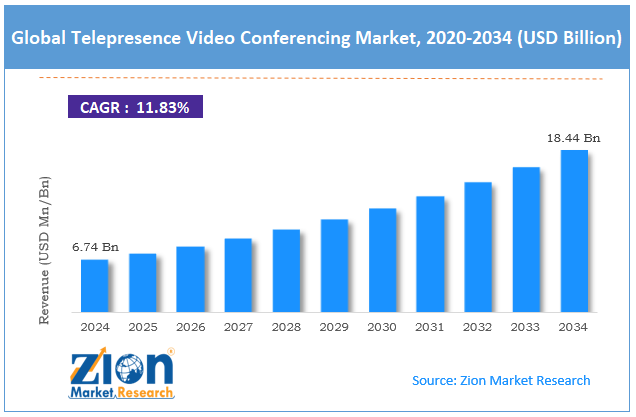
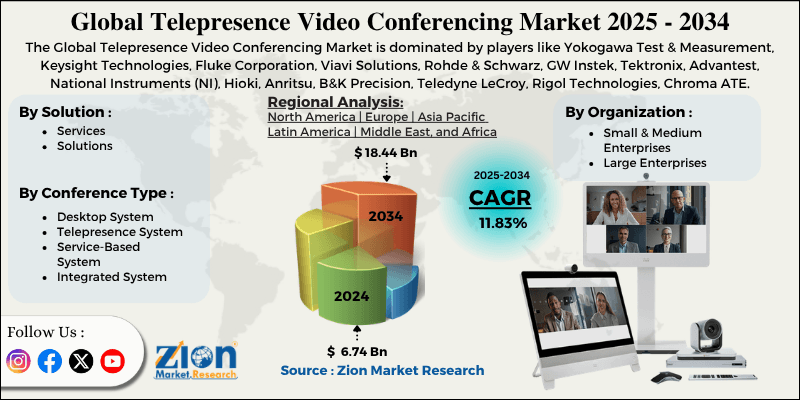
The global telepresence video conferencing market size was worth around USD 6.74 billion in 2024 and is predicted to grow to around USD 18.44 billion by 2034, with a compound annual growth rate (CAGR) of roughly 11.83% between 2025 and 2034.
 Request Free SampleRequest Free Sample
Key Insights:
- As per the analysis shared by our research analyst, the global telepresence video conferencing market is estimated to grow annually at a CAGR of around 11.83% over the forecast period (2025-2034)
- In terms of revenue, the global telepresence video conferencing market size was valued at around USD 6.74 billion in 2024 and is projected to reach USD 18.44 billion by 2034.
- The telepresence video conferencing market is projected to grow at a significant rate due to the rising remote work culture across the globe.
- Based on the solution, the solutions segment is growing at a high rate and will continue to dominate the global market, as per industry projections
- Based on the conference type, the integrated system segment is anticipated to command the largest market share
- Based on the organization, the large enterprises segment is expected to lead the market growth trends
- Based on region, North America is projected to dominate the global market during the forecast period
Telepresence Video Conferencing Market: Overview
Telepresence video conferencing is a new-age mode of digital video-based communication. It simulates an individual’s physical presence in a room. Telepresence video conferencing is designed to provide a level of visual interaction that can produce a natural communication environment. According to official reports, telepresence video conferencing is practically indistinguishable from traditional face-to-face communication, as it is not influenced by the geographical location of the participants. During the forecast period, the telepresence video conferencing industry is expected to generate high revenue, driven by the growing hybrid and remote work culture, business globalization, and monetary advantages associated with the technology. Additionally, the expansion of 5G, cloud computing, and Artificial Intelligence (AI) is expected to work in favor of the industry players. However, the high cost of initial investment, technical challenges in integrating telepresence with legacy infrastructure, and competition from alternative modes of communication will impact business revenue in the long run.
Telepresence Video Conferencing Market: Dynmics
Growth Drivers
How will the growing remote work culture influence the telepresence video conferencing market growth?
The global telepresence video conferencing market is expected to be driven by the rising remote work culture across the globe. According to official reports, more than 21% of the US workforce is currently employed in a remote work setting. Similar trends can be observed in other parts of the world, such as across Asian and European countries. Telepresence video conferencing can help companies improve remote work efficiency by allowing face-to-face-like conversations for remote workers. It helps improve team collaboration and engagement. As companies seek global talent to enhance business operations, they are more likely to invest in telepresence video conferencing technologies.
Business globalization and evolving geopolitics are expected to influence market revenue in the long run
Business globalization is expected to play a crucial role in shaping demand for telepresence video conferencing. Companies are increasingly expanding into new markets through mergers & acquisitions, strategic joint ventures, and other means. However, the evolving geopolitical situation worldwide has created barriers to smooth business travel across geographical locations. Under such circumstances, solutions available in the global telepresence video conferencing market can prove beneficial, as stakeholders can conduct mission-critical meetings using digital tools without needing to be physically present in the boardroom.
Restraints
Why will the high cost of investment affect demand in the telepresence video conferencing market?
The global telepresence video conferencing industry is expected to be constrained by the high initial investment required. The technology leverages high-end hardware elements such as large display panels, 4K cameras, and dedicated control systems. Additionally, the technology is powered by a specially designed telepresence room with appropriate lighting. High licensing fees and software subscriptions further add to the overall cost of technology ownership, resulting in limited end-user adoption.
Opportunities
Ongoing technological advancements in the industry are opening new doors for extended growth
The global telepresence video conferencing market is expected to generate growth opportunities due to ongoing technological advancements reported in the industry. These advancements are directed toward the integration of Artificial Intelligence, next-generation cameras, superior network infrastructure, and other technologies. In March 2024, Cisco, a technology leader, announced the launch of a new range of purpose-built, multifunctional devices for the hybrid workforce. These modernized collaborative tools include Cisco Board Pro G2, an AI-powered, touch-enabled collaboration device, along with the Cisco Desk Phone 9800 Series.
How will expansion into new industry verticals benefit the telepresence video conferencing market players?
New industry verticals such as education, government, and healthcare offer significant growth opportunities to the industry players. Novel industry verticals are seeking new, more effective modes of communication, especially those that frequently work with partners across geographic locations. For instance, the emergence of telemedicine and remote healthcare is an essential driver for telepresence video conferencing tools. Additionally, virtual classrooms drive demand for telepresence conferencing systems.
Challenges
Competition from alternative communication technologies and integration complexities is challenging market growth
The global telepresence video conferencing industry is expected to be challenged by the competition the industry faces from alternative and traditionally used communication technologies, such as voice over internet protocol (VoIP) services, emails, and messaging applications. These solutions require minimal investment and are easy to integrate into existing infrastructure, offering greater advantages as compared to telepresence-based communication systems.
 Request Free SampleRequest Free Sample
Telepresence Video Conferencing Market: Report Scope
| Report Attributes | Report Details |
|---|---|
| Report Name | Telepresence Video Conferencing Market |
| Market Size in 2024 | USD 6.74 Billion |
| Market Forecast in 2034 | USD 18.44 Bllion |
| Growth Rate | CAGR of 11.83% |
| Number of Pages | 228 |
| Key Companies Covered | Yokogawa Test & Measurement, Keysight Technologies, Fluke Corporation, Viavi Solutions, Rohde & Schwarz, GW Instek, Tektronix, Advantest, National Instruments (NI), Hioki, Anritsu, B&K Precision, Teledyne LeCroy, Rigol Technologies, Chroma ATE, and others. |
| Segments Covered | By Solution, By Conference Type, By Organization, and By Region |
| Regions Covered | North America, Europe, Asia Pacific (APAC), Latin America, Middle East, and Africa (MEA) |
| Base Year | 2024 |
| Historical Year | 2019 to 2023 |
| Forecast Year | 2025 - 2034 |
| Customization Scope | Avail customized purchase options to meet your exact research needs. Request For Customization |
Telepresence Video Conferencing Market: Segmentation
The global telepresence video conferencing market is segmented based on solution, conference type, organization, and region.
Why will the solutions segment lead the telepresence video conferencing industry revenue during the forecast period?
Based on the solution, the global market segments are services and solutions. In 2024, the highest growth was listed in the solutions segment. It accounted for 61.09% of global revenue in 2024 and is projected to deliver a CAGR of 12.01% in the coming years. The growing demand for cloud Software-as-a-Service (SaaS) technology and managed deployment will fuel segmental revenue in the future.
Which factors will influence growth in the integrated system segment in the telepresence video conferencing market during the projection period?
Based on conference type, the global telepresence video conferencing industry is fragmented into desktop systems, telepresence systems, service-based systems, and integrated systems. Around 39% of global revenue in 2024 was listed in the system segment. During the forecast period, the integrated system segment is projected to deliver the fastest CAGR of 14.2%. It is expected to capture a high market share due to its affordability and comprehensive end-user applications.
Why will large enterprises continue to lead the telepresence video conferencing industry in the coming years?
Based on organization, the global market divisions are small & medium enterprises and large enterprises. In 2024, around 59% of global revenue was listed in the large enterprises segment. It will continue to remain the most dominant market revenue generator, with a CAGR of 13.7% during the forecast period. Large enterprises typically have budgets for telecommunication technologies. Additionally, the global workforce and strategic partnerships encourage higher use of telepresence technologies in large companies.
Telepresence Video Conferencing Market: Regional Analysis
What is the projected CAGR for North America in the telepresence video conferencing market during the forecast period?
The global telepresence video conferencing market is led by North America, accounting for 35.05% of the global revenue in 2024. It is projected to offer a CAGR of 8.12% during the projection period. The presence of a growing hybrid workforce is a primary regional market growth driver. Additionally, early adoption of modern communication technologies, a higher concentration of Fortune 500 companies in the US region, and globalization will influence regional prominence in the coming years.
Why will Asia-Pacific emerge as the fastest-growing region in the telepresence video conferencing market during the forecast period?
Asia-Pacific is set to emerge as the fastest-growing region in the global telepresence video conferencing market in the coming years. Its global market share in 2024 was around 21.9%, and it is expected to exceed 29% by the end of the forecast period, growing at a CAGR of 10.5%. The rapid expansion of the regional IT sector, increasing workforce, the digitalization of commercial entities, and a growing number of domestic players will aid regional growth trends in the future.
Telepresence Video Conferencing Market: Competitive Analysis
The global telepresence video conferencing market is led by players like:
- Yokogawa Test & Measurement
- Keysight Technologies
- Fluke Corporation
- Viavi Solutions
- Rohde & Schwarz
- GW Instek
- Tektronix
- Advantest
- National Instruments (NI)
- Hioki
- Anritsu
- B&K Precision
- Teledyne LeCroy
- Rigol Technologies
- Chroma ATE
What are the latest key trends in the telepresence video conferencing market?
Integration of metaverse and immersive reality technologies
The ongoing work toward integration of metaverse and immersive reality technologies, such as augmented reality (AR) and virtual reality (VR), into telepresence video conferencing will help the industry thrive during the forecast period. These technologies are designed to improve the overall effectiveness of the communication systems.
Managed services
A promising trend in the telepresence video conferencing market is the growing demand for managed services, including security monitoring, user support, and platform hosting. The telepresence-as-a-service model holds exceptional growth possibilities in the future.
The global telepresence video conferencing market is segmented as follows:
By Solution
- Services
- Solutions
By Conference Type
- Desktop System
- Telepresence System
- Service-Based System
- Integrated System
By Organization
- Small & Medium Enterprises
- Large Enterprises
By Region
- North America
- The U.S.
- Canada
- Mexico
- Europe
- France
- The UK
- Spain
- Germany
- Italy
- Rest of Europe
- Asia Pacific
- China
- Japan
- India
- Australia
- South Korea
- Rest of Asia Pacific
- The Middle East & Africa
- Saudi Arabia
- UAE
- Egypt
- Kuwait
- South Africa
- Rest of the Middle East & Africa
- Latin America
- Brazil
- Argentina
- Rest of Latin America
Table Of Content
Methodology
FrequentlyAsked Questions
Telepresence video conferencing is a new-age mode of digital video-based communication. It simulates an individual’s physical presence in a room.
The global telepresence video conferencing market is expected to be driven by the rising remote work culture across the globe.
According to study, the global telepresence video conferencing market size was worth around USD 6.74 billion in 2024 and is predicted to grow to around USD 18.44 billion by 2034.
The CAGR value of the telepresence video conferencing market is expected to be around 11.83% during 2025-2034.
The global telepresence video conferencing industry is expected to be challenged by the competition the industry faces from alternate and traditionally used communication technologies such as voice over internet protocol (VoIP) services, emails, and messaging applications.
Integration of metaverse and immersive reality technologies and managed services are the emerging trends and innovations impacting the telepresence video conferencing market.
The global telepresence video conferencing market has performed well so far and will offer similar trends in the coming years.
The global telepresence video conferencing market is led by North America, accounting for 35.05% of the global revenue in 2024.
The global telepresence video conferencing market is led by players like Huawei, Microsoft, Logitech, Google, Cisco Systems, Verizon, Enghouse Systems, Pexip, Yealink, Zoom Video Communications, Lifesize, Avaya, StarLeaf, Poly, and ZTE.
The report explores crucial aspects of the telepresence video conferencing market, including a detailed discussion of existing growth factors and restraints, while also browsing future growth opportunities and challenges that impact the market.

List of Contents
Telepresence Video ConferencingIndustry Perspective:Key Insights:OverviewDynmicsReport ScopeSegmentationRegional AnalysisCompetitive AnalysisWhat are the latest key trends in the telepresence video conferencing market?The global telepresence video conferencing market is segmented as follows:HappyClients

