
Global Simulation Software Market Size, Share, Trends, Growth 2034

Simulation Software Market By Deployment (On-Premises and Cloud), By Application (Research & Development, Product Engineering, Gamification, and Others), By Industry (Aerospace & Defense, Manufacturing, Automotive, Healthcare, Electronics & Semiconductor, and Others), and By Region - Global and Regional Industry Overview, Market Intelligence, Comprehensive Analysis, Historical Data, and Forecasts 2026 - 2034
| Market Size in 2025 | Market Forecast in 2034 | CAGR (in %) | Base Year |
|---|---|---|---|
| USD 18.4 Billion | USD 44.3 Billion | 10.25% | 2025 |
Simulation Software Industry Perspective:
What is the anticipated size of the simulation software market during the projection period?
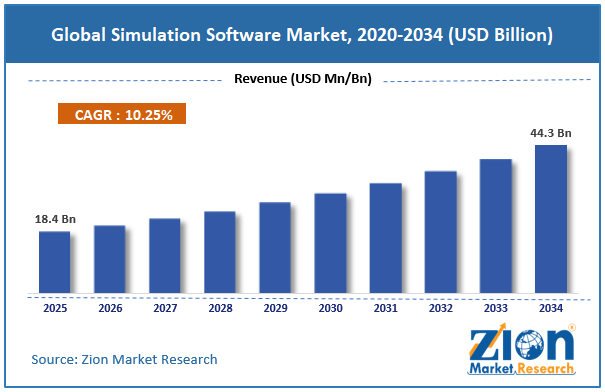
The global simulation software market size was worth around USD 18.4 billion in 2025 and is predicted to grow to around USD 44.3 billion by 2034, with a compound annual growth rate (CAGR) of roughly 10.25% between 2026 and 2034.
 Request Free SampleRequest Free Sample
Key Insights:
- As per the analysis shared by our research analyst, the global simulation software market is estimated to grow annually at a CAGR of around 10.25% over the forecast period (2026-2034)
- In terms of revenue, the global simulation software market size was valued at around USD 18.4 billion in 2025 and is projected to reach USD 44.3 billion, by 2034.
- The simulation software market is projected to grow at a significant rate due to the digitalization of the healthcare infrastructure and growth in defense expenditure.
- Based on the deployment, the cloud segment is growing at a high rate and will continue to dominate the global market as per industry projections.
- Based on the application, the research & development segment is anticipated to command the largest market share.
- Based on the industry, healthcare will emerge as the fastest-growing segment with a CAGR of 17.2%.
- Based on region, Asia-Pacific will contribute notably towards the simulation software market value.
Simulation Software Market: Overview
Simulation software is an advanced computer model based on real-world processes, systems, and phenomena. Simulation software is developed using mathematical formulas and has applications across industries. Simulation software is designed to reproduce digital versions of a real-life situation under defined conditions. This allows organizations to test a system’s behavior before it becomes live. According to market analysis, simulation software is used by engineers to develop prototypes and mitigate associated risks. The most common applications of simulation programs are registered in the healthcare, defense, and aviation industries.
During the forecast period, digitalization of the healthcare infrastructure and growth in defense expenditure will drive market revenue. However, high investment costs, cybersecurity risks, a lack of skilled professionals, and regulatory restrictions will affect market revenue during the forecast period.
Impact of the USA-Israel and Iran war on the Simulation Software Market:
The USA-Israel and Iran war will have a noticeable impact on the simulation software market. It is projected to affect the supply chain and transportation costs of chips, semiconductors, and other raw materials required to build simulation applications. The war is anticipated to encourage more reliance on domestic chip production to ensure sustained market growth. In the long run, this geopolitical instability will drive investments toward the introduction of new supply chain channels and strategic partnerships.
Simulation Software Market: Dynamics
Growth Drivers
Which healthcare applications will drive demand in the simulation software market?
The global simulation software market is expected to be driven by rising healthcare applications. As per industry research, healthcare professionals leverage simulation software to develop patient-centric care. Industry demand is driven by a growing shift away from traditional methods of learning in the healthcare space. For instance, practicing medical procedures on animals, patients, and cadavers without consent has become less acceptable.
In such circumstances, simulation software provides an ethical means to practice skills, knowledge, and behavior required to deliver optimal patient care. In February 2026, Maverick Simulation Solutions launched SIDDH. It is a high-fidelity critical care adult patient simulator and is integrated with advanced lung simulation technology. The ongoing use of digital twins, computational modeling and simulation (CM&S), and artificial intelligence (AI) in the healthcare sector will encourage adoption of digital simulators in the field.
Adoption of smart manufacturing techniques to propel industry revenue during the forecast period
Industry 5.0 and smart manufacturing strategies are projected to encourage simulation software adoption trends in the coming years. The integration of Industrial Internet of Things (IIoT), advanced automation, and robotics across manufacturing facilities requires simulation applications to optimize business processes. These technologies are expensive to deploy with limited scope for error. The solutions in the global simulation software market help companies test production workflows and validate errors before full-scale deployment.
Restraints
Which are the leading growth barriers in the simulation software market?
The global simulation software industry is expected to be restricted due to high cost of investment, repair, and maintenance. Simulation software is an advanced engineering solution that requires optimal information technology (IT) infrastructure to operate. For instance, the average cost of an Artificial Intelligence (AI)-powered simulation application for a healthcare facility can be over USD 1.1 million. Lack of funds and supportive infrastructure worldwide will affect industry growth in the coming years.
Opportunities
Will cloud-based simulation systems generate growth opportunities for the simulation software industry during the forecast period
The global simulation software market is expected to benefit from the rising investments in cloud-based applications. The rapid expansion of the Software-as-a-Service (SaaS) sector across industries has elevated access to simulation programs at cost-effective prices. End-users do not have to invest in building ancillary architecture from scratch. They can collaborate with companies offering simulation programs using flexible billing options such as annual or pay-as-you-go pricing.
In July 2026, Siemens, a leading technology company with a global presence, announced the availability of the latest Simcenter software. It is a portfolio of engineering simulation and testing software, and the new additions include significant enhancements. Simcenter is equipped with AI and is expected to help engineers reduce reliance on time-intensive simulation runs. In March 2026, Synopsys launched the Electronics Digital Twin (eDT) Platform. This open platform is designed to assist the development of physical AI solutions and is expected to drive revenue for cloud-based simulation applications.
Challenges
How will technical challenges and a lack of skilled professionals challenge the simulation software market?
The global simulation software industry is projected to be challenged by technical limitations upon integration with older systems. Creating a coherent ecosystem between simulation software and legacy infrastructure can be resource-intensive and time-consuming. In addition, a lack of skilled professionals and cybersecurity risks will further limit industry growth trends in the coming years.
Simulation Software Market: Report Scope
| Report Attributes | Report Details |
|---|---|
| Report Name | Simulation Software Market |
| Market Size in 2025 | USD 18.4 Billion |
| Market Forecast in 2034 | USD 44.3 Billion |
| Growth Rate | CAGR of 10.25% |
| Number of Pages | 228 |
| Key Companies Covered | Siemens Digital Industries Software, ANSYS Inc., The MathWorks Inc., Hexagon AB, MSC Software Corporation, Synopsys Inc., Autodesk Inc., COMSOL AB, Dassault Systèmes SE, Bentley Systems Inc., AVEVA Group plc, ESI Group, Altair Engineering Inc., Cadence Design Systems Inc., PTC Inc., and others. |
| Segments Covered | By Deployment, By Application, By Industry, and By Region |
| Regions Covered | North America, Europe, Asia Pacific (APAC), Latin America, Middle East, and Africa (MEA) |
| Base Year | 2025 |
| Historical Year | 2020 - 2024 |
| Forecast Year | 2026 - 2034 |
| Customization Scope | Avail customized purchase options to meet your exact research needs. Request For Customization |
Simulation Software Market: Segmentation
The global simulation software market is segmented based on deployment, application, industry, and region.
Why will the cloud segment lead the simulation software industry revenue during the forecast period?
Based on deployment, the global market segments are on-premises and cloud. In 2025, the highest growth was listed in the on-premises segment. It contributed up to 66% of the global revenue. During the forecast period, the cloud segment is anticipated to generate the fastest CAGR of 18.1% due to higher SaaS adoption trends, improved cost-efficiency, scalability, and increasing customization options.
Which will be the fastest-growing application during the forecast period in the simulation software market?
Based on application, the global simulation software industry is fragmented into research & development, product engineering, gamification, and others. The highest revenue in 2025 was listed in the product engineering segment. It accounted for 48% of the global revenue. In the coming years, research & development will lead market growth with a CAGR of 16.2% due to growing use in healthcare research, material development, and chip design.
Which factors drive demand in the healthcare segment in the simulation software industry?
Based on industry, the global market segments are aerospace & defense, manufacturing, automotive, healthcare, electronics & semiconductor, and others. The manufacturing industry was the leading revenue generator in 2025. It accounted for 28.5% of the total market share. During the forecast period, healthcare will emerge as the fastest-growing segment with a CAGR of 17.2%. Segmental growth will be driven by increasing use for surgery preparation, rising digitalization, and use of automation technologies for clinical decision-making.
Simulation Software Market: Regional Analysis
Why will North America lead the simulation software market in the coming years?
The global simulation software market is currently led by North America. In 2025, it accounted for 40.5% of the global revenue and will grow at a CAGR of 13.01% during the forecast period. Early market adoption of simulation systems, increasing defense expenditure, and higher demand in the healthcare sector will drive regional growth trends. In addition, the presence of crucial players and supportive digital infrastructure will prove beneficial for the North American market.
Why will Asia-Pacific generate the fastest CAGR in the simulation software market during the forecast period?
Asia-Pacific is expected to emerge as the fastest-growing region in the simulation software market with a CAGR of 16.91% during the forecast period. In 2025, it accounted for 27.9% of the global revenue. Growth in Asia-Pacific will be driven by rapid industrialization, introduction of new smart factories, accelerated adoption of automation across manufacturing facilities, and an increasing number of domestic providers of simulation programs. The regional chip industry will play a crucial role in shaping the regional market during the forecast period.
Simulation Software Market: Competitive Analysis
The global simulation software market is led by players like:
- Siemens Digital Industries Software
- ANSYS Inc.
- The MathWorks Inc.
- Hexagon AB
- MSC Software Corporation
- Synopsys Inc.
- Autodesk Inc.
- COMSOL AB
- Dassault Systèmes SE
- Bentley Systems Inc.
- AVEVA Group plc
- ESI Group
- Altair Engineering Inc.
- Cadence Design Systems Inc.
- PTC Inc.
What are the latest key trends in the simulation software market?
Higher demand for multiphysics simulation
Multiphysics simulations are platforms that allow multiple functions to run simultaneously. These functions include modeling of electromagnetic, fluid, thermal, and mechanical interactions. Multiphysics simulation platforms offer improved results at cost-effective prices.
Integration with Virtual Reality (VR) and Augmented Reality (AR) technologies
Integration of AR and VR technologies with simulation software enables better visualization. These technologies can enhance training results and reduce manufacturing errors.
The global simulation software market is segmented as follows:
By Deployment
- On-Premises
- Cloud
By Application
- Research & Development
- Product Engineering
- Gamification
- Others
By Industry
- Aerospace & Defense
- Manufacturing
- Automotive
- Healthcare
- Electronics & Semiconductor
- Others
By Region
- North America
- The U.S.
- Canada
- Mexico
- Europe
- France
- The UK
- Spain
- Germany
- Italy
- Rest of Europe
- Asia Pacific
- China
- Japan
- India
- Australia
- South Korea
- Rest of Asia Pacific
- The Middle East & Africa
- Saudi Arabia
- UAE
- Egypt
- Kuwait
- South Africa
- Rest of the Middle East & Africa
- Latin America
- Brazil
- Argentina
- Rest of Latin America
Table Of Content
Methodology
FrequentlyAsked Questions
Simulation software is an advanced computer model based on real-world processes, systems, and phenomena.
The global simulation software market is expected to be driven by rising healthcare applications.
According to study, the global simulation software market size was worth around USD 18.4 billion in 2025 and is predicted to grow to around USD 44.3 billion by 2034.
The CAGR value of the simulation software market is expected to be around 10.25% during 2026-2034.
The global simulation software industry is projected to be challenged by technical limitations upon integration with older systems.
Higher demand for multiphysics simulation and integration with Virtual Reality (VR) and Augmented Reality (AR) technologies are the emerging trends and innovations impacting the simulation software market.
The global simulation software market has performed well so far and will offer similar trends in the coming years.
Asia-Pacific will contribute notably towards the simulation software market value.
The global simulation software market is led by players like The global simulation software market is led by players like Siemens Digital Industries Software, ANSYS, Inc., The MathWorks, Inc., Hexagon AB, MSC Software Corporation, Synopsys, Inc., Autodesk, Inc., COMSOL AB, Dassault Systèmes SE, Bentley Systems, Inc., AVEVA Group plc, ESI Group, Altair Engineering Inc., Cadence Design Systems, Inc., and PTC Inc., among others.
The report explores crucial aspects of the simulation software market, including a detailed discussion of existing growth factors and restraints, while also browsing future growth opportunities and challenges that impact the market.

HappyClients

