
Semiconductor Photonic Integrated Circuits Market Size, and Forecast 2034

Semiconductor Photonic Integrated Circuits Market By Material (III-V Material, Silica-on-silicon, Lithium Niobate and Others), By Integration Process (Hybrid and Monolithic), By Application (Telecommunications, Data Centers, Biomedical and Others) and By Region - Global and Regional Industry Overview, Market Intelligence, Comprehensive Analysis, Historical Data, and Forecasts 2025 - 2034
| Market Size in 2024 | Market Forecast in 2034 | CAGR (in %) | Base Year |
|---|---|---|---|
| USD 14.2 Billion | USD 38.5 Billion | 10.5% | 2024 |
Semiconductor Photonic Integrated Circuits Industry Perspective:
What will be the size of the global semiconductor photonic integrated circuits market during the forecast period?
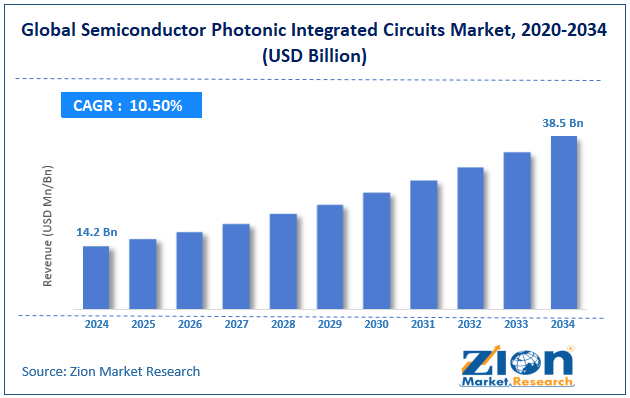
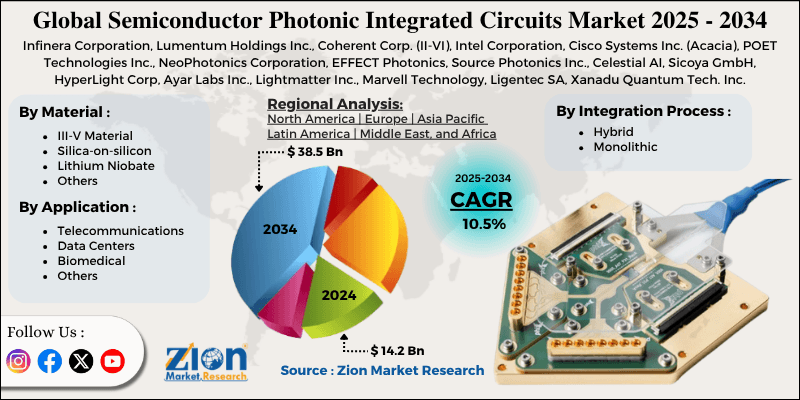
The global semiconductor photonic integrated circuits market size was worth around USD 14.2 billion in 2024 and is predicted to grow to around USD 38.5 billion by 2034 with a compound annual growth rate (CAGR) of roughly 10.5% between 2025 and 2034.
Key Insights
- As per the analysis shared by our research analyst, the global semiconductor photonic integrated circuits market is estimated to grow annually at a CAGR of around 10.5% over the forecast period (2025-2034).
- In terms of revenue, the global semiconductor photonic integrated circuits market size was valued at around USD 14.2 billion in 2024 and is projected to reach USD 38.5 billion by 2034.
- Expansion of AI, Cloud, and High-Performance Computing (HPC) is expected to propel the semiconductor photonic integrated circuits market over the projected period.
- Based on the material, the III-V material segment capture the largest market share of 33% in 2024.
- Based on the integration process, the hybrid integration segment captures the largest revenue share in 2024.
- Based on the application, the data centers segment dominates the market in 2024.
- Based on region, North America captures the largest market share in 2024 of 39%.
Semiconductor Photonic Integrated Circuits Market: Overview
Photonic Integrated Circuits (PICs) made from semiconductors are sophisticated microchips that incorporate many optical components, including lasers, modulators, waveguides, and photodetectors, on a single semiconductor material. The semiconductor materials used are mostly silicon and indium phosphide. PICs do not depend on electrical signals, unlike conventional electronics. Rather, photonic integrated circuits use light to conduct signals and perform processing operations, resulting in increased speeds, higher bandwidths, and greater energy efficiency. They have numerous applications in optical communication, computer systems and data storage, quantum computing, sensing techniques, and LiDAR, among others. By incorporating several photonic functionalities into a single chip, PICs become more compact and simpler while remaining extremely efficient.
Impact of the USA-Israel War on Iran on the Semiconductor Photonic Integrated Circuits Market
The USA-Israel-Iran conflict currently underway is indirectly placing significant strain on the PICs industry by disrupting semiconductor supply chains, increasing the cost of raw materials, and creating uncertainty about technology investments. For instance, there have been disruptions in the availability of helium and petrochemicals, which are important in the production of semiconductors used in chip manufacturing. The cost of production is further elevated by high energy and logistical costs, following disruptions in key shipping lanes such as the Strait of Hormuz. Further, raising production costs is the fact that electronic parts and boards have become expensive, compounded by a supply shortage. This affects photonic chips, which require advanced semiconductors.
Semiconductor Photonic Integrated Circuits Market: Dynamics
Growth Drivers
Why does the surging demand for high-speed data transmission drive the semiconductor photonic integrated circuits market?
There has been an increase in data transfer frequency due to cloud computing, streaming services, 5G, and AI, leading to new performance issues for conventional electronic chips in data transmission. This is because electronic connections suffer from signal loss, heat generation, and bandwidth limitation. In photonic integrated circuits, the shortcomings of electronic connections are avoided, as light signals rather than electrical signals are used. Hence, high bandwidth, quick information transfers, and low latency become the salient features of photonic integrated circuits.
As fast, efficient communication channels become essential for the operation of hyperscale data centers and telecommunications networks, there will be a greater need for photonic integrated circuits to address this challenge. Thus, driving the semiconductor photonic integrated circuits industry.
Restraints
Are the high manufacturing complexity and cost hindering the growth of the semiconductor photonic integrated circuits industry?
Manufacturing complexities and high costs represent another limitation affecting the growth of the semiconductor photonic integrated circuits market. While traditional electronic chips have simpler manufacturing processes than PICs, these devices incorporate numerous optical components, including lasers, modulators, and detectors. The manufacture of such devices is more complex and involves advanced technology and methods that are essential during their production.
In addition, advanced lithography and other critical factors are key to the manufacture of semiconductor PICs. This makes their manufacturing more challenging while increasing the potential for defects. On the other hand, specialized manufacturing facilities, high equipment costs, and elaborate packaging and testing raise production costs.
Opportunities
Do the growing product launches offer a lucrative opportunity for the semiconductor photonic integrated circuits market?
The rising product launch is expected to offer a potential opportunity to the semiconductor photonic integrated circuits market during the projected period. For instance, in April 2026, The Secretary, Ministry of Electronics and Information Technology (MeitY) has introduced two silicon photonics technologies: a) silicon photonics process design kit (PDK) for fabrication of photonics chips; and b) universal packed programmable photonic integrated circuit (PPIC) test engine. Indigenous silicon PDK consists of more than 50 verified components. It helps provide necessary enablement for design in India for various industrial, startup, academic, and defense R&D entities to design innovative Photonic ICs.
The Indigenous universal PPIC test engine represents an advanced, automated characterization solution for photonic and optoelectronics modules across a wide variety of applications. The secretary also announced the start of the center's second phase of technology development. He complimented the center, the Center of Excellence for Programmable Photonic Integrated Circuits and Systems (CoE-CPPICS), stating that silicon photonics in India was on par with that available worldwide. This should be supported by establishing a silicon photonics fab under the India Semiconductor Mission.
Challenges
Lack of standardization and design ecosystem poses a significant challenge to the semiconductor photonic integrated circuits market
The absence of standardization and design ecosystems poses a substantial challenge in the evolution of the PIC industry. Although the manufacturing process for standard semiconductors involves a high level of standardization, along with a well-defined design automation system and process design kit, this is not the case with PICs. The choice of materials, such as silicon photonics or indium phosphide, can result in different design methodologies.
Furthermore, the absence of standardized manufacturing, packaging, and testing processes in PIC design makes it difficult to achieve efficient designs and slows the design process. Design engineers can be deprived of adequate simulation software and other necessary design elements, thereby increasing research costs.
Semiconductor Photonic Integrated Circuits Market: Report Scope
| Report Attributes | Report Details |
|---|---|
| Report Name | Semiconductor Photonic Integrated Circuits Market |
| Market Size in 2024 | USD 14.2 Billion |
| Market Forecast in 2034 | USD 38.5 Billion |
| Growth Rate | CAGR of 10.5% |
| Number of Pages | 227 |
| Key Companies Covered | Infinera Corporation, Lumentum Holdings Inc., Coherent Corp. (II-VI), Intel Corporation, Cisco Systems Inc. (Acacia), POET Technologies Inc., NeoPhotonics Corporation, EFFECT Photonics, Source Photonics Inc., Celestial AI, Sicoya GmbH, HyperLight Corp, Ayar Labs Inc., Lightmatter Inc., Marvell Technology, Ligentec SA, Xanadu Quantum Tech. Inc., Ciena Corporation, OpenLight Photonic Inc., Juniper Networks (Aurrion IP), and others. |
| Segments Covered | By Material, By Integration Process, By Application, and By Region |
| Regions Covered | North America, Europe, Asia Pacific (APAC), Latin America, Middle East, and Africa (MEA) |
| Base Year | 2024 |
| Historical Year | 2019 to 2023 |
| Forecast Year | 2025 - 2034 |
| Customization Scope | Avail customized purchase options to meet your exact research needs. Request For Customization |
Semiconductor Photonic Integrated Circuits Market: Segmentation
Material Insights
Why does the III-V material dominate the semiconductor photonic integrated circuits market?
The III-V material segment capture the largest market shares of 33% in 2024. The growth of this market sector will be driven by various factors, including specific material characteristics, high electron mobility, high light absorption and emission efficiency, high heat stability, and high thermal conductivity. Additionally, the III-V material is chosen over others due to its low power consumption capabilities.
Integration Process Insights
How does the hybrid integration capture the largest market share in the semiconductor photonic integrated circuits market?
The hybrid integration segment captures the largest revenue share in 2024. The various techniques of hybrid integration include selective area growth, die-to-wafer bonding, flip-chip bonding, and many more. Some advantages of hybrid integration of photonic integrated circuits include flexible design, lower costs, increased performance, and reduced physical size. The use of hybrid integration for PIC across applications such as telecommunications, data centers, medical imaging, and sensors will boost its demand in this market segment.
Application Insights
Does data centers segment dominate the semiconductor photonic integrated circuits market?
The data centers segment dominates the market in 2024. It is because of the capacity of such systems to improve the performance. Such PICs serve a very important purpose when it comes to rapid transfer of data by utilizing light as compared to electronic signals. Moreover, their ability to be more efficient when it comes to the use of energy results in their greater usage in data centers. Also, they function at lower temperatures and emit lesser heat.
Regional Insights
Why does North America lead the semiconductor photonic integrated circuits market?
North America captures the largest market share in 2024 of 39%. This is due to factors such as the increasing adoption of 5G technology in the region, the presence of many data centers in North America, rising demand in the biomedical industry, and several semiconductor players in the region. Increased use of PICs in data centers for cost-effectiveness and fast data transmission is driving demand in the market. Besides, the Asia Pacific is expected to grow at the highest CAGR during the forecast period owing to the rising government initiatives and increasing product launch.
Semiconductor Photonic Integrated Circuits Market: Competitive Analysis
The global semiconductor photonic integrated circuits market is dominated by players like;
- Infinera Corporation
- Lumentum Holdings Inc.
- Coherent Corp. (II-VI)
- Intel Corporation
- Cisco Systems Inc. (Acacia)
- POET Technologies Inc.
- NeoPhotonics Corporation
- EFFECT Photonics
- Source Photonics Inc.
- Celestial AI
- Sicoya GmbH
- HyperLight Corp
- Ayar Labs Inc.
- Lightmatter Inc.
- Marvell Technology
- Ligentec SA
- Xanadu Quantum Tech. Inc.
- Ciena Corporation
- OpenLight Photonic Inc.
- Juniper Networks (Aurrion IP)
The global semiconductor photonic integrated circuits market is segmented as follows:
By Material
- III-V Material
- Silica-on-silicon
- Lithium Niobate
- Others
By Integration Process
- Hybrid
- Monolithic
By Application
- Telecommunications
- Data Centers
- Biomedical
- Others
By Region
- North America
- The U.S.
- Canada
- Mexico
- Europe
- France
- The UK
- Spain
- Germany
- Italy
- Rest of Europe
- Asia Pacific
- China
- Japan
- India
- Australia
- South Korea
- Rest of Asia Pacific
- The Middle East & Africa
- Saudi Arabia
- UAE
- Egypt
- Kuwait
- South Africa
- Rest of the Middle East & Africa
- Latin America
- Brazil
- Argentina
- Rest of Latin America
Table Of Content
Methodology
FrequentlyAsked Questions
Photonic Integrated Circuits (PICs) made from semiconductors are sophisticated microchips that incorporate many optical components, including lasers, modulators, waveguides, and photodetectors, on a single semiconductor material.
Key growth drivers for the semiconductor photonic integrated circuits market include rising demand for high-speed data transmission, expansion of AI and cloud computing, increasing need for energy-efficient solutions, and rapid deployment of 5G and optical communication networks.
Major challenges include high manufacturing complexity and costs, integration difficulties with electronic systems, lack of standardization and mature design ecosystem, and complex packaging and testing requirements.
Based on the application, the data centers segment is expected to dominate the semiconductor photonic integrated circuits market growth during the projected period.
Emerging trends and innovations in the semiconductor photonic integrated circuits market include co-packaged optics, programmable photonics, advanced materials (e.g., lithium niobate), and growing adoption in AI, quantum computing, and LiDAR applications, all enabling higher integration, speed, and energy efficiency.
According to the report, the global semiconductor photonic integrated circuits market size was worth around USD 14.2 billion in 2024 and is predicted to grow to around USD 38.5 billion by 2034.
The global semiconductor photonic integrated circuits market is expected to grow at a CAGR of 10.5% during the forecast period.
The global semiconductor photonic integrated circuits industry growth is expected to be led by North America over the forecast period.
Which are the major players leveraging the semiconductor photonic integrated circuits market growth?
The global semiconductor photonic integrated circuits market is dominated by players like Infinera Corporation, Lumentum Holdings Inc., Coherent Corp. (II-VI), Intel Corporation, Cisco Systems Inc. (Acacia), POET Technologies Inc., NeoPhotonics Corporation, EFFECT Photonics, Source Photonics Inc., Celestial AI, Sicoya GmbH, HyperLight Corp, Ayar Labs Inc., Lightmatter Inc., Marvell Technology, Ligentec SA, Xanadu Quantum Tech. Inc., Ciena Corporation, OpenLight Photonic Inc. and Juniper Networks (Aurrion IP) among others.
The market report covers the geographical market along with a comprehensive competitive landscape analysis. It also includes cash flow analysis, profit ratio analysis, market basket analysis, market attractiveness analysis, sentiment analysis, PESTLE analysis, trend analysis, SWOT analysis, trade area analysis, demand & supply analysis, Porter’s five forces analysis, and value chain analysis.

HappyClients