
Global Robotic Process Automation Market Size, Share Report, Growth, Trends, 2032

Robotic Process Automation Market By Component (Software and Service), By End Use Industry (Retail, Transportation, BFSI, Healthcare, Manufacturing, IT & Telecom, and Others), and By Region - Global and Regional Industry Overview, Market Intelligence, Comprehensive Analysis, Historical Data, and Forecasts 2024 - 2032
| Market Size in 2023 | Market Forecast in 2032 | CAGR (in %) | Base Year |
|---|---|---|---|
| USD 4.13 Billion | USD 84.30 Billion | 39.8% | 2023 |
Robotic Process Automation Market: Industry Perspective
What will be the global robotic process automation market size during the forecast period?
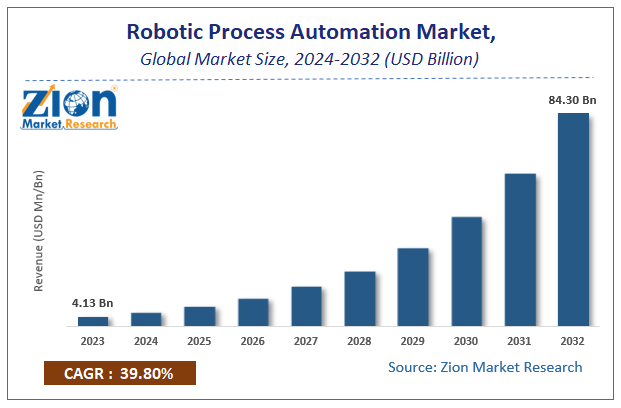
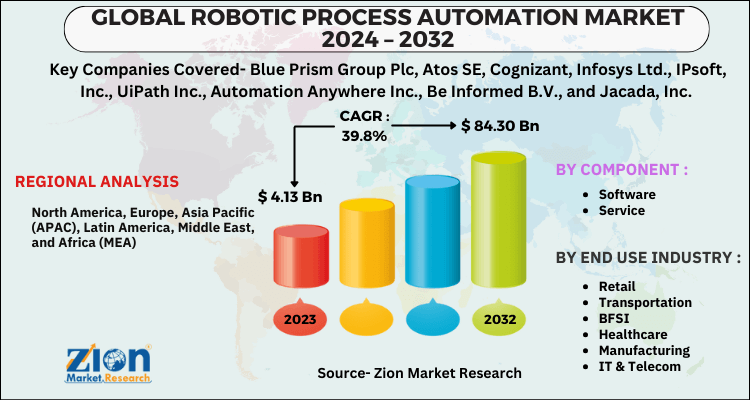
The global robotic process automation market size was worth around USD 4.13 billion in 2023 and is predicted to reach around USD 84.30 billion by 2032, with a compound annual growth rate (CAGR) of roughly 39.8% between 2024 and 2032.
This report provides a comprehensive analysis of the growth drivers, restraints, and challenges shaping demand across the global robotic process automation market throughout the forecast period, while highlighting high-potential emerging opportunities within the industry.
 Request Free Sample
Key Insights
- As per the analysis shared by our research analyst, the global robotic process automation market is estimated to grow annually at a CAGR of around 39.8% over the forecast period (2024-2032).
- In terms of revenue, the global robotic process automation market size was valued at around USD 4.13 billion in 2023 and is projected to reach USD 84.30 billion by 2032.
- The market is driven by increasing use of the internet and automation in the retail sector, digitalization, and demand for automated solutions to handle orders, accounts, and logistics.
- Based on the component segment, the software segment is anticipated to rise at a substantial rate during the forecast period.
- Based on the end use industry segment, the retail sector is expected to contribute significantly to market growth through automated handling of accounts, orders, and shipments.
- North America holds a substantial share of the global robotic process automation market and is anticipated to maintain its dominance during the analysis period.
Robotic Process Automation Market: Overview
Robotic process automation (RPA) refers to software-based tools and related services that automate repetitive, rule-based business processes across applications and systems. Organizations use RPA to handle tasks such as data entry, order updates, account management, and shipment tracking without requiring continuous human intervention at each step.
Robotic Process Automation Market: Growth Drivers
What factors are primarily accelerating demand in the robotic process automation market?
Increasing use of the internet in the retail sector is driving the global robotic process automation market. Digitalization is helping retailers broaden their customer base. In the US alone, e-commerce sales grew by almost 16% in 2017 from 2016. Global e-commerce sales in 2017 were USD 2.3 trillion, up from USD 1.3 trillion in 2014.
A major factor behind this growth is the increasing use of mobile applications for online shopping. Global products and services purchased through mobile accounted for about 60% in 2017, up from 52.5% in 2016. Retail organizations have adopted automated solutions to handle illegal accounts, update orders, and track shipped goods.
Thus, the retail sector will contribute significantly to robotic process automation market growth during the forecast timeframe. However, the high initial investment is expected to adversely affect robotic process automation market growth. Nonetheless, technological advancements and developments across industry sectors may open new avenues for the market in the near future.
Robotic Process Automation Market: Restraints
What factors are limiting the expansion of the robotic process automation market?
High initial investment is expected to have an adverse effect on robotic process automation market growth. Implementing RPA platforms, integrating them with existing systems, and training staff can require substantial upfront capital and project effort.
Smaller organizations or those with limited IT budgets may delay or scale back deployments, which can moderate the pace of adoption in some segments and regions.
Robotic Process Automation Market: Opportunities
Where do significant growth opportunities lie for the robotic process automation market?
Advancements in technology along with developments in various industry sectors may open new avenues for the market in the near future. Expansion beyond retail into BFSI, healthcare, manufacturing, IT and telecom, and transportation creates additional demand for process automation.
Continued growth of digital channels and the need to reduce cost and enhance productivity support longer-term opportunities for both software and service providers.
Robotic Process Automation Market: Challenges
What key challenges confront participants in the robotic process automation market?
Managing the cost and complexity of initial deployment remains a central challenge for many buyers. Integrating RPA with legacy systems and ensuring governance, security, and process quality require careful planning.
Demonstrating clear return on investment and scaling from pilot projects to enterprise-wide automation are ongoing challenges for both vendors and end users.
Robotic Process Automation Market: Report Scope
| Report Attributes | Report Details |
|---|---|
| Report Name | Robotic Process Automation Market |
| Market Size in 2023 | USD 4.13 Billion |
| Market Forecast in 2032 | USD 84.30 Billion |
| Growth Rate | CAGR of 39.8% |
| Number of Pages | 248 |
| Key Companies Covered | Blue Prism Group Plc, Atos SE, Cognizant, Infosys Ltd., IPsoft, Inc., UiPath Inc., Automation Anywhere Inc., Be Informed B.V., and Jacada, Inc., among others |
| Segments Covered | By Component, By End Use Industry, and By Region |
| Regions Covered | North America, Europe, Asia Pacific (APAC), Latin America, Middle East, and Africa (MEA) |
| Base Year | 2023 |
| Historical Year | 2018 - 2022 |
| Forecast Year | 2024 - 2032 |
| Customization Scope | Avail customized purchase options to meet your exact research needs. Request For Customization |
Robotic Process Automation Market: Segmentation
The robotic process automation market is segmented by component, end-use industry, and region. All the segments of the robotic process automation market have been analyzed based on present and future trends and the market is estimated from 2024 to 2032.
By component segment, the robotic process automation market is divided into software and services. The software segment is anticipated to rise at a substantial rate during the forecast period because core automation platforms and bots form the foundation of RPA deployments. This growth drives overall market expansion by anchoring license and subscription demand, while services support implementation, integration, training, and ongoing optimization that help organizations realize value from automation across retail, BFSI, and other industries.
By end-use industry segment, the robotic process automation market is divided into retail, transportation, BFSI, healthcare, manufacturing, IT and telecom, and others. The retail sector is expected to contribute significantly to market growth as organizations use automation to manage accounts, update orders, and track shipments amid rising e-commerce and mobile commerce volumes. This focus drives demand for RPA software and services, while BFSI, healthcare, manufacturing, IT and telecom, and transportation expand adoption to reduce cost and improve productivity in process-intensive operations.
Robotic Process Automation Market: Regional Analysis
Why will North America continue to dominate the global market during the projection period?
North America holds a substantial share in the global robotic process automation market and is anticipated to maintain its dominance during the analysis period. Increasing use of robotic process automation in the retail sector, along with rapid technological advancements, is the major driver of the market in this region. Further, prominent market players such as IPsoft Inc., Automation Anywhere, Inc., and others in the region are expected to shape the robotic process automation market significantly. The use of automation processes in the BFSI sector to reduce costs and enhance productivity is a major driver of growth in the robotic process automation market in the Asia Pacific region. The Asia Pacific is projected to grow at a significant rate during the forecast period.
Recent Developments
-
In October 2020, Automation Anywhere, Inc. announced a strategic cloud partnership with leading technology cloud platforms to deploy web-based, cloud-native digital automation software across global enterprise shared service centers.
Robotic Process Automation Market: Competitive Landscape
The global robotic process automation market is dominated by players:
- Blue Prism Group Plc
- Atos SE
- Cognizant
- Infosys Ltd.
- IPsoft, Inc.
- UiPath Inc.
- Automation Anywhere Inc.
- Be Informed B.V.
- Jacada, Inc.
Robotic Process Automation Market: Key Trends
What are the key trends in the robotic process automation market?
Software-led growth and retail-driven adoption
Software is anticipated to rise at a substantial rate as organizations invest in core automation platforms, while the retail sector contributes significantly through automated handling of accounts, orders, and shipments linked to e-commerce growth.
Expansion into cost and productivity use cases across industries
Beyond retail, BFSI and other sectors are adopting RPA to reduce cost and enhance productivity, supporting broader market expansion and demand for both software and related services.
Segments Covered
The global robotic process automation market is segmented as follows:
By Component
- Software
- Service
By End Use Industry
- Retail
- Transportation
- BFSI
- Healthcare
- Manufacturing
- IT & Telecom
- Others
By Region
- North America
- The U.S.
- Canada
- Mexico
- Europe
- France
- The UK
- Spain
- Germany
- Italy
- Rest of Europe
- Asia Pacific
- China
- Japan
- India
- Australia
- South Korea
- Rest of Asia Pacific
- The Middle East & Africa
- Saudi Arabia
- UAE
- Egypt
- Kuwait
- South Africa
- Rest of the Middle East & Africa
- Latin America
- Brazil
- Argentina
- Rest of Latin America
Table Of Content
Methodology
FrequentlyAsked Questions
Robotic process automation is the use of software and related services to automate repetitive, rule-based business processes such as order updates, account management, and shipment tracking across applications and systems.
Key growth drivers include increasing use of the internet and e-commerce in the retail sector, digitalization, and demand for automated solutions to handle accounts, orders, and logistics, along with broader need to reduce cost and improve productivity.
The global robotic process automation market was valued at approximately USD 4.13 billion in 2023 and is projected to reach around USD 84.30 billion by 2032.
The global robotic process automation market is expected to expand at a compound annual growth rate of approximately 39.8% between 2024 and 2032.
North America holds a substantial share and is anticipated to maintain dominance, supported by retail automation, technology advances, and the presence of major vendors. Asia Pacific is projected to grow at a significant rate.
Major players include Blue Prism Group Plc, Atos SE, Cognizant, Infosys Ltd., IPsoft, Inc., UiPath Inc., Automation Anywhere Inc., Be Informed B.V., and Jacada, Inc.

HappyClients

