RF Test Equipment Market Size, Trend, Growth, Industry Analysis 2034

RF Test Equipment Market By Equipment Type (Power Meters, Network Analyzers, Spectrum Analyzers, Signal Generators, Oscilloscopes, and Others), By Frequency Range (Less than 1 GHz, 1 GHz-6 GHz, 7 GHz-20 GHz, and More than 20 GHz), By Form Factor (Modular, Portable, Bench Top, and Rackmount), By End-Use Industry (Telecommunications, Aerospace & Defense, Electronics Manufacturing, Automotive, Medical Devices, and Others), and By Region - Global and Regional Industry Overview, Market Intelligence, Comprehensive Analysis, Historical Data, and Forecasts 2026 - 2034
| Market Size in 2025 | Market Forecast in 2034 | CAGR (in %) | Base Year |
|---|---|---|---|
| USD 3.99 Billion | USD 8.39 Billion | 8.60% | 2025 |
RF Test Equipment Industry Perspective:
What is the anticipated size of the RF test equipment market during the projection period?
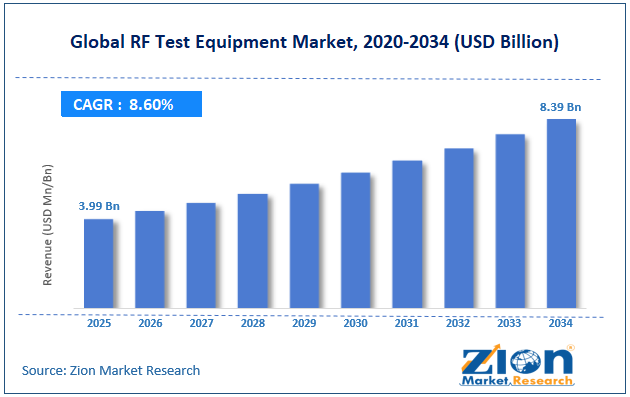
The global RF test equipment market size was worth around USD 3.99 billion in 2025 and is predicted to grow to around USD 8.39 billion by 2034, with a compound annual growth rate (CAGR) of roughly 8.60% between 2026 and 2034.
Key Insights:
- As per the analysis shared by our research analyst, the global RF test equipment market is estimated to grow annually at a CAGR of around 8.60% over the forecast period (2026-2034)
- In terms of revenue, the global RF test equipment market size was valued at around USD 3.99 billion in 2025 and is projected to reach USD 8.39 billion, by 2034.
- The RF test equipment market is projected to grow at a significant rate due to a surge in 5G and telecom investments, growing defense research, and the introduction of next-generation testing equipment.
- Based on the equipment type, network analyzers are projected to deliver a CAGR of 8.9% due to higher applications in automotive radar testing, mmWave communication systems, and semiconductor validation.
- Based on the frequency, more than 20 GHz will emerge as the fastest-growing segment with a CAGR of 11.02%
- Based on the form factor, modular systems will grow at a higher CAGR of 10.5% during the forecast period
- Based on the end-user industry, the automotive sector is anticipated to generate the highest CAGR of 8.12% during the forecast period.
- Based on region, North America is projected to dominate the global market during the forecast period.
RF Test Equipment Market: Overview
Radio frequency (RF) test equipment is an essential tool for designing, testing, producing, and debugging radio frequency devices. Each piece of equipment that leverages radio frequencies is designed using RF testing equipment. Common types of radio frequency test devices include network analyzers, power sensors, signal generators, and spectrum analyzers. RF testing equipment is used across industries, including network & telecommunications, defense, aviation & space exploration, automotive, healthcare, and research organizations. During the forecast period, demand for RF test equipment is expected to grow due to a surge in 5G and telecom investments, growing defense research, and the introduction of next-generation testing equipment. However, high investment costs, the risk of equipment obsolescence, and technical complexities will challenge market growth in the coming years.
Impact of the USA-Israel and Iran war on the RF Test Equipment Market:
The USA-Israel and Iran war has affected the RF test equipment market due to supply chain disruption of essential raw materials such as helium. This conflict has delayed semiconductor-based shipments, which are essential for producing advanced RF test equipment. However, defense-oriented demand for radio frequency testing equipment has continued to grow in the last year. During the forecast period, the war is anticipated to encourage the building of more resilient supply chains.
RF Test Equipment Market: Dynamics
Growth Drivers
How will increased deployment of 5G infrastructure support growth in the RF test equipment market?
The global RF test equipment market will be led by the increasing deployment of 5G networks and the expansion of existing telecommunication infrastructure. Telecom operators frequently use RF test equipment to test, repair, and maintain network architecture elements such as antennas, base stations, transmission systems, radio access network (RAN) equipment, and fiber-optic and wireless backhaul segments. The rapid proliferation of 5G networks and growing efforts to expand telecom services in remote locations will drive market revenue in the coming years. According to official reports, Nigeria witnessed an increase in 5G adoption from 0.1% in June 2024 to over 4.5% by June 2026. Additionally, China is expected to have more than 1.7 billion 5G connections by the end of 2030. Such promising results will promote demand for advanced RF test equipment.
Modern automotive sector to open new doors for growth in the RF test equipment market
Radio frequency test equipment is critical to the optimal performance of modern, advanced, and connected automotives. These vehicles rely heavily on radar systems and wireless communication solutions. Common applications of RF test equipment in automotives include validating Advanced Driver Assistance Systems (ADAS), testing Vehicle-to-Everything (V2X) communication, and testing navigation systems. The introduction of semiautonomous vehicles, self-driving cars, and electric automotives will work in favor of the global RF test equipment market during the forecast period.
Restraints
What are the leading restraints in the RF test equipment industry?
The global RF test equipment industry will be restricted by the high cost of advanced devices and repair & maintenance expenses. Research centers and companies with limited budgets may find sophisticated RF test equipment unaffordable. Additionally, manufacturers have to spend considerable time and resources on initial research & development (R&D), creating difficulties for new players to enter the industry.
Opportunities
What will be the impact of the growing defense budget on the RF test equipment market?
The global RF test equipment market is projected to benefit from the rising defense budget worldwide. The growing use of electronic warfare systems and defense modernization is projected to drive revenue for RF test equipment offering microwave and millimeter-wave testing, high-precision RF analyzers, and radar and satellite testing. 360 One Asset, a leading Indian asset management firm, raised over USD 18 million in funds for the country’s defense and aerospace startups. Rising geopolitical conflict and national security threats will create revenue for RF test equipment manufacturers.
Ongoing technological advancements are delivering novel growth avenues to the RF test equipment companies
Market players are working on delivering next-generation RF test equipment. Most modern equipment operates at higher frequencies and wider bandwidths. Moreover, equipment with multi-standard testing capabilities, advanced signal analysis, and automated testing systems are gaining high growth momentum. In August 2026, Mini-Circuits announced the launch of two novel power amplifiers with Gallium Nitride on Silicon Carbide (GaN-on-SiC) transistors for demanding applications in telecom, test systems, and defense applications.
Challenges
Risk of equipment obsolescence and technical complexities challenge RF test equipment industry expansion
The global RF test equipment industry will be challenged by accelerated technological changes that create risk of equipment obsolescence. Rapid advancements in wireless communication systems, 6G, and automotive radar can reduce equipment lifecycles. Moreover, technical complexities in testing next-generation wireless solutions and high calibration requirements may further affect industry revenue in the coming years.
RF Test Equipment Market: Report Scope
| Report Attributes | Report Details |
|---|---|
| Report Name | RF Test Equipment Market |
| Market Size in 2025 | USD 3.99 Billion |
| Market Forecast in 2034 | USD 8.39 Billion |
| Growth Rate | CAGR of 8.60% |
| Number of Pages | 227 |
| Key Companies Covered | Rohde & Schwarz GmbH & Co. KG, Keysight Technologies Inc., Advantest Corporation, VIAVI Solutions Inc., RIGOL Technologies Inc., National Instruments (NI), Anritsu Corporation, B&K Precision Corporation, EXFO Inc., Teledyne Technologies Incorporated, Yokogawa Electric Corporation, Chroma ATE Inc., Teradyne Inc., Fortive Corporation, Tektronix Inc., and others. |
| Segments Covered | By Equipment Type, By Frequency Range, By Form Factor, By End-Use Industry, and By Region |
| Regions Covered | North America, Europe, Asia Pacific (APAC), Latin America, Middle East, and Africa (MEA) |
| Base Year | 2025 |
| Historical Year | 2020 - 2024 |
| Forecast Year | 2026 - 2034 |
| Customization Scope | Avail customized purchase options to meet your exact research needs. Request For Customization |
RF Test Equipment Market: Segmentation
The global RF test equipment market is segmented based on equipment type, frequency range, form factors, end-user industry, and region.
Why will the network analyzers segment lead the RF test equipment industry revenue during the forecast period?
Based on equipment type, the global market divisions are power meters, network analyzers, spectrum analyzers, signal generators, oscilloscopes, and others. In 2025, the spectrum analyzers segment showed the highest growth. It accounted for 30% of the total revenue. During the forecast period, network analyzers are projected to deliver a CAGR of 8.9% due to higher applications in automotive radar testing, mmWave communication systems, and semiconductor validation.
Which frequency segment will grow the fastest during the forecast period in the RF test equipment market?
Based on frequency, the global RF test equipment industry is fragmented into less than 1 GHz, 1 GHz-6 GHz, 7 GHz-20 GHz, and more than 20 GHz. 1 GHz-6 GHz was the leading segment in 2025, accounting for 54% of the total revenue. In the coming years, more than 20 GHz will emerge as the fastest-growing segment with a CAGR of 11.02%, driven by higher integration in satellite communication and next-generation aerospace systems.
Which factors drive demand in the modular segment in the RF test equipment industry?
Based on form factor, the global market segments are modular, portable, benchtop, and rackmount. In 2025, benchtop RF test equipment was the most popular. It accounted for 47% of the total market share. During the forecast period, modular systems will grow at a higher CAGR of 10.5% as these solutions are customizable and offer multiple measurement functions, thus ensuring enhanced testing capabilities at reduced cost.
What will be the influence of the automotive segment on the RF test equipment market?
Based on the end-user industry, the global market divisions are telecommunications, aerospace & defense, electronics manufacturing, automotive, medical devices, and others. Telecommunications was the leading revenue generator in 2025. It contributed 46% of the total revenue. The Growing integration of wireless systems in modern automotives will propel growth in the end-user industry.
RF Test Equipment Market: Regional Analysis
Why will North America lead the RF test equipment market in the coming years?
The global RF test equipment market is currently led by North America. In 2025, it accounted for 38% of the global revenue and will grow at a CAGR of 7.12% during the forecast period. Growth in North America is driven by extensive 5G network infrastructure, higher defense spending, and growing private-sector investments in space exploration. Additionally, rising efforts to boost domestic chip and semiconductor production will help North America maintain its prominence in the global landscape.
Why will Asia-Pacific generate the fastest CAGR in the RF test equipment market during the forecast period?
Asia-Pacific is expected to emerge as the fastest-growing region in the RF test equipment market with a CAGR of 7.62% during the forecast period. In 2025, it accounted for 36% of the global revenue. Expanding network architecture, growing work on 5G and 6G networking solutions, and accelerated production of next-generation automotives will drive regional growth. Furthermore, integration of advanced robotic solutions across industrial facilities and favorable government policies will encourage growth in Asia-Pacific.
RF Test Equipment Market: Competitive Analysis
The global RF test equipment market is led by players like:
- Rohde & Schwarz GmbH & Co. KG
- Keysight Technologies Inc.
- Advantest Corporation
- VIAVI Solutions Inc.
- RIGOL Technologies Inc.
- National Instruments (NI)
- Anritsu Corporation
- B&K Precision Corporation
- EXFO Inc.
- Teledyne Technologies Incorporated
- Yokogawa Electric Corporation
- Chroma ATE Inc.
- Teradyne Inc.
- Fortive Corporation
- Tektronix Inc.
What are the latest key trends in the RF test equipment market?
Modular and software-defined instruments
Modular and software-defined instruments offer several advantages over conventional equipment. These benefits include faster reconfiguration and improved scalability. Modular equipment is expected to grow significantly in the future.
Remote testing and cloud integration
Cloud-integrated RF test equipment with remote testing features has become a prominent market trend. They encourage collaborative validation and centralized test management, promoting greater end-user adoption.
The global RF test equipment market is segmented as follows:
By Equipment Type
- Power Meters
- Network Analyzers
- Spectrum Analyzers
- Signal Generators
- Oscilloscopes
- Others
By Frequency Range
- Less than 1 GHz
- 1 GHz-6 GHz
- 7 GHz-20 GHz
- More than 20 GHz
By Form Factor
- Modular
- Portable
- Benchtop
- Rackmount
By End-Use Industry
- Telecommunications
- Aerospace & Defense
- Electronics Manufacturing
- Automotive
- Medical Devices
- Others
By Region
- North America
- The U.S.
- Canada
- Mexico
- Europe
- France
- The UK
- Spain
- Germany
- Italy
- Rest of Europe
- Asia Pacific
- China
- Japan
- India
- Australia
- South Korea
- Rest of Asia Pacific
- The Middle East & Africa
- Saudi Arabia
- UAE
- Egypt
- Kuwait
- South Africa
- Rest of the Middle East & Africa
- Latin America
- Brazil
- Argentina
- Rest of Latin America
Table Of Content
Methodology
FrequentlyAsked Questions
Radio frequency (RF) test equipment is an essential tool required to design, test, produce, and debug all radio frequency devices.
The global RF test equipment market will be led by the increasing deployment of the 5G network and the expansion of existing telecommunication infrastructure.
According to study, the global RF test equipment market size was worth around USD 3.99 billion in 2025 and is predicted to grow to around USD 8.39 billion by 2034.
The CAGR value of the RF test equipment market is expected to be around 8.60% during 2026-2034.
The global RF test equipment industry will be challenged by accelerated technological changes that create a risk of equipment obsolescence.
Modular and software-defined instruments, remote testing, and cloud integration are the emerging trends and innovations impacting the RF test equipment market.
The global RF test equipment market has performed well so far and will offer similar trends in the coming years.
North America will contribute notably towards the RF test equipment market value.
The global RF test equipment market is led by players like Rohde & Schwarz GmbH & Co. KG, Keysight Technologies, Inc., Advantest Corporation, VIAVI Solutions Inc., RIGOL Technologies Inc., National Instruments (NI), Anritsu Corporation, B&K Precision Corporation, EXFO Inc., Teledyne Technologies Incorporated, Yokogawa Electric Corporation, Chroma ATE Inc., Teradyne, Inc., Fortive Corporation, and Tektronix, Inc.
The report explores crucial aspects of the RF test equipment market, including a detailed discussion of existing growth factors and restraints, while also browsing future growth opportunities and challenges that impact the market.

HappyClients