
Refillable Deodorant Market Size, Growth, Global Trends, Forecast 2034

Refillable Deodorant Market By Type (Powder Deodorants, Spray Deodorants, Stick Deodorants, and Roll-On Deodorants), By Mechanism (Electric and Manual), By Application (Feet, Body, and Underarm), By Scent (Sensitive Skin, Unscented, and Fragrances), By Target Group (Men, Women, and Unisex), and By Region - Global and Regional Industry Overview, Market Intelligence, Comprehensive Analysis, Historical Data, and Forecasts 2026 - 2034
| Market Size in 2025 | Market Forecast in 2034 | CAGR (in %) | Base Year |
|---|---|---|---|
| USD 218.74 Million | USD 1,046.38 Million | 18.99% | 2025 |
Refillable Deodorant Industry Perspective:
What is the anticipated size of the refillable deodorant market during the projection period?
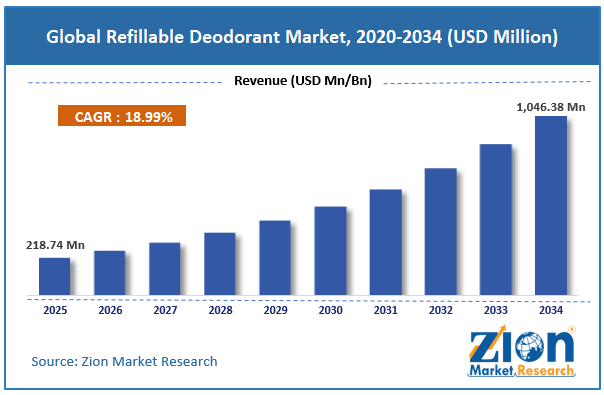
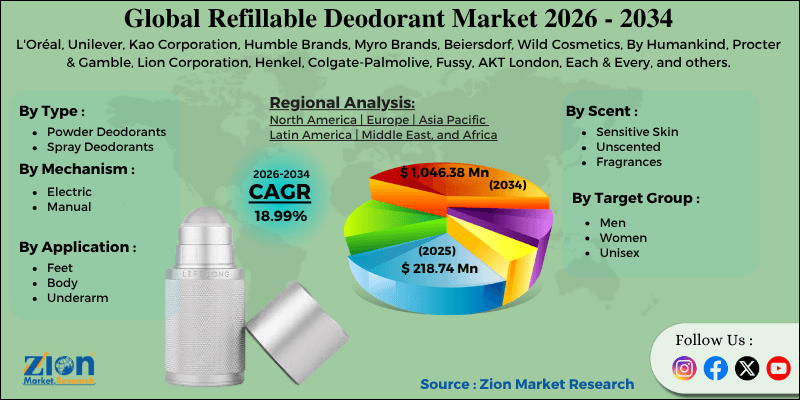
The global refillable deodorant market size was worth around USD 218.74 million in 2025 and is predicted to grow to around USD 1,046.38 million by 2034, with a compound annual growth rate (CAGR) of roughly 18.99% between 2026 and 2034.
Key Insights:
- As per the analysis shared by our research analyst, the global refillable deodorant market is estimated to grow annually at a CAGR of around 18.99% over the forecast period (2026-2034)
- In terms of revenue, the global refillable deodorant market size was valued at around USD 218.74 million in 2025 and is projected to reach USD 1,046.38 million by 2034.
- The refillable deodorant market is projected to grow at a significant rate due to the rising environmental consciousness among the population.
- Based on the type, the stick deodorants segment is growing at a high rate and will continue to dominate the global market as per industry projections.
- Based on the mechanism, the manual segment is anticipated to command the largest market share.
- Based on the application, the underarm segment is expected to lead the market growth trends.
- Based on the scent, the sensitive skin segment is projected to influence revenue in the market.
- Based on the target group, the women segment will emerge as the fastest-growing segment.
- Based on region, Europe is projected to dominate the global market during the forecast period.
Refillable Deodorant Market: Overview
A refillable deodorant is an eco-friendly substitute for single-use deodorants. It consists of a two-part system that includes a replaceable inner cartridge and a permanent outer casing. Refillable deodorants are purchased, and the inner cartridge is replaced once the previous one empties. The primary benefit of refillable deodorants is reduced packaging waste and improved product cost for the brands. During the forecast period, demand for refillable deodorants is expected to continue growing, driven by heightened environmental consciousness among the general public. In addition, emphasis on reducing plastic and packaging waste and product innovation will aid accelerated market growth in the coming years. However, limited availability in the commercial market, competition from regular deodorants, and changing consumer preferences will affect market growth trends during the forecast period.
Refillable Deodorant Market: Dynamics
Growth Drivers
How will environmental consciousness affect refillable deodorant market growth?
The global refillable deodorant market is expected to be driven by the rising environmental consciousness among the population. Modern consumers are aware of the long-term impact of excessive consumerism. They are seeking brands and products that reduce carbon footprints and adopt sustainable business practices. Refillable deodorants significantly reduce packaging waste as only the inner cartridge needs to be refilled, keeping the outer case intact. As per market analysis, more than 79.9% of global consumers are willing to pay more for eco-friendly goods. These trends are projected to work in favor of refillable deodorant producers.
Rising emphasis on reducing waste and the need to reduce production costs to encourage industry expansion
Consumer goods such as deodorants are some of the largest contributors to plastic and packaging waste. In 2023, more than 79.7 million tonnes of packaging waste were generated in Europe, as per the European Commission. Countries worldwide have launched new and stringent initiatives to curb plastic waste and its environmental impact. Refillable deodorants can help reduce single-use packaging, thus gaining more acceptance in the commercial ecosystem.
In addition, organizations are looking out for ways to reduce product cost as the global trading system is currently highly volatile. Fluctuating raw material prices, availability, and trade wars have encouraged production innovation. The global refillable deodorant market will benefit as companies reduce dependency on plastic and metal for outer case production.
Restraints
Why will cost constraints and performance limitations affect growth in the refillable deodorant market?
The global refillable deodorant industry is expected to be restricted due to the high upfront cost of products. Although in the long run, refillable deodorants are considered more cost-effective, the purchase price of the first product is generally higher than that of traditional single-use deodorants. Furthermore, most refillable systems are specific to brands, and refills are designed to fit their corresponding cases. This means that consumers cannot use the same outer case for all refillable deodorants. Buyers who seek variety may not prefer refillable deodorants.
Opportunities
Product innovation and new launches to open new expansion possibilities during the forecast period
The global refillable deodorant market is anticipated to generate growth opportunities due to consistent product innovation. The introduction of new variants in the market allows brands to tap into new consumer groups with diverse preferences. In February 2026, Dove, one of the largest consumer goods producers, launched its first-ever range of refillable 72-hour anti-perspirants. The products in the range offer skincare benefits, lasting protection, and eco-friendliness. In addition, organizations can experiment with natural fragrance-based refillable deodorants as consumers are showing a greater inclination toward chemical-free personal care items. Other innovation areas include biodegradable and recyclable refill packs, smart packaging, and gender-neutral formulations.
In August 2025, Hyléance, a France-based beauty company, launched ThePackHub. It is a novel range of 50 milliliter roll-on containers. The company aims to leverage reusability as a primary selling point for the products.
Challenges
Which factors will emerge as leading challenges in the refillable deodorant industry?
The global refillable deodorant industry is projected to be challenged by limited commercial availability of products and competition from conventional deodorants. Currently, only a select number of brands globally offer refillable deodorants. These products have not reached larger consumer groups, thus affecting profit margins. Furthermore, conventional deodorant manufacturers are adopting sustainable business practices to compete with refillable variants, thus diluting overall revenue.
Refillable Deodorant Market: Report Scope
| Report Attributes | Report Details |
|---|---|
| Report Name | Refillable Deodorant Market |
| Market Size in 2025 | USD 218.74 Million |
| Market Forecast in 2034 | USD 1,046.38 Million |
| Growth Rate | CAGR of 18.99% |
| Number of Pages | 230 |
| Key Companies Covered | L'Oréal, Unilever, Kao Corporation, Humble Brands, Myro Brands, Beiersdorf, Wild Cosmetics, By Humankind, Procter & Gamble, Lion Corporation, Henkel, Colgate-Palmolive, Fussy, AKT London, Each & Every, and others. |
| Segments Covered | By Type, By Mechanism, By Application, By Scent, By Target Group, and By Region |
| Regions Covered | North America, Europe, Asia Pacific (APAC), Latin America, Middle East, and Africa (MEA) |
| Base Year | 2025 |
| Historical Year | 2020 - 2024 |
| Forecast Year | 2026 - 2034 |
| Customization Scope | Avail customized purchase options to meet your exact research needs. Request For Customization |
Refillable Deodorant Market: Segmentation
The global refillable deodorant market is segmented based on type, mechanism, application, scent, target, and region.
Why will the spray deodorants segment lead the refillable deodorant industry revenue during the forecast period?
Based on type, the global market segments are powder deodorants, spray deodorants, stick deodorants, and roll-on deodorants. In 2025, the highest growth was listed in the stick deodorants segment, accounting for 47.5% of the global revenue. During the forecast period, spray deodorants are anticipated to be the fastest-growing segment, with a CAGR of 12.01%, due to product innovations such as compressed spray technologies.
Which will be the fastest-growing mechanism during the forecast period in the refillable deodorant market?
Based on mechanism, the global refillable deodorant industry is fragmented into electric and manual. In 2025, the industry was dominated by manual deodorants. The segment contributed 96% of global revenue and will continue growing at a CAGR of 11% due to design simplicity, higher consumer acceptance, and low maintenance.
Which factors drive demand in the underarm segment in the refillable deodorant industry?
Based on application, the global market divisions are feet, body, and underarm. In 2025, the largest market share was held by the underarm segment. It dominated 88% of total returns and is projected to grow at a CAGR of 10.02%. Deodorants are generally preferred to control underarm odor. Introduction of skin-friendly refillable roll-ons will aid in segmental dominance during the projection period.
Which scent will contribute notably to the refillable deodorant market?
Based on scent, the global market segments are sensitive skin, unscented, and fragrances. Contributing up to 73% of global revenue in 2025, the fragrances segment was the leading growth propeller. The sensitive skin segment is anticipated to emerge as the fastest-growing segment with a CAGR of 12% during the forecast period. Consumers are seeking alcohol-free, hypoallergenic, and dermatologist-tested deodorants.
What will be the influence of the women segment on the refillable deodorant market?
Based on the target group, the global market is divided into men, women, and unisex. The highest revenue-grossing segment in 2025 was women. It accounted for 53% of global revenue and is projected to grow at a CAGR of 9.5% during the forecast period. Growing female workforce, broader option availability, and evolving buying patterns will contribute to segmental growth.
Refillable Deodorant Market: Regional Analysis
Why will Europe lead the refillable deodorant market in the coming years?
The global refillable deodorant market is currently led by Europe. In 2025, it accounted for 44.78% of global revenue and is projected to grow at a CAGR of 8.81% during the forecast period. The presence of growing environmentally conscious consumer groups is one of the strongest regional growth propellers. Moreover, European countries are home to the largest personal care & hygiene brands. These organizations have amplified innovation-related spending, encouraging higher regional market growth.
Why will Asia-Pacific generate the fastest CAGR in the refillable deodorant market during the forecast period?
Asia-Pacific is expected to emerge as the fastest-growing region in the refillable deodorant market with a CAGR of 12.17% during the forecast period. In 2025, it accounted for 28% of the global revenue. Rising consumerism, changing lifestyles, and higher disposable income are leading regional growth propellers. In addition, public awareness of excessive packaging waste has improved in recent years. Demand for natural and chemical-free refillable deodorants will continue to grow in the region during the forecast period.
Refillable Deodorant Market: Competitive Analysis
The global refillable deodorant market is led by players like:
- L'Oréal
- Unilever
- Kao Corporation
- Humble Brands
- Myro Brands
- Beiersdorf
- Wild Cosmetics
- By Humankind
- Procter & Gamble
- Lion Corporation
- Henkel
- Colgate-Palmolive
- Fussy
- AKT London
- Each & Every
What are the latest key trends in the refillable deodorant market?
Demand for standardized cases
Organizations producing refillable deodorants can improve effectiveness by offering standardized or industry-specific outer cases. This will allow consumers to refill cartridges of their choice without worrying about case compatibility.
Subscription model
Subscription-based online delivery of refillable deodorants is gaining traction, especially among urban buyers. The model offers convenience and has proven more cost-effective, as it provides recurring revenue for subscription providers.
The global refillable deodorant market is segmented as follows:
By Type
- Powder Deodorants
- Spray Deodorants
- Stick Deodorants
- Roll-On Deodorants
By Mechanism
- Electric
- Manual
By Application
- Feet
- Body
- Underarm
By Scent
- Sensitive Skin
- Unscented
- Fragrances
By Target Group
- Men
- Women
- Unisex
By Region
- North America
- The U.S.
- Canada
- Mexico
- Europe
- France
- The UK
- Spain
- Germany
- Italy
- Rest of Europe
- Asia Pacific
- China
- Japan
- India
- Australia
- South Korea
- Rest of Asia Pacific
- The Middle East & Africa
- Saudi Arabia
- UAE
- Egypt
- Kuwait
- South Africa
- Rest of the Middle East & Africa
- Latin America
- Brazil
- Argentina
- Rest of Latin America
Table Of Content
Methodology
FrequentlyAsked Questions
A refillable deodorant is an eco-friendly substitute for single-use deodorants.
The global refillable deodorant market is expected to be driven by the rising environmental consciousness among the population.
According to study, the global refillable deodorant market size was worth around USD 218.74 million in 2025 and is predicted to grow to around USD 1,046.38 million by 2034.
The CAGR value of the refillable deodorant market is expected to be around 18.99% during 2026-2034.
The global refillable deodorant industry is projected to be challenged by limited commercial availability of products and competition from conventional deodorants.
Demand for standardized cases and subscription models is the emerging trend and innovation impacting the refillable deodorant market.
The global refillable deodorant market has performed well so far and will offer similar trends in the coming years.
Europe will contribute notably to the refillable deodorant market value.
The global refillable deodorant market is led by players like L'Oréal, Unilever, Kao Corporation, Humble Brands, Myro Brands, Beiersdorf, Wild Cosmetics, By Humankind, Procter & Gamble, Lion Corporation, Henkel, Colgate-Palmolive, Fussy, AKT London, Each & Every, and others.
The report explores crucial aspects of the refillable deodorant market, including a detailed discussion of existing growth factors and restraints, while also browsing future growth opportunities and challenges that impact the market.

HappyClients

