
Recycled Ocean Plastic Market Size, Share, Trends, Growth and Forecast 2034

Recycled Ocean Plastic Market By Product (Polystyrene, Polyethylene Terephthalate, Polypropylene, High-Density Polyethylene, Low-Density Polyethylene, Polyvinyl Chloride, and Others), By Source (Plastic Beverage Holders, Fishing Line, Plastic Bottles, Plastic Bags, Straws & Stirrers, and Others), By Application (Interiors, Footwear, Apparel, Bags & Luggage, and Others), and By Region - Global and Regional Industry Overview, Market Intelligence, Comprehensive Analysis, Historical Data, and Forecasts 2026 - 2034
| Market Size in 2025 | Market Forecast in 2034 | CAGR (in %) | Base Year |
|---|---|---|---|
| USD 1.92 Billion | USD 3.49 Billion | 6.84% | 2025 |
Recycled Ocean Plastic Industry Perspective:
What is the anticipated size of the recycled ocean plastic market during the projection period?
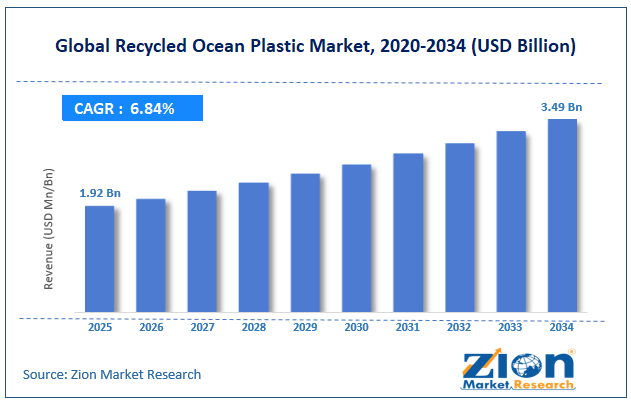
The global recycled ocean plastic market size was worth around USD 1.92 billion in 2025 and is predicted to grow to around USD 3.49 billion by 2034, with a compound annual growth rate (CAGR) of roughly 6.84% between 2026 and 2034.
Key Insights:
- As per the analysis shared by our research analyst, the global recycled ocean plastic market is estimated to grow annually at a CAGR of around 6.84% over the forecast period (2026-2034)
- In terms of revenue, the global recycled ocean plastic market size was valued at around USD 1.92 billion in 2025 and is projected to reach USD 3.49 billion, by 2034.
- The recycled ocean plastic market is projected to grow at a significant rate due to a surge in environmental pollution, rising concerns over marine ecosystem damage, regulatory pressure, and evolving consumer preferences.
- Based on the product, the polyethylene terephthalate segment is growing at a high rate and will continue to dominate the global market as per industry projections.
- Based on the source, the plastic bottles segment is anticipated to command the largest market share.
- Based on the application, the apparel segment is expected to lead the market growth trends.
- Based on region, Asia-Pacific is projected to dominate the global market during the forecast period.
Recycled Ocean Plastic Market: Overview
Recycled ocean plastic refers to products made from plastic waste recovered from the ocean. These products support sustainability and circular economy strategies by limiting the volume of plastic in the oceans. Market research suggests growing interest among companies in sourcing recycled ocean plastic resins to produce a wide range of products, such as footwear, clothing, and medical supplies, among others. Managing ocean plastic is a major environmental concern worldwide, especially in low-income economies with poor plastic-management infrastructure. During the forecast period, demand for recycled ocean plastic is expected to grow due to a surge in environmental pollution, rising concerns about marine ecosystem damage, regulatory pressure, and evolving consumer preferences. However, a lack of supportive infrastructure, high investment costs, and the absence of standardized policies will affect market growth during the projection period.
Impact of the USA-Israel and Iran war on the Recycled Ocean Plastic Market:
The USA-Israel and Iran war has helped increase demand for recycled plastic, subsequently driving market revenue. Virgin plastic cost has increased due to supply chain disruptions of petrochemicals from Middle Eastern countries. As a result, investment in recycled plastics has increased. In the long term, the war will continue influencing market revenue as players seek to mitigate future geopolitical conflict by investing in non-virgin materials.
Recycled Ocean Plastic Market: Dynamics
Growth Drivers
Which environmental concerns will influence growth in the recycled ocean plastic market during the forecast period?
The global recycled ocean plastic market is expected to be driven by rising environmental concerns and escalating damage to marine ecosystems. Ocean plastic pollution is one of the most critical crises that requires immediate attention. This form of pollution damages sensitive habitats, harms marine life, and subsequently enters the global food supply chain. According to the Center for Biological Diversity, thousands of seals, seabirds, sea turtles, and other marine animals are killed every year due to different forms of ocean-based plastic pollution. A new analysis by the European Commission has put the eastern Atlantic Ocean as a high-risk area. The analysis also recommends expanding ocean cleanup efforts to improve effectiveness.
Government regulations and mandates to promote market revenue in the coming years
Governments worldwide have intensified their efforts to reduce plastic pollution in the ocean. These efforts include stricter mandates for companies to use recycled content in their production lines. In April 2026, the Indian government launched a new requirement for 40% recycled content in rigid plastic packaging. In August 2026, the European Union brought the Packaging and Packaging Waste Regulation (PPWR) into force, targeting the recycled-plastic market. Under this legal framework, companies will be required to use increasing amounts of recycled plastic in their packaging. Such initiatives are likely to work in favor of the global recycled ocean plastic market.
Restraints
How will cost constraints affect the recycled ocean plastic industry during the projection period?
The global recycled ocean plastic industry is projected to be restricted due to high cost constraints. Building infrastructure to recycle ocean plastic requires major investments in specialized equipment and supply chain networks. Moreover, cleaning, sorting, and processing ocean plastic further adds to the overall financial burden. The lack of a sufficient skilled workforce is another critical growth barrier for industry leaders.
Opportunities
What will be the impact of technological advancements on the recycled ocean plastic market?
The global recycled ocean plastic market is expected to benefit significantly from the introduction of novel recycling technologies. Market players are working on improving the cost-efficiency of recycling systems while optimizing process output. In June 2026, KBR, a leading US-based technology company, announced the launch of patented polymer dissolution technology (PDT). This process is designed to purify and recycle polyethylene and polypropylene. PDT will help balance plastic consumption, waste generation, and the performance capacity of existing technologies.
Proliferation of circular economy to promote market revenue over the projection period
Recycled ocean plastic is an essential element of circular economy-related concepts. Recycling used plastic from the ocean feeds essential secondary raw materials back into the production cycle. It helps reduce plastic waste and supports effective use of raw materials. End consumers are actively preferring brands and companies that contribute to developing a circular system. Additionally, these efforts are also supported by regional governments.
Challenges
Lack of standardization and supportive infrastructure to challenge the recycled ocean plastic industry
The global recycled ocean plastic industry is expected to be challenged by a lack of standardized processes. This creates gaps in the quality, traceability, consistency, and certification of recycled ocean plastic. Moreover, the absence of supportive infrastructure in developing and underdeveloped parts of the world may further limit industry growth in the coming years.
Recycled Ocean Plastic Market: Report Scope
| Report Attributes | Report Details |
|---|---|
| Report Name | Recycled Ocean Plastic Market |
| Market Size in 2025 | USD 1.92 Billion |
| Market Forecast in 2034 | USD 3.49 Billion |
| Growth Rate | CAGR of 6.84% |
| Number of Pages | 227 |
| Key Companies Covered | Plastix, SEAQUAL INITIATIVE, Parley for the Oceans, Fishy Filaments, OceanCycle, Aquafil, Plastic Bank, Bureo, UBQ Materials, Tide Ocean Material, ReSea Project, Ocean Integrity, Econyl, and others. |
| Segments Covered | By Product, By Source, By Application, and By Region |
| Regions Covered | North America, Europe, Asia Pacific (APAC), Latin America, Middle East, and Africa (MEA) |
| Base Year | 2025 |
| Historical Year | 2020 - 2024 |
| Forecast Year | 2026 - 2034 |
| Customization Scope | Avail customized purchase options to meet your exact research needs. Request For Customization |
Recycled Ocean Plastic Market: Segmentation
The global recycled ocean plastic market is segmented based on product, source, application, and region.
Why will the polyethylene terephthalate segment lead the recycled ocean plastic industry revenue during the forecast period?
Based on product, the global market segments are polystyrene, polyethylene terephthalate, polypropylene, high-density polyethylene, low-density polyethylene, polyvinyl chloride, and others. In 2025, the polyethylene terephthalate segment showed the highest growth. It accounted for 37.5% of the global revenue and will continue growing at a CAGR of 8.61% during the forecast period. Polyethylene terephthalate (PET)-based bottles are major contributors to growing plastic-led ocean pollution. The exceptional recycling benefits of PET will encourage segmental expansion in the future.
Which will be the fastest-growing source during the forecast period in the recycled ocean plastic market?
Based on source, the global recycled ocean plastic industry is fragmented into plastic beverage holders, fishing line, plastic bottles, plastic bags, straws & stirrers, and others. Plastic bottles emerged as the fastest-growing segment. It held prominence with 44.56% of the total market share and will grow at a strong CAGR during the forecast period. According to Recycle Track Systems (RTS), around 75 to 199 million tons of plastic waste currently pollute oceans worldwide. Plastic bottles constitute a major portion of this waste, fueling segmental revenue.
Which factors drive demand in the apparel segment in the recycled ocean plastic industry?
Based on application, the global market segments are interiors, footwear, apparel, bags & luggage, and others. In 2025, the apparel segment accounted for around 42.01% of total revenue. It is expected to maintain its dominance during the forecast period. Growing mandates for fashion brands, especially fast and ultra-fashion companies, to incorporate recycled materials in production chains will improve segmental revenue in the coming years.
Recycled Ocean Plastic Market: Regional Analysis
Why will Asia-Pacific lead the recycled ocean plastic market during the forecast period?
The global recycled ocean plastic market is expected to be dominated by Asia-Pacific during the forecast period. In 2025, it accounted for 45% of the global revenue and is projected to grow at a CAGR of 8.1% during the forecast period. Asia-Pacific is one of the largest contributors to growing plastic-led ocean pollution. The presence of a vast coastline across major Asian countries, high plastic consumption, and a surge in government efforts to curb marine pollution will aid regional dominance.
How is Europe expected to perform in the recycled ocean plastic market during the projection period?
Europe is anticipated to deliver a CAGR of 7.49% in the global recycled ocean plastic market during the forecast period. It dominated 30.02% of the total market share. The European Union has launched several comprehensive initiatives to limit plastic from entering its water bodies. Evolving consumer preferences for environmentally sustainable brands, supportive government policies, and the presence of several companies offering recycled ocean plastic are the leading regional market growth drivers.
Recycled Ocean Plastic Market: Competitive Analysis
The global recycled ocean plastic market is led by players like:
- Plastix
- SEAQUAL INITIATIVE
- Parley for the Oceans
- Fishy Filaments
- OceanCycle
- Aquafil
- Plastic Bank
- Bureo
- UBQ Materials
- Tide Ocean Material
- ReSea Project
- Ocean Integrity
- Econyl
What are the latest key trends in the recycled ocean plastic market?
Investments in ocean-bound plastic
Expansion of preventive strategies, such as using ocean-bound plastic (OBP), is a prominent market trend. It involves recycling plastic that has not yet reached the ocean. It lowers production costs and also promotes higher-quality end products.
Automotive applications
Automotive companies are emerging as prominent users of recycled ocean plastic. Automotive applications are driving demand for superior purification systems and standardized frameworks to ensure consistent quality of end products.
The global recycled ocean plastic market is segmented as follows:
By Product
- Polystyrene
- Polyethylene Terephthalate
- Polypropylene
- High-Density Polyethylene
- Low-Density Polyethylene
- Polyvinyl Chloride
- Others
By Source
- Plastic Beverage Holders
- Fishing Line
- Plastic Bottles
- Plastic Bags
- Straws & Stirrers
- Others
By Application
- Interiors
- Footwear
- Apparel
- Bags & Luggage
- Others
By Region
- North America
- The U.S.
- Canada
- Mexico
- Europe
- France
- The UK
- Spain
- Germany
- Italy
- Rest of Europe
- Asia Pacific
- China
- Japan
- India
- Australia
- South Korea
- Rest of Asia Pacific
- The Middle East & Africa
- Saudi Arabia
- UAE
- Egypt
- Kuwait
- South Africa
- Rest of the Middle East & Africa
- Latin America
- Brazil
- Argentina
- Rest of Latin America
Table Of Content
Methodology
FrequentlyAsked Questions
Recycled ocean plastic refers to products developed using plastic waste from the ocean. These products support sustainability and circular economy strategies by reducing the volume of plastic in the oceans.
The global recycled ocean plastic market is expected to be driven by rising environmental concerns and escalating damage to the marine ecosystem.
According to study, the global recycled ocean plastic market size was worth around USD 1.92 billion in 2025 and is predicted to grow to around USD 3.49 billion by 2034.
The CAGR value of the recycled ocean plastic market is expected to be around 6.84% during 2026-2034.
The global recycled ocean plastic industry is expected to be challenged by a lack of standardized processes.
Investments in ocean-bound plastic and automotive applications are emerging trends and innovations impacting the recycled ocean plastic market.
The global recycled ocean plastic market has performed well so far and will offer similar trends in the coming years.
Asia-Pacific will contribute notably towards the recycled ocean plastic market value.
The global recycled ocean plastic market is led by players like Plastix, SEAQUAL INITIATIVE, Parley for the Oceans, Fishy Filaments, OceanCycle, Aquafil, Plastic Bank, Bureo, UBQ Materials, Tide Ocean Material, ReSea Project, Ocean Integrity, Econyl, and others.
The report explores crucial aspects of the recycled ocean plastic market, including a detailed discussion of existing growth factors and restraints, while also browsing future growth opportunities and challenges that impact the market.

HappyClients

