
Reactive Dyes Market Size, Trend, Growth, Industry Analysis 2034

Reactive Dyes Market By Type (Vinyl Sulphone Reactive Dyes, Monochlorotriazine Reactive Dyes, Bifunctional Reactive Dyes, Polyfunctional Reactive Dyes), By Application (Cotton Dyeing, Silk Dyeing, Wool Dyeing, Blended Fabric Dyeing), By Form (Powder Form, Liquid Form, Granular Form, Paste Form), By End Use Industry (Textile Manufacturing, Garment Processing, Home Textile Production, Yarn and Fiber Dyeing), and By Region - Global and Regional Industry Overview, Market Intelligence, Comprehensive Analysis, Historical Data, and Forecasts 2026 - 2034
| Market Size in 2025 | Market Forecast in 2034 | CAGR (in %) | Base Year |
|---|---|---|---|
| USD 6.37 Billion | USD 14.24 Billion | 9.35% | 2025 |
Reactive Dyes Industry Perspective:
What will be the size of the reactive dyes market during the forecast period?
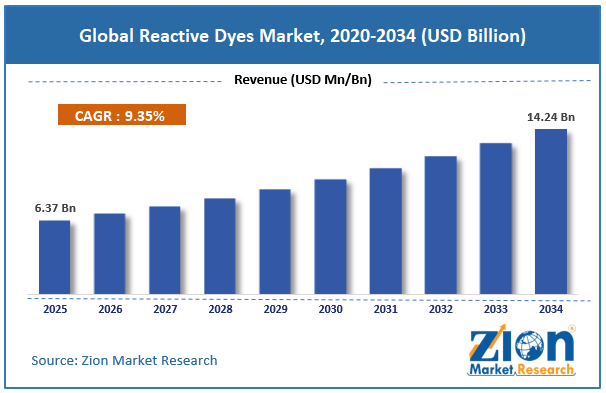
The global reactive dyes market size was valued at approximately USD 6.37 billion in 2025 and is projected to reach around USD 14.24 billion by 2034, growing at a compound annual growth rate of approximately 9.35% between 2026 and 2034.
Key Insights
- As per the analysis shared by our research team, the global reactive dyes market is estimated to grow at a compound annual growth rate of approximately 9.35% during the forecast period from 2026 to 2034.
- In terms of revenue, the global reactive dyes market was valued at approximately USD 6.37 billion in 2025 and is projected to reach USD 14.24 billion by 2034.
- The reactive dyes market is expected to grow strongly due to rising textile production, increasing demand for colorfast fabrics, growing preference for sustainable dyeing methods, and expanding garment manufacturing activity.
- Based on type, vinyl sulphone reactive dyes lead the market because of their strong reactivity and wide color availability, while bifunctional reactive dyes are gaining strong momentum as one of the fastest-growing types among manufacturers seeking better fixation rates.
- Based on application, cotton dyeing leads the market due to cotton's widespread use in garments and home textiles. In contrast, blended fabric dyeing is the fastest-growing segment as mixed-fiber clothing gains popularity.
- Based on form, powder dyes lead the market because they are easier to store and have a longer shelf life. In contrast, liquid dyes are the fastest-growing segment as automated dyeing units prefer ready-to-use formulations.
- Based on end-use industry, textile manufacturing leads the market due to large-scale fabric production needs, while garment processing is growing rapidly as fashion brands expand in-house finishing and coloring operations.
- Based on region, Asia Pacific leads the global reactive dyes market. At the same time, the Middle East is the fastest-growing region due to expanding textile manufacturing investments and growing garment export activity.
Reactive Dyes Market: Overview
Reactive dyes are textile colorants that chemically bond with fabric fibers, creating bright, durable colors that resist fading and washing. The reactive dyes market includes powder, liquid, granular, and paste formulations used mainly for cotton, silk, wool, and blended fabrics. These dyes are widely used in clothing, home textiles, fashion fabrics, and other textile products because they provide a broad range of colors, strong wash fastness, and good color consistency. Rising demand for colorful, long-lasting fabrics is increasing reactive dye consumption among textile manufacturers worldwide. Growing focus on sustainable textile production is also encouraging the development of low-salt and low-water dye formulations that reduce resource use and wastewater generation. Textile mills are expanding production capacity to meet changing fashion trends, seasonal demand, and growing global clothing consumption. Manufacturers are improving dye fixation and processing efficiency to reduce chemical waste and improve production results. Better dyeing technologies are also helping textile producers achieve more uniform shades while lowering processing losses. New reactive dye formulations designed for blended and difficult-to-dye fabrics are expanding application opportunities. Digital sourcing platforms are also helping textile businesses access reactive dyes from manufacturers more easily, supporting market expansion across regional and industrial textile supply chains.
The reactive dyes industry continues to grow as chemical manufacturers, textile mills, and fashion brands work together to create more vibrant, durable, and environmentally responsible coloring solutions worldwide.
Reactive Dyes Market: Strategic Perspective
Where is the reactive dyes market heading?
The reactive dyes market is expected to shift toward more sustainable, water-efficient, and high-fixation dye formulations as textile manufacturers become more selective about environmental impact and production costs. Low-salt dyes, digital-printing-compatible formulations, blended fabric solutions, and eco-certified colorants are likely to gain attention alongside traditional reactive dye products.
Where should businesses invest in the reactive dyes market?
The reactive dyes market presents opportunities in water-saving dye technologies, specialty color formulations, eco-friendly certification, regional production facilities, and direct partnerships with textile mills. Investment in efficient manufacturing and supply chains can also help companies maintain quality while controlling costs, particularly as demand grows in emerging textile hubs and expanding garment export economies.
What will reshape competition in the reactive dyes market?
Success in the reactive dyes market will increasingly depend on how effectively companies respond to changing environmental regulations and textile industry preferences. Companies that combine advanced dye chemistry with reliable product availability, competitive pricing, sustainable processing methods, and strong technical support are likely to stand out in an increasingly regulated chemical manufacturing space.
Reactive Dyes Market: Technology Roadmap 2026–2034
What is the projected development roadmap of the reactive dyes market over the forecast period?
The reactive dyes market is advancing through improved dye fixation chemistry, more precise color-matching technology, expanded use of low-water dyeing processes, and growing incorporation of biodegradable components, making textile coloring more efficient and environmentally responsible. The market is expected to grow at a compound annual growth rate of approximately 9.35% over the forecast period, driven by rising textile demand, evolving environmental regulations, and ongoing refinement of dye manufacturing technology.
The following roadmap outlines key development phases expected through 2034.
2026–2028: Efficiency and Compliance Building Phase
- Low-salt formulation development: Dye manufacturers are expected to reformulate products requiring less salt while maintaining strong color fixation on fabric.
- Environmental compliance sourcing: Companies are likely to focus more on eco-certified raw materials, lower heavy-metal content, and cleaner production processes to meet tightening regulations.
- Application-specific product positioning: Manufacturers are expected to create dye ranges targeting specific fabric needs, including delicate silk dyeing, heavy-duty cotton dyeing, and blended fiber applications.
2029–2031: Product Diversification and Distribution Expansion Phase
- Digital printing compatibility growth: Dye formulations compatible with digital textile printing technology are expected to gain greater market attention.
- New shade experimentation: Companies are likely to introduce color ranges using innovative pigment combinations, fluorescent shades, and season-specific palettes to differentiate products and attract fashion brands.
- Digital procurement expansion: Online industrial platforms, direct-to-mill sales, and bulk ordering systems are expected to give dye manufacturers additional ways to reach textile businesses.
2032–2034: Sustainable and Smart Dyeing Phase
- Next-generation formulations: Manufacturers are expected to move toward biodegradable dye components, reduced-water-consumption processes, and lower-waste packaging as sustainability becomes a stronger purchasing factor.
- Quality-monitoring technology: Smart dosing systems may increasingly provide information about dye concentration, batch consistency, or fixation efficiency during production.
- Customized color solutions: Reactive dyes could increasingly be developed around individual mill requirements, with products tailored to specific fabric types, production scales, and regional color preferences.
Reactive Dyes Market: Dynamics
Growth Drivers
What is driving changing consumer preferences in the reactive dyes market?
The reactive dyes market is evolving as textile manufacturers focus more on color quality, efficient processing, and environmental performance. Buyers are increasingly seeking dyes that require less water and salt while still delivering strong color results. This trend is encouraging manufacturers to develop low-salt, biodegradable, and easily washable reactive dye formulations. Products with higher fixation rates can reduce color loss, wastewater generation, and processing time, creating opportunities for improved textile dyeing solutions. Small-batch reactive dyes are supporting specialty textile producers, while bulk products remain important for large textile mills. Growing demand for sustainable textile production is also pushing companies to offer simpler chemical formulations and clearer technical information. Distributors are expanding their product catalogs, while online chemical marketplaces make reactive dyes easier to compare and buy. Manufacturers are also developing new shades, color combinations, and blended-fabric formulations to serve changing fashion and textile needs. Improved packaging is helping protect dye quality during storage and transportation while making handling easier during industrial textile production.
Premium and specialty products are creating opportunities in the reactive dyes market.
The reactive dyes market is finding new growth opportunities through premium products that provide better color quality, production efficiency, and environmental performance. Manufacturers are developing advanced reactive dyes with improved fixation, specialty shades, and eco-friendly ingredients to attract textile mills seeking higher-value solutions. Low-water and reduced-salt dye formulations are gaining attention as textile producers work to lower resource consumption and wastewater during dyeing. Sustainable packaging is another emerging opportunity, with companies introducing recyclable containers, concentrated products, and bulk-dispensing formats that simplify storage and handling. Garment exporters, home textile manufacturers, and yarn processors are increasing their use of specialty reactive dyes because consistent shade matching can reduce production errors and material waste. Online industrial marketplaces are helping smaller dye manufacturers reach customers beyond traditional distribution channels and expand their market presence. Regional production facilities can also improve delivery speed and reduce supply chain dependence on overseas sources. Small-batch reactive dyes are creating opportunities in custom fabrics, boutique textiles, and specialized printing where unique colors are important. These trends are broadening applications and creating new revenue opportunities across the market.
Restraints
High production costs are a key challenge limiting growth in the reactive dyes market.
The reactive dyes market faces challenges from stricter environmental regulations, rising raw material costs, and growing competition from alternative dyeing technologies. Fluctuations in petrochemical prices, transportation expenses, production costs, and regulatory requirements can make manufacturing budgets difficult to manage. Textile producers are also paying greater attention to wastewater treatment, chemical use, and effluent quality, increasing pressure on dye manufacturers to offer cleaner formulations. Reactive dyes compete with pigment dyes, natural dyes, and other coloring technologies, giving textile manufacturers several alternatives. Maintaining consistent shades across large production batches can also be difficult when dye formulations contain sensitive chemical ingredients. Wastewater management remains another challenge because untreated or poorly treated dye effluents can increase environmental concerns and compliance costs. In developing markets, limited wastewater treatment infrastructure may further restrict efficient dyeing operations. Manufacturers can address these challenges by improving dye fixation, developing low-impact formulations, reducing raw material waste, adopting sustainable packaging, controlling production costs, and strengthening distribution networks to stay competitive.
Opportunities
Will sustainability-focused product innovation open new opportunities in the reactive dyes market?
The reactive dyes market is expanding beyond traditional cotton dyeing as textile manufacturers seek coloring solutions that improve efficiency, environmental performance, and processing results. Dyes designed to reduce water consumption, lower energy use, and shorten dyeing cycles are creating new product categories for environmentally conscious textile mills. Premium reactive dyes with advanced chemical structures, eco-certified ingredients, low-salt formulations, and improved fixation technology are helping manufacturers target customers seeking higher performance and better production efficiency. Blended-fabric and multi-fiber dyes provide another opportunity by helping textile producers meet rising demand for mixed-material clothing and home textiles. Small-batch formulations are gaining importance among boutique manufacturers, custom printers, and specialty fabric producers that require precise shade matching, while bulk formulations continue to serve large textile mills. Growing production among garment exporters, home textile manufacturers, and yarn processors is supporting additional demand. Online industrial platforms are helping smaller dye producers reach customers beyond traditional chemical distributors. Sustainable packaging, concentrated formulations, and improved handling systems can increase product appeal. Manufacturers are also developing regional color ranges and seasonal shades to match fashion trends. Ready-to-use liquid formulations and specialty packaging further support convenient, precise dyeing across diverse textile applications worldwide.
Challenges
How are rising costs and supply challenges affecting the reactive dyes market?
The reactive dyes market faces challenges from fluctuating raw material prices, rising regulatory costs, and increasing environmental concerns related to textile wastewater. Changes in petrochemical prices, transportation expenses, and production capacity can affect dye availability and increase manufacturing costs. Textile producers are also paying greater attention to environmental certifications, encouraging dye manufacturers to develop products with stronger sustainability credentials. Reactive dyes face competition from pigment dyes, natural dyes, and digital printing inks, giving textile manufacturers several alternative coloring technologies. Wastewater treatment remains a major concern because dyeing processes can generate chemical effluents that require proper treatment before discharge. In emerging markets, limited chemical distribution networks and wastewater treatment infrastructure can restrict market expansion. Dependence on imported raw materials also exposes manufacturers to supply disruptions, currency fluctuations, and higher logistics costs. Companies can reduce these challenges by improving supply chain planning, sourcing materials locally, developing efficient, low-impact formulations, adopting sustainable packaging, and strengthening regional distribution networks to support stable market growth.
Reactive Dyes Market: Report Scope
| Report Attributes | Report Details |
|---|---|
| Report Name | Reactive Dyes Market |
| Market Size in 2025 | USD 6.37 Billion |
| Market Forecast in 2034 | USD 14.24 Billion |
| Growth Rate | CAGR of 9.35% |
| Number of Pages | 228 |
| Key Companies Covered | Huntsman Corporation, Archroma, DyStar Group, Kiri Industries, Atul Ltd, Jihua Group, Longsheng Group, Colourtex Industries, Anand International, Rudolf GmbH, and others. |
| Segments Covered | By Type, By Application, By Form, By End-Use Industry, and By Region |
| Regions Covered | North America, Europe, Asia Pacific (APAC), Latin America, Middle East, and Africa (MEA) |
| Base Year | 2025 |
| Historical Year | 2020 - 2024 |
| Forecast Year | 2026 - 2034 |
| Customization Scope | Avail customized purchase options to meet your exact research needs. Request For Customization |
Reactive Dyes Market: Segmentation
The global reactive dyes market is segmented by type, application, form, end-use industry, and region.
Why do vinyl sulphone reactive dyes lead the reactive dyes market by type?
Based on type, the global reactive dyes market is categorized into vinyl sulphone, monochlorotriazine, bifunctional, and polyfunctional reactive dyes. Vinyl sulphone reactive dyes hold about 40% of the market share, leading due to their strong reactivity, wide color range, and long-standing use across major textile processing facilities. Bifunctional reactive dyes hold around 26% market share. This is the fastest-growing segment because manufacturers increasingly seek formulations that deliver higher fixation rates and less processing waste.
How is cotton dyeing application maintaining its lead in the reactive dyes market?
Based on application, the reactive dyes industry is divided into cotton dyeing, silk dyeing, wool dyeing, and blended fabric dyeing. Cotton dyeing accounts for approximately 46% of the global market share, driven by cotton's widespread use in garments, home textiles, and industrial fabric applications. Blended fabric dyeing holds around 19% market share. It is the fastest-growing due to the expanding popularity of mixed-fiber clothing that requires specialized dyeing formulations.
Where does powder form stand in the reactive dyes market landscape by form?
Based on form, the market is classified into powder, liquid, granular, and paste. Powder-form dyes lead with about a 45% share because they are easier to store, have a longer shelf life, and are the standard formulation across textile mills. Liquid form dyes hold around 21% market share. They are growing steadily as more automated dyeing units prefer ready-to-use formulations that reduce handling and mixing time.
Which end-use industry accounts for the largest share in the reactive dyes market?
By end-use industry, the market is segmented into textile manufacturing, garment processing, home textile production, and yarn and fiber dyeing. Textile manufacturing accounts for about 50% of the market, leading because of large-scale fabric production requirements across apparel and industrial textile sectors. Garment processing holds around 22% market share. This segment is expanding quickly as fashion brands and garment exporters expand in-house dyeing and finishing operations.
Reactive Dyes Market: Regional Analysis
What factors are strengthening Asia Pacific's position in the reactive dyes market?
Asia Pacific leads the global reactive dyes market and is expected to grow at a CAGR of around 5.8% during the forecast period. A large textile manufacturing base, strong garment exports, and growing demand for high-quality fabric dyeing solutions support its leading position. China, India, and Bangladesh are major markets because of their extensive textile production capacity and expanding apparel industries. Textile mills across these countries widely use reactive dyes for cotton and blended fabrics because they provide bright colors, strong wash fastness, and reliable color consistency. Rising fabric and garment production is encouraging dye manufacturers to build long-term supply relationships with textile producers. Growing demand for export-quality fabrics is also increasing the use of advanced dye formulations with improved fixation and lower environmental impact. Asia Pacific's strong chemical manufacturing industry helps producers maintain competitive costs and develop products suited to local processing conditions.
Direct mill supply, industrial distributors, and online procurement platforms are improving access to reactive dye products across major textile hubs. Rising interest in low-salt, water-efficient, and eco-certified dyes is encouraging product innovation. Increasing investment in automated textile processing equipment is also creating demand for efficient dye formulations. Expanding textile exports, established supply chains, and continued investment in processing infrastructure are expected to help Asia Pacific maintain its leading position in the market.
How are changing lifestyles driving growth in the Middle East reactive dyes market?
The Middle East reactive dyes market is expected to grow at a volume CAGR of around 5.3% during the forecast period, supported by increasing textile manufacturing investments, expanding garment production, and growing demand for reliable fabric coloring solutions. Saudi Arabia, the UAE, and Egypt are important markets as textile processing, home furnishing, and apparel manufacturing activities continue to develop. Rising industrial investment is encouraging textile producers to adopt higher-quality reactive dyes that provide strong color consistency, wash fastness, and efficient processing. New manufacturing zones are also increasing demand for dependable dye supplies across garment factories, home textile plants, and yarn processing facilities. Growing interest in sustainable textile production is encouraging manufacturers to consider low-water, low-salt, and eco-certified reactive dye formulations.
Suppliers are adapting products to regional water quality and processing conditions, creating demand for specialized formulations and technical support. Growing garment export ambitions are further increasing the need for consistent, high-quality dyeing solutions. Industrial distributors are expanding their product ranges to include premium and specialty reactive dyes, while local suppliers are developing products tailored to regional requirements. Government initiatives supporting textile manufacturing, industrial diversification, and production infrastructure are expected to strengthen investment and create sustained opportunities in the Middle East market during the forecast period.
Recent Market Developments
- In April 2026, Archroma introduced its latest textile dyeing innovations, including NOVACRON® ADVANCE reactive inks, at Techtextil 2026, focusing on high color performance, productivity, and more sustainable textile production.
Reactive Dyes Market: Competitive Analysis
The leading players in the global reactive dyes market are:
- Huntsman Corporation
- Archroma
- DyStar Group
- Kiri Industries
- Atul Ltd
- Jihua Group
- Longsheng Group
- Colourtex Industries
- Anand International
- Rudolf GmbH
The global reactive dyes market is segmented as follows:
By Type
- Vinyl Sulphone Reactive Dyes
- Monochlorotriazine Reactive Dyes
- Bifunctional Reactive Dyes
- Polyfunctional Reactive Dyes
By Application
- Cotton Dyeing
- Silk Dyeing
- Wool Dyeing
- Blended Fabric Dyeing
By Form
- Powder Form
- Liquid Form
- Granular Form
- Paste Form
By End-Use Industry
- Textile Manufacturing
- Garment Processing
- Home Textile Production
- Yarn and Fiber Dyeing
By Region
- North America
- The U.S.
- Canada
- Mexico
- Europe
- France
- The UK
- Spain
- Germany
- Italy
- Rest of Europe
- Asia Pacific
- China
- Japan
- India
- Australia
- South Korea
- Rest of Asia Pacific
- The Middle East & Africa
- Saudi Arabia
- UAE
- Egypt
- Kuwait
- South Africa
- Rest of the Middle East & Africa
- Latin America
- Brazil
- Argentina
- Rest of Latin America
Table Of Content
Methodology
FrequentlyAsked Questions
Reactive dyes are textile colorants that chemically bond with fabric fibers, creating bright, durable colors that resist fading and washing. The reactive dyes market includes powder, liquid, granular, and paste formulations used mainly for cotton, silk, wool, and blended fabrics. These dyes are widely used in clothing, home textiles, fashion fabrics, and other textile products because they provide a broad range of colors, strong wash fastness, and good color consistency.
The global reactive dyes market is expected to grow due to rising textile production, increasing demand for colorfast fabrics, growing preference for sustainable dyeing methods, and expanding garment manufacturing activity worldwide.
According to research, the global reactive dyes market was valued at approximately USD 6.37 billion in 2025 and is projected to reach approximately USD 14.24 billion by 2034.
The compound annual growth rate of the reactive dyes market is expected to be approximately 9.35% from 2026 to 2034.
Asia Pacific is expected to lead the global reactive dyes market throughout the forecast period, driven by its massive textile manufacturing base, expanding garment export industry, and strong chemical production capabilities.
The major players in the global reactive dyes market include Huntsman Corporation, Archroma, DyStar Group, Kiri Industries, Atul Ltd, Jihua Group, Longsheng Group, Colourtex Industries, Anand International, and Rudolf GmbH.
The report examines key aspects of the reactive dyes market, including research and development drivers, adoption barriers, application opportunities, competitive landscape dynamics, detailed regional market performance analysis, and a comprehensive forward-looking outlook across all major types, applications, forms, end-use industries, and geographic regions through 2034.
Macroeconomic factors will influence the reactive dyes market as rising industrial production, expanding textile exports, and stronger demand for quality fabrics support consumption of reactive dyes. However, inflation, higher raw material costs, rising energy prices, and increased transportation expenses may raise production costs, encouraging textile manufacturers to select affordable dye formulations.
The reactive dyes market offers investment and partnership opportunities in sustainable dye technologies, specialty color formulations, regional production facilities, wastewater treatment solutions, and direct textile mill partnerships. Collaboration among dye manufacturers, textile mills, garment exporters, and research institutions can support product innovation, improve production efficiency, and expand regional market presence.
Prices in the reactive dyes market are rising as raw material, energy, labor, and transportation costs increase. Premium products, including eco-certified, low-salt, and high-fixation formulations, are also priced higher due to better chemistry and specialized processing. In contrast, standard dye products remain more affordable for cost-sensitive textile producers.

HappyClients

