
FRP Tank Water And Wastewater Market Size, Share, Trends, Growth 2034

FRP Tank Water And Wastewater Market By Application (Water Conservation, Wastewater, Plumbing Engineered Solutions, Industrial Wastewater, and Others), By End-User (Municipal, Industrial, Residential, and Others), and By Region - Global and Regional Industry Overview, Market Intelligence, Comprehensive Analysis, Historical Data, and Forecasts 2025 - 2034
| Market Size in 2024 | Market Forecast in 2034 | CAGR (in %) | Base Year |
|---|---|---|---|
| USD 2.46 Billion | USD 3.88 Billion | 5.20% | 2024 |
FRP Tank Water And Wastewater Industry Perspective:
What will be the size of the global FRP tank water and wastewater market during the forecast period?
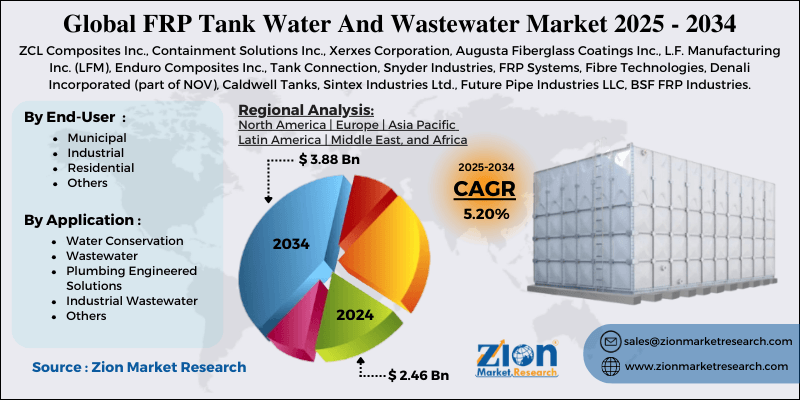
The global FRP tank water and wastewater market size was around USD 2.46 billion in 2024 and is projected to reach USD 3.88 billion by 2034, with a compound annual growth rate (CAGR) of roughly 5.20% between 2025 and 2034.

Key Insights:
- As per the analysis shared by our research analyst, the global FRP tank water and wastewater market is estimated to grow annually at a CAGR of around 5.20% over the forecast period (2025-2034)
- In terms of revenue, the global FRP tank water and wastewater market size was valued at around USD 2.46 billion in 2024 and is projected to reach USD 3.88 billion by 2034.
- The FRP tank water and wastewater market is projected to grow significantly owing to the rising water scarcity, Industrial growth, and Corrosion resistance, accelerating adoption.
- Based on application, the wastewater segment is the largest, while the industrial wastewater segment is projected to record sizeable revenue over the forecast period.
- Based on end-user, the industrial segment is expected to lead the market, followed by the municipal segment.
- By region, Asia Pacific is projected to dominate the global market during the forecast period, followed by North America.
FRP Tank Water And Wastewater Market: Overview
An FRP tank is a corrosion-resistant storage solution widely used in water and wastewater treatment due to its durability and high strength-to-weight ratio. It tolerates harsh climates, environmental stress, and moisture, making it suitable for storing chemicals, sludge, effluents, and potable water. The global FRP tank water and wastewater market is poised to expand rapidly, driven by rising demand for corrosion-resistant infrastructure, the expansion of municipal water treatment projects, and stringent environmental regulations. FRP tanks provide optimal corrosion resistance to moisture, chemicals, and saline environments. This increases its suitability for wastewater and water storage applications. The growing replacement of concrete and steel tanks is fueling demand.
Moreover, governments are heavily investing in upgrading wastewater and water infrastructure. Speedy urbanization is augmenting the need for reliable storage systems. FRP tanks are extensively adopted in new municipal facilities. Furthermore, tighter discharge and water-quality norms require durable containment systems. FRP tanks help prevent contamination and the risk of leaks. Regulatory compliance is increasing product adoption. Despite growth, the global market is constrained by factors such as high initial investment costs and volatility in raw material prices. FRP tanks usually have higher upfront costs than those made of conventional materials. Budget limitations may hamper adoption in developing markets. Cost sensitivity impacts purchasing decisions. Likewise, the cost of fiberglass and resins varies because of supply chain factors. This affects profit margins and production costs. Market instability may slow growth.
Nonetheless, the global FRP tank water and wastewater industry stands to benefit from several key opportunities, such as rapid urbanization in developing economies, the growth of decentralized wastewater systems, and the expansion of desalination and water reuse projects. The growing urban population needs enhanced water infrastructure. New treatment plants need trustworthy storage solutions, creating strong demand potential. Small-scale and modular treatment systems are growing in rural regions. FRP tanks are suitable for compact installations; hence, the segment offers untapped growth prospects. Additionally, water scarcity is driving the development of desalination facilities. FRP tanks are resistant to saline environments. These projects offer fresh application domains.
FRP Tank Water And Wastewater Market: Dynamics
Growth Drivers
How are corrosion resistance and long‑term durability features propelling the FRP tank water and wastewater market development?
FRP materials inherently resist corrosion from saline water and chemicals. And wastewater environments in which concrete or steel degrade fast. This results in reduced maintenance costs and longer service life, making these tanks a highly preferred choice for wastewater applications. Their corrosion resistance also backs the storage of aggressive treatment chemicals without frequent repairs or recoating. The durability factor directly supports lifecycle cost benefits over conventional tank materials, thereby increasing preference and driving growth in the global FRP tank water and wastewater market.
How do its lightweight, easy-to-install advantages drive the FRP tank water and wastewater market?
FRP tanks are majorly lighter than concrete or steel tanks, reducing installation time and transportation complexity. This lightweight property streamlines site assembly and reduces construction labor and equipment costs, mainly in urban and remote locations. Quick deployment can fast-track infrastructure projects, lowering overall project schedules. These practical installation benefits make FRP tanks appealing for fast-growing projects worldwide.
Restraints
Material compatibility & use‑case limits adversely impact the market progress
Standard RP formulations have material limitations, such as poor performance at high temperatures, in aggressive chemical environments, or under high pressure, that require specialized resins. This limits their use for some industrial or wastewater fluid streams where compatibility concerns exist. Some sectors continue to choose specialized alloys or stainless steel for high-strength or high-temperature containment. Such perception, even if manageable by tailored resin systems, may hamper market share in niche applications.
Opportunities
How are sustainable water management & desalination projects creating promising avenues for the growth of the FRP tank water and wastewater industry?
The global focus on sustainable water management, desalination, and reuse, especially in water-scarce areas, is surging demand for corrosion-resistant, durable storage solutions. FRP tanks are particularly well-suited for desalination applications, as they can withstand saline water, aggressive treatment chemicals, and extreme environmental conditions without degrading or corroding. Their chemical resistance and long service life make them the best choice for post-treatment and pre-treatment storage in water purification systems.
As desalination and advanced water treatment projects expand in coastal Asia, the Middle East, and other arid regions, the FRP tank water and wastewater industry continues to advance, creating new prospects and a wider addressable market in these high-demand regions.
Challenges
Supply chain & raw material volatility limit the market growth
The FRP tank industry is affected by fluctuations in key raw materials such as resins and fiberglass, which are tied to global petrochemical prices. Volatile or growing costs may increase production costs, delay long-term contracts or infrastructure projects, and affect profitability. In addition, supply chain disruptions from shipping delays, geopolitical issues, or trade restrictions may create inventory shortages and project delays, underscoring the importance of careful sourcing and planning for buyers and manufacturers.
FRP Tank Water And Wastewater Market: Report Scope
| Report Attributes | Report Details |
|---|---|
| Report Name | FRP Tank Water And Wastewater Market |
| Market Size in 2024 | USD 2.46 Billion |
| Market Forecast in 2034 | USD 3.88 Bllion |
| Growth Rate | CAGR of 5.20% |
| Number of Pages | 223 |
| Key Companies Covered | ZCL Composites Inc., Containment Solutions Inc., Xerxes Corporation, Augusta Fiberglass Coatings Inc., L.F. Manufacturing Inc. (LFM), Enduro Composites Inc., Tank Connection, Snyder Industries, FRP Systems, Fibre Technologies, Denali Incorporated (part of NOV), Caldwell Tanks, Sintex Industries Ltd., Future Pipe Industries LLC, BSF FRP Industries, and others. |
| Segments Covered | By Application, By End-User, and By Region |
| Regions Covered | North America, Europe, Asia Pacific (APAC), Latin America, Middle East, and Africa (MEA) |
| Base Year | 2024 |
| Historical Year | 2019 to 2023 |
| Forecast Year | 2025 - 2034 |
| Customization Scope | Avail customized purchase options to meet your exact research needs. Request For Customization |
FRP Tank Water And Wastewater Market: Segmentation
The global FRP tank water and wastewater market is segmented based on application, end-user, and region.
Why is the Wastewater segment projected to dominate the FRP tank water and wastewater market?
Based on application, the global FRP tank water and wastewater industry is divided into water conservation, wastewater, plumbing engineered solutions, industrial wastewater, and others. The wastewater segment accounts for approximately 43% of the total market due to its broad use in sewage treatment, reuse systems, and recycling. Its growth is driven by surging demand for FRP tanks, which offer reliability and corrosion resistance in wastewater environments. Continuous investment in industrial and municipal wastewater infrastructure backs its leadership.
Conversely, the industrial wastewater segment holds the second-largest share at 30% of the total market. This growth is attributed to stringent effluent discharge standards and high process water volumes in manufacturing sectors. The segmental dominance is supported by the growing number of industries adopting FRP tanks for effluent treatment and storage, driven by regulatory compliance benefits and durability.
What factors help the Industrial segment lead the FRP tank water and wastewater industry?
Based on end-user, the global FRP tank water and wastewater market is segmented into municipal, industrial, residential, and others. The industrial segment captures nearly 60% of the total market, fueled by strong demand in manufacturing, chemical processing, and industrial wastewater/water applications needing corrosion-resistant containment solutions. The segment’s prominence is backed by high-volume use in effluent and process storage. Industrial users value FRP for chemical resistance, durability, and low maintenance, keeping it ahead of other domains.
Nevertheless, the municipal segment holds a second-leading 30% share of the market, supported by the rapid expansion of sewage treatment infrastructure and public water supply. Municipal demand typically accounts for a major share as cities upgrade treatment systems and invest in corrosion-resistant storage solutions. Segmental growth is supported by urbanization, rising sanitation spending, and regulatory compliance.
FRP Tank Water And Wastewater Market: Regional Analysis
Why is Asia Pacific outperforming other regions in the global FRP Tank Water and Wastewater market?
Asia Pacific is anticipated to retain its leading role in the global FRP tank water and wastewater market, with a 7.5% CAGR, driven by speedy urbanization and industrialization, government initiatives and infrastructure spending, and cost efficiency and local manufacturing. APAC is witnessing fast industrial and urban growth, fueling large-scale investments in water supply, industrial effluent management, and wastewater treatment. Developing industrial parks and cities needs durable treatment and storage solutions. This makes FRP tanks a highly preferred choice. This infrastructure growth highlights the regional market dominance.
Moreover, governments in the region are heavily investing in water treatment, sanitation, and environmental compliance projects. Programs aimed at wastewater treatment, pollution control, and clean water accessibility increase the adoption of FRP tanks. Public funding and policy support create steady and high-volume demand. Furthermore, APAC benefits from low labor and production costs, enabling competitively priced FRP tanks. The presence of regional manufacturers reduces import dependence and facilitates project deployment. These economic advantages make FRP solutions more broadly adopted and more accessible.
Why does North America rank second in the global FRP Tank Water and Wastewater Market?
North America ranks as the second-largest region in the global FRP tank water and wastewater industry, with a 6.5% CAGR, driven by advanced infrastructure and upgrades, strict environmental regulations, and technological innovation and adoption. North America has well-established water and wastewater infrastructure that requires continuous replacement and upgrading. Obsolete concrete and steel tanks are being replaced with corrosion-resistant FRP tanks. This trend helps drive strong demand in the industrial and municipal sectors.
Moreover, strict regulations on effluent discharge, water quality, and chemical storage encourage the use of FRP tanks. Municipalities and industries adopt FRP solutions to comply with EPA state-level standards. Regulatory pressure drives consistent demand for leak-proof, durable tanks.
Additionally, the widespread adoption of advanced materials, IoT-enabled tanks, and smart monitoring systems improved the utility of FRP tanks. Regional end users prefer advanced solutions that enhance operational efficiency and reduce maintenance costs. Technological readiness augments market dominance.
FRP Tank Water And Wastewater Market: Competitive Analysis
The leading players in the global FRP tank water and wastewater market are:
- ZCL Composites Inc.
- Containment Solutions Inc.
- Xerxes Corporation
- Augusta Fiberglass Coatings Inc.
- L.F. Manufacturing Inc. (LFM)
- Enduro Composites Inc.
- Tank Connection
- Snyder Industries
- FRP Systems
- Fibre Technologies
- Denali Incorporated (part of NOV)
- Caldwell Tanks
- Sintex Industries Ltd.
- Future Pipe Industries LLC
- BSF FRP Industries
What are the key trends in the global FRP Tank Water and Wastewater Market?
Smart & IoT‑enabled monitoring:
The incorporation of digital monitoring systems and IoT sensors within FRP tanks is gaining attention, allowing real-time tracking of levels, structural health, pressure, and temperature. This trend backs predictive maintenance and operational efficiency, reducing lifecycle and downtime costs for industrial users and utilities. The convergence of digital technology with FRP infrastructure is transforming tank systems into intelligent assets.
Customization & modular designs growth:
There is a surging demand for customizable and modular FRP tank solutions tailored to specific capacities, application needs, and site constraints. Manufacturers are offering flexible configurations that streamline installation, relocation, and expandability, mainly for large wastewater plants and remote projects. Modular products reduce installation time and logistics costs.
The global FRP tank water and wastewater market is segmented as follows:
By Application
- Water Conservation
- Wastewater
- Plumbing Engineered Solutions
- Industrial Wastewater
- Others
By End-User
- Municipal
- Industrial
- Residential
- Others
By Region
- North America
- The U.S.
- Canada
- Mexico
- Europe
- France
- The UK
- Spain
- Germany
- Italy
- Rest of Europe
- Asia Pacific
- China
- Japan
- India
- Australia
- South Korea
- Rest of Asia Pacific
- The Middle East & Africa
- Saudi Arabia
- UAE
- Egypt
- Kuwait
- South Africa
- Rest of the Middle East & Africa
- Latin America
- Brazil
- Argentina
- Rest of Latin America
Table Of Content
Methodology
FrequentlyAsked Questions
How are market trends and consumer preferences evolving in the FRP tank water and wastewater market?

List of Contents
FRP Tank Water And WastewaterIndustry Perspective:Key Insights:OverviewDynamicsReport ScopeSegmentationRegional AnalysisCompetitive AnalysisWhat are the key trends in the global FRP Tank Water and Wastewater Market?The global FRP tank water and wastewater market is segmented as follows:HappyClients

