
Global Protein Hydrolysis Enzymes Market Size, Share, Growth Analysis Report - Forecast 2034

Protein Hydrolysis Enzymes Market By Source (Animal, Plant, And Micro-Organism), By Application (Detergent & Cleansing, Pharmaceutical, Food & Beverages, Textile, And Others), and By Region: Global and Regional Industry Overview, Market Intelligence, Comprehensive Analysis, Historical Data, and Forecasts 2025 - 2034
| Market Size in 2024 | Market Forecast in 2034 | CAGR (in %) | Base Year |
|---|---|---|---|
| USD 2.64 Billion | USD 4.91 Billion | 6.4% | 2024 |
Protein Hydrolysis Enzymes Industry Perspective
What will be the global protein hydrolysis enzymes market size during the forecast period?
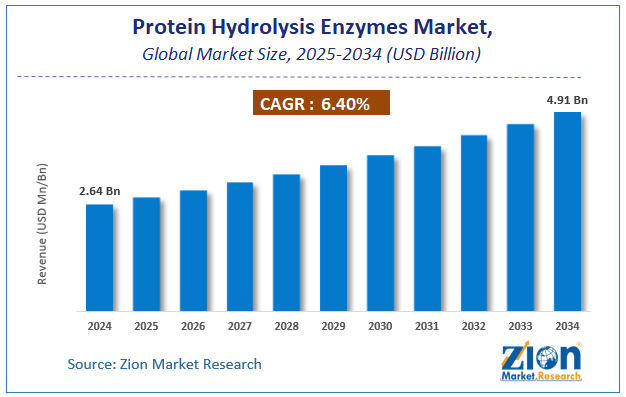
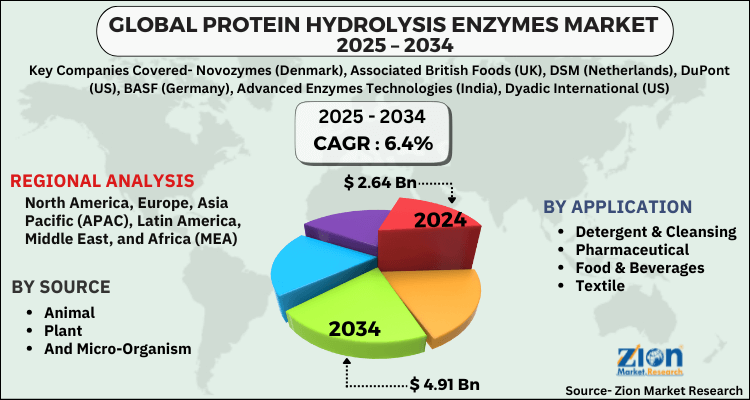
The global protein hydrolysis enzymes market size was worth around USD 2.64 billion in 2024 and is predicted to grow to around USD 4.91 billion by 2034 with a compound annual growth rate (CAGR) of roughly 6.4% between 2025 and 2034.
The protein hydrolysis enzymes market is driven by increasing demand from various end-use industries including food and beverage, pharmaceuticals, animal feed, and detergents, coupled with a growing emphasis on sustainable and eco-friendly processes.
Key Insights
- As per the analysis shared by our research analyst, the global protein hydrolysis enzymes market is estimated to grow annually at a CAGR of around 6.4% over the forecast period (2025-2034).
- Regarding revenue, the global protein hydrolysis enzymes market size was valued at around USD 2.64 billion in 2024 and is projected to reach USD 4.91 billion by 2034.
- The protein hydrolysis enzymes market is projected to grow at a significant rate due to increasing demand from various end-use industries, including food and beverage, pharmaceuticals, animal feed, and detergents, coupled with a growing emphasis on sustainable and eco-friendly processes.
- Based on the source, the animal segment is expected to lead the global market.
- On the basis of Application, the detergent & cleansing segment is growing at a high rate and will continue to dominate the global market.
- Based on region, North America is predicted to dominate the global market during the forecast period because of advanced industrial infrastructure, high adoption of enzyme technologies, and strong presence of key end-use industries.
Protein Hydrolysis Enzymes Market: Overview
Protein hydrolysis means the breakdown of proteins into small peptides and amino acids. Moreover, hydrolysis of protein enzymes is referred to as hydrolysis of pancreatic protease through the protein hydrolytic process. Additionally, firms use different kinds of enzymes from different sources such as microbes, bacteria, plants, and animals. Furthermore, protein hydrolysis enzymes find a slew of uses in textiles, pharmaceuticals, food, photography, detergents, and animal feeds.
Protein Hydrolysis Enzymes Market: Dynamics
Surge in protease enzyme acceptance due to benefits provided by protein peptide hydrolysis into amino acids will promulgate scope of protein hydrolysis enzymes market growth over forecasting timeframe. Rise in product penetration in China, Japan, India, and Vietnam will trigger growth of the protein hydrolysis enzymes industry over the ensuing years. Modification in food protein characteristics and reduction in animal feed costs for hydrolysis of protein enzymes will prompt market demand. Furthermore, a prominent use of protein hydrolysis enzymes in regulating nitrogen content & phosphorous pollution will favorably influence expansion of the protein hydrolysis enzymes industry. However, a surge in utilization of bio-chemicals as substitute products in industries can hamper growth of the protein hydrolysis enzymes market in the near future.
Moreover, high demand for protein hydrolysis enzymes in manufacturing enhanced flavors and aromatic hydrolysates for various kinds of food & beverages will steer elevation of protein hydrolysis enzymes market growth graph during forecasting timeframe. Rise in product usage in the pharmaceutical sector will boost market trends.
Protein Hydrolysis Enzymes Market: Report Scope
| Report Attributes | Report Details |
|---|---|
| Report Name | Protein Hydrolysis Enzymes Market |
| Market Size in 2024 | USD 2.64 Billion |
| Market Forecast in 2034 | USD 4.91 Billion |
| Growth Rate | CAGR of 6.4% |
| Number of Pages | 210 |
| Key Companies Covered | Novozymes (Denmark), Associated British Foods (UK), DSM (Netherlands), DuPont (US), BASF (Germany), Advanced Enzymes Technologies (India), Dyadic International (US), and Chr. Hansen (Denmark), and others. |
| Segments Covered | By Source, By Application, and By Region |
| Regions Covered | North America, Europe, Asia Pacific (APAC), Latin America, The Middle East and Africa (MEA) |
| Base Year | 2024 |
| Historical Year | 2020 to 2023 |
| Forecast Year | 2025 - 2034 |
| Customization Scope | Avail customized purchase options to meet your exact research needs. Request For Customization |
Protein Hydrolysis Enzymes Market: Segmentation
The protein hydrolysis enzymes market is segmented by source, application, and region. All the segments of the protein hydrolysis enzymes market have been analyzed based on present and future trends, and the market is estimated from 2025 to 2034.
Based on the source, the protein hydrolysis enzymes market is divided into animal, plant, and microorganism. Animal-derived proteases such as trypsin have long-established industrial track records, offering reliable activity profiles that support consistent performance in pharmaceutical, food, and specialized processing applications. Their proven efficacy in controlled hydrolysis processes and compatibility with existing manufacturing systems contribute to sustained preference among end-users. This dominance helps drive overall market growth by providing dependable solutions for high-value applications where process predictability and regulatory familiarity are critical. Continued demand from established industries reinforces the segment’s contribution to revenue expansion throughout the forecast horizon.
Based on application, the protein hydrolysis enzymes market is segmented into detergent and cleansing, pharmaceutical, food and beverages, textile, and others. The detergent & cleansing segment is growing at a high rate and will continue to dominate the global market. Proteases effectively break down protein-based stains, enabling efficient cleaning performance under a range of temperature and pH conditions while supporting the formulation of more environmentally compatible detergent products. Strong demand from household and industrial cleaning sectors, combined with ongoing innovation in enzyme-enhanced formulations, underpins this leadership position. Dominance in detergents drives significant volume consumption and encourages continuous product improvement, which in turn supports broader market revenue growth and technology advancement across related applications.
Protein Hydrolysis Enzymes Market: Regional Analysis
Why will North America continue to dominate the global market during the projection period?
North America is predicted to dominate the global protein hydrolysis enzymes market during the forecast period. The region benefits from advanced industrial infrastructure, high adoption rates of enzyme technologies across detergent, food, pharmaceutical, and feed sectors, and the strong presence of leading manufacturers and research institutions. Mature regulatory frameworks and significant investment in biotechnology innovation further support sustained demand and product development. The United States, in particular, drives regional leadership through robust end-use industries and continuous technological advancement, reinforcing North America’s contribution to overall market growth, innovation pipelines, and commercial expansion.
Expansion of the protein hydrolysis enzymes industry in the Asia Pacific zone in the forecast years can be due to massive use of the product in flourishing pharmaceutical, detergent, and animal feed sectors. Apart from this, a rise in product use in countries such as Vietnam, India, and China will promulgate scope of market expansion in the region.
Recent Developments
- In September 2020, Novozymes A/S introduced Fiberex, a tool based on new enzymes and a yeast strain that can transform corn fiber into ethanol, with the objective of assisting biofuel manufacturers in producing substantial high-value, low-carbon fuel at reasonable operational costs.
- In February 2021, Novozymes A/S, a global biotech firm based in Denmark, declared a strategic collaboration with FMC Corporation, an American chemical manufacturing firm, for researching, co-developing, and commercializing biological enzyme-driven crop protection solutions for farmers across the globe.
Protein Hydrolysis Enzymes Market: Competitive Analysis
The report provides a company market share analysis to give a broader overview of the key market players. In addition, the report also covers key strategic developments of the market, including acquisitions & mergers, new product launches, agreements, partnerships, collaborations & joint ventures, research & development, and regional expansion of major participants involved in the protein hydrolysis enzymes market on a global and regional basis.
The global protein hydrolysis enzymes market is dominated by players like:
- Novozymes (Denmark)
- Associated British Foods (UK)
- DSM (Netherlands)
- DuPont (US)
- BASF (Germany)
- Advanced Enzymes Technologies (India)
- Dyadic International (US)
- Chr. Hansen (Denmark)
Protein Hydrolysis Enzymes Market: Key Trends
What are the key trends in the protein hydrolysis enzymes market?
Growing emphasis on sustainable and eco-friendly enzyme solutions
Manufacturers are increasingly focusing on enzyme systems that reduce reliance on harsh chemicals, lower energy consumption, and support environmental compliance. This trend is driven by regulatory pressures and end-user demand for cleaner industrial processes across detergents, food processing, and other applications.
Advancements in enzyme engineering and microbial production technologies
Continuous innovation in fermentation techniques, genetic optimization, and enzyme stability enhancement is enabling more efficient, cost-effective, and application-specific protein hydrolysis enzymes. These developments expand performance ranges and open new commercial opportunities in pharmaceuticals, functional foods, and specialized industrial uses.
The global protein hydrolysis enzymes market is segmented as follows;
By Source
- Animal
- Plant
- Micro-Organism
By Application
- Detergent & Cleansing
- Pharmaceutical
- Food & Beverages
- Textile
- Others
By Region
- North America
- The U.S.
- Canada
- Mexico
- Europe
- France
- The UK
- Spain
- Germany
- Italy
- Rest of Europe
- Asia Pacific
- China
- Japan
- India
- Australia
- South Korea
- Rest of Asia Pacific
- The Middle East & Africa
- Saudi Arabia
- UAE
- Egypt
- Kuwait
- South Africa
- Rest of the Middle East & Africa
- Latin America
- Brazil
- Argentina
- Rest of Latin America
Table Of Content
Methodology
FrequentlyAsked Questions
The protein hydrolysis enzymes market encompasses the production, distribution, and application of proteolytic enzymes that catalyze the breakdown of proteins into smaller peptides and amino acids. These enzymes are sourced from animals, plants, and microorganisms and are used across detergents, pharmaceuticals, food and beverages, textiles, and other industrial sectors.
The global protein hydrolysis enzymes market is expected to grow due to growing demand in the food and beverage industry, increasing applications in pharmaceuticals and animal feed, advancements in enzyme technology, and rising consumer preference for protein-rich products.
According to a study, the global protein hydrolysis enzymes market size was worth around USD 2.64 billion in 2024 and is expected to reach USD 4.91 billion by 2034.
The global protein hydrolysis enzymes market is expected to grow at a CAGR of 6.4% during the forecast period.
North America is expected to dominate the protein hydrolysis enzymes market over the forecast period.
Leading players in the global protein hydrolysis enzymes market include Novozymes (Denmark), Associated British Foods (UK), DSM (Netherlands), DuPont (US), BASF (Germany), Advanced Enzymes Technologies (India), Dyadic International (US), and Chr. Hansen (Denmark), among others.

HappyClients

