
Potash Fertilizers Market Size, Share, Growth, Opportunities 2034

Potash Fertilizers Market By Product Type (Muriate of Potash, Sulfate of Potash, Potassium Nitrate, Potassium Schoenite, Potassium Chloride), By Crop Type (Cereals and Grains, Fruits and Vegetables, Oilseeds and Pulses, Sugarcane, Turf and Ornamentals), By Application Method (Broadcasting, Fertigation, Foliar Application, Band Placement, Soil Incorporation), By End-User (Commercial Farmers, Small and Marginal Farmers, Horticulture Producers, Government Agricultural Programs), By Distribution Channel (Agrochemical Retailers, Cooperative Societies, Direct Farm Supply, Online Agricultural Platforms), and By Region – Global and Regional Industry Overview, Market Intelligence, Comprehensive Analysis, Historical Data, and Forecasts 2025 - 2034-
| Market Size in 2024 | Market Forecast in 2034 | CAGR (in %) | Base Year |
|---|---|---|---|
| USD 27.86 Billion | USD 40.38 Billion | 4.21% | 2024 |
Potash Fertilizers Industry Perspective:
What is the projected size of the potash fertilizers market during the forecast period?
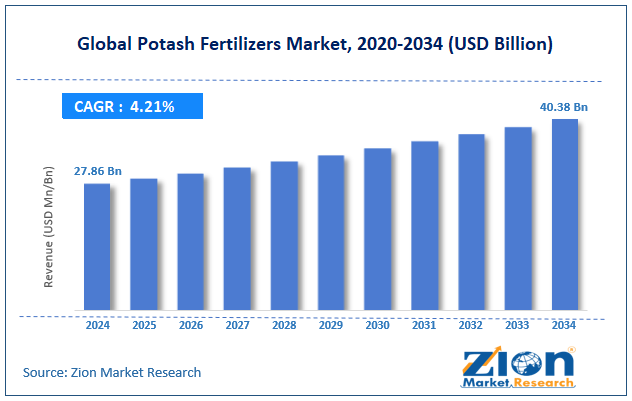
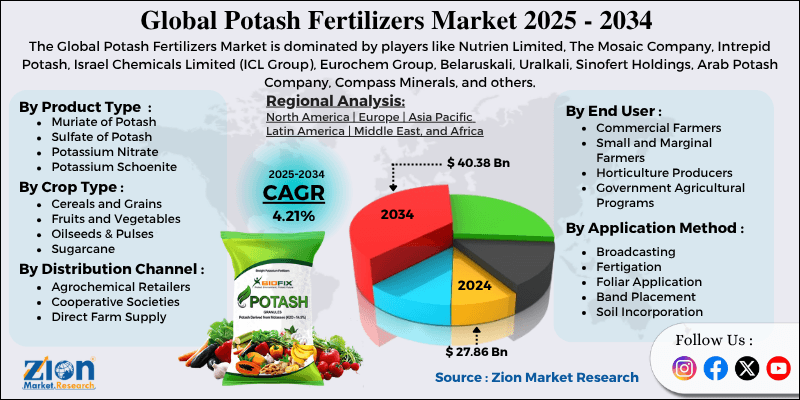
The global potash fertilizers market size was worth approximately USD 27.86 billion in 2024 and is projected to grow to around USD 40.38 billion by 2034, with a compound annual growth rate (CAGR) of roughly 4.21% between 2025 and 2034.
Key Insights
- As per the analysis shared by our research analyst, the global potash fertilizers market is estimated to grow annually at a CAGR of around 4.21% over the forecast period (2025 to 2034).
- In terms of revenue, the global potash fertilizers market size was valued at approximately USD 27.86 billion in 2024 and is projected to reach USD 40.38 billion by 2034.
- The potash fertilizers market is projected to grow significantly due to rising global food demand driven by a growing world population, increasing need to boost crop productivity on shrinking available farmland, growing awareness among farmers about balanced soil nutrition and the importance of potassium for yield quality, government programs promoting modern agricultural inputs in developing economies, and the rapid expansion of high-value fruit, vegetable, and export crop farming that requires superior crop nutrition management.
- Based on product type, the muriate of potash segment is expected to lead the potash fertilizers market, while the sulfate of potash segment is anticipated to grow rapidly.
- Based on crop type, the cereals and grains segment is expected to lead the potash fertilizers market. In contrast, the fruits and vegetables segment is anticipated to grow at a notable rate.
- Based on application method, the broadcasting segment is expected to lead the potash fertilizers market, while the fertigation segment is anticipated to grow rapidly.
- Based on end-user, the commercial farmers segment is the dominant group. In contrast, the small and marginal farmers segment holds a growing and commercially significant share, supported by government subsidy programs.
- Based on distribution channel, the agrochemical retailers segment is expected to lead the potash fertilizers market, while the online agricultural platforms segment is anticipated to grow steadily.
- Based on region, Asia Pacific is projected to dominate the global potash fertilizers market during the estimated period, followed by North America.
Potash Fertilizers Market: Overview
Potash fertilizers are crop nutrients that provide potassium, an essential mineral that plants need to grow properly and stay healthy. Potassium helps plants build strong stems and roots, use water efficiently, and resist diseases and drought. It also improves the quality and yield of fruits, grains, and vegetables. When soil lacks sufficient potassium, crops grow slowly, produce less, and become more susceptible to pests and environmental stress. Potash fertilizers help solve this problem by supplying the right amount of potassium to the soil or through irrigation systems, thereby improving plant growth and productivity. The most commonly used potash fertilizer is muriate of potash, also known as potassium chloride, which accounts for the majority of global use. Other types include sulfate of potash, which is suitable for crops that are sensitive to chloride, such as fruits and vegetables. Potassium nitrate is another option that provides both potassium and nitrogen, while potassium schoenite supplies magnesium in addition to potassium. Each type is selected based on the crop’s needs, soil conditions, and farming method. The potash fertilizer market is growing steadily as global food demand increases. Farmers need to produce more crops from limited land, making proper plant nutrition very important. Governments are also supporting fertilizer use through subsidies and agricultural programs. This is especially important in developing regions, where improving soil quality helps increase crop yields and farmers' incomes.
The rising global food demand, the need to improve crop yields on existing farmland, growing awareness of potassium's role in plant health, and the expansion of high-value horticulture and export agriculture are all driving consistent growth in the potash fertilizers market.
Potash Fertilizers Market: Technology Roadmap 2025 to 2034
What are the key growth trends and future developments shaping the potash fertilizers market during the forecast period?
The potash fertilizers market is shaped by precision farming, smarter nutrient use, a focus on sustainability, soil health awareness, and rising demand from both large and small farmers. The market is expected to grow at a CAGR of around 4.21% over the forecast period, driven by expanding agricultural activity in Asia, Africa, and Latin America, as well as intensifying crop production in North America and Europe.
The following roadmap outlines key development phases expected during the forecast period.
2025–2027: Precision Application and Soil Awareness Phase
- Farmers are expected to use soil testing and digital tools to apply the right amount of potassium, reducing waste and improving crop yield.
- Controlled-release fertilizers are likely to gain wider use, supplying nutrients slowly and improving plant uptake.
- Potash use through irrigation systems is projected to increase, especially in water-scarce areas, improving efficiency.
2028–2031: Digital Farming and Sustainable Nutrition Phase
- Farmers are expected to use drones and satellite data to identify nutrient gaps and apply fertilizers more precisely.
- Companies are likely to develop low-chloride and specialty potash products for organic and high-value crops.
- Digital tracking systems are projected to help monitor fertilizer use, supporting food safety and sustainable farming.
2032–2034: Smart Farming and Climate-Ready Phase
- Artificial intelligence is expected to guide farmers on when and how much potassium to use based on soil and weather data.
- Bio-based potash fertilizers are likely to improve soil health along with nutrient supply.
- Climate-smart fertilizers are projected to help crops handle drought, heat, and changing weather conditions.
Potash Fertilizers Market: Dynamics
Growth Drivers
How is the rising global demand for food driving growth in the potash fertilizers market?
The potash fertilizers market is primarily driven by rising global food demand and the need to increase crop production on limited farmland. As the world population grows, more people are consuming higher-quality diets that include fruits, vegetables, meat, and dairy, increasing demand for crops. However, the amount of available farmland is not growing at the same pace, so farmers must produce more from the same land. This makes proper soil nutrition and fertilizer use very important. Potassium is one of the most commonly deficient nutrients in soil, especially in areas with continuous cropping. When potassium levels are low, crop yields drop, quality reduces, and farmers earn less. Potash fertilizers help address this problem by replenishing soil nutrients cost-effectively. In developing regions, where there is a large gap between current and potential farm output, the use of potash fertilizers can significantly improve productivity, making them essential for food security and agricultural growth.
High-value horticulture and export agriculture are driving strong demand for potash fertilizers.
The potash fertilizers market is growing due to the rapid rise of high-value farming and export-focused agriculture, which require better crop quality. Farmers growing fruits, vegetables, flowers, and other premium crops need to meet strict quality standards for size, color, taste, and shelf life, especially for export markets in Europe and North America. These quality factors depend heavily on proper potassium nutrition during plant growth. As a result, farmers are willing to spend more on advanced potash fertilizers that improve crop output and quality. Specialty products like sulfate of potash and potassium nitrate are in high demand because they provide nutrients without harming sensitive crops. For example, sulfate of potash is preferred as it does not contain chloride, which can affect taste and storage life. Crops such as tomatoes, grapes, citrus fruits, bananas, berries, and flowers benefit greatly from these fertilizers. Countries like India, Vietnam, Kenya, Peru, South Africa, and Chile are expanding their export agriculture, bringing more land under high-value crop production. This trend is driving steady, strong demand for premium potash fertilizers, making it an important growth driver for the overall market.
Restraints
Why do price volatility and concentrated supply create major challenges in the potash fertilizers market?
The potash fertilizers market faces several challenges that can slow its growth, especially in developing countries where farmers are highly sensitive to price changes. Potash prices often fluctuate due to limited global supply, currency movements, shipping costs, and geopolitical factors. When prices rise suddenly, many farmers reduce fertilizer use or skip it altogether, which lowers crop yields and weakens soil quality over time. Another major issue is that most potash production is concentrated in a few countries, such as Canada, Russia, and Belarus. This creates supply risks and makes importing countries vulnerable to disruptions.
Regions like Asia, Africa, and Latin America depend heavily on imports, increasing their exposure to price and supply instability. While some countries like India and China provide subsidies to support farmers, these programs are costly and not always sustainable. Small farmers without such support are the most affected, as they struggle to afford proper crop nutrition.
Opportunities
Rising food demand and expanding modern farming are creating strong growth opportunities in the potash fertilizers market.
The potash fertilizers industry offers strong growth opportunities driven by rising global food demand and the need to improve crop productivity. One major opportunity lies in developing regions such as Africa, Southeast Asia, and Latin America, where fertilizer use remains low but agricultural potential is high. As governments and private players invest in rural infrastructure, distribution networks, and farmer education, the adoption of potash fertilizers is expected to increase significantly. Another key opportunity comes from the expansion of high-value crops like fruits, vegetables, and plantation crops, which require better nutrient management and drive demand for specialty potash products. The growing use of precision agriculture technologies also creates opportunities, as farmers increasingly use soil testing, sensors, and data-driven tools to apply fertilizers more efficiently. This supports demand for advanced and controlled-release potash products.
In addition, the shift toward sustainable farming is encouraging the development of eco-friendly fertilizers and improved nutrient management practices. Expanding irrigation systems, especially drip irrigation, further supports the use of fertigation-based potash. Overall, improving access, product innovation, and increased awareness among farmers are creating strong future opportunities for the potash fertilizers market.
Challenges
Soil imbalance and low awareness are key challenges in the potash fertilizer market.
The potash fertilizers industry faces several ongoing challenges that need attention from companies, governments, and farmers. A key issue is uneven potassium levels in the soil, with some areas lacking nutrients while others have excess due to overuse. In many developing countries, poor soil testing means farmers apply fertilizers without knowing their actual needs, leading to low yields or wasted input. Environmental regulations in developed regions are also becoming stricter to control fertilizer runoff into water bodies, thereby limiting excessive use and requiring more careful application. Another challenge is low awareness among farmers, especially in rural areas where traditional practices are still common and knowledge of proper fertilizer use is limited. Access to reliable advice and quality products is also a concern. To overcome these issues, there is a need for better education, improved soil testing, and stronger supply systems. These challenges continue to affect the steady growth of the potash fertilizers market.
Potash Fertilizers Market: Report Scope
| Report Attributes | Report Details |
|---|---|
| Report Name | Potash Fertilizers Market |
| Market Size in 2024 | USD 27.86 Billion |
| Market Forecast in 2034 | USD 40.38 Bllion |
| Growth Rate | CAGR of 4.21% |
| Number of Pages | 226 |
| Key Companies Covered | Nutrien Limited, The Mosaic Company, Intrepid Potash, Israel Chemicals Limited (ICL Group), Eurochem Group, Belaruskali, Uralkali, Sinofert Holdings, Arab Potash Company, Compass Minerals, and others. |
| Segments Covered | By Product Type, By Crop Type, By Application Method, By End-User, By Distribution Channel, and By Region |
| Regions Covered | North America, Europe, Asia Pacific (APAC), Latin America, Middle East, and Africa (MEA) |
| Base Year | 2024 |
| Historical Year | 2019 to 2023 |
| Forecast Year | 2025 - 2034 |
| Customization Scope | Avail customized purchase options to meet your exact research needs. Request For Customization |
Potash Fertilizers Market: Segmentation
The global potash fertilizers market is segmented based on product type, crop type, application method, end-user, distribution channel, and region.
What makes muriate of potash the dominant product type in the potash fertilizers market?
Based on product type, the global potash fertilizers industry is segregated into muriate of potash, sulfate of potash, potassium nitrate, potassium schoenite, and potassium chloride specialty grades. The muriate of potash segment accounted for approximately 56% of the global market share and is expected to remain dominant throughout the forecast period. Muriate of potash leads because it is the most concentrated, affordable, and readily available source of potassium for most staple crop farming systems worldwide. The sulfate of potash segment is growing rapidly. It holds approximately 18% of market share, driven by strong demand from the expanding fruit, vegetable, and specialty crop sectors, where chloride sensitivity makes muriate of potash unsuitable.
Why does the cereals and grains segment lead crop type demand in the potash fertilizers market?
Based on crop type, the potash fertilizers market is classified into cereals and grains, fruits and vegetables, oilseeds and pulses, sugarcane, and turf and ornamentals. The cereals and grains segment accounts for nearly 39% of the global market share. Cereals and grains lead because rice, wheat, corn, and barley are the foundational food crops of the world, grown on the largest areas of agricultural land and consumed by the greatest number of people. The fruits and vegetables segment holds around 26% of the market share, driven by rapid global growth in fresh produce consumption and export-oriented horticulture, both of which demand premium crop nutrition management.
Why does the broadcasting segment lead application method demand in the potash fertilizers market?
Based on application method, the potash fertilizers industry is segmented into broadcasting, fertigation, foliar application, band placement, and soil incorporation. The broadcasting segment accounts for nearly 41% of the global market share. Broadcasting is the simplest and most widely used method, allowing farmers to spread fertilizers evenly across large fields with minimal effort and cost. The fertigation segment holds around 24% of the market share, driven by the growing use of drip irrigation systems that improve nutrient efficiency and reduce wastage, especially in water-scarce regions.
How does the commercial farmers segment establish dominance among end-users in the potash fertilizers market?
Based on end-user, the market is divided into commercial farmers, small and marginal farmers, horticulture producers, and government agricultural programs. The commercial farmers segment accounts for around 41% of the total market share. Commercial farmers lead because large-scale farming operations apply fertilizers at regular rates across extensive areas, creating consistent and high-volume demand throughout every growing season. The small and marginal farmers segment holds around 35% of the market share, representing the enormous number of smallholder farming households worldwide who, even at lower individual application rates, collectively represent a massive and growing market as access to fertilizers and agricultural support improves.
Why do agrochemical retailers dominate the distribution channel in the potash fertilizers market?
Based on distribution channel, the potash fertilizers market is segmented into agrochemical retailers, cooperative societies, direct farm supply, and online agricultural platforms. The agrochemical retailers segment accounts for approximately 46% of the global market share. Agrochemical retailers lead because most farmers, particularly in developing countries, buy fertilizers locally from nearby dealers who also offer credit, application advice, and access to complementary products such as seeds, crop protection chemicals, and irrigation equipment. The online agricultural platforms segment holds around 12% of the market share. It is growing, particularly in countries with strong digital infrastructure and rising smartphone adoption among farmers, where digital platforms offer better price transparency, home delivery, and access to a wider range of specialty products.
Potash Fertilizers Market: Regional Analysis
Why does Asia Pacific lead the global potash fertilizers market?
The potash fertilizers market is led by Asia Pacific, which accounts for about 42.1% of global market share and remains the leading region due to its large agricultural base and high food production needs. The region includes some of the world's most populous countries, creating strong, sustained demand for crops and fertilizers. China and India are the key contributors, together making up a major share of potash consumption. China is the largest global user of potash fertilizers, supported by its large-scale production of rice, wheat, corn, fruits, and vegetables, as well as government subsidies and modern farming programs. India is the second-largest consumer, with demand driven by its extensive cereal production, growing fruit and vegetable farming, and government subsidies that make fertilizers affordable for millions of small farmers. Southeast Asian countries such as Indonesia, Vietnam, Thailand, Malaysia, and the Philippines are also important markets, supported by crops such as rice, palm oil, rubber, and sugarcane, as well as rising horticulture production. Australia also contributes through its large-scale wheat, barley, and canola farming. Overall, the region’s large farming population, increasing food demand, improving agricultural practices, and strong government support make Asia Pacific the leading region in the potash fertilizers market.
What drives North America's important role in the global potash fertilizers market?
North America is the second-largest region in the potash fertilizers market, accounting for about 21.6% of global demand, driven by strong production and advanced farming practices. The region is both a major producer and consumer of potash fertilizers. Canada plays a key role as it has some of the world’s largest and highest-quality potash reserves, especially in Saskatchewan, and exports to many countries. The United States is the largest consumer in the region, with high demand driven by crops such as corn, soybeans, wheat, cotton, and fruits and vegetables that require regular potassium applications. Farmers in the U.S. use modern farming methods, supported by strong soil testing systems, expert advisory services, and efficient distribution networks. The use of precision agriculture is also high, helping farmers apply fertilizers more accurately and reduce waste. Canada also has a strong farming sector, with crops such as grains, canola, and pulses, which adds to steady demand. Mexico is an emerging market, with growing production of fruits, vegetables, and sugarcane, and improving access to fertilizers. Overall, strong production capacity, advanced technology, and large-scale farming make North America the second leading region in the potash fertilizers market.
Recent Market Developments
- In February 2026, Nutrien Ltd. announced expectations of continued growth in global potash demand, projecting total shipments between 74 and 77 million tons in 2026, driven by soil nutrient depletion and strong agricultural demand.
- In September 2025, Nutrien Ltd. announced the sale of its stake in Argentina’s Profertil for USD 600 million as part of its strategy to focus on core fertilizer operations, including strengthening its potash business.
- In November 2025, Nutrien Ltd. announced plans to evaluate strategic options for its phosphate business while highlighting strong global potash demand growth expected through 2026 due to tight supply and increased crop production.
Potash Fertilizers Market: Competitive Analysis
The leading players in the global potash fertilizers market are:
- Nutrien Limited
- The Mosaic Company
- Intrepid Potash
- Israel Chemicals Limited (ICL Group)
- Eurochem Group
- Belaruskali
- Uralkali
- Sinofert Holdings
- Arab Potash Company
- Compass Minerals
The global Potash Fertilizers Market is segmented as follows:
By Product Type
- Muriate of Potash
- Sulfate of Potash
- Potassium Nitrate
- Potassium Schoenite
- Potassium Chloride Specialty Grades
By Crop Type
- Cereals and Grains
- Fruits and Vegetables
- Oilseeds and Pulses
- Sugarcane
- Turf and Ornamentals
By Application Method
- Broadcasting
- Fertigation
- Foliar Application
- Band Placement
- Soil Incorporation
By End-User
- Commercial Farmers
- Small and Marginal Farmers
- Horticulture Producers
- Government Agricultural Programs
By Distribution Channel
- Agrochemical Retailers
- Cooperative Societies
- Direct Farm Supply
- Online Agricultural Platforms
By Region
- North America
- The U.S.
- Canada
- Mexico
- Europe
- France
- The UK
- Spain
- Germany
- Italy
- Rest of Europe
- Asia Pacific
- China
- Japan
- India
- Australia
- South Korea
- Rest of Asia Pacific
- The Middle East & Africa
- Saudi Arabia
- UAE
- Egypt
- Kuwait
- South Africa
- Rest of the Middle East & Africa
- Latin America
- Brazil
- Argentina
- Rest of Latin America
Table Of Content
Methodology
FrequentlyAsked Questions
Potash fertilizers are crop nutrients that provide potassium, an essential mineral that plants need to grow properly and stay healthy. Potassium helps plants build strong stems and roots, use water efficiently, and resist diseases and drought.
The global potash fertilizers market is projected to grow due to rising global food demand from a growing world population, the pressing need to improve crop yields on existing farmland to close food production gaps, increasing farmer awareness of balanced soil nutrition and the role of potassium in crop quality, government programs promoting fertilizer use in developing economies, and the rapid expansion of high-value horticulture and export agriculture that requires superior crop nutrition inputs.
According to the study, the global potash fertilizers market size was worth around USD 27.86 billion in 2024 and is predicted to grow to around USD 40.38 billion by 2034.
The CAGR value of the potash fertilizers market is expected to be around 4.21% during 2025 to 2034.
Asia Pacific is expected to lead the global potash fertilizers market during the forecast period, supported by the enormous scale of agricultural activity in China, India, and Southeast Asia, strong government support for crop nutrition, and rapidly expanding high-value horticulture production across the region.
The major players profiled in the global potash fertilizers market include Nutrien Limited, The Mosaic Company, Intrepid Potash, ICL Group, Eurochem Group, Belaruskali, Uralkali, Sinofert Holdings, Arab Potash Company, and Compass Minerals.
The report examines key aspects of the potash fertilizers market, including a detailed analysis of current growth drivers and constraints, emerging opportunities in developing agricultural markets, significant challenges related to pricing and supply chain concentration, a competitive landscape overview, regional market breakdowns, and a forward-looking analysis across all major product types, crop categories, application methods, and geographies.
The potash fertilizers market is being influenced by precision farming, soil testing, and digital tools that help farmers apply the right amount of nutrients, improving efficiency, reducing waste, and increasing overall crop yield and quality.
The potash fertilizers market is seeing companies expand production capacity, invest in sustainable and specialty products, and strengthen global supply chains. Many players are forming partnerships, expanding distribution networks, and focusing on emerging markets to increase their reach, while also adopting digital solutions and precision agriculture technologies to better serve farmers.
The potash fertilizers market is dominated by direct sales and distributor networks, with agricultural cooperatives and retail channels holding the largest share due to their strong reach among farmers and well-established supply systems.

List of Contents
Potash FertilizersIndustry Perspective:Key InsightsOverviewTechnology Roadmap 2025 to 2034DynamicsReport ScopeSegmentationRegional AnalysisRecent Market DevelopmentsCompetitive AnalysisThe leading players in the global potash fertilizers market are:The global Market is segmented as follows:HappyClients

