
Polyurethane Acrylate (PUA) Dispersion Market Size, Share, Trends, Growth 2034

Polyurethane Acrylate (PUA) Dispersion Market By Type (Aliphatic PUA Dispersions, Aromatic PUA Dispersions, Solvent Borne PUA Dispersions, Water Borne PUA Dispersions), By Application (Coatings and Paints, Adhesives and Sealants, Textile and Leather Finishing, Printing Inks), By End-Use Industry (Construction Industry, Automotive Industry, Furniture and Wood Industry, Packaging Industry), By Formulation (Single Component Systems, Two Component Systems, Radiation Curable Systems, Hybrid Systems), and By Region - Global and Regional Industry Overview, Market Intelligence, Comprehensive Analysis, Historical Data, and Forecasts 2026 - 2034
| Market Size in 2025 | Market Forecast in 2034 | CAGR (in %) | Base Year |
|---|---|---|---|
| USD 2.86 Billion | USD 5.38 Billion | 7.26% | 2025 |
Polyurethane Acrylate (PUA) Dispersion Industry Perspective:
What will be the size of the polyurethane acrylate (PUA) dispersion market during the forecast period?
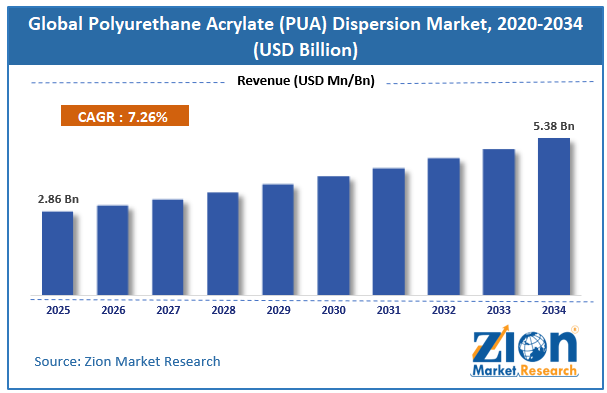
The global polyurethane acrylate (PUA) dispersion market size was valued at approximately USD 2.86 billion in 2025 and is projected to reach around USD 5.38 billion by 2034, growing at a compound annual growth rate of approximately 7.26% between 2026 and 2034.
Key Insights
- As per the analysis shared by our research team, the global polyurethane acrylate dispersion market is estimated to grow at a compound annual growth rate of approximately 7.26% during the forecast period from 2026 to 2034.
- In terms of revenue, the global polyurethane acrylate dispersion market was valued at approximately USD 2.86 billion in 2025 and is projected to reach USD 5.38 billion by 2034.
- The polyurethane acrylate dispersion market is expected to grow strongly due to tightening environmental regulations, rising demand for water-based coatings, growing furniture and construction activity, and expanding use of radiation-curable formulations.
- Based on type, waterborne PUA dispersions lead the market because of their lower environmental impact and ease of use, while aliphatic PUA dispersions are gaining strong momentum as one of the fastest-growing types due to their superior resistance to yellowing and outdoor weathering.
- Based on application, coatings and paints lead the market due to widespread use in furniture and industrial finishing. In contrast, textile and leather finishing is the fastest-growing segment as fashion and footwear brands seek softer, more durable coatings.
- Based on end-use industry, the construction industry leads the market due to rising demand for protective floor and wall coatings, while the automotive industry is steadily growing as manufacturers seek lightweight, chip-resistant finishes.
- Based on formulation, two-component systems lead the market due to their strong performance and durability, while radiation-curable systems are growing rapidly as manufacturers seek faster production speeds and lower energy use.
- Based on region, Asia Pacific leads the global polyurethane acrylate dispersion market. At the same time, North America is the fastest-growing region due to stricter environmental rules and rising demand for sustainable coatings.
Polyurethane Acrylate (PUA) Dispersion Market: Overview
Polyurethane acrylate (PUA) dispersion is a coating material made by combining polyurethane and acrylic resins to provide flexibility, toughness, hardness, and fast curing. These water-based or solvent-based dispersions are used for protective and decorative coatings on wood furniture, leather, textiles, printed materials, plastics, metals, and industrial equipment. The polyurethane acrylate dispersion market is growing as manufacturers replace solvent-heavy coatings with cleaner alternatives that produce fewer harmful fumes and support environmental goals. PUA dispersions provide strong scratch resistance, good flexibility, smooth surface finishes, and reliable durability, making them useful in furniture, automotive, packaging, and other industries. Stricter regulations on volatile organic compound emissions are also encouraging coating producers to develop safer, lower-emission formulations. Advances in resin technology are improving adhesion and performance across different surfaces. In addition, UV-curable polyurethane acrylate dispersions can harden quickly under ultraviolet light, helping manufacturers increase production speed and reduce drying time. They also improve coating efficiency, product appearance, and long-term surface protection. Rising demand for durable, high-quality, and environmentally responsible products is further supporting the adoption of polyurethane acrylate dispersions across various end-use industries worldwide.
The polyurethane acrylate dispersion industry continues to expand as chemical manufacturers, coating formulators, and end-use industries work together to create safer, longer-lasting, and more efficient surface protection solutions worldwide.
Polyurethane Acrylate (PUA) Dispersion Market: Strategic Perspective
Where is the polyurethane acrylate dispersion market heading?
The polyurethane acrylate dispersion market is expected to evolve toward greener, faster-curing, and more versatile coating solutions that can be applied across wood, textile, leather, and industrial surfaces with minimal environmental impact. Greater focus on bio-based raw materials, low-emission formulations, and application-specific dispersions could make these coatings more attractive to industries facing stricter sustainability requirements.
Where should businesses invest in the polyurethane acrylate dispersion market?
The polyurethane acrylate dispersion market offers promising investment opportunities in bio-based resin development, UV curable technology, high-performance textile coatings, and low-VOC formulation research. Companies that can develop solutions for automotive interiors, sustainable packaging, and premium furniture finishing may benefit as industries continue to prioritize environmentally responsible materials.
What will reshape competition in the polyurethane acrylate dispersion market?
Competition in the polyurethane acrylate dispersion market is likely to be shaped by formulation innovation, regulatory compliance, production cost efficiency, and the ability to offer customized solutions for specific end-use applications. Companies that deliver consistent product quality, meet varying regional emission standards, and provide strong technical support are likely to gain an advantage.
Polyurethane Acrylate (PUA) Dispersion Market: Technology Roadmap 2026–2034
What is the projected development roadmap of the polyurethane acrylate (PUA) dispersion market over the forecast period?
The polyurethane acrylate dispersion market is advancing through improved resin formulations, more efficient curing technologies, expanded use of bio-based raw materials, and growing adoption of hybrid dispersion systems, making coatings more durable and environmentally friendly for a wide range of industries. The market is expected to grow at a compound annual growth rate of approximately 7.26% over the forecast period, driven by tightening environmental standards, developing application techniques, and continuous refinement of dispersion chemistry.
The following roadmap outlines key development phases expected through 2034.
2026–2028: Regulatory Compliance and Formulation Improvement Phase
- Improved water-based formulations: Manufacturers are expected to refine waterborne dispersions so they match or exceed the performance of traditional solvent-based coatings.
- Lower-emission production: Companies are likely to invest in cleaner manufacturing processes that reduce volatile organic compound emissions during both production and application.
- Greater adoption in furniture finishing: PUA dispersions are expected to become more common in wood coating applications as furniture makers respond to stricter indoor air quality regulations.
2029–2031: Performance Enhancement and Application Expansion Phase
- Hybrid system development: Manufacturers are expected to combine polyurethane acrylate chemistry with other resin types to create coatings that offer both flexibility and extreme hardness.
- Radiation curing growth: More production lines are expected to adopt UV and electron beam curing methods, reducing energy consumption and speeding up manufacturing processes.
- Expansion into automotive and packaging: PUA dispersions are expected to spread further into automotive interior components and flexible packaging materials as their scratch resistance and flexibility become more valued.
2032–2034: Sustainable and Specialized Chemistry Phase
- Bio-based raw material integration: Formulators are likely to increase the use of renewable feedstocks to reduce the carbon footprint of dispersion production.
- Advanced surface customization: Dispersions may be engineered to offer specific properties such as anti-microbial protection, self-healing surfaces, or enhanced grip texture for specialized applications.
- Circular economy alignment: PUA dispersion technology may increasingly support recyclable and biodegradable coating systems, helping industries meet long-term sustainability commitments.
Polyurethane Acrylate (PUA) Dispersion Market: Dynamics
Growth Drivers
What is driving the expansion of the polyurethane acrylate (PUA) dispersion market across industrial applications?
The polyurethane acrylate dispersion market is expanding as manufacturers seek coating materials that provide strong protection, flexibility, and long-lasting surface performance. PUA dispersions offer good resistance to scratches, moisture, abrasion, and everyday wear, making them valuable across furniture, automotive, leather, and textile applications. Furniture manufacturers use these coatings to protect wood surfaces while maintaining a smooth and attractive appearance. Automotive suppliers apply PUA dispersions to interior trim and plastic components because their flexibility helps coatings withstand temperature changes without cracking. Leather manufacturers use them to improve surface durability and appearance, while textile producers apply PUA-based finishes to enhance fabric performance and wear resistance. These performance benefits are increasing the use of polyurethane acrylate dispersions in products that require both visual quality and reliable protection. Growing demand for longer-lasting consumer and industrial products is pushing manufacturers to choose advanced coating technologies that improve product life, reduce surface damage, and maintain consistent finish quality across demanding end-use applications.
Sustainable coating demand is creating fresh opportunities in the polyurethane acrylate (PUA) dispersion market.
The polyurethane acrylate dispersion market is gaining momentum as manufacturers move toward coating systems that support environmental goals and reduce harmful emissions. Water-based PUA dispersions are becoming increasingly attractive because they can reduce dependence on conventional solvent-heavy coating systems and help lower volatile organic compound emissions. Stricter environmental regulations in major markets are encouraging coating producers to develop formulations that meet changing chemical and emission requirements. Furniture manufacturers are adopting lower-emission coatings for indoor products, while automotive companies are seeking coating solutions that support improved vehicle interior air quality. Growing consumer awareness of environmentally responsible products is also encouraging brands to consider cleaner coating technologies.
Government programs supporting sustainable manufacturing and the expansion of environmental certification schemes are further strengthening this shift. As companies face increasing pressure to improve their environmental performance, polyurethane acrylate dispersions are becoming a practical option for manufacturers seeking to balance coating performance with sustainability requirements across furniture, automotive, packaging, construction, and other industrial applications.
Restraints
How is technical complexity affecting the polyurethane acrylate (PUA) dispersion market?
The polyurethane acrylate dispersion market faces challenges from raw material price fluctuations, complex formulations, and varying performance requirements across applications. Key raw materials can become more expensive due to crude oil price changes, supply disruptions, and unstable sourcing, making production costs difficult to manage. Developing formulations that balance flexibility, hardness, adhesion, and fast drying requires skilled chemists and extensive testing, which can increase development time and operating costs. Different industries also demand specific coating properties, making it difficult for manufacturers to offer one formulation that works equally well across wood, plastics, metals, textiles, and other surfaces. Some companies remain cautious about replacing established solvent-based coatings because they may question whether PUA dispersions can deliver similar performance. Humidity and temperature changes during application can also affect coating quality and consistency. Limited access to advanced coating equipment in developing markets may further slow adoption. Stable raw material sourcing, better technical support, flexible formulations, and industry standards can help overcome these challenges and support market growth.
Opportunities
Will broader industry adoption create new opportunities in the polyurethane acrylate (PUA) dispersion market?
The polyurethane acrylate dispersion market offers significant growth opportunities through advanced formulations for applications beyond traditional surface coatings. Hybrid formulations that combine polyurethane flexibility with acrylic hardness can help manufacturers meet specific performance needs across specialized industries. UV-curable and radiation-curable PUA dispersions also provide opportunities to improve manufacturing efficiency by enabling rapid curing and shorter processing times. Growing demand for sustainable packaging is creating opportunities for PUA coatings in specialty printing, labels, and flexible packaging materials. Flexible electronics represent another emerging application where coatings require strong adhesion, flexibility, and reliable surface protection.
Advanced textile and leather finishing technologies can further expand PUA dispersion use in footwear, fashion, and performance fabrics. Manufacturers that develop easy-to-apply formulations with improved adhesion and application versatility can address a wider range of substrates and production conditions. Continued research into resin chemistry, curing methods, and application-specific formulations can help companies develop higher-value products and capture emerging demand. These opportunities can broaden the role of polyurethane acrylate dispersions across innovative manufacturing sectors worldwide.
Challenges
Formulation consistency is a key challenge for the polyurethane acrylate (PUA) dispersion market.
The polyurethane acrylate dispersion market faces challenges involving product consistency, regulatory compliance, and coating performance under different environmental conditions. Manufacturers must maintain uniform quality across production batches because small changes in raw material purity can affect coating strength, flexibility, adhesion, and finish. Different countries also have varying rules for chemical content and emissions, increasing compliance requirements for companies operating globally. PUA dispersion performance may change under extreme humidity or temperature, creating concerns about reliability in demanding applications.
Manufacturers must also adjust formulations for different surfaces, including leather, wood, plastics, and metals, which adds technical complexity. Protecting proprietary formulations from competitors can require strong intellectual property strategies. A shortage of skilled professionals in polymer chemistry, formulation development, and coating application may further raise production and research costs. To overcome these barriers, companies can improve quality control, standardize testing, strengthen regulatory processes, and provide clear technical guidance. These measures can build customer confidence, support consistent product performance, and encourage responsible market growth.
Polyurethane Acrylate (PUA) Dispersion Market: Report Scope
| Report Attributes | Report Details |
|---|---|
| Report Name | Polyurethane Acrylate (PUA) Dispersion Market |
| Market Size in 2025 | USD 2.86 Billion |
| Market Forecast in 2034 | USD 5.38 Billion |
| Growth Rate | CAGR of 7.26% |
| Number of Pages | 227 |
| Key Companies Covered | Covestro AG, BASF SE, Alberdingk Boley GmbH, DIC Corporation, Allnex Group, Lubrizol Corporation, Mitsui Chemicals, Stahl Holdings, Woodbridge Foam Corporation, Chemtura Corporation, and others. |
| Segments Covered | By Type, By Application, By End Use Industry, By Formulation, and By Region |
| Regions Covered | North America, Europe, Asia Pacific (APAC), Latin America, Middle East, and Africa (MEA) |
| Base Year | 2025 |
| Historical Year | 2020 - 2024 |
| Forecast Year | 2026 - 2034 |
| Customization Scope | Avail customized purchase options to meet your exact research needs. Request For Customization |
Polyurethane Acrylate (PUA) Dispersion Market: Segmentation
The global polyurethane acrylate (PUA) dispersion market is segmented by type, application, end-use industry, formulation, and region.
What makes waterborne PUA dispersions the dominant type in the polyurethane acrylate dispersion market?
Based on type, the market is segmented into aliphatic, aromatic, solvent-borne, and waterborne dispersions. Waterborne PUA dispersions hold about 45% of the market share, leading due to their lower environmental impact and compliance with tightening emission regulations. Aliphatic PUA dispersions hold around 24% market share. They are the fastest-growing segment because of their strong resistance to yellowing and suitability for outdoor and UV-exposed applications.
How do coatings and paints applications maintain their leading position in the polyurethane acrylate dispersion market?
Based on application, the polyurethane acrylate PUA dispersion industry is divided into coatings and paints, adhesives and sealants, textile and leather finishing, and printing inks. Coatings and paints account for approximately 37% of the global market share, driven by widespread use in furniture, flooring, and industrial equipment finishing. Textile and leather finishing holds around 21% market share. It is the fastest-growing segment due to expanding use of soft, durable coatings in fashion and footwear manufacturing.
What makes the construction industry the dominant end-use industry in the polyurethane acrylate dispersion market?
By end-use industry, the market is classified into construction, automotive, furniture and wood, and packaging. The construction industry leads with about a 33% share, driven by rising demand for protective and decorative coatings on floors, walls, and structural surfaces. The automotive industry holds around 23% market share. It is growing steadily as manufacturers seek lightweight, chip-resistant coatings for interior and exterior components.
How does the two-component system formulation shape the demand landscape of the polyurethane acrylate dispersion market?
Based on formulation, the polyurethane acrylate dispersion market is categorized into single-component, two-component, radiation curable, and hybrid systems. Two-component systems account for about 35% of the market, leading because of their strong mechanical performance and long-lasting durability in demanding applications. Radiation-curable systems hold around 20% market share. This segment is expanding quickly as manufacturers prioritize faster curing times and reduced energy consumption on production lines.
Polyurethane Acrylate (PUA) Dispersion Market: Regional Analysis
Why is Asia Pacific leading the global polyurethane acrylate (PUA) dispersion market?
Asia Pacific holds a 39.48% share of the global polyurethane acrylate dispersion market and is expected to maintain its leading position during the forecast period. The region benefits from a strong manufacturing base across furniture, automotive, textiles, packaging, and construction industries. China and India are major contributors, supported by expanding industrial production, urbanization, and rising demand for coated products. Growing construction activity is increasing the need for protective floor and wall coatings, while furniture exports from Vietnam and Malaysia are driving steady demand for wood-finishing solutions. Regional chemical manufacturers are increasing production to meet domestic and export needs, while global companies are expanding their manufacturing facilities across the region.
Growing environmental awareness and stricter emission standards are also encouraging industries to shift from solvent-based coatings toward water-based polyurethane acrylate dispersions. Asia Pacific's cost-competitive manufacturing environment provides access to raw materials, skilled workers, and established supply chains. Increasing automotive production and textile manufacturing are further supporting demand for advanced coating technologies. Rising investment in sustainable materials, durable surface protection, and cleaner manufacturing processes is expected to strengthen regional adoption and keep Asia Pacific at the forefront of the global market throughout the forecast period across key industries.
What makes North America the fastest-growing region in the polyurethane acrylate (PUA) dispersion market?
North America holds a 27.16% share of the global polyurethane acrylate dispersion market and is expected to grow strongly during the forecast period. Stricter environmental regulations, rising demand for sustainable coatings, and increasing investment in green building projects support growth. The United States and Canada are key contributors, with regulatory authorities focusing more on reducing volatile organic compound emissions across industries. Furniture manufacturers are reformulating coatings to meet indoor air quality requirements, while automotive companies are adopting water-based PUA dispersions for interior components as consumers seek healthier vehicle cabin environments. Construction companies are also choosing low-emission floor and wall coatings to support green building certifications and sustainability goals.
Growing research in polymer chemistry is helping manufacturers develop advanced polyurethane acrylate dispersion formulations with improved durability, adhesion, and application performance. Consumer awareness of the health concerns linked to solvent-based coatings is further encouraging brands to promote water-based alternatives. Meanwhile, sustainable packaging, specialty printing, and textile finishing are creating additional opportunities for PUA dispersion manufacturers. Continued regulatory pressure, green construction, and sustainable manufacturing practices are expected to strengthen demand and drive strong growth in the North America market during the forecast period across major end-use industries.
Recent Market Developments
- In April 2026, Covestro AG, Marquardt, and E Ink developed a transparent waterborne polyurethane coating based on Covestro’s INSQIN® and Impranil® technologies for automotive interiors, enabling smart e-paper displays to be integrated into coated synthetic materials.
- In June 2026, Econic Technologies introduced new polycarbonate ether polyols made using captured CO₂ for polyurethane dispersions, offering coating manufacturers improved adhesion, durability, and environmental resistance while reducing reliance on fossil-based raw materials.
Polyurethane Acrylate (PUA) Dispersion Market: Competitive Analysis
The leading players in the global polyurethane acrylate dispersion market are Covestro AG, BASF SE, Alberdingk Boley GmbH, DIC Corporation, Allnex Group, Lubrizol Corporation, Mitsui Chemicals, Stahl Holdings, Woodbridge Foam Corporation, and Chemtura Corporation.
The global polyurethane acrylate (PUA) dispersion market is segmented as follows:
By Type
- Aliphatic PUA Dispersions
- Aromatic PUA Dispersions
- Solvent-Borne PUA Dispersions
- Waterborne PUA Dispersions
By Application
- Coatings and Paints
- Adhesives and Sealants
- Textile and Leather Finishing
- Printing Inks
By End Use Industry
- Construction Industry
- Automotive Industry
- Furniture and Wood Industry
- Packaging Industry
By Formulation
- Single Component Systems
- Two Component Systems
- Radiation Curable Systems
- Hybrid Systems
By Region
- North America
- The U.S.
- Canada
- Mexico
- Europe
- France
- The UK
- Spain
- Germany
- Italy
- Rest of Europe
- Asia Pacific
- China
- Japan
- India
- Australia
- South Korea
- Rest of Asia Pacific
- The Middle East & Africa
- Saudi Arabia
- UAE
- Egypt
- Kuwait
- South Africa
- Rest of the Middle East & Africa
- Latin America
- Brazil
- Argentina
- Rest of Latin America
Table Of Content
Methodology
FrequentlyAsked Questions
Polyurethane acrylate (PUA) dispersion is a coating material made by combining polyurethane and acrylic resins to provide flexibility, toughness, hardness, and fast curing. These water-based or solvent-based dispersions are used for protective and decorative coatings on wood furniture, leather, textiles, printed materials, plastics, metals, and industrial equipment.
The global polyurethane acrylate (PUA) dispersion market is expected to grow due to tightening environmental regulations, rising demand for water-based coatings, growing construction and furniture activity, and expanding use of radiation-curable formulations worldwide.
According to research, the global polyurethane acrylate (PUA) dispersion market was valued at approximately USD 2.86 billion in 2025 and is projected to reach approximately USD 5.38 billion by 2034.
The compound annual growth rate of the polyurethane acrylate (PUA) dispersion market is expected to be approximately 7.26% from 2026 to 2034.
Asia Pacific is expected to lead the global polyurethane acrylate (PUA) dispersion market throughout the forecast period, driven by a large manufacturing base, growing construction activity, and expanding furniture and automotive industries.
Which are the major players driving the growth of the polyurethane acrylate (PUA) dispersion market?
The major players in the global polyurethane acrylate (PUA) dispersion market include Covestro AG, BASF SE, Alberdingk Boley GmbH, DIC Corporation, Allnex Group, Lubrizol Corporation, Mitsui Chemicals, Stahl Holdings, Woodbridge Foam Corporation, and Chemtura Corporation.
The report examines key aspects of the polyurethane acrylate (PUA) dispersion market, including research and development drivers, adoption barriers, application opportunities, competitive landscape dynamics, detailed regional market performance analysis, and a comprehensive forward-looking outlook across all major types, applications, end-use industries, formulations, and geographic regions through 2034.
Stricter volatile organic compound emission limits, indoor air quality standards, and green building certification requirements are shaping the polyurethane acrylate (PUA) dispersion market. Governments are also encouraging manufacturers to reduce solvent use and improve transparency around chemical content.
The major growth opportunities in the global polyurethane acrylate (PUA) dispersion market include furniture finishing, automotive interiors, sustainable packaging, textile and leather manufacturing, and construction coatings, supported by rising demand for durable and low-emission surface treatments.
Bio-based resin development, UV and radiation curing technology, hybrid formulation systems, and low-emission manufacturing are key trends shaping the polyurethane acrylate (PUA) dispersion market. Integration with sustainable packaging and green building initiatives is also expanding its everyday use.

List of Contents
Polyurethane Acrylate (PUA) DispersionIndustry Perspective:Key InsightsOverviewStrategic PerspectiveTechnology Roadmap 20262034DynamicsReport ScopeSegmentationRegional AnalysisRecent Market DevelopmentsCompetitive AnalysisThe global polyurethane acrylate (PUA) dispersion market is segmented as follows:HappyClients

