
Personal Emergency Response Systems (PERS) Market Size, Share and Forecast 2034

Personal Emergency Response Systems (PERS) Market By Type (Mobile PERS, Standalone PERS and Landline PERS), By End-Use (Senior Living Facilities, Assisted Living Facilities, Home-based Users and Others) and By Region - Global and Regional Industry Overview, Market Intelligence, Comprehensive Analysis, Historical Data, and Forecasts 2025 - 2034
| Market Size in 2024 | Market Forecast in 2034 | CAGR (in %) | Base Year |
|---|---|---|---|
| USD 6.5 Billion | USD 11.5 Billion | 5.9% | 2024 |
Personal Emergency Response Systems (PERS) Industry Perspective:
What will be the size of the global Personal Emergency Response Systems (PERS) market during the forecast period?
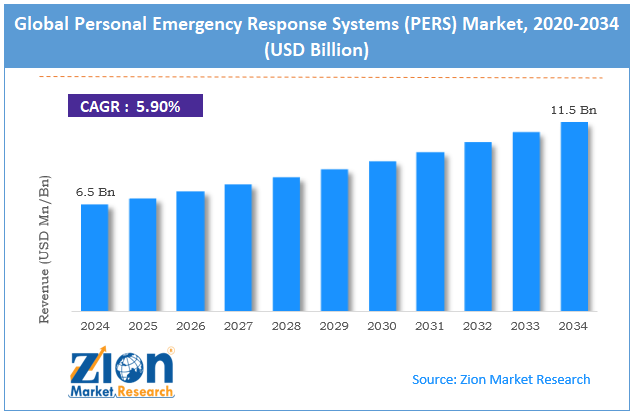
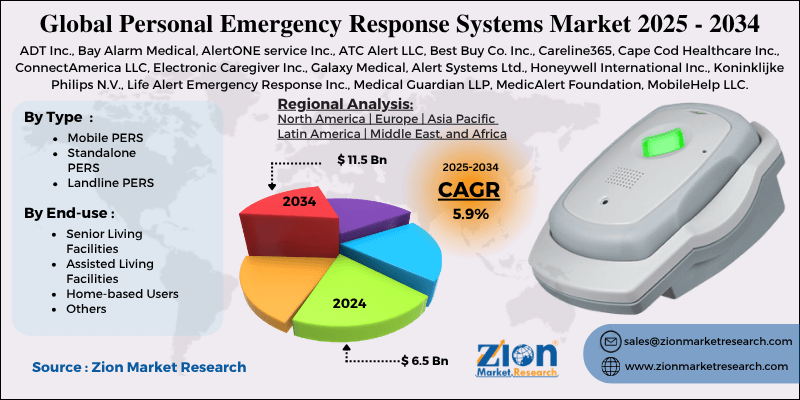
The global Personal Emergency Response Systems (PERS) market size was worth around USD 6.5 billion in 2024 and is predicted to grow to around USD 11.5 billion by 2034 with a compound annual growth rate (CAGR) of roughly 5.9% between 2025 and 2034.
Key Insights
- As per the analysis shared by our research analyst, the global Personal Emergency Response Systems (PERS) market is estimated to grow annually at a CAGR of around 5.9% over the forecast period (2025-2034).
- In terms of revenue, the global Personal Emergency Response Systems (PERS) market size was valued at around USD 6.5 billion in 2024 and is projected to reach USD 11.5 billion by 2034.
- Increasing prevalence of chronic disease is expected to propel the Personal Emergency Response Systems (PERS) market over the projected period.
- Based on the type, the mobile PERS segment captures the largest market share in 2024 of 54%.
- Based on the end-use, the home-based users segment captures the largest revenue share in 2024 of 60%.
- Based on region, North America accounted for the largest market share of 45% in 2024.
Personal Emergency Response Systems (PERS) Market: Overview
Personal Emergency Response Systems (PERS) are emergency safety systems designed to provide urgent assistance in medical emergencies or other personal emergencies. Usually, these systems consist of devices such as pendants, smartwatches, and wristbands designed to detect emergencies and send urgent alerts. The alert is generated by pressing a button on the device, which sends messages to monitoring services or caregivers who can respond immediately.
Some of the most recent designs of Personal Emergency Response Systems (PERS) have incorporated advanced capabilities, including automatic fall detection, GPS, two-way communication, and telehealth. Generally, Personal Emergency Response Systems (PERS) enable users to live independently without compromising their safety.
Impact of the USA-Israel War on Iran on the Personal Emergency Response Systems (PERS) Market
There are some indirect ways in which the war between the United States and Israel, with the involvement of Iran (2026), influences the PERS market. First of all, there are disruptions in global supply chains, which lead to increased transportation and delivery costs and even a shortage of key raw materials used in electronics and other technologies. Moreover, due to this military conflict, there are major changes in the global economy, especially in energy markets, as the war triggered a global crisis that drove oil prices higher. It means production costs across all industries have risen, which can affect the growth rate in the PERS market because it will be more expensive to produce such devices.
Disruptions in the global economy, particularly in the pharmaceutical industry and medicine-related technologies, may also delay investments in healthcare assistive technologies, including personal emergency response systems. Nevertheless, it draws attention to remote healthcare management and emergency services, thereby creating favorable conditions for the development of PERS.
Personal Emergency Response Systems (PERS) Market: Dynamics
Growth Drivers
How does the growth of home healthcare and telehealth drive the Personal Emergency Response Systems (PERS) market?
Rapid development and deployment of home care and telehealth services are among the main forces driving the PERS market, as this system aligns with the general trend towards decentralization and individualization of the healthcare system. As healthcare institutions pay increasing attention to patient care outside hospitals, there is an increased need for technological solutions capable of providing continuous remote monitoring and immediate assistance in emergency situations. Devices within the personal emergency response system ensure prompt notification of emergency situations and two-way communication between patients and medical personnel; this technology can be used to remotely monitor the condition of elderly people and those with various illnesses at home.
Thanks to developments in telehealth and telecare, including improvements in internet connectivity and the greater spread of smartphones and related services, PERS can be successfully integrated into telemedicine services to provide rapid assistance in emergencies. At the same time, home care helps minimize hospital admissions and healthcare costs, making PERS an efficient and necessary tool.
Restraints
High initial and subscription costs hindering the industry growth
The very high costs associated with PERS systems at the outset and on a continuing basis represent a serious constraint on the expansion of the PERS market. This is because PERS entails not only an initial investment in hardware (pendants or bracelets worn around the neck or wrist or home-based devices) but also monthly costs for monitoring and related services. These can present a serious obstacle for the elderly who are often on fixed incomes. This is particularly true in developing countries and areas where consumer awareness may be rising, but buying power remains low.
In addition, inadequate insurance coverage for PERS services in some markets is another major stumbling block for PERS systems, as consumers have to pay the full cost out of their own pockets. As a consequence, although PERS systems provide significant value in terms of safety and good health, their very high costs constitute an obstacle to widespread adoption and expansion.
Opportunities
Why does the rising product launch offer a lucrative opportunity for the Personal Emergency Response Systems (PERS) market?
The rising product launch is expected to offer a potential opportunity to the market growth during the projected period. For instance, in February 2025, LogicMark, Inc., a company that produces personal emergency response systems (PERS), health communications devices, and care economy technologies, introduced the new version of their popular medical alert product the Guardian Alert 911 Plus. The new version of their direct-to-911 medical alert system includes the latest 4G LTE connectivity technology paired with the fall detection feature.
Fall detection ensures that 911 will be contacted around the clock automatically in case a person has an accident, and there is no need to press a button to make contact. Direct-to-911 communication allows customers to communicate directly with first responders simply by pressing a button. Medical alert devices are often large and inconvenient for wearing daily because many such products are bulky and cumbersome.
Challenges
Why do the limited awareness and digital literacy pose a significant challenge to the Personal Emergency Response Systems (PERS) market?
The lack of awareness and digital literacy is a key barrier to PERS adoption and use, as the elderly the most critical target audience are the ones who need it most. They may simply be unaware of this technology's existence and its advantages, such as quick access to help, fall detection, and remote monitoring. Therefore, even a useful product cannot become popular and widely adopted. Moreover, due to limited digital literacy, users may have difficulty using a particular product and its components, including smartphone applications, GPS, and connected health systems. This aspect may lead to reluctance to use PERS at all, since elderly people usually prefer avoiding innovations and using only traditional approaches.
Moreover, the process of setting up the device, maintaining it, and charging it may be too complicated for an elderly person. Furthermore, due to the absence of digital skills, users may use a particular product incorrectly, such as neglecting it in everyday life or forgetting to turn on the alarm in emergencies. Such problems are widespread in rural areas where there is no infrastructure to support the functioning of digital products. Overall, despite the obvious advantages of PERS, it is difficult to attract customers due to the mentioned barriers.
Personal Emergency Response Systems (PERS) Market: Report Scope
| Report Attributes | Report Details |
|---|---|
| Report Name | Personal Emergency Response Systems (PERS) Market |
| Market Size in 2024 | USD 6.5 Billion |
| Market Forecast in 2034 | USD 11.5 Billion |
| Growth Rate | CAGR of 5.9% |
| Number of Pages | 225 |
| Key Companies Covered | ADT Inc., Bay Alarm Medical, AlertONE service Inc., ATC Alert LLC, Best Buy Co. Inc., Careline365, Cape Cod Healthcare Inc., ConnectAmerica LLC, Electronic Caregiver Inc., Galaxy Medical, Alert Systems Ltd., Honeywell International Inc., Koninklijke Philips N.V., Life Alert Emergency Response Inc., Medical Guardian LLP, MedicAlert Foundation, MobileHelp LLC, ModivCare Inc., Rescue Alert, TruSense LLC, Tunstall Healthcare Group Ltd., and others. |
| Segments Covered | By Type, By End-use, and By Region |
| Regions Covered | North America, Europe, Asia Pacific (APAC), Latin America, Middle East, and Africa (MEA) |
| Base Year | 2024 |
| Historical Year | 2019 to 2023 |
| Forecast Year | 2025 - 2034 |
| Customization Scope | Avail customized purchase options to meet your exact research needs. Request For Customization |
Personal Emergency Response Systems (PERS) Market: Segmentation
Type Insights
Why does the mobile PERS dominate the Personal Emergency Response Systems (PERS) market?
The mobile PERS segment captures the largest market share in 2024 of 54%. It is motivated by growing need for safety and connectivity. In contrast to standard phone-based PERS systems, mobile PERS employs cellular technologies and GPS tracking, thus giving users an opportunity to receive emergency help not only at home but also outside their house. Such devices are especially popular among those seniors who want to maintain independent lifestyle with some degree of protection.
Moreover, recent developments in wearable devices include smaller design, increased battery capacity, and additional functionalities including fall alert, geo-tracking, and bidirectional communication. Thanks to rapid expansion of the smartphone industry and improvement of network infrastructure, such gadgets can easily be combined with remote mobile applications that monitor users' condition in real time.
End-use Insights
Do the home-based users capture the largest market share in the Personal Emergency Response Systems (PERS) market?
The home-based users segment captures the largest revenue share in 2024 of 60%. The development is mainly due to the growing trend of aging at home and at-home caregiving. The aging population and people suffering from chronic illnesses are deciding to stay in their homes instead of shifting to nursing homes or hospitals. The PERS technology provides security in such situations by offering instant response, real-time monitoring, and fast connectivity to healthcare providers.
Also, with the rising popularity of home healthcare services and telemedicine, the use of PERS as an integral element in remote patient monitoring has been established to save on hospital visits and associated expenses. Advanced technological features like wearables, falls detection, and intelligent homes have also made it more user-friendly at home.
Regional Insights
Why does North America lead the Personal Emergency Response Systems (PERS) market?
North America accounted for the largest market share of 45% in 2024. This is facilitated by a mature healthcare framework, the adoption of sophisticated technologies, and fast-paced aging demographics. In countries such as the US and Canada, the population is aging, with a majority of individuals requiring continuous monitoring and emergency assistance, thereby increasing the need for PERS solutions. Besides, another contributing factor is the high level of public awareness of personal safety devices, increased expenditure on healthcare services, and favorable reimbursements in the North American region, which create a favorable market environment.
The availability of top players and innovations in technologies such as wearables, GPS-based solutions, and AI-powered fall detection further expands the market potential in the region. Furthermore, the growth of home health care and telemedicine has led to the integration of PERS into remote patient monitoring systems, making it vital to contemporary care delivery.
Personal Emergency Response Systems (PERS) Market: Competitive Analysis
The global Personal Emergency Response Systems (PERS) market is dominated by players like:
- ADT Inc.
- Bay Alarm Medical
- AlertONE service Inc.
- ATC Alert LLC
- Best Buy Co. Inc.
- Careline365
- Cape Cod Healthcare Inc.
- ConnectAmerica LLC
- Electronic Caregiver Inc.
- Galaxy Medical
- Alert Systems Ltd.
- Honeywell International Inc.
- Koninklijke Philips N.V.
- Life Alert Emergency Response Inc.
- Medical Guardian LLP
- MedicAlert Foundation
- MobileHelp LLC
- ModivCare Inc.
- Rescue Alert
- TruSense LLC
- Tunstall Healthcare Group Ltd.
The global Personal Emergency Response Systems (PERS) market are segmented as follows:
By Type
- Mobile PERS
- Standalone PERS
- Landline PERS
By End-use
- Senior Living Facilities
- Assisted Living Facilities
- Home-based Users
- Others
By Region
- North America
- The U.S.
- Canada
- Mexico
- Europe
- France
- The UK
- Spain
- Germany
- Italy
- Rest of Europe
- Asia Pacific
- China
- Japan
- India
- Australia
- South Korea
- Rest of Asia Pacific
- The Middle East & Africa
- Saudi Arabia
- UAE
- Egypt
- Kuwait
- South Africa
- Rest of the Middle East & Africa
- Latin America
- Brazil
- Argentina
- Rest of Latin America
Table Of Content
Methodology
FrequentlyAsked Questions
Personal Emergency Response Systems (PERS) are emergency safety systems designed to provide urgent assistance in medical emergencies or other personal emergencies. Usually, these systems consist of devices such as pendants, smartwatches, and wristbands designed to detect emergencies and send urgent alerts. The alert is generated by pressing a button on the device, which sends messages to monitoring services or caregivers who can respond immediately.
The Personal Emergency Response Systems (PERS) market is driven by aging populations, rising demand for independent living, advancements in wearable and telehealth technologies, and the expansion of home healthcare services.
The Personal Emergency Response Systems (PERS) market is restrained by high device and subscription costs, limited awareness and digital literacy among elderly users, reliability issues such as false alarms, privacy and data security concerns, and competition from alternative technologies like smartphones and smartwatches.
Based on the end-use, the home-based user’s segment is expected to dominate the Personal Emergency Response Systems (PERS) market growth during the projected period.
One of the most prominent trends is the shift from landline-based systems to mobile and wearable PERS devices equipped with GPS, Bluetooth, and cellular connectivity, enabling real-time monitoring and assistance beyond the home environment.
According to the report, the global Personal Emergency Response Systems (PERS) market size was worth around USD 6.5 billion in 2024 and is predicted to grow to around USD 11.5 billion by 2034.
The global Personal Emergency Response Systems (PERS) market is expected to grow at a CAGR of 5.9% during the forecast period.
The global Personal Emergency Response Systems (PERS) industry growth is expected to be led by North America over the forecast period.
Which are the major players leveraging the Personal Emergency Response Systems (PERS) market growth?
The global Personal Emergency Response Systems (PERS) market is dominated by players like ADT Inc., Bay Alarm Medical, AlertONE service Inc., ATC Alert LLC, Best Buy Co. Inc., Careline365, Cape Cod Healthcare Inc., ConnectAmerica LLC, Electronic Caregiver Inc., Galaxy Medical, Alert Systems Ltd., Honeywell International Inc., Koninklijke Philips N.V., Life Alert Emergency Response Inc., Medical Guardian LLP, MedicAlert Foundation, MobileHelp LLC, ModivCare Inc., Rescue Alert, TruSense LLC and Tunstall Healthcare Group Ltd. among others.
The market report covers the geographical market along with a comprehensive competitive landscape analysis. It also includes cash flow analysis, profit ratio analysis, market basket analysis, market attractiveness analysis, sentiment analysis, PESTLE analysis, trend analysis, SWOT analysis, trade area analysis, demand & supply analysis, Porter’s five forces analysis, and value chain analysis.

HappyClients

