Fall Protection Market Size, Share, Trends, Growth and Forecast 2034

Fall Protection Market By Product Type (Full Body Harnesses, Lanyards and Energy Absorbers, Self-Retracting Lifelines, Anchor Systems, Horizontal Lifeline Systems, Safety Nets), By Material (Polyester, Nylon, Kevlar, Steel, Aluminum), By End-User (Industrial Workers, Construction Workers, Utility and Energy Workers, Government and Emergency Services), By Distribution Channel (Direct Sales, Distributors and Dealers, Online Retail), and By Region - Global and Regional Industry Overview, Market Intelligence, Comprehensive Analysis, Historical Data, and Forecasts 2025 - 2034
| Market Size in 2024 | Market Forecast in 2034 | CAGR (in %) | Base Year |
|---|---|---|---|
| USD 4.77 Billion | USD 7.58 Billion | 5.30% | 2024 |
Fall Protection Industry Perspective:
What is the projected size of the fall protection market during the forecast period?
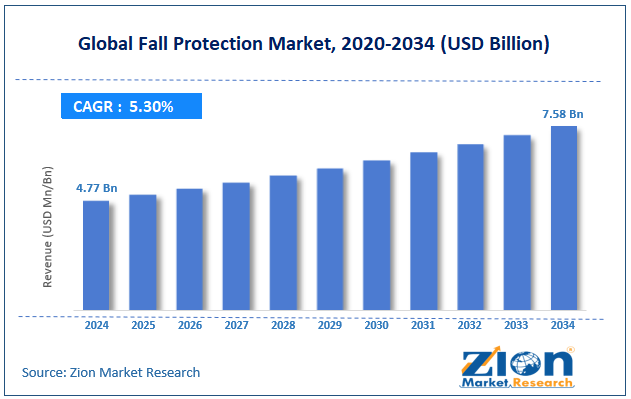
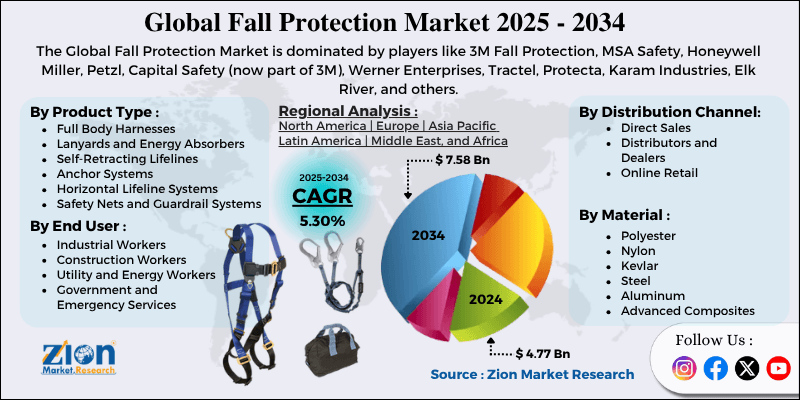
The global fall protection market size was worth approximately USD 4.77 billion in 2024 and is projected to grow to around USD 7.58 billion by 2034, with a compound annual growth rate (CAGR) of roughly 5.30% between 2025 and 2034.
Key Insights
- As per the analysis shared by our research analyst, the global fall protection market is estimated to grow annually at a CAGR of around 5.30% over the forecast period (2025–2034).
- In terms of revenue, the global fall protection market size was valued at approximately USD 4.77 billion in 2024 and is projected to reach USD 7.58 billion by 2034.
- The fall protection market is projected to grow significantly due to tightening workplace safety regulations across major economies, rapid growth in construction and infrastructure projects worldwide, increasing awareness about the financial and human cost of workplace accidents, rising demand for advanced and lightweight protective equipment, and growing adoption of fall protection systems in emerging industrial sectors such as wind energy and solar power.
- Based on product type, the full-body harness segment is expected to lead the fall protection market, while the self-retracting lifelines segment is anticipated to grow rapidly.
- Based on material, the polyester segment is expected to lead the fall protection market, while the advanced composite materials segment is anticipated to grow at a notable rate.
- Based on end-user, the industrial workers segment is the dominant group, while the utility and energy sector workers segment holds a growing, commercially significant share.
- Based on distribution channel, the offline segment is expected to lead the fall protection market, while the online segment is anticipated to grow steadily.
- Based on region, North America is projected to dominate the global fall protection market during the estimated period, followed by Europe.
Fall Protection Market: Overview
Fall protection means using safety systems and equipment to prevent workers from falling or to stop a fall safely before it causes serious injury. These solutions are used wherever people work at heights, such as construction sites, rooftops, factories, oil rigs, and wind turbines. The goal is simple: keep workers away from edges or catch them securely if they fall. Common equipment includes full-body harnesses, safety lanyards, self-retracting lifelines, anchor points, guardrails, safety nets, and horizontal lifeline systems. Each item has a specific role and is chosen based on the task, working height, and level of risk.
For example, a roofer may use a harness with a retractable lifeline, while a wind turbine technician may need a specialized climbing and fall-arrest system. The fall protection market is growing as safety awareness rises, regulations become stricter, and industries like construction, energy, and manufacturing expand. Companies are investing more in safety programs and better equipment to reduce accidents and meet legal requirements. Growth is especially strong in developing countries where construction and industrial activity are increasing quickly. This trend is expected to continue as employers prioritize worker well-being, adopt modern protective technologies, and implement stricter site safety practices to create safer working environments across both large projects and smaller day-to-day operations in every industry.
The rising number of workplace falls, stricter safety laws, a stronger safety culture, and growth in the construction and energy sectors are driving steady growth in the fall protection market.
Fall Protection Market: Technology Roadmap 2025–2034
What are the key growth trends and future developments shaping the fall protection market during the forecast period?
The fall protection market is driven by smart wearables, sensor-based monitoring, the growth of the construction and renewable energy sectors, stricter safety regulations, and lighter, stronger protective equipment. The market is expected to grow at a CAGR of around 5.30% over the forecast period, driven by rising demand from the construction, oil and gas, wind energy, and manufacturing sectors.
The following roadmap outlines key development phases expected during the forecast period.
2025–2027: Smart Safety and Lightweight Design Phase
- Fall protection harnesses will be integrated with sensors that detect sudden movement or shock, automatically sending alerts when a fall occurs.
- Manufacturers will focus on lighter materials that meet safety standards yet are more comfortable for long-term wear.
- Wearable technology will enable safety managers to monitor workers' locations and movements in real time via connected devices.
2028–2031: Connected Safety Systems and Data-Driven Compliance Phase
- Harnesses and lifeline systems will connect to cloud-based platforms that automatically track equipment inspection histories, usage hours, and maintenance schedules.
- Companies will use data analytics to predict equipment wear and replace components before they become unsafe, reducing risk and downtime.
- Training programs for fall protection will become more digital, with augmented reality simulations that teach workers the correct way to wear and use safety equipment.
2032–2034: Fully Integrated Worksite Safety Phase
- Fall protection systems will become part of fully connected smart construction sites, with real-time data shared between safety officers, equipment managers, and project supervisors.
- Artificial intelligence tools will analyze movement patterns and working conditions to recommend the safest harness and anchor configurations automatically.
- Next-generation materials, including graphene-enhanced webbing and ultra-light alloy connectors, will make fall protection gear stronger, thinner, and more comfortable than ever before.
Fall Protection Market: Dynamics
Growth Drivers
How are tightening global workplace safety regulations driving growth in the fall protection market?
The fall protection market is growing rapidly due to stricter safety regulations and a growing focus on worker safety across industries. Governments worldwide are enforcing clear laws requiring companies to protect workers at height. For example, in countries like the United States and across Europe and Asia, businesses must provide proper fall protection equipment or face serious consequences. These include heavy fines, legal trouble, project delays, and reputational damage. As enforcement becomes stricter, companies are increasing their spending on safety systems to avoid risks and stay compliant. This trend is especially strong in developing countries, where construction and industrial activities are expanding rapidly alongside tighter safety regulations.
At the same time, companies are realizing that safety is not just about following rules but also about improving business performance. Workplace accidents can lead to delays, higher insurance costs, and loss of skilled workers. By investing in fall protection, companies reduce risks and create safer environments, which improves employee trust and productivity. Strong safety practices also help businesses attract and retain talent. Altogether, strict regulations and growing awareness are driving steady demand and long-term growth in the fall protection market.
What role is the rapid global expansion of the construction industry playing in driving demand for fall protection equipment?
The fall protection market is growing rapidly as the construction industry, one of the largest users of safety equipment worldwide, continues to expand. Construction work is highly risky, with falls from height being a leading cause of serious injuries and deaths, making safety equipment essential on every site. As construction activity increases across regions such as the Asia Pacific, the Middle East, and Africa, the number of workers exposed to height-related risks is rising, directly boosting demand for fall protection gear. Governments in countries like India, China, and Indonesia are investing heavily in infrastructure projects such as roads, bridges, airports, housing, and smart cities, all of which require reliable safety systems.
At the same time, North America and Europe are seeing growth driven by renovation and new construction projects. Increasing project complexity, multiple height levels, and crowded worksites are also driving demand for advanced and flexible safety solutions. Companies are adopting more advanced equipment to manage risks more efficiently, making construction growth a major driver of the continued expansion of the fall protection market worldwide.
Restraints
How are high equipment costs and lack of awareness creating challenges for the fall protection market in developing regions?
The fall protection industry faces several restraints that can slow its growth, especially in price-sensitive and developing regions. One major challenge is the high cost of reliable safety equipment such as full-body harnesses, lifelines, and anchor systems, which many small businesses and contractors find difficult to afford. When budgets are tight, some employers choose cheaper, lower-quality options or avoid proper safety measures, increasing risk and limiting market demand. Low awareness about workplace safety also acts as a barrier, as many workers and small employers do not fully understand the importance of fall protection or how to use equipment correctly. Weak enforcement of safety regulations in informal sectors further reduces adoption. Economic slowdowns also affect growth, as reduced construction activity and lower industrial spending directly reduce demand for safety equipment.
During periods of financial difficulty, companies often cut safety budgets first, delaying purchases and upgrades. All these factors combined create uneven adoption and slow the overall expansion of the fall protection market.
Opportunities
What impact is the rapid growth of the wind energy sector having on opportunities in the fall protection market?
The fall protection market is experiencing strong growth driven by the rapid expansion of renewable energy, especially wind and solar power. Wind turbines are extremely tall structures, often exceeding 100 meters, and workers must climb inside towers and operate at very high elevations, creating a critical need for advanced, specialized safety equipment. As countries invest heavily in clean energy to reduce carbon emissions and meet climate goals, the number of wind farms is increasing across regions such as Europe, North America, Asia, and Latin America. Each turbine requires regular inspection and maintenance over many years, leading to continuous demand for fall protection systems designed for vertical climbing and confined spaces.
At the same time, the rapid expansion of solar energy is creating new demand, as workers install and maintain panels on rooftops and at large solar farms where fall risks remain high. Growing clean energy projects are opening new customer segments and encouraging manufacturers to design innovative, purpose-built safety solutions, creating strong long-term growth potential for the fall protection market.
Challenges
How are equipment inspection and counterfeit products creating challenges in the fall protection market?
The fall protection industry faces several key challenges that impact both safety and business growth. A major issue is the availability of counterfeit and low-quality equipment in some regions. Fake harnesses, lanyards, and connectors may look similar to certified products but often fail during real use, putting workers at serious risk. Such products also damage trust and create unfair price competition for genuine manufacturers. Another critical challenge is poor inspection and maintenance of equipment. Safety gear can weaken over time due to sunlight, chemicals, moisture, and daily wear, and without regular checks, even good equipment can fail when needed most. Many companies lack adequate systems or trained staff to conduct timely inspections, increasing the risk of accidents. Lack of training is another major concern, as workers often do not know how to use equipment correctly.
Incorrect use, such as improper attachment points or poor fit, significantly reduces protection. Limited awareness, weak monitoring, and cost-cutting behavior further increase risks, making safety gaps a serious and ongoing challenge for the global fall protection market.
Fall Protection Market: Report Scope
| Report Attributes | Report Details |
|---|---|
| Report Name | Fall Protection Market |
| Market Size in 2024 | USD 4.77 Billion |
| Market Forecast in 2034 | USD 7.58 Bllion |
| Growth Rate | CAGR of 5.30% |
| Number of Pages | 227 |
| Key Companies Covered | 3M Fall Protection, MSA Safety, Honeywell Miller, Petzl, Capital Safety (now part of 3M), Werner Enterprises, Tractel, Protecta, Karam Industries, Elk River, and others. |
| Segments Covered | By Product Type, By Material, By End-User, By Distribution Channel, and By Region |
| Regions Covered | North America, Europe, Asia Pacific (APAC), Latin America, Middle East, and Africa (MEA) |
| Base Year | 2024 |
| Historical Year | 2019 to 2023 |
| Forecast Year | 2025 - 2034 |
| Customization Scope | Avail customized purchase options to meet your exact research needs. Request For Customization |
Fall Protection Market: Segmentation
The global fall protection market is segmented based on product type, material, end-use industry, end-user, distribution channel, and region.
What makes full-body harnesses the leading product type in the fall protection market?
Based on product type, the global fall protection industry is divided into full body harnesses, lanyards and energy absorbers, self-retracting lifelines, anchor systems, horizontal lifeline systems, and safety nets. The full body harnesses segment accounted for approximately 34% of the global market share and is expected to remain dominant throughout the forecast period. Full body harnesses lead because they are the most fundamental and universally required piece of fall protection equipment, used across nearly every industry where workers are exposed to height hazards. The self-retracting lifelines segment is growing rapidly and holds approximately 22% of market share, driven by their ease of use, automatic locking function, and growing adoption in construction and industrial maintenance.
Why does polyester dominate as the leading material in the fall protection market?
Based on material, the fall protection market is categorized into polyester, nylon, Kevlar, steel, aluminum, and advanced composites. The polyester segment accounts for nearly 41% of the global market share. Polyester leads because it offers an excellent combination of strength, durability, resistance to moisture and chemicals, and relatively low cost. The nylon segment holds around 27% of the market share, valued for its flexibility and shock-absorbing properties, particularly in energy-absorbing lanyards.
How does the industrial worker segment emerge as the primary end-user group in the fall protection market?
Based on end-user, the market is classified into industrial workers, construction workers, utility and energy workers, and government and emergency services personnel. The industrial workers segment accounts for around 37% of the total market share. It leads because of the sheer number of workers employed across manufacturing, processing, and general industry who regularly work at elevated heights and require both personal fall arrest systems and collective fall protection measures. The construction workers segment holds around 33% of the market share, closely reflecting the volume of active construction projects worldwide and the mandatory use of fall protection equipment on regulated job sites.
Why does the offline distribution channel lead the fall protection market?
Based on distribution channel, the fall protection market is segmented into offline and online channels. The offline segment accounts for approximately 79% of the global market share. It leads because buyers of safety equipment strongly prefer to physically examine products, verify certifications, receive expert guidance from trained sales staff, and arrange reliable after-sales support and inspection services before making a purchase. The online segment holds around 21% share and is growing, particularly for repeat purchases of consumable items such as lanyards, replacement hooks, and personal harnesses, for which buyers are already familiar.
Fall Protection Market: Regional Analysis
Why does North America remain the top region in the fall protection market?
North America is expected to account for about 33.8% of global demand and remain the leading region in the fall protection market. North America leads mainly because workplace safety rules are very strict and strongly enforced. In the United States, the Occupational Safety and Health Administration has clear and detailed safety requirements that companies must follow when workers operate at heights. Canada also enforces strict safety standards through provincial regulations and has a strong culture of adhering to safety rules at worksites. Because of these strict laws and high awareness, companies regularly invest in high-quality fall protection equipment, making the region a stable, high-value market. The United States is the largest contributor in the region, supported by large-scale construction projects, a strong oil and gas industry, expanding wind energy installations, and a broad manufacturing sector in which workers often perform tasks at heights.
A well-developed rental market for safety equipment also helps maintain steady demand, as companies can easily access gear when needed. Canada also shows strong demand due to its active construction, mining, and energy industries, which require reliable safety systems. Mexico is growing steadily, with increasing construction activity and improving safety enforcement, creating new opportunities. The presence of leading manufacturers, greater product availability, and strong safety awareness ensure that North America continues to lead the fall protection market during the forecast period.
What factors contribute to Europe's growth in the fall protection market?
Europe is expected to account for about 26.4% of the global fall protection market. The region benefits from strong and well-organized workplace safety rules that are followed across many countries. Organizations like the European Agency for Safety and Health at Work, along with national authorities, ensure that companies follow strict safety practices when dealing with height-related risks. Employers are required to take proper steps to prevent falls and provide suitable safety equipment, which helps keep demand steady across industries such as construction, manufacturing, and energy. Countries like Germany, the United Kingdom, France, the Netherlands, and the Scandinavian nations are major contributors due to active construction projects, strong industrial sectors, and growing investments in renewable energy.
Wind energy plays a very important role, especially in Northern Europe, where both offshore and onshore wind farms require continuous maintenance at great heights. Eastern European countries are also becoming important as construction activity rises and safety standards align with wider European regulations. European companies are known for producing high-quality, advanced fall-protection equipment, including smart safety systems and specialized rescue gear. Strong regulations, high awareness, and advanced manufacturing capabilities help Europe maintain its position as the second-largest region in the fall protection market.
Recent Market Developments
- In March 2026, 3M Company announced a $1.95 billion deal with Bain Capital to acquire Madison Fire & Rescue and combine it with its Scott Safety business to form a new safety-focused joint venture, strengthening its position in the global safety and protection segment.
Fall Protection Market: Competitive Analysis
The leading players in the global fall protection market are:
- 3M Fall Protection
- MSA Safety
- Honeywell Miller
- Petzl
- Capital Safety (now part of 3M)
- Werner Enterprises
- Tractel
- Protecta
- Karam Industries
- Elk River
The global fall protection market is segmented as follows:
By Product Type
- Full Body Harnesses
- Lanyards and Energy Absorbers
- Self-Retracting Lifelines
- Anchor Systems
- Horizontal Lifeline Systems
- Safety Nets and Guardrail Systems
By Material
- Polyester
- Nylon
- Kevlar
- Steel
- Aluminum
- Advanced Composites
By End-User
- Industrial Workers
- Construction Workers
- Utility and Energy Workers
- Government and Emergency Services
By Distribution Channel
- Direct Sales
- Distributors and Dealers
- Online Retail
By Region
- North America
- The U.S.
- Canada
- Mexico
- Europe
- France
- The UK
- Spain
- Germany
- Italy
- Rest of Europe
- Asia Pacific
- China
- Japan
- India
- Australia
- South Korea
- Rest of Asia Pacific
- The Middle East & Africa
- Saudi Arabia
- UAE
- Egypt
- Kuwait
- South Africa
- Rest of the Middle East & Africa
- Latin America
- Brazil
- Argentina
- Rest of Latin America
Table Of Content
Methodology
FrequentlyAsked Questions
Fall protection means using safety systems and equipment to prevent workers from falling or to stop a fall safely before it causes serious injury. These solutions are used wherever people work at heights, such as construction sites, rooftops, factories, oil rigs, and wind turbines.
The global fall protection market is projected to grow due to increasingly strict occupational safety regulations worldwide, rapid expansion of the construction and renewable energy sectors, growing awareness of the human and financial costs of workplace fall accidents, rising demand for lightweight and technologically advanced protective equipment, and the increasing adoption of comprehensive safety management systems in both developed and developing economies.
According to a study, the global fall protection market size was worth around USD 4.77 billion in 2024 and is predicted to grow to around USD 7.58 billion by 2034.
The CAGR value of the fall protection market is expected to be around 5.30% during 2025–2034.
North America is expected to lead the global fall protection market during the forecast period, supported by strong regulatory enforcement, large construction and industrial activity, and high awareness of workplace safety requirements.
The major players profiled in the global fall protection market include 3M Fall Protection, MSA Safety, Honeywell Miller, Petzl, Capital Safety, Werner Enterprises, Tractel, Protecta, Karam Industries, and Elk River.
The report examines key aspects of the fall protection market, including a detailed analysis of current growth drivers and constraints, emerging opportunities, significant challenges facing manufacturers and end users, a competitive landscape analysis, regional market breakdowns, and a future outlook across all major product types, materials, industries, and geographies.
The fall protection market value chain includes raw material sourcing, product design, manufacturing, distribution, installation, worker training, inspection services, maintenance support, and end-user safety program integration.
The fall protection market has shown steady growth driven by strict safety regulations and rising awareness, and is expected to continue growing in the coming years due to construction expansion, industrial development, and increased investment in worker safety solutions.
The fall protection market will see strong opportunities in construction, renewable energy, manufacturing, oil and gas, mining, and transportation, as these sectors involve high-risk work at heights and are adopting advanced safety equipment to meet regulations and improve worker safety standards globally.

HappyClients