
Organic Chicken Market Size, Share, Growth, Opportunities 2034

Organic Chicken Market By Product (Fresh & Frozen and Processed), By Distribution (Retail, Specialty Store and Online) and By Region - Global and Regional Industry Overview, Market Intelligence, Comprehensive Analysis, Historical Data, and Forecasts 2025 - 2034
| Market Size in 2024 | Market Forecast in 2034 | CAGR (in %) | Base Year |
|---|---|---|---|
| USD 4.5 Billion | USD 16.5 Billion | 13.9% | 2024 |
Organic Chicken Industry Perspective:
What will be the size of the global organic chicken market during the forecast period?
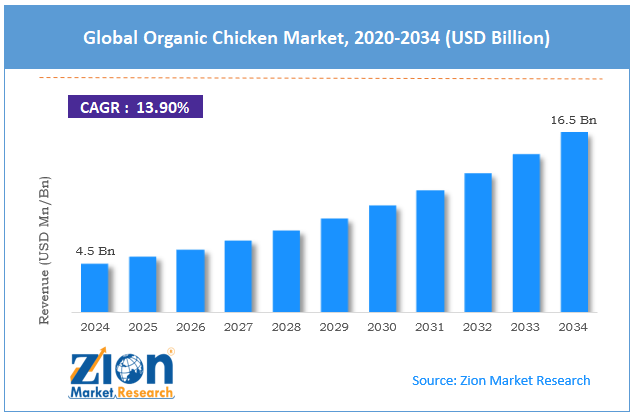
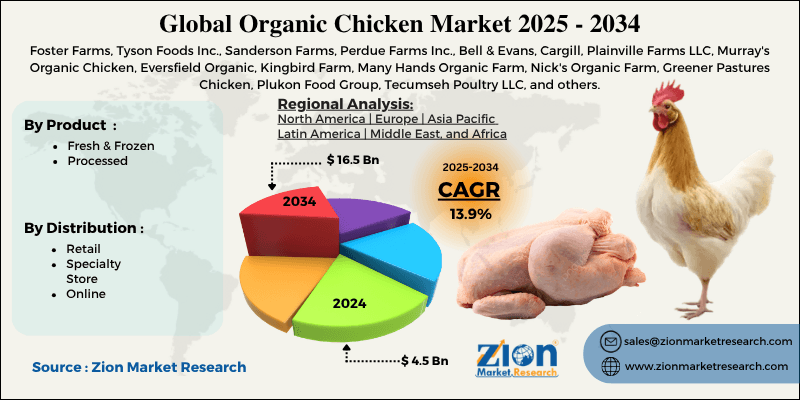
The global organic chicken market size was worth around USD 4.5 billion in 2024 and is predicted to grow to around USD 16.5 billion by 2034 with a compound annual growth rate (CAGR) of roughly 13.9% between 2025 and 2034.
Key Insights
- As per the analysis shared by our research analyst, the global organic chicken market is estimated to grow annually at a CAGR of around 13.9% over the forecast period (2025-2034).
- In terms of revenue, the global organic chicken market size was valued at around USD 4.5 billion in 2024 and is projected to reach USD 16.5 billion by 2034.
- Increasing demand for clean-label & chemical-free food is expected to propel the organic chicken market over the projected period.
- Based on the product, the fresh & frozen segment captures the largest market share of over 45% in 2024.
- Based on the distribution, the retail distribution captures the largest revenue share in 2024 of over 40%.
- Based on region, North America accounted for the highest market share in the organic chicken market in 2024 of 42%.
Organic Chicken Market: Overview
Organic chicken means chicken produced to organic standards of production (Certified organic), fed a pure organic diet, and raised in humane, biodiverse farm conditions. Organic chickens are fed 100% organic feed (free of pesticides and fertilizers, non-GMO, non-animal products) and are not given injections of steroids or antibiotics. They are usually given access to the outdoors (grazing), the freedom to move naturally, and humane conditions.
Organic chickens are produced under far more stringent producer standards and guidelines, thus allowing consumers transparency, traceability, and high-quality standards. Organic, particularly for chicken, is seen by consumers as a healthier, safer, and more environmentally friendly product.
Impact of the USA-Israel War on Iran on the Organic Chicken Market
The USA–Israeli conflict with Iran is more of an indirect influence on the organic chicken sector; it is unlikely to have a huge direct impact however as it is such a diverse market it is most perhaps the knock on effect for the price of organic chicken which could influence buy to go for non-organic chicken instead; offsetting the premium price of organic, therefore putting pressure on the price of organic related products. It could also be argued that there is greater price pressure on organic products, forcing up retail prices and affecting demand, which could decline as consumers cut back on organic purchases and purchase more conventional chicken. These influences would also affect the supply side, including availability and supply continuity.
Organic Chicken Market: Dynamics
Growth Drivers
How does the rising health consciousness drive the organic chicken market?
Growing health consciousness is a major factor driving the organic chicken market, as people are increasingly aware of the link between diet and health, leading to greater organic consumption. Due to growing awareness of the harmful effects of antibiotics, hormones, and chemical residues in poultry, consumption is gradually shifting from conventionally reared to organic chicken, which is healthier and more natural.
Organic chicken is considered to be better on safety, labeling, and nutritional value grounds. Moreover, increased awareness through mass media, wellness trends, and government campaigns is leading people to make healthier choices, which is again underpinned by catering to the urban and mid-income groups.
Restraints
High production cost is hindering the organic chicken market
High production costs are the controlling factor that impairs the growth of the organic chicken market, as they directly affect price, scale, and market accessibility. An organic system farm using certified organic poultry feed, which is much higher in price than normal poultry feed, shall not use any antibiotics, nor use hormones or synthetic additives. The farmers will also require bigger space, better shelter, and outdoor access to promote animal welfare while increasing infrastructure, operational, and transport costs.
Certification is time-consuming and incurs compliance-related expenses, as well as frequent audits. Consequently, the flagship product is higher-priced, thereby limiting its availability to consumers in the market and, in turn, lowering producers' profit margins, thus impairing the market growth of organic chicken.
Opportunities
Do the growing product launches offer a lucrative opportunity for the organic chicken market?
The increasing product launch is expected to offer a potential opportunity to the organic chicken market during the forecasted period. For instance, in December 2025, ORGE CO LTD, a top Korean Eco-Friendly Food Company, has recently launched two new products of Organic Chicken (Organic Chicken Drumstick and Organic Chicken Whole Leg), in their eyes is reaching overseas markets comprehensively and strengthening the organization's position in the markets. Meanwhile, demand for premium organic products in the HK SAR and Japan continues to increase significantly.
With three certifications, including Organic Livestock Certification, Chungcheongbuk-do Excellent Agricultural Products Quality Certification, HACCP farm certification, and Organic Processed Food Certification, the trust of organic chicken is established, and the company cooperated with the export marketing company Brother and Sister for launching the products, and also plans to join the food exhibition in HK SAR and Japan. Besides, the company is working with local bloggers/KOLs in the markets to sponsor promotional posts for the launch.
Challenges
Why does the premium pricing & limited consumer base pose a significant challenge to the organic chicken market?
Premium pricing and a limited consumer base represent a major challenge for the organic chicken market – a lack of volume leading to low economies of scale and a narrow customer base directly constrain demand, volume, and long-term penetration. Organic chicken is priced significantly above conventionally grown chicken, often at double the price, due to high input costs such as organic feed and the high costs of farming and certification. This high price deters a significant portion of consumers, particularly those in price-conscious or developing markets, who lack the financial flexibility to pay a premium for organic chicken.
Hence, organic chicken has generated limited demand among a segment of health-conscious, high-income consumers and has failed to reach a broader consumer base. This limited demand means producers cannot benefit from economies of scale in the long term, and hence cannot keep prices down and volume high. Moreover, retailers will not stock in large volumes if it is slow-moving relative to the cheaper alternative. This lack of economies of scale for mass marketing is a constraint to expansion.
Organic Chicken Market: Report Scope
| Report Attributes | Report Details |
|---|---|
| Report Name | Organic Chicken Market |
| Market Size in 2024 | USD 4.5 Billion |
| Market Forecast in 2034 | USD 16.5 Bllion |
| Growth Rate | CAGR of 13.9% |
| Number of Pages | 225 |
| Key Companies Covered | Foster Farms, Tyson Foods Inc., Sanderson Farms, Perdue Farms Inc., Bell & Evans, Cargill, Plainville Farms LLC, Murray's Organic Chicken, Eversfield Organic, Kingbird Farm, Many Hands Organic Farm, Nick's Organic Farm, Greener Pastures Chicken, Plukon Food Group, Tecumseh Poultry LLC, and others. |
| Segments Covered | By Product, By Distribution, and By Region |
| Regions Covered | North America, Europe, Asia Pacific (APAC), Latin America, Middle East, and Africa (MEA) |
| Base Year | 2024 |
| Historical Year | 2019 - 2023 |
| Forecast Year | 2025 - 2034 |
| Customization Scope | Avail customized purchase options to meet your exact research needs. Request For Customization |
Organic Chicken Market: Segmentation
Product Insights
Why does the fresh & frozen dominate the organic chicken market?
The fresh & frozen segment captures the largest market share of over 45% in 2024. The growth in the fresh chicken market share is predominantly being driven by the higher consumer health consciousness worldwide. Consumers are increasingly focusing on more nutritious sources of protein and are taking more balanced diets. People are now willing to buy fresh, natural chicken over processed, frozen chicken because it offers more health benefits. Consumers’ demand for transparency is increasing as they seek more knowledge about their food, such as where it is cultivated, how it is grown, and the processes used to ensure healthy growth.
Moreover, there has been a tremendous rise in e-commerce, which has also contributed to growth in market share, as instant purchases have become very easy. The trend of meal kits and ready-to-cook options with fresh chicken as the main ingredient has also contributed to the growth.
Distribution Insights
Does the retail distribution capture the largest market share in the organic chicken market?
The retail distribution captures the largest revenue share in 2024 of over 40%. The convenience offered to consumers’ shopping habits by shopping venues also aids the growth of the retail distribution channel for organic chicken. Consumers are shifting towards shopping at supermarkets and hypermarkets for their organic produce, and, with the expansion of modern trade, the available space and choice for organic chicken in retail outlets has also increased. Further, the availability of organic chicken in large retail formats also ensures product quality, leading to consumer confidence and higher purchase rates.
Regional Insights
Why does North America lead the organic chicken market?
North America accounted for the highest market share in the organic chicken market in 2024 of 42%. One of the main catalysts for regional growth is the trend of consumers to focus on the sustainability and ethics of their animal consumption. North American consumers are increasingly concerned about animal welfare and the environmental impacts associated with conventional poultry production practices. The organic system is involved with animal welfare and the promotion of more sustainable animal production through a clear code of conduct.
The primary global body governing animal welfare in organic production is the USDA, through its National Organic Program, which has set standards that producers must meet to meet quality benchmarks in respect of feed, housing, and general care. This has led consumers to become increasingly interested in organic chicken for ethical, as well as health reasons.
Organic Chicken Market: Competitive Analysis
The global organic chicken market is dominated by players like:
- Foster Farms
- Tyson Foods Inc.
- Sanderson Farms
- Perdue Farms Inc.
- Bell & Evans
- Cargill
- Plainville Farms LLC
- Murray's Organic Chicken
- Eversfield Organic
- Kingbird Farm
- Many Hands Organic Farm
- Nick's Organic Farm
- Greener Pastures Chicken
- Plukon Food Group
- Tecumseh Poultry LLC
The global organic chicken market is segmented as follows:
By Product
- Fresh & Frozen
- Processed
By Distribution
- Retail
- Specialty Store
- Online
By Region
- North America
- The U.S.
- Canada
- Mexico
- Europe
- France
- The UK
- Spain
- Germany
- Italy
- Rest of Europe
- Asia Pacific
- China
- Japan
- India
- Australia
- South Korea
- Rest of Asia Pacific
- The Middle East & Africa
- Saudi Arabia
- UAE
- Egypt
- Kuwait
- South Africa
- Rest of the Middle East & Africa
- Latin America
- Brazil
- Argentina
- Rest of Latin America
Table Of Content
Methodology
FrequentlyAsked Questions
Organic chicken means chicken produced to organic standards of production (Certified organic), fed a pure organic diet, and raised in humane, biodiverse farm conditions. Organic chickens are fed 100% organic feed (free of pesticides and fertilizers, non-GMO, non-animal products) and are not given injections of steroids or antibiotics.
The organic chicken market is primarily driven by rising health consciousness among consumers, increasing demand for clean-label and chemical-free food products, and growing awareness of food safety and animal welfare. Consumers are increasingly shifting toward organic chicken due to concerns about antibiotics, hormones, and synthetic additives used in conventional poultry, viewing organic options as healthier and more natural.
The growth of the organic chicken market is restrained by several key challenges, primarily centered around high production costs, limited scalability, and affordability issues. Organic poultry farming requires expensive certified feed, adherence to strict regulatory standards, and better animal welfare practices such as free-range rearing, all of which increase operational costs and result in premium pricing. This high price limits consumer adoption, especially in price-sensitive markets, creating a relatively small customer base.
Based on the product, the fresh & frozen segment is expected to dominate the organic chicken market growth during the projected period.
One of the key trends is the growing adoption of sustainable and eco-friendly farming practices, including improved waste management, alternative feed solutions, and reduced environmental impact, aligning with consumer demand for ethical food production. Technological advancements such as precision farming, AI-based monitoring systems, and automated poultry management are helping farmers optimize animal health, welfare, and productivity.
According to the report, the global organic chicken market size was worth around USD 4.5 billion in 2024 and is predicted to grow to around USD 16.5 billion by 2034.
The global organic chicken market is expected to grow at a CAGR of 13.9% during the forecast period.
The global organic chicken industry growth is expected to be led by North America over the forecast period.
The global organic chicken market is dominated by players like Foster Farms, Tyson Foods, Inc., Sanderson Farms, Perdue Farms, Inc., Bell & Evans, Cargill, Plainville Farms LLC, Murray's Organic Chicken, Eversfield Organic, Kingbird Farm, Many Hands Organic Farm, Nick's Organic Farm, Greener Pastures Chicken, Plukon Food Group and Tecumseh Poultry LLC among others.
The market report covers the geographical market along with a comprehensive competitive landscape analysis. It also includes cash flow analysis, profit ratio analysis, market basket analysis, market attractiveness analysis, sentiment analysis, PESTLE analysis, trend analysis, SWOT analysis, trade area analysis, demand & supply analysis, Porter’s five forces analysis, and value chain analysis.

HappyClients

