
Optical Genome Mapping Market Size, Share, Trends, Growth and Forecast 2034

Optical Genome Mapping Market By Product and Service (Instruments, Consumables, Software and Data Analysis Tools, Services), By Application (Cancer Research and Oncology, Constitutional Genetics and Rare Disease Diagnosis, Infectious Disease Research, Agricultural Genomics, Drug Discovery and Development), By End User (Hospitals and Clinical Laboratories, Academic and Research Institutions, Pharmaceutical and Biotechnology Companies, Forensic Laboratories, Contract Research Organizations), By Technology (Nanochannel-Based Optical Mapping, Fluorescence-Based Optical Mapping, Single-Molecule Optical Mapping), and By Region - Global and Regional Industry Overview, Market Intelligence, Comprehensive Analysis, Historical Data, and Forecasts 2025 - 2034
| Market Size in 2024 | Market Forecast in 2034 | CAGR (in %) | Base Year |
|---|---|---|---|
| USD 207.3 Million | USD 1810.00 Million | 26.74% | 2024 |
Optical Genome Mapping Industry Perspective:
What are the expected growth rate and market size of the optical genome mapping market during the forecast period?
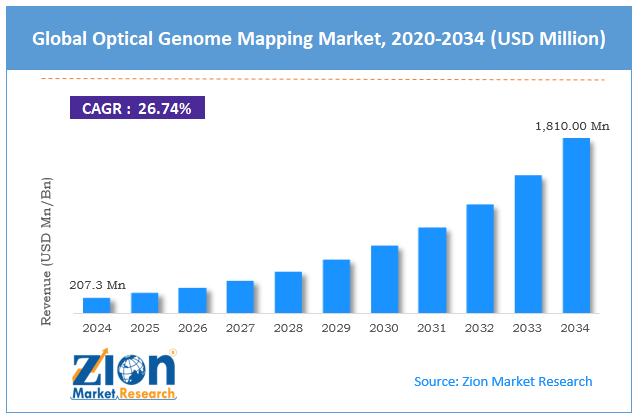
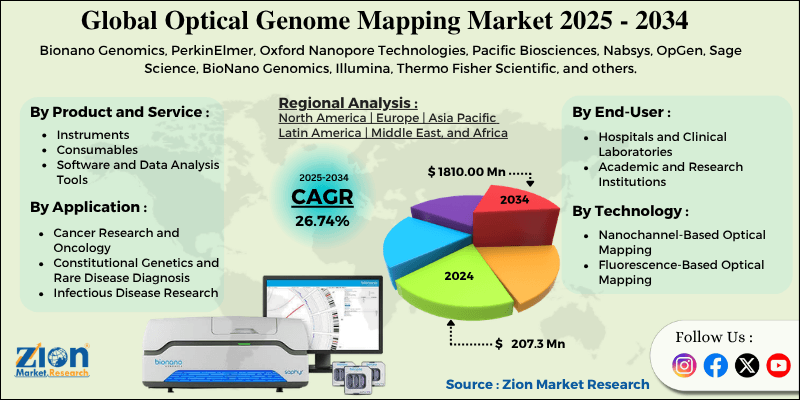
The global optical genome mapping market size was worth approximately USD 207.3 million in 2024 and is projected to grow to around USD 1,810.00 million by 2034, with a compound annual growth rate of roughly 26.74% between 2025 and 2034.
Optical Genome Mapping Market: Overview
Optical genome mapping is a powerful genomic analysis technique that allows scientists to study the full structure of DNA by observing long, intact strands rather than fragmented pieces. It examines how DNA is arranged within chromosomes, enabling the detection of large structural changes like deletions, duplications, inversions, and rearrangements often missed by traditional sequencing. The process involves carefully stretching DNA molecules on specialized nanochannel chips and tagging specific sequence patterns with fluorescent markers. High-resolution imaging systems capture these patterns and convert them into detailed genome maps, which are then compared with reference genomes to identify abnormalities linked to disease. Because the DNA remains largely unbroken, the method provides a more complete and accurate structural view. Optical genome mapping is increasingly used in cancer research, rare disease diagnosis, and advanced genetic studies, helping improve understanding of complex conditions and enabling more precise, targeted treatment strategies. It also supports the detection of complex chromosomal rearrangements and gene fusions that are critical for accurate disease classification and prognosis. Integration with advanced bioinformatics platforms further enhances data interpretation, enabling faster and more reliable clinical decision-making.
Key Insights
- As per the analysis shared by our research analyst, the global optical genome mapping market is estimated to grow annually at a compound annual growth rate of around 26.74% over the forecast period from 2025 to 2034.
- In terms of revenue, the global optical genome mapping market size was valued at approximately USD 207.3 million in 2024 and is projected to reach USD 1,810.00 million by 2034.
- The optical genome mapping market is expected to grow due to rising demand for comprehensive genomic analysis in clinical diagnostics, increasing adoption of precision medicine, growing investment in rare disease research, expanding cancer genomics programs, and continuous improvements in optical mapping instruments and data analysis software.
- Based on product and service type, the instruments segment is expected to lead growth in the optical genome mapping market, while the software and data analysis tools segment is anticipated to expand rapidly as demand for accurate, user-friendly genomic data interpretation platforms increases.
- Based on application, the cancer research and oncology segment is expected to lead the optical genome mapping market, while the constitutional genetics and rare disease diagnosis segment is anticipated to grow steadily as clinical adoption of optical genome mapping for difficult-to-diagnose patients expands.
- Based on end user, the academic and research institutions segment is the largest, while the pharmaceutical and biotechnology companies segment is growing rapidly as drug developers use optical genome mapping to understand disease mechanisms and identify therapeutic targets.
- Based on technology, the nanochannel-based optical mapping segment is expected to lead the optical genome mapping market, while the single-molecule optical mapping segment is anticipated to grow strongly as researchers push for higher resolution and sensitivity in structural variant detection.
- Based on region, North America is projected to dominate the global optical genome mapping market during the estimated period, followed by Europe.
The optical genome mapping market is growing due to rising genomic research, increased demand for advanced genetic testing, and greater focus on precision medicine.
Impact of the USA-Israel War on Iran on the Optical Genome Mapping Market
The conflict between the United States, Israel, and Iran may have a limited impact on the optical genome mapping market, primarily affecting research collaborations and supply chains in the Middle East. Some joint research efforts and exchange programs could face delays, and the supply of specialized instruments, reagents, and consumables may slow down temporarily, creating short-term challenges for ongoing projects. Over time, a stronger global focus on healthcare resilience and precision medicine is expected to drive investment in genomics infrastructure, creating new growth opportunities and supporting long-term expansion of the optical genome mapping market worldwide.
Optical Genome Mapping Market: Technology Roadmap 2025 to 2034
What key trends and future developments will drive the optical genome mapping market during the forecast period?
Advances in genomic instrumentation, bioinformatics software, and clinical integration are transforming the optical genome-mapping market, making it faster, more affordable, and more accessible to laboratories worldwide. The market is expected to grow at a compound annual growth rate of around 26.74% over the forecast period, supported by rising demand from cancer centers, rare disease clinics, pharmaceutical companies, and academic research groups that require detailed structural genomic information beyond the scope of standard sequencing methods.
The following roadmap outlines the key development phases expected during the forecast period.
2025 to 2027: Clinical Adoption Expansion and Instrument Improvement Phase
- New optical mapping systems will deliver faster results, clearer images, and lower testing costs, making routine clinical use more practical.
- Clear testing guidelines and strong clinical studies will help doctors and laboratory experts trust results and use them more widely.
- Linking genome-mapping data with hospital record systems will simplify workflows and help doctors incorporate genetic insights into treatment decisions.
2028 to 2031: Bioinformatics Integration and Rare Disease Diagnosis Phase
- AI and machine learning tools will be added to software, helping detect DNA changes faster and reducing manual analysis errors.
- Large population studies will provide robust reference data, helping doctors better understand genetic variation across different groups.
- Medical guidelines will include optical genome mapping for specific diseases, encouraging insurance coverage and boosting clinical adoption worldwide.
2032 to 2034: Precision Medicine Integration and Emerging Market Expansion Phase
- Optical genome mapping will be combined with other genetic tests to provide doctors with a more complete view of a patient's health.
- Smaller and more affordable machines will allow laboratories in developing regions to adopt the technology more easily.
- Newborn screening programs may use this technology to detect genetic conditions early and support better long-term patient outcomes.
Optical Genome Mapping Market: Dynamics
Growth Drivers
The rising global burden of genetic diseases and cancer is driving the optical genome mapping market.
The optical genome mapping industry is growing steadily as cases of genetic disorders and cancer continue to increase across global populations. The growing need for accurate, detailed genetic testing is driving healthcare providers to adopt advanced diagnostic technologies that can detect complex DNA changes more effectively. Traditional methods like karyotyping and fluorescence-based tests often miss subtle structural variations, while newer approaches still have limitations in identifying larger genome rearrangements. Optical genome mapping provides a clearer, more complete view of chromosome structure in a single analysis, making it highly valuable for cancer diagnosis and treatment planning. In rare disease cases, many patients experience long delays before receiving a confirmed diagnosis, but optical genome mapping is helping identify previously undetected genetic causes. Increasing awareness among doctors, stronger support from patient groups, and growing investment in genomics research are driving wider adoption.
What role does the growth of precision medicine and personalized treatment strategies play in driving the optical genome mapping market?
The optical genome mapping market is gaining strong momentum from the global rise of precision medicine, where treatments are tailored to a patient’s unique genetic profile. In cancer care, doctors need a clear understanding of how a tumor’s DNA is structured to choose the most effective therapy. Optical genome mapping helps by showing large genetic changes that influence how cancers grow and respond to treatment. Pharmaceutical companies are also using it to study disease patterns, identify new drug targets, and improve the development of medicines. Beyond oncology, areas such as rare diseases, heart conditions, and neurological disorders are benefiting from deeper genetic insights provided by advanced mapping technologies. Governments in countries like the United Kingdom and the United States are investing heavily in genomics programs to support wider adoption. Growing healthcare focus on personalized treatment, improved diagnostic accuracy, and expanding research funding are driving sustained demand for optical genome mapping solutions worldwide.
Restraints
High instrument costs and complex data interpretation slow growth in the optical genome mapping market.
The optical genome-mapping market faces several challenges that slow its wider adoption in hospitals and diagnostic labs. The high cost of instruments and sample preparation materials makes adoption difficult for smaller labs and healthcare systems with limited budgets. Many facilities in developing regions cannot invest in advanced genomic tools due to financial constraints. Insurance coverage for optical genome mapping tests remains limited in many countries, limiting patient access and discouraging routine use. Another key issue is data analysis, as results are complex and require trained bioinformatics experts to interpret accurately. Many labs lack skilled professionals, which delays implementation. Regulatory approval processes for clinical use are still evolving in several regions, creating uncertainty for healthcare providers. At the same time, improvements in next-generation sequencing technologies are becoming more affordable and competitive, which is adding pressure to adoption.
Opportunities
What opportunities does growing investment in genomics infrastructure and rare disease research create for the optical genome mapping market?
The optical genome mapping industry offers strong growth opportunities driven by rising government support for genomics research and increasing focus on understanding complex genetic changes. Many countries are building large genetic databases and population studies, creating demand for technologies that can detect detailed DNA structure variations at scale. Growing awareness of rare diseases and active patient advocacy groups are encouraging better diagnosis and pushing healthcare systems to support advanced testing methods. Pharmaceutical and biotechnology companies are also creating new opportunities by using optical genome mapping to identify suitable patients for clinical trials and to develop more targeted therapies. Contract research organizations are adopting the technology to provide specialized genomic services, opening additional revenue channels. Beyond healthcare, agriculture is emerging as a new area where optical genome mapping helps improve crop quality and understand plant genetics. Expanding use across multiple industries, increasing research funding, and rising demand for precision-based insights are expected to create long-term growth opportunities for the optical genome mapping market worldwide.
Challenges
How do bioinformatics complexity, standardization gaps, and reimbursement uncertainty challenge the optical genome mapping market?
The optical genome mapping market faces several challenges that are slowing its shift from research use to routine clinical testing. One major issue is the complexity of data analysis, as the technology produces large datasets that require strong computing systems and trained experts to interpret results accurately. Many clinical laboratories lack sufficiently skilled professionals with genomics expertise, which limits wider adoption. Another challenge is the lack of standard methods for sample preparation, data processing, and result interpretation, making it difficult to compare findings across laboratories. Regulatory approval processes are still developing in many regions, creating uncertainty for healthcare providers. In addition, reimbursement policies remain unclear, as insurers continue to evaluate the value of optical genome mapping compared to existing diagnostic methods. These factors together slow adoption and require better training, clearer guidelines, and stronger industry collaboration to support market growth.
Optical Genome Mapping Market: Report Scope
| Report Attributes | Report Details |
|---|---|
| Report Name | Optical Genome Mapping Market |
| Market Size in 2024 | USD 207.3 Million |
| Market Forecast in 2034 | USD 1810.00 Million |
| Growth Rate | CAGR of 26.74% |
| Number of Pages | 230 |
| Key Companies Covered | Bionano Genomics, PerkinElmer, Oxford Nanopore Technologies, Pacific Biosciences, Nabsys, OpGen, Sage Science, BioNano Genomics, Illumina, Thermo Fisher Scientific, and others. |
| Segments Covered | By Product and Service, By Application, By End User, By Technology, and By Region |
| Regions Covered | North America, Europe, Asia Pacific (APAC), Latin America, Middle East, and Africa (MEA) |
| Base Year | 2024 |
| Historical Year | 2019 - 2023 |
| Forecast Year | 2025 - 2034 |
| Customization Scope | Avail customized purchase options to meet your exact research needs. Request For Customization |
Optical Genome Mapping Market: Segmentation
The global optical genome mapping market is segmented based on product and service type, application, end user, technology, and region.
What makes the instruments segment the leading product category in the optical genome mapping market?
Based on product and service type, the global optical genome mapping market is divided into instruments, consumables, software, data analysis tools, and services. The instruments segment accounts for about 41% of the market and leads because capital equipment purchases form the foundation of laboratory setup and represent the largest single expenditure in optical genome mapping adoption. The consumables segment holds around 33% of the market. It generates recurring revenue, as each test requires new reagents and chips, supporting steady growth in consumable sales.
Why does cancer research and oncology lead the application segment in the optical genome mapping market?
Based on application, the market is segregated into cancer research and oncology, constitutional genetics and rare disease diagnosis, infectious disease research, agricultural genomics, and drug discovery and development. The cancer research and oncology segment leads with about 45% share due to complex genome analysis needs. The constitutional genetics and rare disease diagnosis segment holds around 27% of the market. It is growing steadily as clinicians increasingly turn to optical genome mapping to resolve diagnostic cases where conventional cytogenetic or molecular testing has failed.
What helps academic and research institutions lead the end-user segment in the optical genome mapping market?
Based on end user, the optical genome mapping industry is classified into hospitals and clinical laboratories, academic and research institutions, pharmaceutical and biotechnology companies, forensic laboratories, and contract research organizations. The academic and research institutions segment leads with about 38% share, driven by early adoption for genomics research and clinical validation. The pharmaceutical and biotechnology segment accounts for about 26% of the market. It is growing rapidly as drug developers invest in genomics for precision medicine and companion diagnostics.
Why does nanochannel-based optical mapping lead the technology segment in the optical genome mapping market?
Based on technology, the optical genome mapping market is categorized into nanochannel-based optical mapping, fluorescence-based optical mapping, and single-molecule optical mapping. The nanochannel-based optical mapping segment leads with about 54% share, driven by consistent DNA stretching and high-quality genome imaging. The single-molecule optical mapping segment holds around 22% of the market. It is growing as researchers seek higher sensitivity methods capable of detecting rare structural variants and analyzing heterogeneous samples containing mixed cell populations.
Optical Genome Mapping Market: Regional Analysis
Why does North America lead the global optical genome mapping market?
The optical genome mapping market is led by North America, accounting for about 40% of global demand and expected to remain the top region throughout the forecast period. North America holds a strong position due to advanced healthcare systems, early adoption of new technologies, and strong funding support for genomics research. The United States plays a central role, with leading hospitals, research institutions, and biotechnology companies actively using optical genome mapping in cancer research and rare disease diagnosis. High awareness among clinicians and patients has increased demand for more accurate genetic testing solutions. Government-backed genomics programs and private investments are helping laboratories upgrade their capabilities and adopt advanced diagnostic tools. Insurance coverage for genetic testing is gradually expanding, making these technologies more accessible. Pharmaceutical companies in the region are also using optical genome mapping to support drug discovery and clinical trials, especially in precision medicine. Strong collaboration between academic institutions and industry players is accelerating innovation and improving clinical applications. Availability of skilled professionals and advanced laboratory infrastructure further supports growth. Continuous investment in research, combined with a focus on personalized healthcare, ensures that North America remains a key driver of technological advancement and market expansion in optical genome mapping.
What supports Europe's strong position in the global optical genome mapping market?
The optical genome mapping market ranks Europe as the second-largest region, accounting for about 30% of the market. Europe maintains a strong presence due to well-established healthcare systems, increasing focus on genetic research, and supportive government initiatives. Countries such as Germany, the United Kingdom, France, and Italy are actively investing in genomic research and expanding their research capabilities. Public healthcare systems across the region are gradually integrating advanced genetic testing into clinical practice, improving early diagnosis and treatment planning. Strong regulatory frameworks ensure quality and safety, which builds trust among healthcare providers and patients. Research institutions and universities play a major role in advancing optical genome mapping applications, particularly in rare disease studies and cancer research. Collaborative projects across European countries are helping share data and improve understanding of genetic conditions. Increasing awareness about precision medicine and personalized healthcare is also supporting adoption. Funding from government bodies and research organizations continues to strengthen infrastructure and innovation. With steady progress in clinical validation and growing use in diagnostics, Europe is expected to remain a key contributor to global market growth.
Recent Market Developments
- In March 2026, Pacific Biosciences highlighted expanded adoption of its HiFi long-read sequencing technology in large-scale genomics and structural variation research programs.
- In February 2026, Bionano Genomics announced Bionano Symposium 2026, bringing together global researchers to present new clinical and oncology applications for optical genome mapping technologies.
Optical Genome Mapping Market: Competitive Analysis
The leading players in the global optical genome mapping market are:
- Bionano Genomics
- PerkinElmer
- Oxford Nanopore Technologies
- Pacific Biosciences
- Nabsys
- OpGen
- Sage Science
- BioNano Genomics
- Illumina
- Thermo Fisher Scientific
The global optical genome mapping market is segmented as follows:
By Product and Service
- Instruments
- Consumables
- Software and Data Analysis Tools
- Services
By Application
- Cancer Research and Oncology
- Constitutional Genetics and Rare Disease Diagnosis
- Infectious Disease Research
- Agricultural Genomics
- Drug Discovery and Development
By End User
- Hospitals and Clinical Laboratories
- Academic and Research Institutions
- Pharmaceutical and Biotechnology Companies
- Forensic Laboratories
- Contract Research Organizations
By Technology
- Nanochannel-Based Optical Mapping
- Fluorescence-Based Optical Mapping
- Single-Molecule Optical Mapping
By Region
- North America
- The U.S.
- Canada
- Mexico
- Europe
- France
- The UK
- Spain
- Germany
- Italy
- Rest of Europe
- Asia Pacific
- China
- Japan
- India
- Australia
- South Korea
- Rest of Asia Pacific
- The Middle East & Africa
- Saudi Arabia
- UAE
- Egypt
- Kuwait
- South Africa
- Rest of the Middle East & Africa
- Latin America
- Brazil
- Argentina
- Rest of Latin America
Table Of Content
Methodology
FrequentlyAsked Questions
Optical genome mapping is a powerful genomic analysis technique that allows scientists to study the full structure of DNA by observing long, intact strands rather than fragmented pieces. It examines how DNA is arranged within chromosomes, enabling the detection of large structural changes like deletions, duplications, inversions, and rearrangements often missed by traditional sequencing.
The global optical genome mapping market is expected to grow due to rising demand for comprehensive structural genomic analysis in clinical diagnostics, expanding precision medicine programs, growing investment in rare disease research, increasing adoption in cancer genomics, and continuous improvements in optical mapping instruments, consumables, and data analysis software.
According to the study, the global optical genome mapping market size was approximately USD 207.3 million in 2024 and is expected to reach USD 1,810.00 million by 2034.
The compound annual growth rate value of the optical genome mapping market is expected to be around 26.74% from 2025 to 2034.
North America is expected to lead the global optical genome mapping market due to strong federal and private investment in genomics research, a well-developed clinical genetics infrastructure, a high concentration of leading technology companies, growing precision medicine programs, and favorable reimbursement trends for advanced genetic diagnostic testing.
The major players profiled in the global optical genome mapping market include Bionano Genomics, PerkinElmer, Oxford Nanopore Technologies, Pacific Biosciences, Nabsys, OpGen, Sage Science, Illumina, and Thermo Fisher Scientific.
The report provides a detailed analysis of the optical genome mapping market, including a thorough review of key growth drivers and restraints, technology development trends, clinical adoption patterns, regional performance analysis, competitive landscape review, and a forward-looking outlook covering all major product types, applications, end users, and technologies across every key geography.
The optical genome mapping market offers opportunities in instrument development, consumables supply, bioinformatics platforms, and partnerships with hospitals, research institutes, and pharmaceutical companies focusing on precision medicine and structural genomic analysis.
The optical genome mapping market value chain includes raw material suppliers, instrument manufacturers, reagent and chip producers, software and bioinformatics providers, distributors, and end users such as hospitals, diagnostic labs, and research institutions.
Stakeholders in the optical genome mapping market should focus on reducing costs, improving data analysis tools, strengthening clinical validation, forming partnerships with healthcare providers, expanding into emerging markets, and investing in training and regulatory compliance to support wider adoption.

HappyClients

