
NOR Flash Market Size, Trend, Growth, Industry Analysis 2034

NOR Flash Market By Type (Serial NOR Flash, Parallel NOR Flash), By Density (Low Density, Medium Density, High Density), By Application (Automotive Electronics, Industrial Equipment, Telecommunication Devices, Consumer Electronics), By End User (Original Equipment Manufacturers, Aftermarket Suppliers, Contract Manufacturers, Data Centers), and By Region - Global and Regional Industry Overview, Market Intelligence, Comprehensive Analysis, Historical Data, and Forecasts 2026 - 2034
| Market Size in 2025 | Market Forecast in 2034 | CAGR (in %) | Base Year |
|---|---|---|---|
| USD 5.27 Billion | USD 10.73 Billion | 8.22% | 2025 |
NOR Flash Industry Perspective:
What will be the size of the NOR flash market during the forecast period?
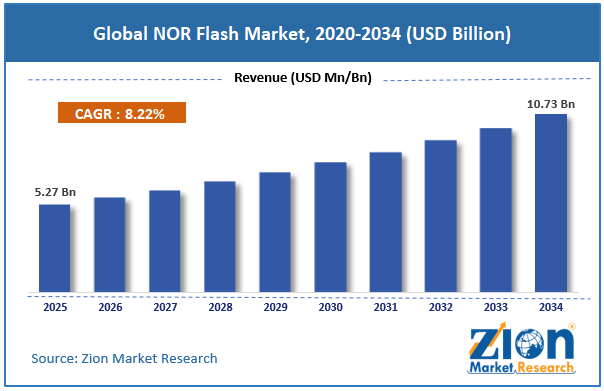
The global NOR flash market size was valued at approximately USD 5.27 billion in 2025 and is projected to reach around USD 10.73 billion by 2034, growing at a compound annual growth rate of approximately 8.22% between 2026 and 2034.
Key Insights
- As per the analysis shared by our research team, the global NOR flash market is estimated to grow at a compound annual growth rate of approximately 8.22% during the forecast period from 2026 to 2034.
- In terms of revenue, the global NOR flash market was valued at approximately USD 5.27 billion in 2025 and is projected to reach USD 10.73 billion by 2034.
- The NOR flash market is expected to grow strongly due to rising vehicle electrification, increasing factory automation, growing demand for dependable firmware storage, and expanding telecommunication infrastructure.
- Based on type, serial NOR flash leads the market because of its compact design and lower pin count, while parallel NOR flash is gaining steady traction in applications that require very high-speed data access.
- Based on density, medium-density chips lead the market because they balance storage capacity and cost efficiency. In contrast, high-density chips are the fastest-growing segment as devices demand more onboard storage.
- Based on application, automotive electronics leads the market due to rising use of electronic control units. At the same time, industrial equipment is the fastest-growing application as factories continue to automate their operations.
- Based on end user, original equipment manufacturers lead the market due to large-scale integration into finished products, while contract manufacturers are growing rapidly as companies outsource more of their electronics assembly work.
- Based on region, Asia Pacific leads the global NOR flash market, while North America is the fastest-growing region due to rising investment in automotive technology and advanced industrial systems.
NOR Flash Market: Overview
NOR flash is a type of non-volatile memory that stores data even when a device is turned off and allows fast access to stored information. NOR Flash memory is widely used to store firmware, boot programs, and other important software because devices can read data quickly and run code directly from the chip. The NOR Flash market covers memory chips used in cars, industrial equipment, telecom systems, home appliances, and consumer electronics. Growing use of smart devices, factory automation, connected cars, and advanced electronics is increasing demand for reliable memory solutions. NOR flash is valued for its fast performance, long data storage life, and reliable operation in demanding conditions. Automakers use it in driver assistance systems, infotainment systems, and electronic control units. Industrial machines use NOR flash to store software needed for smooth operation, while telecom equipment relies on it for system updates and stable performance. Manufacturers are developing higher-density chips, smaller packages, faster memory, and lower-power designs. These improvements are helping NOR Flash fit into compact devices while supporting reliable performance, efficient operation, and long-term data storage across growing electronic applications.
The NOR flash industry continues to expand as chipmakers, device manufacturers, and technology companies work together to create faster, smaller, and more reliable memory solutions worldwide.
NOR Flash Market: Strategic Perspective
Where is the NOR flash market heading?
The NOR flash market is expected to shift toward higher-density, faster, and more energy-efficient chips as devices become more complex and power-conscious. Automotive-grade memory, industrial-grade durability, smaller packaging, and improved reliability are likely to shape future product development alongside traditional consumer applications.
Where should businesses invest in the NOR flash market?
The NOR flash market presents opportunities in automotive-grade memory chips, industrial automation components, compact packaging solutions, and localized chip production. Investment in efficient manufacturing processes and stronger supply chains can also help companies maintain consistent output, particularly as demand grows across emerging economies and expanding technology sectors.
What will reshape competition in the NOR flash market?
Success in the NOR flash market will increasingly depend on how effectively companies respond to changing performance and reliability requirements across industries. Companies that combine faster read speeds with dependable manufacturing quality, competitive pricing, compact chip design, and strong customer relationships are likely to stand out in an increasingly competitive semiconductor market.
NOR Flash Market: Technology Roadmap 2026–2034
What is the projected development roadmap of the NOR flash market over the forecast period?
The NOR flash market is advancing through improved chip fabrication methods, more precise quality control processes, expanded automotive-grade production, and growing incorporation of energy-saving features, making memory chips more capable and dependable for everyday electronic use. The market is expected to grow at a compound annual growth rate of approximately 8.22% over the forecast period, driven by rising automation needs, evolving safety standards, and ongoing refinement of semiconductor manufacturing technology.
The following roadmap outlines key development phases expected through 2034.
2026–2028: Reliability and Application Expansion Phase
- Automotive-grade products: Chipmakers are expected to develop NOR Flash products that meet strict safety, reliability, and temperature requirements for vehicles.
- Better manufacturing quality: Companies are likely to improve chip production and quality checks to reduce defects and deliver consistent performance.
- Industry-specific products: Manufacturers are expected to develop NOR Flash chips for specific uses in cars, industrial equipment, sensors, and telecom systems.
2029–2031: Performance Enhancement and Market Broadening Phase
- Higher storage capacity: NOR Flash chips with greater storage capacity in smaller sizes are expected to gain wider use across different electronic devices.
- Smaller chip packaging: Companies are likely to develop smaller, thinner, heat-resistant packages that fit compact electronic devices.
- Wider regional supply: Local factories, direct supply deals, and regional distribution centers are expected to help chipmakers supply memory products to manufacturers faster.
2032–2034: Efficient and Intelligent Memory Phase
- Lower power use: Manufacturers are expected to develop NOR Flash chips that use less power as device makers focus on energy efficiency.
- Memory health monitoring: Future chips may include features that detect errors and provide information about memory condition and remaining operating life.
- Application-specific memory: NOR Flash products could be designed for specific industries, with different speed, durability, and temperature features based on device requirements.
NOR Flash Market: Dynamics
Growth Drivers
What is driving rising demand for dependable memory solutions in the NOR flash market?
The NOR Flash market is growing as electronic devices require reliable memory for storing firmware, boot programs, and software. Rising demand for fast system startup and quick firmware updates is increasing the use of NOR flash in automotive, industrial, telecom, and consumer electronics. Energy-efficient device design is also pushing manufacturers to develop lower-power memory chips. Higher storage capacity supports applications that need larger software and firmware files, while smaller chip packages help memory fit into compact electronic products. Manufacturers are also improving production methods and chip designs to deliver consistent quality and easier device integration. Growing demand for connected and automated equipment is further increasing the need for dependable embedded memory. These factors are expanding NOR Flash adoption across modern electronic systems and supporting market growth as manufacturers seek memory solutions that combine reliable data storage, fast access, compact design, and efficient operation.
Automotive and industrial applications are creating opportunities in the NOR flash market.
Automotive and industrial applications are becoming major growth drivers for the NOR Flash market as electronic systems become increasingly advanced and software-dependent. Modern vehicles use NOR flash for infotainment systems, electronic control units, and driver assistance functions that require reliable access to stored software. Industrial machines and control systems also depend on memory chips for operating programs, system settings, and firmware updates. Telecom equipment is creating additional demand as network devices require dependable memory for continuous operation and software management. The growing use of electronics in safety-focused and industrial environments is increasing demand for chips that can operate reliably across wider temperature ranges and demanding conditions. Higher-endurance NOR Flash products are gaining importance where systems need long service lives. These application-specific requirements are encouraging manufacturers to develop automotive-grade, industrial-grade, and high-reliability memory products. Rising electronic content in vehicles, factories, telecom infrastructure, and automated equipment is therefore expanding the addressable market for NOR flash and supporting long-term market growth.
Restraints
High manufacturing costs are a key challenge limiting growth in the NOR flash market.
High production costs can restrain the NOR Flash market by increasing the cost of manufacturing and selling memory chips. Semiconductor fabrication requires expensive equipment, advanced production processes, and strict quality controls, which can increase investment requirements for manufacturers. Fluctuations in raw materials, energy, transportation, and equipment costs can further affect production expenses and profit margins. Developing higher-performance NOR Flash products can also require additional research, testing, and manufacturing investment. These costs may be harder for smaller chipmakers to manage, limiting their ability to compete with established semiconductor companies.
Rising production expenses can also increase product prices, making some NOR Flash solutions less attractive for applications where lower-cost memory technologies are available. Manufacturers can reduce this restraint by improving production efficiency, increasing manufacturing yields, optimizing chip designs, and using cost-effective packaging. Better production planning and process improvements can help control expenses while maintaining the reliability and performance expected from NOR Flash products.
Opportunities
Will application-specific chip innovation open new opportunities for the NOR flash market?
The NOR Flash market is expanding beyond traditional consumer electronics as manufacturers seek memory chips that offer speed, reliability, and strong performance. Automotive safety systems, industrial controls, and telecom equipment are creating demand for specialized NOR Flash products. Advanced chips with higher endurance, wider temperature tolerance, and improved error handling are helping manufacturers serve industries that need dependable memory for long periods. Automotive modules and industrial sensors are also creating opportunities as electronic systems become more advanced. Compact chip packages are becoming more important in wearables, smart devices, and other space-constrained products, while higher-capacity chips support complex systems.
Automotive suppliers, industrial equipment makers, and telecom companies are expanding demand through specialized purchasing channels. Direct online distribution is helping smaller chipmakers reach customers without depending only on traditional semiconductor distributors. Efficient packaging, thinner designs, and better heat management can further improve product value. Manufacturers are also exploring regional production and application-specific chip designs to meet local industry needs. Ready-to-use memory modules and compact, purpose-built products can help device makers integrate memory faster and simplify product development. These trends are creating new growth opportunities across automotive, industrial, telecom, consumer electronics, and connected devices.
Challenges
How are rising costs and supply challenges affecting the NOR flash market?
The NOR Flash industry faces challenges from competing memory technologies, changing customer requirements, and semiconductor supply risks. NAND Flash, EEPROM, and other memory solutions give device manufacturers several options, so NOR Flash suppliers must clearly demonstrate advantages such as fast read access, reliable code storage, and long data retention. As electronic systems become more advanced, device makers are also demanding higher speed, greater endurance, stronger security, and longer product lifecycles.
Meeting these requirements can increase product development and testing needs. Supply chain disruptions pose another challenge, especially when manufacturers rely on imported materials, specialized equipment, or overseas suppliers. Shortages can delay production and increase delivery times for customers. Currency changes and international transportation costs can also affect supply planning. Manufacturers can address these challenges by improving chip performance, strengthening supplier networks, expanding regional production, and developing memory products designed for specific applications. These measures can help NOR Flash companies remain competitive while responding to changing technology and supply requirements.
NOR Flash Market: Report Scope
| Report Attributes | Report Details |
|---|---|
| Report Name | NOR Flash Market |
| Market Size in 2025 | USD 5.27 Billion |
| Market Forecast in 2034 | USD 10.73 Billion |
| Growth Rate | CAGR of 8.22% |
| Number of Pages | 228 |
| Key Companies Covered | Winbond Electronics, Macronix International, GigaDevice Semiconductor, Microchip Technology, Infineon Technologies, STMicroelectronics, Micron Technology, ISSI (Integrated Silicon Solution), Puya Semiconductor, XTX Technology, and others. |
| Segments Covered | By Type, By Density, By Application, By End User, and By Region |
| Regions Covered | North America, Europe, Asia Pacific (APAC), Latin America, Middle East, and Africa (MEA) |
| Base Year | 2025 |
| Historical Year | 2020 - 2024 |
| Forecast Year | 2026 - 2034 |
| Customization Scope | Avail customized purchase options to meet your exact research needs. Request For Customization |
NOR Flash Market: Segmentation
The global NOR flash market is segmented by type, density, application, end user, and region.
Why does serial NOR flash lead the NOR flash market by type?
Based on type, the global NOR flash market is divided into serial NOR flash and parallel NOR flash. Serial NOR flash holds about 63% of the market share, leading because of its compact pin structure, simpler circuit board design, and broad compatibility across many device categories. Parallel NOR flash holds around 37% market share. It continues to see steady use in applications requiring extremely high-speed, direct memory access, particularly in specialized industrial systems.
How is medium-density chip usage maintaining its lead in the NOR flash market?
Based on density, the NOR flash industry is classified into low-density, medium-density, and high-density chips. Medium-density chips account for about 44% of the global market share, driven by their practical balance of storage capacity, cost, and suitability for common firmware and code storage needs. High-density chips hold around 29% market share. This segment is the fastest-growing because demand for greater onboard storage is rising in increasingly complex electronic devices.
Where does automotive electronics stand in the NOR flash application landscape?
By application, the market is segmented into automotive electronics, industrial equipment, telecommunication devices, and consumer electronics. Automotive electronics leads with about a 34% share because modern vehicles increasingly integrate electronic control units, driver assistance systems, and infotainment platforms. Industrial equipment holds around 27% market share. It is growing steadily as more factories adopt automated systems requiring dependable embedded memory.
Which segment accounts for the largest end-user share in the NOR flash market?
Based on end user, the NOR flash market is categorized into original equipment manufacturers, aftermarket suppliers, contract manufacturers, and data centers. Original equipment manufacturers account for about 49% of the market, leading because they integrate chips at scale into finished vehicles, machines, and electronic products. Contract manufacturers hold around 24% market share. This segment is expanding quickly as more companies outsource electronics assembly to specialized production partners.
NOR Flash Market: Regional Analysis
What factors are strengthening Asia Pacific's position in the NOR flash market?
Asia Pacific leads the global NOR flash market and is expected to grow at a CAGR of around 6.1% during the forecast period. The region benefits from a large semiconductor manufacturing base and a rapidly expanding electronics industry, creating strong demand for reliable memory chips. China and Taiwan are key markets because of their major chip production capacity and strong consumer electronics sectors. Manufacturers are increasingly using NOR flash in vehicles, appliances, industrial equipment, and connected devices.
Rising investment in local semiconductor production is helping companies secure stable chip supplies, while expanding automotive and telecom industries are increasing demand across major manufacturing centers. Growing factory automation is also pushing manufacturers to adopt higher-density, durable memory chips that support long-term device operation. The region has advanced fabrication facilities, skilled engineers, and specialized production equipment, allowing chipmakers to develop memory products for different applications. Automotive suppliers, industrial equipment manufacturers, telecom companies, and electronics producers are expanding demand beyond traditional technology hubs. Growing electronics exports are also increasing the use of NOR flash in products shipped to global markets.
Local semiconductor companies are developing memory products suited to regional applications and manufacturing needs. Rising investment, stronger production capacity, engineering expertise, and expanding electronics manufacturing are expected to help Asia Pacific maintain its leading position in the global NOR Flash market throughout the forecast period. Rising demand for smart devices, connected vehicles, industrial automation, and advanced telecom infrastructure is further strengthening regional adoption and supporting steady demand from manufacturers across Asian markets.
How is expanding technology investment driving growth in the North America NOR flash market?
The North America NOR Flash market is expected to grow at a volume CAGR of around 6.8% during the forecast period. Growth is supported by rising investment in automotive technology, industrial automation, and advanced electronic systems that require reliable memory chips. The United States and Canada are key markets, supported by automotive innovation, industrial modernization, and technology development. Increasing government and private investment in semiconductor manufacturing is encouraging local production and improving chip supply.
Growing vehicle electrification is also increasing demand for dependable memory used in electronic control systems, infotainment, and safety applications. NOR flash is also used in factory equipment, telecom infrastructure, data centers, and defense electronics, expanding demand beyond consumer devices. Manufacturers are showing greater interest in automotive-grade chips with wider temperature ranges and strong reliability for demanding environments.
Local production is becoming increasingly important as companies seek shorter supply chains and application-specific memory products. Industrial modernization and telecom infrastructure upgrades are also supporting demand for dependable memory solutions. Chip suppliers are expanding their focus on automotive, industrial, and specialized NOR Flash products to meet changing customer requirements.
Strong semiconductor investment, advanced technology development, and growing demand for reliable electronic components are expected to support sustained growth in the North America NOR Flash market throughout the forecast period. Rising demand for connected vehicles, smart factories, and advanced communication systems is further strengthening regional adoption.
Recent Market Developments
- In April 2026, Infineon Technologies highlighted growing demand for NOR flash as rising AI and advanced electronics activity increased interest in reliable memory solutions, supporting stronger market opportunities for NOR Flash manufacturers.
NOR Flash Market: Competitive Analysis
The leading players in the global NOR flash market are:
- Winbond Electronics
- Macronix International
- GigaDevice Semiconductor
- Microchip Technology
- Infineon Technologies
- STMicroelectronics
- Micron Technology
- ISSI (Integrated Silicon Solution)
- Puya Semiconductor
- XTX Technology
The global NOR flash market is segmented as follows:
By Type
- Serial NOR Flash
- Parallel NOR Flash
By Density
- Low Density
- Medium Density
- High Density
By Application
- Automotive Electronics
- Industrial Equipment
- Telecommunication Devices
- Consumer Electronics
By End User
- Original Equipment Manufacturers
- Aftermarket Suppliers
- Contract Manufacturers
- Data Centers
By Region
- North America
- The U.S.
- Canada
- Mexico
- Europe
- France
- The UK
- Spain
- Germany
- Italy
- Rest of Europe
- Asia Pacific
- China
- Japan
- India
- Australia
- South Korea
- Rest of Asia Pacific
- The Middle East & Africa
- Saudi Arabia
- UAE
- Egypt
- Kuwait
- South Africa
- Rest of the Middle East & Africa
- Latin America
- Brazil
- Argentina
- Rest of Latin America
Table Of Content
Methodology
FrequentlyAsked Questions
NOR flash is a type of non-volatile memory that stores data even when a device is turned off and allows fast access to stored information. NOR Flash memory is widely used to store firmware, boot programs, and other important software because devices can read data quickly and run code directly from the chip.
The global NOR flash market is expected to grow due to rising vehicle electrification, increasing factory automation, growing demand for dependable firmware storage, and expanding telecommunication infrastructure worldwide.
According to research, the global NOR flash market was valued at approximately USD 5.27 billion in 2025 and is projected to reach approximately USD 10.73 billion by 2034.
The compound annual growth rate of the NOR flash market is expected to be approximately 8.22% from 2026 to 2034.
Asia Pacific is expected to lead the global NOR flash market throughout the forecast period, driven by its large semiconductor manufacturing base, expanding electronics sector, and growing fabrication infrastructure.
The major players in the global NOR flash market include Winbond Electronics, Macronix International, GigaDevice Semiconductor, Microchip Technology, Infineon Technologies, STMicroelectronics, Micron Technology, ISSI (Integrated Silicon Solution), Puya Semiconductor, and XTX Technology.
The report examines key aspects of the NOR flash market, including research and development drivers, adoption barriers, application opportunities, competitive landscape dynamics, detailed regional market performance analysis, and a comprehensive forward-looking outlook across all major types, densities, applications, end-user segments, and geographic regions through 2034.
Rising investment and higher technology spending are supporting demand in the NOR flash market, especially for dependable and automotive-grade products. However, inflation and rising raw material, fabrication, and transportation costs may increase prices and encourage manufacturers to seek more cost-efficient alternatives.
The NOR flash market offers opportunities in automotive-grade chips, industrial automation components, localized fabrication, and direct supply distribution. Partnerships between chipmakers, device manufacturers, distributors, and contract assemblers can support expansion.
Prices in the NOR flash market are rising as raw material, fabrication, energy, labor, and transportation costs increase. Premium products, including automotive-grade, high-endurance, and high-density chips, are also priced higher due to better manufacturing processes and specialized quality control. In contrast, standard chip products remain more affordable for cost-sensitive buyers.

HappyClients

