
Natural Fiber Composites Market Size, Share, Value and Forecast 2034

Natural Fiber Composites Market By Type (Wood Fiber Composites, Hemp Fiber Composites, Flax Fiber Composites, Jute Fiber Composites, and Others), By Matrix (Inorganic Compound, Natural Polymer, and Synthetic Polymer), By End-Use (Automotive, Building and Construction, Consumer Goods, Packaging, Aerospace, and Others), and By Region - Global and Regional Industry Overview, Market Intelligence, Comprehensive Analysis, Historical Data, and Forecasts 2025 - 2034
| Market Size in 2024 | Market Forecast in 2034 | CAGR (in %) | Base Year |
|---|---|---|---|
| USD 9.44 Billion | USD 23.53 Billion | 12.10% | 2024 |
Natural Fiber Composites Industry Perspective:
What will be the size of the global natural fiber composites market during the forecast period?
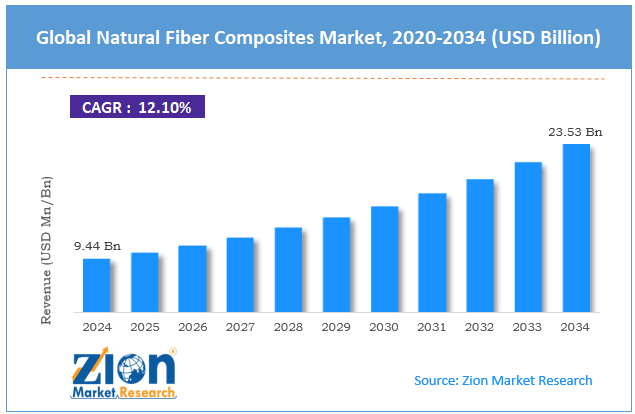
The global natural fiber composites market size was around USD 9.44 billion in 2024 and is projected to reach USD 23.53 billion by 2034, with a compound annual growth rate (CAGR) of roughly 12.10% between 2025 and 2034. The report examines the primary drivers, challenges, and restraints shaping global demand for the natural fiber composites market throughout the forecast period and identifies high-growth opportunities across the industry.
Key Insights:
- As per the analysis shared by our research analyst, the global natural fiber composites market is estimated to grow annually at a CAGR of around 12.10% over the forecast period (2025-2034)
- In terms of revenue, the global natural fiber composites market size was valued at around USD 9.44 billion in 2024 and is projected to reach USD 23.53 billion by 2034.
- The natural fiber composites market is projected to grow significantly owing to rising environmental awareness and sustainability trends, expansion in consumer electronics applications, and advancements in bio-based composite technologies.
- Based on type, the wood fiber composites segment is expected to lead the market, while the hemp fiber composites segment is expected to grow considerably.
- Based on the matrix, the inorganic compound segment is the dominating segment, while the synthetic polymer segment is projected to witness sizeable revenue over the forecast period.
- Based on end-use, the automotive segment is expected to lead the market, followed by the building and construction segment.
- By region, Europe is projected to dominate the global market during the forecast period, followed by Asia Pacific.
Natural Fiber Composites Market: Overview
Natural fiber composites are materials formed by reinforcing a polymer matrix with fibers obtained from animals or plants, such as flax, jute, silk, or hemp. They offer benefits like biodegradability, low density, and renewable sourcing, making them an eco-friendly alternative to synthetic composites. The global natural fiber composites market is likely to expand rapidly, fueled by growing environmental awareness, government policies and regulations, and escalating demand from the automotive industry. Worldwide demand for eco-friendly and sustainable materials is increasing as awareness of environmental pollution and climate change grows. Natural fiber composites, being biodegradable and renewable, are viewed as a green alternative to synthetic materials. This environmental focus motivates industries to adopt these composites across consumer goods, construction, and automotive applications.
Moreover, governments worldwide are implementing regulations to promote the use of renewable materials and reduce non-biodegradable plastics. Policies such as tax incentives, subsidies, and mandates that favor eco-friendly products create a supportive industry environment. These norms stimulate investment and accelerate the adoption of natural fiber composites in multiple industries. Furthermore, the automotive industry increasingly seeks low-weight materials to enhance fuel efficiency and lower emissions. Natural fiber composites offer a high strength-to-weight ratio, making them ideal for dashboards, interior panels, and door trims. Growing consumer preferences for sustainable vehicles further fuel the integration of these materials.
Nevertheless, the global market faces limitations due to factors such as variability in fiber quality and limited high-temperature performance. Natural fibers vary notably due to differences in harvesting, cultivation, and environmental conditions. This instability impacts length, strength, and moisture content, creating obstacles in achieving uniform composite quality. Manufacturers face challenges in standardizing products, hampering broader industrial adoption. Likewise, natural fibers degrade at temperatures over 200°C, limiting their use in high-performing polymers. This prevents applications in industries like advanced engineering, aerospace, and heavy machinery. Thermal sensitivity reduces their competitiveness relative to synthetic composites in demanding environments.
Still, the global natural fiber composites industry benefits from several favorable factors, including the integration of biodegradable polymers and advanced surface treatment technologies. Integrating natural fibers with biodegradable polymers yields eco-friendly, fully compostable composites. These materials address end-of-life disposal concerns and meet environmental regulations. The approach offers fresh opportunities in consumer products, packaging, and single-use applications. Additionally, progressing surface treatment techniques enhance fiber-matrix bonding, improving moisture resistance, durability, and strength. These innovations allow natural fiber composites to meet more demanding industrial needs. Improved performance expands application potential in construction, automotive, and industrial sectors.
Natural Fiber Composites Market: Dynamics
Growth Drivers
How is the natural fiber composites market driven by automotive lightweighting & fuel efficiency?
The automotive industry’s drive to reduce emissions and enhance fuel efficiency through lightweighting is a key market driver. Natural fiber composites are widely used in seat belts, interior panels, underbody shields, and door trims to replace heavier materials, contributing to significant weight reductions across vehicle models. Adoption is growing worldwide as automakers work to comply with stringent fuel-economy and electric-vehicle efficiency standards. The automotive segment consistently accounts for the largest share of composite demand. Material innovations and OEM collaborations continue to reinforce the application’s growth.
How are technological advancements & innovation fueling the natural fiber composites market?
Current R&D in fiber treatment, processing technologies, and matrix compatibility is improving the performance profile of natural fiber composites. Surface modification techniques, automated fabrication, and hybrid composites techniques are enhancing durability, manufacturing efficiency, and moisture resistance. Injection molding and other advanced processes are expanding design flexibility and driving adoption for high-precision components. These innovations are narrowing the performance gap relative to traditional composites, attracting interest from new industry segments. Continuous development in material science is hence a major driver of the natural fiber composites market.
Restraints
Higher processing complexity adversely impacts the industry's progress
Processing natural fiber composites often requires surface treatments, specialized equipment, or compatibilizers to ensure fiber-matrix performance and adhesion. These additional manufacturing steps increase production cost and complexity. Most small and mid-scale manufacturers lack the expertise or capital to invest in optimized processes. Quality control challenges and longer cycle times further impact competitiveness. This restraint hampers industry penetration, mainly in price-sensitive segments.
Opportunities
How is the expansion in construction & infrastructure creating promising avenues for the growth of the natural fiber composites industry?
Green building standards and growing government incentives for sustainable materials are expanding the use of natural fiber composites. These composites are actively specified for decking, insulation boards, and wall panels, and façade systems in eco-focused construction. Their lower lifecycle costs and low embodied carbon increase their appeal to infrastructure developers. Regions with strict carbon-reduction targets are driving higher adoption rates, thereby positively impacting the natural fiber composites industry. This trend is creating large-scale and durable demand beyond traditional industrial applications.
Challenges
Developing robust standards & testing protocols limits market growth
The lack of widely accepted standards for natural fiber composites creates industry fragmentation. Disparate testing techniques and benchmarks make it challenging for buyers to compare materials on equal footing. This uncertainty hampers procurement decisions in regulated industries like aerospace and automotive. Collaborative standardization efforts are underway, but progress is slow. This is a key challenge to achieving uniform performance validation.
Natural Fiber Composites Market: Segmentation
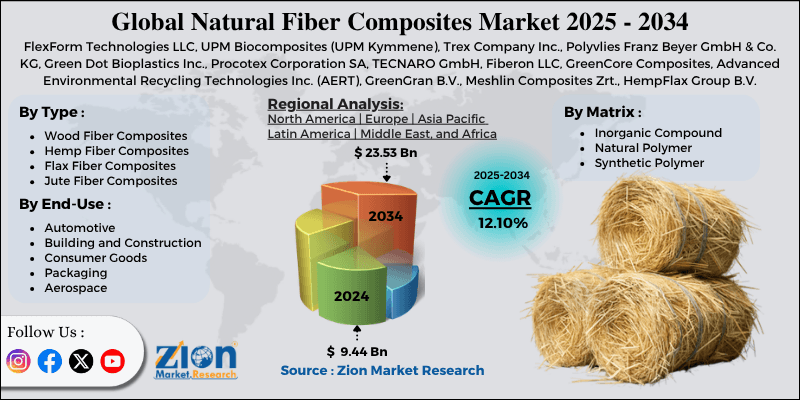
The global natural fiber composites market is segmented based on type, matrix, end-use, and region.
Why is the Wood Fiber Composites segment projected to dominate the natural fiber composites market?
Based on type, the global natural fiber composites industry is divided into wood fiber composites, hemp fiber composites, flax fiber composites, jute fiber composites, and others. The wood fiber composites segment accounts for the largest share, with 59% of the total. It is driven by cost-effectiveness, its abundant availability, and extensive use in consumer goods, automotive, and construction. They combine ease of integration, strength, and recyclability with polymers, making them ideal for diverse industries.
Conversely, the hemp fiber composites segment ranks second in the market, with a 20% share, driven by renewable sourcing, superior tensile strength, and growing demand in construction, automotive, and high-performance applications. Their eco-friendly and lightweight properties make them a strong choice over synthetic fibers. Hemp composites are rapidly gaining market share and are recognized as the fastest-growing segment, the next-largest after wood fibers.
What factors help the Inorganic Compound segment lead the natural fiber composites market?
Based on matrix, the global natural fiber composites market is segmented into inorganic compound, natural polymer, and synthetic polymer. The inorganic compound segment leads with 42% market share. They offer thermal stability, superior strength, and durability, making them ideal for automotive and construction applications. Their performance benefits are reflected in their extensive use of matrix type.
However, the synthetic polymer segment holds the second-largest share in the market at 32%. They are widely used for their strong fiber bonding, flexibility, and lightweight properties. They are compatible with different natural fibers and suitable for consumer goods, automotive, and industrial products.
What are the key reasons for the leadership of the Automotive segment in the natural fiber composites market?
Based on end-use, the global market is segmented into automotive, building and construction, consumer goods, packaging, aerospace, and others. The automotive segment leads with 53% of the total market. These composites are used in semi-structural components and interiors to improve fuel efficiency and reduce weight. Strong demand for sustainable materials keeps the automotive sector as the dominating segment.
Nevertheless, the building and construction segment ranks second with 30% of the market share. Natural fiber composites are used in insulation, panels, and decking for sustainable construction. Growing green building initiatives fuel adoption in the segment.
Natural Fiber Composites Market: Report Scope
| Report Attributes | Report Details |
|---|---|
| Report Name | Natural Fiber Composites Market |
| Market Size in 2024 | USD 9.44 Billion |
| Market Forecast in 2034 | USD 23.53 Billion |
| Growth Rate | CAGR of 12.10% |
| Number of Pages | 230 |
| Key Companies Covered | FlexForm Technologies LLC, UPM Biocomposites (UPM Kymmene), Trex Company Inc., Polyvlies Franz Beyer GmbH & Co. KG, Green Dot Bioplastics Inc., Procotex Corporation SA, TECNARO GmbH, Fiberon LLC, GreenCore Composites, Advanced Environmental Recycling Technologies Inc. (AERT), GreenGran B.V., Meshlin Composites Zrt., HempFlax Group B.V., NPSP BV, Weyerhaeuser Company, and others. |
| Segments Covered | By Type, By Matrix, By End-Use, and By Region |
| Regions Covered | North America, Europe, Asia Pacific (APAC), Latin America, Middle East, and Africa (MEA) |
| Base Year | 2024 |
| Historical Year | 2019 to 2023 |
| Forecast Year | 2025 - 2034 |
| Customization Scope | Avail customized purchase options to meet your exact research needs. Request For Customization |
Natural Fiber Composites Market: Regional Analysis
What gives Europe a competitive edge in the global Natural Fiber Composites Market?
Europe is projected to maintain its dominant position in the global natural fiber composites market, with a 10.2% CAGR, driven by strong industrial demand, consumer preferences, R&D, and advanced manufacturing infrastructure. The construction and automotive industries need durable, lightweight, and eco-friendly materials. High usage of natural fiber composites in panels, interiors, and building elements strengthens industry dominance.
Moreover, eco-conscious consumers are actively preferring sustainable products in packaging, household goods, and vehicles. Combined with strong regional R&D and industry collaborations, this drives the advancement and adoption of natural composites. Furthermore, Europe holds technological capabilities and well-established manufacturing facilities. Efficient production processes and proficient labor make it easy to integrate natural fiber composites into industrial applications.
Why does Asia Pacific rank second in the global Natural Fiber Composites Market?
Asia Pacific maintains its position as the second-largest region, with a 13.9% CAGR in the global natural fiber composites industry, driven by growing automotive demand, government support and policies, and infrastructure development. Automotive production is rapidly expanding in economies such as India, China, and Japan. Natural fiber composites are increasingly used for dashboards, interior panels, and other low-weight components to enhance fuel efficiency.
Moreover, several governments in the region offer incentives and promote the use of eco-friendly materials. Policies encouraging sustainable development and renewable resources drive industry growth for natural fiber composites. Additionally, massive infrastructure projects and growing urbanization create high demand for durable, lightweight, and cost-effective construction materials. Natural fiber composites are preferred for insulation, panels, and decking applications.
Natural Fiber Composites Market: Competitive Analysis
The leading players in the global natural fiber composites market are:
- FlexForm Technologies LLC
- UPM Biocomposites (UPM Kymmene)
- Trex Company Inc.
- Polyvlies Franz Beyer GmbH & Co. KG
- Green Dot Bioplastics Inc.
- Procotex Corporation SA
- TECNARO GmbH
- Fiberon LLC
- GreenCore Composites
- Advanced Environmental Recycling Technologies Inc. (AERT)
- GreenGran B.V.
- Meshlin Composites Zrt.
- HempFlax Group B.V.
- NPSP BV
- Weyerhaeuser Company
What are the key trends in the global Natural Fiber Composites Market?
Hybrid composite development
Manufacturers are actively combining natural fibers with synthetic fibers or advanced polymers to create hybrid composites. These hybrids deliver enhanced mechanical performance while retaining sustainability advantages. This trend extends applicability into higher-performance domains, such as industrial components and structural automotive parts.
Shift toward sustainable & biodegradable materials
Manufacturers across packaging, consumer goods, and automotive are increasingly prioritizing environmentally friendly materials to meet sustainability goals. Natural fiber composites, being biodegradable and renewable, are replacing synthetic options in several applications. This trend is fueling advancement and adoption worldwide as brands align with environmental commitments.
The global natural fiber composites market is segmented as follows:
By Type
- Wood Fiber Composites
- Hemp Fiber Composites
- Flax Fiber Composites
- Jute Fiber Composites
- Others
By Matrix
- Inorganic Compound
- Natural Polymer
- Synthetic Polymer
By End-Use
- Automotive
- Building and Construction
- Consumer Goods
- Packaging
- Aerospace
- Others
By Region
- North America
- The U.S.
- Canada
- Mexico
- Europe
- France
- The UK
- Spain
- Germany
- Italy
- Rest of Europe
- Asia Pacific
- China
- Japan
- India
- Australia
- South Korea
- Rest of Asia Pacific
- The Middle East & Africa
- Saudi Arabia
- UAE
- Egypt
- Kuwait
- South Africa
- Rest of the Middle East & Africa
- Latin America
- Brazil
- Argentina
- Rest of Latin America
Table Of Content
Methodology
FrequentlyAsked Questions
Natural fiber composites are materials formed by reinforcing a polymer matrix with fibers obtained from animals or plants, such as flax, jute, silk, or hemp. They offer benefits like biodegradability, low density, and renewable sourcing, making them an eco-friendly alternative to synthetic composites.
The global natural fiber composites market is projected to grow due to increasing demand for automotive lightweighting, growth in the construction and building materials sector, and expansion of wind energy and renewable infrastructure.
According to a study, the global natural fiber composites market size was around USD 9.44 billion in 2024 and is expected to grow to around USD 23.53 billion by 2034.
The CAGR value of the natural fiber composites market is expected to be around 12.10% during 2025-2034.
Emerging trends and innovations in the natural fiber composites market include biodegradable polymers, hybrid composites, light-weighting, advanced fiber treatments, and expansion in emerging economies.
Europe is expected to lead the global natural fiber composites market during the forecast period.
The key players profiled in the global natural fiber composites market include FlexForm Technologies LLC, UPM Biocomposites (UPM‑Kymmene), Trex Company, Inc., Polyvlies Franz Beyer GmbH & Co. KG, Green Dot Bioplastics Inc., Procotex Corporation SA, TECNARO GmbH, Fiberon LLC, GreenCore Composites, Advanced Environmental Recycling Technologies, Inc. (AERT), GreenGran B.V., Meshlin Composites Zrt., HempFlax Group B.V., NPSP BV, and Weyerhaeuser Company.
Leading players are adopting strategies such as mergers & acquisitions, partnerships, capacity expansion, R&D investments, and geographic market diversification to grow their presence.
Pricing trends in the natural fiber composites market exhibit moderate fluctuations, driven by fiber quality, raw material availability, and rising demand for sustainable alternatives.
The report examines key aspects of the natural fiber composites market, including a detailed analysis of current growth factors and restraints, as well as future growth opportunities and challenges that will affect the market.

HappyClients

