
Mobile Image Sensor Market Size, Share, Growth, Opportunities 2034

Mobile Image Sensor Market By Type (1 MP and Below, 2-5 MP, 8-13 MP, and Above 13 MP), By Application (iOS System and Android System), and By Region - Global and Regional Industry Overview, Market Intelligence, Comprehensive Analysis, Historical Data, and Forecasts 2025 - 2034
| Market Size in 2024 | Market Forecast in 2034 | CAGR (in %) | Base Year |
|---|---|---|---|
| USD 8.85 Billion | USD 17.90 Billion | 8.14% | 2024 |
Mobile Image Sensor Industry Perspective:
What is the anticipated CAGR for the mobile image sensor market during the projection period?
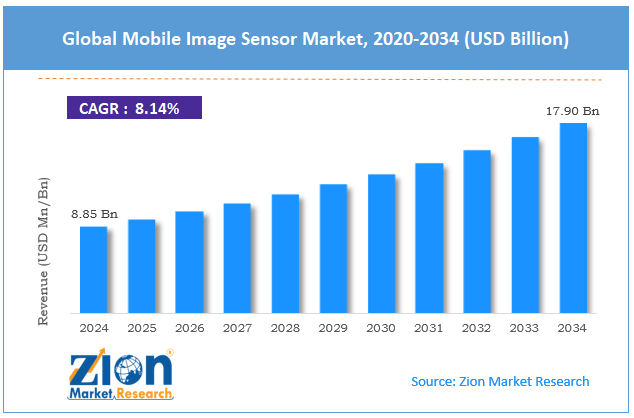
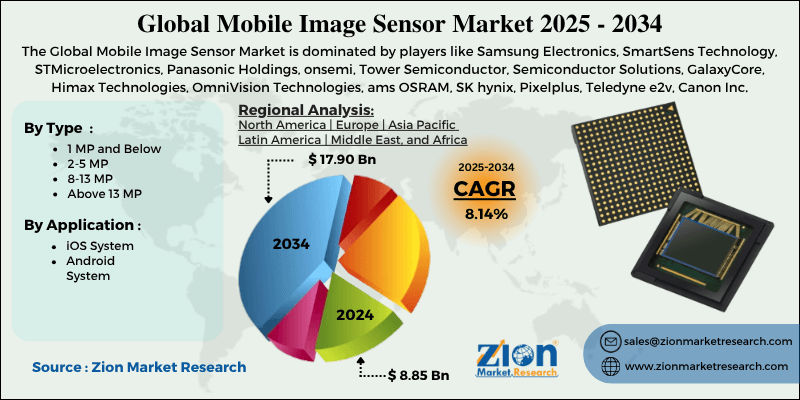
The global mobile image sensor market size was worth around USD 8.85 billion in 2024 and is predicted to grow to around USD 17.90 billion by 2034 with a compound annual growth rate (CAGR) of roughly 8.14% between 2025 and 2034.
Key Insights:
- As per the analysis shared by our research analyst, the global mobile image sensor market is estimated to grow annually at a CAGR of around 8.14% over the forecast period (2025-2034)
- In terms of revenue, the global mobile image sensor market size was valued at around USD 8.85 billion in 2024 and is projected to reach USD 17.90 billion by 2034.
- The market is projected to grow at a significant rate due to rising smartphone ownership across the globe.
- Based on the type, the 13 MP segment is growing at a high rate and will continue to dominate the global market, as per industry projections
- Based on the application, the Android system segment is anticipated to command the largest market share
- Based on region, the Asia-Pacific is projected to dominate the global market during the forecast period
Mobile Image Sensor Market: Overview
A mobile image sensor is a chip that captures light passing through a camera lens and converts it into an image. Image sensors in mobile phones determine the camera’s resolution and picture quality. Over the years, demand for extremely fine and compact mobile image sensors has increased due to the growing miniaturization of digital devices. In addition, industry players continue to focus on improving film speed to deliver high-resolution images within a fraction of a second when a user clicks a picture. During the forecast period, demand for mobile image sensors is expected to continue growing due to rising smartphone ownership worldwide.
Furthermore, the emergence of mobile photography trends, higher sales of affordable phones, and luxury smartphone markets will open new growth avenues for the industry players. However, escalating trade wars between prominent countries and the evolving landscape of the semiconductor industry may impact business revenue in the long run.
Mobile Image Sensor Market: Dynamics
Growth Drivers
How will growing smartphone ownership influence demand in the mobile image sensor market?
The global mobile image sensor market is expected to grow due to rising smartphone ownership across the globe. According to industry research, more than 4 billion people worldwide own a smartphone and use it for everyday activities. In addition, the increasing application of smartphones across education and learning institutions and among corporate employees has further intensified the market demand rate. Mobile image sensors are essential components of the latest mobile phones since they are used for capturing light and converting it into images with high resolutions. During the forecast period, production of affordable mobile phones and changes in consumer lifestyle are expected to propel the smartphone ownership rate further, adding to the existing market growth trends.
Growing mobile photography trends to fuel industry revenue during the forecast period
The mobile photography trend has captured the attention of the global population. Professional photographers and cinematographers regularly leverage mobile image sensors to capture special moments. In February 2026, Sony, a leading player in the global market, announced the launch of a new image sensor in the form of IMX06A-AJ1R-J. It is a 50.3-megapixel stacked Backside Illuminated (BSI) Complementary Metal-Oxide-Semiconductor CMOS) sensor equipped with a nearly 1-inch optical format. Apart from excellent pixel count, IMX06A-AJ1R-J is designed to deliver computational flexibility, higher speed, and High Dynamic Range (HDR) performance. Such advancements in mobile image sensor technology developed around mobile photography will work in favor of the industry players.
Restraints
What will be the impact of geopolitical tension on the mobile image sensor market?
The global mobile image sensor market will be restricted due to intensifying geopolitical tension across the globe. The ongoing war between the USA, Israel, and Iran has already disrupted global trade as fuel prices continue to go up. Similarly, regional conflicts and trade wars between Western and Asian economies will have a significant impact on the semiconductor supply chain and raw materials required for producing image sensors.
Opportunities
Expansion of multi-camera systems in mobile phones to generate growth opportunities
The global mobile sensor industry is anticipated to experience new growth opportunities due to the rising expansion of multi-camera systems. Modern smartphone companies are increasingly offering dual, triple, and quad-camera systems. These image sensors are designed to offer wide-angle shots, optical zoom, and depth sensing features. Multiple camera systems are produced using a higher number of image sensors, thus offering expansion possibilities to the industry players. For instance, in February 2026, Samsung, one of the world’s leading technology companies, launched the S26 Ultra, which features an Artificial Intelligence (AI) camera with four image sensors, including a 200 MP primary sensor and ultra-wide lenses.
How will emerging applications shape the mobile image sensor market during the forecast period?
The solutions available in the global mobile image sensor market are gaining popularity in emerging applications such as the automotive sector and the wearables industry. For instance, mobile image sensors are leveraged to improve the performance of Advanced Driver Assistance Systems (ADAS). In addition, they are used in wearables such as smart glasses and fitness bands to track and record images. For instance, the recently launched Ray-Ban Meta Smart Glasses are equipped with a built-in camera, allowing hands-free moments and AI-powered object recognition.
Challenges
Concerns over image sensor size and performance, along with high competition, challenge market growth
The global mobile image sensor industry is expected to be challenged by the growing concerns over sensor size and its performance. Smartphone miniaturization has driven demand for compact image sensors. However, as per industry analysis, bigger sensors deliver superior performance. Technical complexities associated with balancing image sensor size and performance will impact business growth trends. In addition, smartphone market saturation and high competition within the industry will further limit market expansion in the coming years.
Mobile Image Sensor Market: Report Scope
| Report Attributes | Report Details |
|---|---|
| Report Name | Mobile Image Sensor Market |
| Market Size in 2024 | USD 8.85 Billion |
| Market Forecast in 2034 | USD 17.90 Billion |
| Growth Rate | CAGR of 8.14% |
| Number of Pages | 225 |
| Key Companies Covered | Samsung Electronics, SmartSens Technology, STMicroelectronics, Panasonic Holdings, onsemi, Tower Semiconductor, Semiconductor Solutions, GalaxyCore, Himax Technologies, OmniVision Technologies, ams OSRAM, SK hynix, Pixelplus, Teledyne e2v, Canon Inc., and others. |
| Segments Covered | By Type, By Application, and By Region |
| Regions Covered | North America, Europe, Asia Pacific (APAC), Latin America, Middle East, and Africa (MEA) |
| Base Year | 2024 |
| Historical Year | 2019 to 2023 |
| Forecast Year | 2025 - 2034 |
| Customization Scope | Avail customized purchase options to meet your exact research needs. Request For Customization |
Mobile Image Sensor Market: Segmentation
The global mobile image sensor market is segmented based on type, application, and region.
Why will above 13 MP lead the mobile image sensor market during the forecast period?
Based on type, the global market segments are 1 MP and below, 2-5 MP, 8-13 MP, and above 13 MP. In 2024, the highest growth was listed in the above 13 MP segment, accounting for 55% of the global revenue. It will continue growing at a CAGR of 10% during the forecast period due to growing demand for better image quality and enhanced performance in low-light areas. Additionally, above 13 MP mobile image sensors are widely used in the affordable phone range section, further helping the segment thrive.
What is the projected CAGR for the Android system segment in the mobile image sensor market?
Based on the application, the global market divisions are iOS and Android systems. The highest growth rate was listed in the Android system segment, leading up to 81% of the global revenue. It is expected to offer a CAGR of 9.02% during the forecast period due to rising sales of Android-based phones. The introduction of premium and affordable Android phones will influence segmental growth trends in the future.
Mobile Image Sensor Market: Regional Analysis
Why will Asia-Pacific lead the mobile image sensor market during the forecast period?
The global mobile image sensor market is expected to be led by Asia-Pacific during the forecast period. In 2024, it accounted for 58% of the global revenue and will offer a CAGR of 9.5% in the coming years. The presence of some of the leading manufacturers of affordable and high-end mobile image sensors in countries such as China and South Korea will aid the expansion of the regional market. Furthermore, the growing penetration of smartphones across emerging Asian countries will help the region thrive.
What is the projected CAGR for North America during the forecast period in the mobile image sensor industry?
North America is projected to emerge as the second-highest revenue generator in the mobile image sensor market during the forecast period. In 2024, it contributed up to 26% of the global revenue and will grow at a CAGR of 6.5% during the forecast period. Growing demand for premium smartphones, increasing use of iOS devices, and the use of mobile image sensors in emerging industries will benefit the regional players. In addition, rising investments in domestic chip production may work in favor of North American companies.
Mobile Image Sensor Market: Competitive Analysis
The global mobile image sensor market is led by players like:
- Samsung Electronics
- SmartSens Technology
- STMicroelectronics
- Panasonic Holdings
- onsemi
- Tower Semiconductor
- Semiconductor Solutions
- GalaxyCore
- Himax Technologies
- OmniVision Technologies
- ams OSRAM
- SK hynix
- Pixelplus
- Teledyne e2v
- Canon Inc.
What are the latest key trends in the mobile image sensor market?
Virtual Reality (VR) and Augmented Reality (AR) applications
The growing use of mobile image sensors in VR and AR devices is an emerging market trend. Mobile image sensors are used by game-based VR and AR tools to elevate player experience.
Demand for high-resolution sensors
The mobile image sensor industry is witnessing accelerated demand for high-resolution sensors offering over 50 MP. Increasing use of premium phones will offer new growth avenues to the industry leaders.
The global mobile image sensor market is segmented as follows:
By Type
- 1 MP and Below
- 2-5 MP
- 8-13 MP
- Above 13 MP
By Application
- iOS System
- Android System
By Region
- North America
- The U.S.
- Canada
- Mexico
- Europe
- France
- The UK
- Spain
- Germany
- Italy
- Rest of Europe
- Asia Pacific
- China
- Japan
- India
- Australia
- South Korea
- Rest of Asia Pacific
- The Middle East & Africa
- Saudi Arabia
- UAE
- Egypt
- Kuwait
- South Africa
- Rest of the Middle East & Africa
- Latin America
- Brazil
- Argentina
- Rest of Latin America
Table Of Content
Methodology
FrequentlyAsked Questions
A mobile image sensor is a chip that captures light passing through a camera lens and converts it into an image.
The global mobile image sensor market is expected to grow due to rising smartphone ownership across the globe.
According to study, the global mobile image sensor market size was worth around USD 8.85 billion in 2024 and is predicted to grow to around USD 17.90 billion by 2034.
The CAGR value of the mobile image sensor market is expected to be around 8.14% during 2025-2034.
The global mobile image sensor industry is expected to be challenged by the growing concerns over sensor size and its performance.
Virtual Reality (VR) and Augmented Reality (AR) application and demand for high resolution sensors are the emerging trends and innovations impacting the mobile image sensor market.
The global mobile image sensor market has performed well so far and will offer similar trends in the coming years.
The global mobile image sensor market is expected to be led by Asia-Pacific during the forecast period.
The global mobile image sensor market is led by players like Samsung Electronics, SmartSens Technology, STMicroelectronics, Panasonic Holdings, onsemi, Tower Semiconductor, Semiconductor Solutions, GalaxyCore, Himax Technologies, OmniVision Technologies, ams OSRAM, SK hynix, Pixelplus, Teledyne e2v, and Canon Inc.
The report explores crucial aspects of the mobile image sensor market including detailed discussion of existing growth factors and restraints while also browsing future growth opportunities and challenges that impact the market.

HappyClients

