
Mastic Gum Market Size, Trend, Growth, Industry Analysis 2034

Mastic Gum Market By Product Form (Raw Mastic Gum, Mastic Gum Powder, Mastic Gum Capsules, Mastic Gum Oil, and Mastic Gum Chewing Products), By Application (Pharmaceuticals, Food and Beverages, Cosmetics and Personal Care, Nutraceuticals, and Industrial Applications), By End User (Hospitals and Clinics, Food Manufacturers, Cosmetic Companies, Dietary Supplement Producers, and Research Institutions), By Distribution Channel (Online Retail, Pharmacies and Drug Stores, Specialty Health Stores, Supermarkets and Hypermarkets, and Direct Sales), and By Region - Global and Regional Industry Overview, Market Intelligence, Comprehensive Analysis, Historical Data, and Forecasts 2025 - 2034
| Market Size in 2024 | Market Forecast in 2034 | CAGR (in %) | Base Year |
|---|---|---|---|
| USD 753.27 Million | USD 1,044.23 Million | 3.64% | 2024 |
Mastic Gum Industry Perspective:
What are the expected growth rate and market size of the mastic gum market during the forecast period?
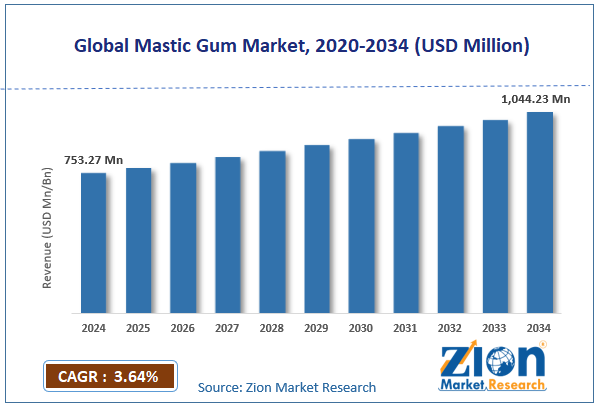
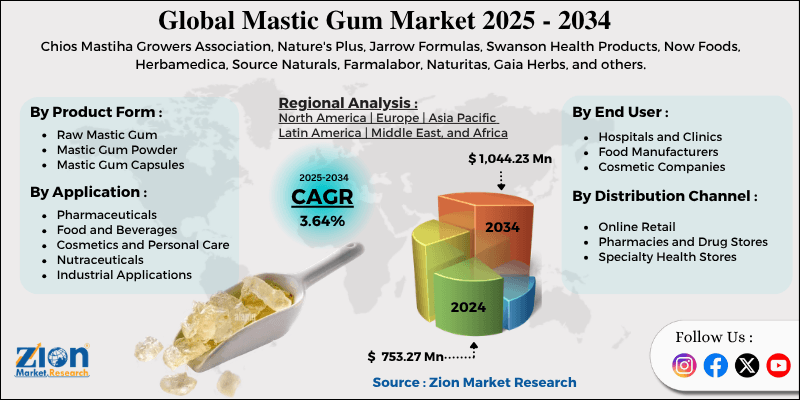
The global mastic gum market size was worth approximately USD 753.27 million in 2024 and is projected to grow to around USD 1,044.23 million by 2034, with a compound annual growth rate of roughly 3.64% between 2025 and 2034.
Mastic Gum Market: Overview
Mastic gum is a natural resin obtained from the mastic tree, Pistacia lentiscus, mainly grown on the island of Chios, valued for its health benefits, flavor, and traditional uses. When the tree bark is gently cut, it releases a sticky liquid that dries into small crystal-like pieces known as mastic gum. People have used it for centuries for chewing, freshening breath, and supporting digestive health. In modern applications, mastic gum is widely used in healthcare as a supplement that helps improve digestion, reduce stomach discomfort, and fight harmful bacteria. The food and beverage industry uses it as a natural flavoring in sweets, bakery products, beverages, and chewing gums. Cosmetic companies use mastic gum extracts in skincare and haircare products for their soothing and antioxidant properties.
Consumers prefer traditional, safe solutions, while ongoing research continues to support its benefits, driving steady growth in the mastic gum market across multiple industries worldwide. The mastic gum market is growing due to rising demand for natural health products, increasing use in food and cosmetics, growing consumer preference for plant-based ingredients, and expanding research supporting its digestive and antimicrobial benefits.
Key Insights
- As per the analysis shared by our research analyst, the global mastic gum market is estimated to grow annually at a compound annual growth rate of around 3.64% over the forecast period from 2025 to 2034.
- In terms of revenue, the global mastic gum market size was valued at approximately USD 753.27 million in 2024 and is projected to reach USD 1,044.23 million by 2034.
- The mastic gum market is expected to grow due to increasing consumer preference for natural and herbal health products, growing scientific evidence supporting its digestive and antimicrobial benefits, rising demand from the cosmetics industry, the expanding nutraceutical sector, and growing awareness of traditional Mediterranean health practices.
- Based on product form, the mastic gum capsules segment is expected to lead growth in the mastic gum market, while the mastic gum powder segment is anticipated to expand rapidly due to its versatility across food, pharmaceutical, and cosmetic applications.
- Based on application, the pharmaceuticals segment is expected to lead the mastic gum market, while the nutraceuticals segment is anticipated to grow steadily as more consumers turn to natural supplements for digestive health and general wellness.
- Based on end user, the dietary supplement producers segment is the largest, while the cosmetic companies segment is growing rapidly as demand for natural, plant-based beauty ingredients rises globally.
- Based on distribution channel, the pharmacies and drug stores segment is expected to lead the mastic gum market, while the online retail segment is anticipated to grow strongly as e-commerce platforms make specialty health products more accessible to global consumers.
- Based on region, Europe is projected to dominate the global mastic gum market during the estimated period, followed by North America.
Impact of the USA-Israel War on Iran on the Mastic Gum Market
The conflict between the United States, Israel, and Iran may affect the mastic gum market in the short term, as trade routes across the Mediterranean and the Middle East could face temporary disruptions, leading to delays and slightly higher shipping costs for buyers and distributors. Over time, supply chains are expected to adjust as companies explore alternative logistics routes, strengthen distribution networks, and improve sourcing strategies to maintain steady product availability across key markets. Rising demand from regions such as the Asia Pacific and North America is expected to support recovery, helping the market remain stable and continue to grow despite short-term challenges.
Mastic Gum Market: Technology Roadmap 2025 to 2034
What key trends and future developments will drive the mastic gum market during the forecast period?
Scientific research, advanced extraction methods, and growing consumer awareness are reshaping the mastic gum market, improving product quality and expanding the range of industries that use this natural resin. The market is expected to grow at a compound annual growth rate of around 3.64% over the forecast period, supported by rising demand from pharmaceutical companies, nutraceutical producers, cosmetic manufacturers, and food companies seeking clean-label, natural ingredients.
The following roadmap outlines the key development phases expected during the forecast period.
2025 to 2027: Product Standardization and Pharmaceutical Application Growth Phase
- Advances in extraction and purification technology will allow manufacturers to produce more consistent, high-quality mastic gum extracts suitable for pharmaceutical-grade applications.
- Clinical research on mastic gum's role in treating Helicobacter pylori infections and inflammatory bowel conditions will gain momentum, generating more evidence to support medical use.
- Food and beverage companies will increase their use of mastic gum as a natural flavoring and preservative, driven by clean-label trends and the shift toward minimally processed products.
2028 to 2031: Nutraceutical Expansion and Cosmetic Innovation Phase
- Nutraceutical companies will launch a wider range of mastic gum-based supplements targeting digestive health, oral care, and anti-inflammatory support, expanding product availability in health stores and online platforms.
- Cosmetic manufacturers will develop more advanced formulations using mastic gum oil and extract in anti-aging, skin-brightening, and wound-healing products backed by clinical evidence.
- Sustainable farming and harvesting practices on Chios Island will be developed to support growing global demand while protecting the natural mastic tree ecosystem.
2032 to 2034: Advanced Formulation and Global Market Penetration Phase
- Biotechnology companies will explore synthetic or laboratory-produced mastic compounds to complement natural resin supply and meet growing demand without straining the natural source.
- Personalized nutraceutical products using mastic gum as a key ingredient will become more common, supported by consumer health data and customized supplement platforms.
- Emerging markets across Asia Pacific, Latin America, and the Middle East will become important growth areas as awareness of mastic gum's benefits spreads and local distribution networks expand.
Mastic Gum Market: Dynamics
Growth Drivers
The rising global preference for natural and plant-based health products is driving the mastic gum market.
The mastic gum market is growing steadily due to rising demand for natural health products and plant-based alternatives to synthetic medicines worldwide. Mastic gum, derived from the mastic tree (Pistacia lentiscus), is widely valued for its ability to support digestion and relieve stomach discomfort. Scientific studies linking mastic gum to relief from acidity, indigestion, and bacterial infections such as Helicobacter pylori are strengthening consumer trust and increasing product adoption. Growing cases of digestive issues like irritable bowel syndrome and gastritis are encouraging people to choose gentler, natural remedies alongside conventional treatments. The beauty and personal care industry is also driving demand, as mastic gum extracts are used in skincare and hair care products for their soothing and antioxidant properties.
Rising health awareness, rising disposable incomes, and easy access to information through digital platforms are driving wider product adoption. A strong preference for safe, traditional, and effective ingredients continues to drive growth in the global mastic gum market.
What role does the growing demand for functional foods and natural preservatives play in driving the mastic gum market?
The mastic gum market is growing due to rising demand for functional foods and clean-label ingredients that offer both taste and health benefits. Mastic gum, sourced from the mastic tree Pistacia lentiscus, has a unique flavor widely used in Mediterranean cooking, baking, and confectionery products. Food companies are adding it to breads, chocolates, beverages, and chewing products for its natural taste and preservative qualities. Increasing consumer preference for products with fewer artificial additives is encouraging the use of natural ingredients like mastic gum. Food regulations in several regions are also promoting reduced use of synthetic preservatives, further supporting demand.
Growing interest in healthy eating patterns, such as the Mediterranean diet, is increasing awareness of traditional ingredients. Expanding use in packaged foods and premium products is helping manufacturers meet consumer expectations for quality, safety, and natural sourcing, driving steady global growth in the mastic gum market.
Restraints
Limited geographic supply and high production costs slow growth in the mastic gum market.
The mastic gum market faces several restraints, including limited supply, high prices, and low awareness in many regions. Mastic gum is mainly produced on the Greek island of Chios from the mastic tree Pistacia lentiscus, which restricts large-scale production and keeps supply limited. Harvesting requires skilled labor and careful manual collection, which slows the process and increases overall costs. Higher prices can discourage buyers in price-sensitive markets where natural supplements are still gaining popularity. Awareness of mastic gum remains low outside Mediterranean regions, limiting its reach in countries across Asia and Latin America.
Variations in product quality across suppliers can erode consumer trust and repeat purchases. Different rules for health claims across countries also make it difficult for companies to promote and sell products globally. These challenges, together, slow wider adoption and limit the market's faster growth worldwide.
Opportunities
What opportunities does growing scientific research and expanding e-commerce create for the mastic gum market?
The mastic gum industry offers strong growth opportunities due to rising research, expanding online sales, and growing interest in natural health products worldwide. Scientific studies are increasingly supporting the benefits of mastic gum for digestion, oral health, and inflammation, encouraging healthcare professionals and companies to develop new, evidence-based supplements and formulations. E-commerce platforms are making mastic gum products accessible to consumers in regions with limited physical stores, helping brands reach a wider audience. Social media and digital marketing are also increasing awareness, especially among younger consumers looking for natural wellness solutions.
Emerging markets across Asia Pacific, Southeast Asia, and Latin America offer significant untapped opportunities driven by rising incomes and health awareness. Partnerships between mastic gum producers and global nutraceutical and cosmetic companies can expand distribution and improve product visibility. These factors are creating new revenue streams and supporting long-term growth in the mastic gum market.
Challenges
How do supply chain limitations, consumer awareness gaps, and regulatory complexity challenge the mastic gum market?
The mastic gum market faces several challenges, including limited supply, low awareness, and uneven product quality across regions. Most natural mastic gum comes from the Greek island of Chios, making the supply highly dependent on local weather, labor availability, and crop conditions. Any disruption can reduce output and increase prices, pushing some buyers toward cheaper synthetic alternatives. Many consumers are still unfamiliar with mastic gum and its benefits, which slows demand growth and requires strong marketing efforts. Smaller producers often struggle to invest in global promotion and distribution. Differences in product quality across suppliers can also erode trust, as lower-grade products may not deliver the expected results.
Regulatory rules for labeling and health claims vary across countries, making it harder to sell products internationally. These challenges require greater awareness, improved quality control, and stronger supply management to support steady growth in the mastic gum market worldwide.
Mastic Gum Market: Report Scope
| Report Attributes | Report Details |
|---|---|
| Report Name | Mastic Gum Market |
| Market Size in 2024 | USD 753.27 Million |
| Market Forecast in 2034 | USD 1,044.23 Million |
| Growth Rate | CAGR of 3.64% |
| Number of Pages | 231 |
| Key Companies Covered | Chios Mastiha Growers Association, Nature's Plus, Jarrow Formulas, Swanson Health Products, Now Foods, Herbamedica, Source Naturals, Farmalabor, Naturitas, Gaia Herbs, and others. |
| Segments Covered | By Product Form, By Application, By End User, By Distribution Channel, and By Region |
| Regions Covered | North America, Europe, Asia Pacific (APAC), Latin America, Middle East, and Africa (MEA) |
| Base Year | 2024 |
| Historical Year | 2019 - 2023 |
| Forecast Year | 2025 - 2034 |
| Customization Scope | Avail customized purchase options to meet your exact research needs. Request For Customization |
Mastic Gum Market: Segmentation
The global mastic gum market is segmented based on product form, application, end user, distribution channel, and region.
What makes mastic gum capsules the leading product form in the mastic gum market?
Based on product form, the global mastic gum market is divided into raw mastic gum, mastic gum powder, mastic gum capsules, mastic gum oil, and mastic gum chewing products. The mastic gum capsules segment accounts for about 38% of the market, due to their ease of use and standardized daily dosing. The mastic gum oil segment holds around 22% of the market. It is widely used in cosmetics and personal care products and is growing as natural beauty brands expand their use of plant-based ingredients.
Why does the pharmaceutical application lead the indication segment in the mastic gum market?
Based on application, the market is divided into pharmaceuticals, food and beverages, cosmetics and personal care, nutraceuticals, and industrial applications. The pharmaceuticals segment holds about 35% of the market, leading due to strong evidence supporting digestive and antibacterial benefits. The nutraceuticals segment holds around 28% of the market. It is growing steadily as consumers prefer natural health solutions and brands develop targeted mastic gum formulations.
What helps dietary supplement producers lead the end-user segment in the mastic gum market?
Based on end user, the mastic gum industry is classified into hospitals and clinics, food manufacturers, cosmetic companies, dietary supplement producers, and research institutions. The dietary supplement producers segment holds about 42% of the market and leads because the supplement industry has been the most active in developing and marketing mastic gum products to health-conscious consumers globally. The cosmetic companies segment holds about 24% of the market. It is growing rapidly as the natural beauty trend continues to drive demand for plant-derived active ingredients with proven skin benefits.
Why does the pharmacy and drug stores channel lead distribution in the mastic gum market?
Based on distribution channel, the mastic gum market is categorized into online retail, pharmacies and drug stores, specialty health stores, supermarkets and hypermarkets, and direct sales. The pharmacies and drug stores segment holds about 33% of the market, leading due to strong consumer trust and pharmacist recommendations. The online retail segment holds around 29% of the market. It is growing quickly as e-commerce platforms make it easier to find and buy natural health products globally.
Mastic Gum Market: Regional Analysis
Why does Europe lead the global mastic gum market?
The mastic gum market is led by Europe, accounting for about 42% of global demand and expected to remain the top region throughout the forecast period. Strong cultural roots and long-standing use of mastic gum across Mediterranean countries support steady demand. Greece plays a central role as the primary source of authentic mastic gum, especially from the island of Chios, where production has been practiced for generations. Local consumers are familiar with its benefits for digestion, oral care, and food applications, which keeps demand stable across households and industries. The food and beverage sector uses mastic gum in traditional sweets, baked goods, and drinks, while pharmaceutical companies include it in supplements for digestive health.
Cosmetic brands in Europe are also increasing their use of plant-based ingredients, adding mastic gum extracts to skincare and haircare products. Strong regulations that support natural, safe ingredients encourage manufacturers to use authentic materials. Tourism also plays a role, as visitors discover mastic gum products and continue purchasing them after returning home. Well-developed retail networks and specialty stores make these products widely available. Growing awareness of natural remedies and traditional ingredients continues to strengthen demand.
What supports North America's strong position in the global mastic gum market?
The mastic gum market ranks North America as the second-largest region, contributing about 27% of the market share. Demand in the United States and Canada is rising as consumers focus more on natural health products and preventive wellness. Increasing awareness about digestive health and interest in plant-based supplements are driving the adoption of mastic gum in capsule and powder forms. Health-conscious consumers are actively seeking alternatives to synthetic products, and mastic gum is gaining attention for its traditional use and research-backed benefits. The region has a strong nutraceutical industry that promotes dietary supplements through pharmacies, health stores, and online platforms.
E-commerce plays a major role by making niche products easily accessible to a wider audience. Social media and wellness influencers are also helping educate consumers about natural remedies, increasing product visibility. Cosmetic companies are gradually introducing mastic gum extracts in clean-label beauty products. Higher disposable income allows consumers to spend more on premium health and wellness products. Continuous product innovation and marketing efforts are expanding awareness. Growing trust in natural solutions and strong distribution channels support steady growth, making North America an important and expanding market for mastic gum products.
Recent Market Developments
- In March 2026, Norevo GmbH and other ingredient suppliers expanded their presence in natural resin-based products, including mastic gum, to support growing demand from food, pharmaceutical, and nutraceutical industries globally.
Mastic Gum Market: Competitive Analysis
The leading players in the global mastic gum market are:
- Chios Mastiha Growers Association
- Nature's Plus
- Jarrow Formulas
- Swanson Health Products
- Now Foods
- Herbamedica
- Source Naturals
- Farmalabor
- Naturitas
- Gaia Herbs
The global mastic gum market is segmented as follows:
By Product Form
- Raw Mastic Gum
- Mastic Gum Powder
- Mastic Gum Capsules
- Mastic Gum Oil
- Mastic Gum Chewing Products
By Application
- Pharmaceuticals
- Food and Beverages
- Cosmetics and Personal Care
- Nutraceuticals
- Industrial Applications
By End User
- Hospitals and Clinics
- Food Manufacturers
- Cosmetic Companies
- Dietary Supplement Producers
- Research Institutions
By Distribution Channel
- Online Retail
- Pharmacies and Drug Stores
- Specialty Health Stores
- Supermarkets and Hypermarkets
- Direct Sales
By Region
- North America
- The U.S.
- Canada
- Mexico
- Europe
- France
- The UK
- Spain
- Germany
- Italy
- Rest of Europe
- Asia Pacific
- China
- Japan
- India
- Australia
- South Korea
- Rest of Asia Pacific
- The Middle East & Africa
- Saudi Arabia
- UAE
- Egypt
- Kuwait
- South Africa
- Rest of the Middle East & Africa
- Latin America
- Brazil
- Argentina
- Rest of Latin America
Table Of Content
Methodology
FrequentlyAsked Questions
Mastic gum is a natural resin obtained from the mastic tree, Pistacia lentiscus, mainly grown on the island of Chios, and is valued for its health benefits, flavor, and traditional uses. When the tree bark is gently cut, it releases a sticky liquid that dries into small crystal-like pieces known as mastic gum.
The global mastic gum market is expected to grow due to rising consumer preference for natural health products, increasing scientific evidence supporting mastic gum's digestive and antimicrobial benefits, growing demand from the cosmetics industry, the expanding global nutraceutical sector, and rising awareness of Mediterranean dietary traditions.
According to the study, the global mastic gum market size was worth around USD 753.27 million in 2024 and is predicted to grow to around USD 1,044.23 million by 2034.
The compound annual growth rate value of the mastic gum market is expected to be around 3.64% from 2025 to 2034.
Europe is expected to lead the global mastic gum market due to its role as the primary producer of authentic mastic gum, deep cultural familiarity with the product, strong demand from the pharmaceutical and cosmetic industries, and favorable regulatory conditions for the use of natural ingredients.
The major players profiled in the global mastic gum market include Chios Mastiha Growers Association, Nature's Plus, Jarrow Formulas, Swanson Health Products, Now Foods, Herbamedica, Source Naturals, Farmalabor, Naturitas, and Gaia Herbs.
The report provides a detailed analysis of the mastic gum market, including a thorough review of key growth drivers and market restraints, application trends across pharmaceuticals, food, and cosmetics, regional performance analysis, competitive landscape review, and a forward-looking outlook covering all major product forms, applications, end users, and distribution channels across every key geography.
The mastic gum market value chain includes cultivation of mastic trees, manual resin harvesting, cleaning and grading, processing into extracts or powders, packaging, distribution through suppliers, and final use across food, pharmaceutical, and cosmetic industries globally.
The mastic gum market is influenced by strict geographic origin protection, varying health claim regulations, and environmental factors, such as climate conditions that affect tree yield and long-term supply stability across producing regions.
The mastic gum market players are focusing on expanding global distribution networks, investing in clinical research, developing new supplements and cosmetic formulations, forming partnerships with nutraceutical brands, and promoting product awareness through digital marketing and international trade channels.

HappyClients

