
Global Malware Analysis Market Size, Share, Trends and Forecast, 2032

Malware Analysis Market By component (services and solutions), By deployment mode (Cloud and on-premise), By organization size (large enterprise and small & mid-size enterprises), By end-user (manufacturing, energy & utilities, IT & telecom, healthcare, retail, BFSI, aerospace & defense, and others) And By Region: - Global And Regional Industry Overview, Market Intelligence, Comprehensive Analysis, Historical Data, And Forecasts, 2024-2032
| Market Size in 2023 | Market Forecast in 2032 | CAGR (in %) | Base Year |
|---|---|---|---|
| USD 9.45 Billion | USD 67.83 Billion | 24.48% | 2023 |
Description
How big is the Malware Analysis Market?
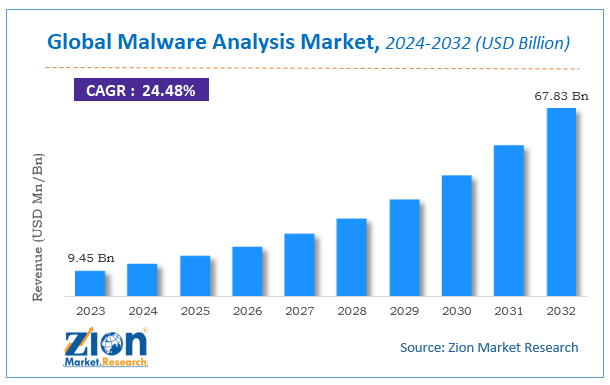
According to the report published by Zion Market Research, the global Malware Analysis Market size was valued at USD 9.45 Billion in 2023 and is predicted to reach USD 67.83 Billion by the end of 2032. The market is expected to grow with a CAGR of 24.48% during the forecast period. The report analyzes the global Malware Analysis Market's growth drivers, restraints, and impact on demand during the forecast period. It will also help navigate and explore the arising opportunities in the Malware Analysis industry.
Global Malware Analysis Market: Overview
The process of examining the risk, purposes, and functionality of the malware i.e. a suspicious URL or file is termed malware analysis. This reveals the type of malware, its nature, and the methodologies of attacking that will allow the Security Analysts, Threat Researchers, and Incident Responders to effectively and quickly triage & respond to the security incidents. Malware can have much functionality and can come in the form of Trojan horses, spyware, worms, and viruses.
Global Malware Analysis Market: Growth Factors
The global malware analysis market is growing at a speedy rate. The rise in BYOD policies in organizations, increase in the frequency of cyber-attacks, and growing phishing threats are some of the key factors that are driving the growth of the global market. Further, across the world, malware is becoming a huge threat to companies as it's been as simple as something like just opening an email attachment that may end up costing the organization millions of dollars if suitable controls are not in place. In addition to this, cybercriminals to combat anti-malware systems continuously develop new attack methods and more sophisticated malware.
In addition to this, malware analysis offers key benefits that help the security analysts and incident responders to practically respond to the incidents by the severity level, enrich context when threat hunting, improve the efficacy of IOC alerts & notifications, and find unknown IOCs that needs to be blocked. This has led to the necessity for malware analysis which in turn is propelling the growth of the global malware analysis market. In addition to this, the rise in digitalization and rapidly growing IT & telecom sectors are also some of the aspects that are boosting the growth of the global market. Also, factors like the growing adoption of malware analysis tools and growing demand from the BFSI sector are fueling the growth of the market.
Furthermore, advancement in the technology for the development of innovative products may open numerous opportunities for the growth of the global malware analysis market over the forecast period. However, the lack of internal cyber security specialists and false-positive alerts due to the use of single or few AV engines may impede the growth of the global malware analysis market.
The outbreak of Covid-19 has a positive impact on the global malware analysis market. Owing to the policies of organizations to work remotely due to strict lockdowns & restrictions on movement, there is an increase in the incidences of cyber-attack in the organizations. Thus, there is a rise in the demand for malware analysis tools by organizations as it helps to detect the behavior of the malware. All such factors have led to significant growth in the global market during the pandemic period.

Malware Analysis Market: Report Scope
| Report Attributes | Report Details |
|---|---|
| Report Name | Malware Analysis Market |
| Market Size in 2023 | USD 9.45 Billion |
| Market Forecast in 2032 | USD 67.83 Billion |
| Growth Rate | CAGR of 24.48% |
| Number of Pages | 207 |
| Key Companies Covered | FireEye, McAfee, Qualys, Check Point Software Technologies, Fortinet, Kaspersky Lab, Symantec Corporation, Sophos Group, Palo Alto Networks, Inc., and Cisco Systems Inc. |
| Segments Covered | By component, By deployment mode, By organization size, By end-user and By Region |
| Regions Covered | North America, Europe, Asia Pacific (APAC), Latin America, Middle East, and Africa (MEA) |
| Base Year | 2023 |
| Historical Year | 2018 - 2022 |
| Forecast Year | 2024 - 2032 |
| Customization Scope | Avail customized purchase options to meet your exact research needs. Request For Customization |
Global Malware Analysis Market: Segmentation
The global malware analysis market is bifurcated based on component, deployment mode, organization size, end-user, and region.
Based on the component, the global malware analysis market is divided into services and solutions.
Cloud and on-premise are the deployment mode of the malware analysis market.
Based on the organization size, the global market is divided into large enterprise and small & mid-size enterprises.
The end-user segment is classified into manufacturing, energy & utilities, IT & telecom, healthcare, retail, BFSI, aerospace & defense, and others.
Global Malware Analysis Market: Regional Analysis
North America is projected to lead the global malware analysis market during the forecast period. Factors such as the presence of key players in the US, heavy investments in the development of cutting-edge technologies in malware analysis tools, and well-established IT infrastructure are augmenting the growth of the global market in this region. Asia Pacific is anticipated to grow at a rapid rate. This is due to an increase in malware attacks and the growing demand for malware analysis from the banking & financial sectors. Europe is also expected to account for a significant share in the market.
Global Malware Analysis Market: Competitive Analysis
- FireEye
- McAfee
- Qualys
- Check Point Software Technologies
- Fortinet
- Kaspersky Lab
- Symantec Corporation
- Sophos Group
- Palo Alto Networks, Inc.
- Cisco Systems Inc.
are some of the dominant players that are operating in the global malware analysis market.
The Global Malware Analysis Market is segmented as follows:
By Component
- Services
- Solutions
By Deployment Mode
- Cloud
- On-Premise
By Organization Size
- Large Enterprise
- Small
- Mid-Size Enterprises
By End-User
- Manufacturing
- Energy & Utilities
- IT & Telecom
- Healthcare
- Retail
- BFSI
- Aerospace & Defense
- And Others
By Region
- North America
- The U.S.
- Canada
- Mexico
- Europe
- France
- The UK
- Spain
- Germany
- Italy
- Rest of Europe
- Asia Pacific
- China
- Japan
- India
- Australia
- South Korea
- Rest of Asia Pacific
- The Middle East & Africa
- Saudi Arabia
- UAE
- Egypt
- Kuwait
- South Africa
- Rest of the Middle East & Africa
- Latin America
- Brazil
- Argentina
- Rest of Latin America
What Reports Provides
- Full in-depth analysis of the parent market
- Important changes in market dynamics
- Segmentation details of the market
- Former, on-going, and projected market analysis in terms of volume and value
- Assessment of niche industry developments
- Market share analysis
- Key strategies of major players
- Emerging segments and regional markets
- Testimonials to companies in order to fortify their foothold in the market.
Table Of Content

FrequentlyAsked Questions
Malware analysis is the study of malicious software to understand its behavior. It helps improve cybersecurity and threat prevention.
The global Malware Analysis market is expected to be driven by the Driven by increasing frequency and complexity of cyberattacks, growing enterprise security spending, and demand for faster threat detection and incident response. Cloud security needs and regulatory compliance support market growth.
According to study, the global Malware Analysis market size was worth around USD 9.45 Billion in 2023 and is predicted to grow to around USD 67.83 Billion By 2032.
The global Malware Analysis market is expected to grow at a Compound Annual Growth Rate (CAGR) of around CAGR 24.48% during the forecast period from 2024-2032.
The global Malware Analysis industry is projected to be challenged by Challenges include rapidly evolving attack methods, shortage of skilled analysts, and high tooling costs for sandboxing and reverse engineering.
The Opportunities include rising cybersecurity budgets, adoption of automated threat intelligence platforms, and demand for managed malware analysis services will offer significant growth opportunities in the Malware Analysis market.
AI/ML-driven sandboxing and behavioral detection; automated threat hunting with SOAR/XDR integration; cloud-based detonation and scalable reverse-engineering workflows are the emerging trends and innovations impacting the Malware Analysis market.
The global Malware Analysis market is expected to be led by North America during the forecast period.
Some of the prominent players operating in the global Malware Analysis market are; FireEye, McAfee, Qualys, Check Point Software Technologies, Fortinet, Kaspersky Lab, Symantec Corporation, Sophos Group, Palo Alto Networks, Inc., and Cisco Systems Inc. and others.
The report explores crucial aspects of the Malware Analysis market, including a detailed discussion of existing growth factors and restraints, while also browsing future growth opportunities and challenges that impact the market.
HappyClients

