
Location-Based Services (LBS) Market Size, Share & Forecast 2034

Location-Based Services (LBS) Market By Component (Hardware, Software and Services), By Location Type (Indoor and Outdoor), By Technology (GPS (Global Positioning System), Wi-Fi, RFID & NFC, Bluetooth Low Energy (BLE) and Others), By Application (Mapping & Navigation, Location-Based Advertising, Asset & Fleet Tracking, Social Networking & Entertainment and Others), By End-Use (Aerospace & Defense, BFSI, IT and Telecommunications, Energy & Power, Government, Healthcare, Retail, Transportation & Logistics and Others) and By Region - Global and Regional Industry Overview, Market Intelligence, Comprehensive Analysis, Historical Data, and Forecasts 2025 - 2034
| Market Size in 2024 | Market Forecast in 2034 | CAGR (in %) | Base Year |
|---|---|---|---|
| USD 69 Billion | USD 224 Billion | 12.5% | 2024 |
Location-Based Services (LBS) Industry Perspective:
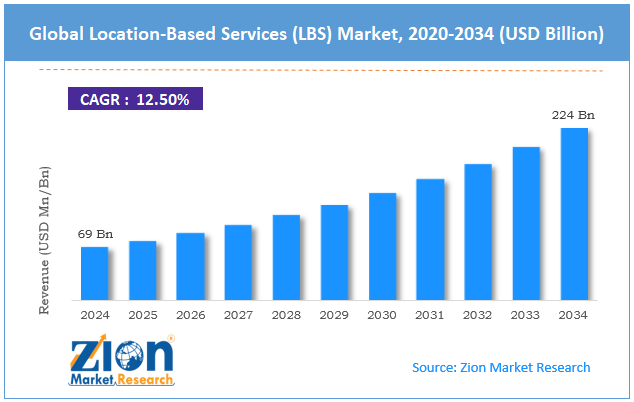
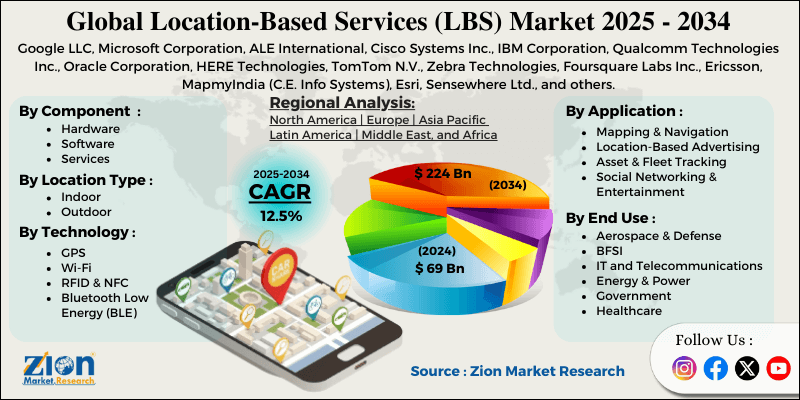
The global location-based services (LBS) market size was worth around USD 69 billion in 2024 and is predicted to grow to around USD 224 billion by 2034, with a compound annual growth rate (CAGR) of roughly 12.5% between 2025 and 2034.
Key Insights
- As per the analysis shared by our research analyst, the global Location-Based Services (LBS) market is estimated to grow annually at a CAGR of around 12.5% over the forecast period (2025-2034).
- In terms of revenue, the global Location-Based Services (LBS) market size was valued at around USD 69 billion in 2024 and is projected to reach USD 224 billion by 2034.
- Proliferation of smartphones & mobile devices is expected to drive the Location-Based Services (LBS) market over the forecast period.
- Based on the component, the software segment is expected to capture the largest market share over the projected period.
- Based on the location type, the outdoor segment is expected to capture the largest market share over the projected period.
- Based on the technology, the GPS (Global Positioning System) segment is expected to capture the largest market share over the projected period.
- Based on the application, the mapping & navigation segment is expected to capture the largest market share over the projected period.
- Based on the end-use, the transportation & logistics segment is expected to capture the largest market share over the projected period.
- Based on region, North America is expected to dominate the market during the forecast period.
Location-Based Services (LBS) Market: Overview
Location-Based Services (LBS) are software programs and systems that use real-time global location data to provide users with information, services, or features tailored to their location. Most of the time, one can use these services on their smartphone or tablet. To find accurate locations, these services use geodata from GPS satellites, cellular tower triangulation, Wi-Fi positioning, Bluetooth beacons, or short-range sensors. This enables features like customized advertising and navigation to work. As more people utilize smartphones and IoT devices, the Location-Based Services (LBS) business is booming. These technologies enable accurate, real-time location data for tracking and navigation. GPS, 5G networks, and positioning technologies are improving, making them more precise and responsive. This is making them more popular in sectors such as retail, logistics, and healthcare.
Location-Based Services (LBS) Market Dynamics
Growth Drivers
Does the rising adoption of location-based marketing propel the location-based services industry growth?
Location-based marketing is becoming more popular because it is accurate and can target particular groups of people. Companies focus on customers in specific areas or adjust their marketing messages based on where customers are. This level of accuracy makes marketing campaigns more successful and increases demand for advanced LBS. Location-based marketing also increases conversion rates by sending marketing messages to people based on where they are and what they are likely to need and want. This effectiveness makes LBS more valuable to businesses and enables service providers to make more money. Also, location-based services (LBS) can provide crucial information about how people behave, such as how often they visit and how they move around. These insights help firms plan their marketing strategies and run more successful campaigns, which is why LBS is such an essential tool for many of them.
Restraints
Growing concern about privacy and data security is impeding the market growth
People are less likely to share sensitive location data that reveals their travel patterns, habits, and behaviors because they fear being tracked, having their data stolen, or having their surveillance abused. This is slowing the growth of the Location-Based Services (LBS) market. Strict laws like the GDPR in Europe, the CCPA in California, and India's DPDP Act require explicit consent, data minimization, and the ability to opt out. These laws make it more expensive to comply with the standards and limit ways to acquire data, such as always-on tracking, which can slash ad revenue by up to 30%. Thus, these factors hamper the market growth.
Opportunities
How does the growing demand for real-time data and analysis offer a potential opportunity to the location-based services market?
When people in fields like retail, logistics, and healthcare can see and analyze real-time location data, they can make better judgments. Businesses know that having accurate, up-to-date information is essential for better planning and running their operations, hence LBS is in high demand. Companies can use real-time data to provide customers with services tailored to their location. This includes making real-time offers, assisting delivery personnel in identifying the best routes, and suggesting local businesses.
All of these things make the consumer experience better and make more people want LBS. Emergency responders can also use real-time location data to find those who need help. This is making LBS increasingly popular in health care and safety. Real-time tracking also helps you manage resources more effectively, respond faster, and keep operations running smoothly.
Challenges
How do high infrastructure, installation & maintenance costs pose a major challenge to the location-based services market expansion?
The Location-Based Services (LBS) market is struggling to grow because it is costly to build, install, and maintain networks that use GPS, Wi-Fi positioning, beacons, geofencing, and cellular triangulation. This is especially true in large or urban areas where accuracy requires dense coverage. These costs are more than just hardware; they also include software development, data storage, analytics platforms, system integration, and ongoing upgrades for old infrastructure, which can cost millions (for instance, USD 2–5 million for RTLS setups). This is especially hard on small and medium-sized businesses (SMEs) that can't benefit from economies of scale.
Location-Based Services (LBS) Market: Report Scope
| Report Attributes | Report Details |
|---|---|
| Report Name | Location-Based Services (LBS) Market |
| Market Size in 2024 | USD 69 Billion |
| Market Forecast in 2034 | USD 224 Billion |
| Growth Rate | CAGR of 12.5% |
| Number of Pages | 217 |
| Key Companies Covered | Google LLC, Microsoft Corporation, ALE International, Cisco Systems Inc., IBM Corporation, Qualcomm Technologies Inc., Oracle Corporation, HERE Technologies, TomTom N.V., Zebra Technologies, Foursquare Labs Inc., Ericsson, MapmyIndia (C.E. Info Systems), Esri, Sensewhere Ltd., and others. |
| Segments Covered | By Component, By Location Type, By Technology, By Application, By End Use, and By Region |
| Regions Covered | North America, Europe, Asia Pacific (APAC), Latin America, Middle East, and Africa (MEA) |
| Base Year | 2024 |
| Historical Year | 2019 to 2023 |
| Forecast Year | 2025 - 2034 |
| Customization Scope | Avail customized purchase options to meet your exact research needs. Request For Customization |
Location-Based Services (LBS) Market: Segmentation
The global Location-Based Services (LBS) industry is segmented based on component, location type, technology, application, end-use, and region.
Based on the component, the global market is bifurcated into hardware, software, and services. The software segment is expected to dominate the market. More and more people are using location-based services (LBS) software as smart cities become more widespread. The reason for this is that city planners and governments want to make things safer for everyone, better manage traffic, and better serve the public. LBS enables cities to monitor traffic, crowds, and infrastructure in real time. This helps them respond swiftly to emergencies and manage their businesses more smoothly. These technologies are becoming more interconnected through APIs and cloud platforms, making it easier for services and departments to share data. From smart parking to emergency response apps, LBS is a big part of making cities work, connect, and respond better.
Based on the location type, the global Location-Based Services (LBS) industry is bifurcated into indoor and outdoor. The outdoor segment holds the major market share. The rapid growth of ride-hailing and delivery services such as Uber, Lyft, Swiggy, and DoorDash is significantly fueling demand for outdoor location-based services (LBS).
Based on the technology, the global Location-Based Services (LBS) market is divided into GPS (Global Positioning System), Wi-Fi, RFID & NFC, Bluetooth Low Energy (BLE), and Others. The GPS (Global Positioning System) segment is expected to dominate the market over the forecast period. The rapid growth of navigation and mobility applications such as Google Maps, Waze, and Apple Maps has significantly boosted demand for GPS-based location-based services (LBS).
Based on the application, the global industry is divided into Mapping & Navigation, Location-Based Advertising, Asset & Fleet Tracking, Social Networking & Entertainment, and Others. The mapping & navigation segment holds the largest market share, driven by the rapid expansion of transportation, logistics, and delivery services.
Based on the end use, the global market is divided into Aerospace & Defense, BFSI, IT and Telecommunications, Energy & Power, Government, Healthcare, Retail, Transportation & Logistics, and Others. The Transportation & Logistics segment is expected to grow significantly during the forecast period, driven by global trade growth and the e-commerce boom.
Location-Based Services (LBS) Market: Regional Analysis
Does North America dominate the location-based services market over the projected period?
The North America region is expected to dominate the Location-Based Services (LBS) market. North America benefits from the large number of digital companies, such as Google, Apple, Amazon, Uber, and Meta, that are investing significantly in location-based services (LBS) technologies. Their constant work on new navigation, delivery, advertising, and mobility apps encourages early adoption and improvements in LBS infrastructure. These companies set high performance standards, define global trends, and promote the development of new, location-aware services across many fields. This solidifies the region's market dominance. Besides, Asia Pacific is expected to grow at the highest CAGR during the projected period, owing to increasing e-commerce and smart city projects.
Location-Based Services (LBS) Market: Competitive Analysis
The global Location-Based Services (LBS) market is dominated by players like:
- Google LLC
- Microsoft Corporation
- ALE International
- Cisco Systems Inc.
- IBM Corporation
- Qualcomm Technologies Inc.
- Oracle Corporation
- HERE Technologies
- TomTom N.V.
- Zebra Technologies
- Foursquare Labs Inc.
- Ericsson
- MapmyIndia (C.E. Info Systems)
- Esri
- Sensewhere Ltd.
The global Location-Based Services (LBS) market is segmented as follows:
By Component
- Hardware
- Software
- Services
By Location Type
- Indoor
- Outdoor
By Technology
- GPS (Global Positioning System)
- Wi-Fi
- RFID & NFC
- Bluetooth Low Energy (BLE)
- Others
By Application
- Mapping & Navigation
- Location-Based Advertising
- Asset & Fleet Tracking
- Social Networking & Entertainment
- Others
By End Use
- Aerospace & Defense
- BFSI
- IT and Telecommunications
- Energy & Power
- Government
- Healthcare
- Retail
- Transportation & Logistics
- Others
By Region
- North America
- The U.S.
- Canada
- Europe
- France
- The UK
- Spain
- Germany
- Italy
- Rest of Europe
- Asia Pacific
- China
- Japan
- India
- South Korea
- Southeast Asia
- Rest of Asia Pacific
- Latin America
- Brazil
- Mexico
- Rest of Latin America
- Middle East & Africa
- GCC
- South Africa
- Rest of Middle East & Africa
Table Of Content
Methodology
FrequentlyAsked Questions

HappyClients

