
Life Science Instrumentation Market Growth, Size, Share, Trends, and Forecast 2032

Life Science Instrumentation Market: By Application (research applications, clinical and diagnostic applications, and others), By End user (cell counting, centrifuges, chromatography, clinical chemistry analyzers, electrophoresis, flow cytometry, immunoassay, liquid handling, lyophilization, microscopy, and NGS), By Technology (cell counting, centrifuges, chromatography, clinical chemistry analyzers, electrophoresis, flow cytometry, immunoassays, liquid handling, lyophilization equipment, microscopy, next-generation sequencing (NGS), PCR, spectroscopy, and other technologies), and By Region - Global and Regional Industry Overview, Market Intelligence, Comprehensive Analysis, Historical Data, and Forecasts 2024 - 2032
| Market Size in 2023 | Market Forecast in 2032 | Growth Rate (in %) | Base Year |
|---|---|---|---|
| USD 54.54 Billion | USD 95.33 Billion | CAGR at 6.40% | 2023 |
Description
What is the Life Science Instrumentation Market Size?
According to the report published by Zion Market Research, the global Life Science Instrumentation Market size was valued at USD 54.54 Billion in 2023 and is predicted to reach USD 95.33 Billion by the end of 2032. The market is expected to grow with a CAGR of 6.40% during the forecast period. The report analyzes the global Life Science Instrumentation Market’s growth drivers, restraints, and impact on demand during the forecast period. It will also help navigate and explore the arising opportunities in the Life Science Instrumentation Market industry.
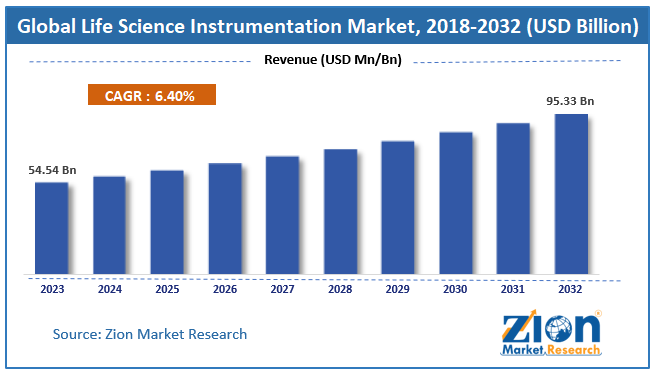
Global Life Science Instrumentation Market: Overview
Analytical chemistry has established itself constructive in analyzing the formation of materials and it is being used in innovative applications. Proper life science instrumentation is required in order to make this study. The global market for life science instrumentation is, therefore, looking at a potential future ahead. From validating how safe and sound a food sample is to analyze DNA for discovering new medicines for chronic syndromes, the uses of life science instrumentation are numerous.
Global Life Science Instrumentation Market: Growth Factors
The global life science instrumentation market is increasing owing to the technological developments, the rise in investment for life science research, and growing food safety and security concerns. Furthermore, the growing research and development activities in biotechnology and pharmaceuticals industries are supporting the expansion of the global life science instrumentation market. Among the different technologies, next-generation sequencing division would observe the fastest expansion in the future. Expansion of highly developed sequencing platforms, rising application areas of descendants sequencing would have a constructive impact on the development of the life science instrumentation market.
The growing popularity of analytical instruments, research activities, increasing research proteomics, and high development in up-coming economies offer abundant opportunities in the global life science instrumentation market. Most important analytical instrument makers are focusing on the expansion of miniaturized instruments, which is the leading trend observed in the global market.
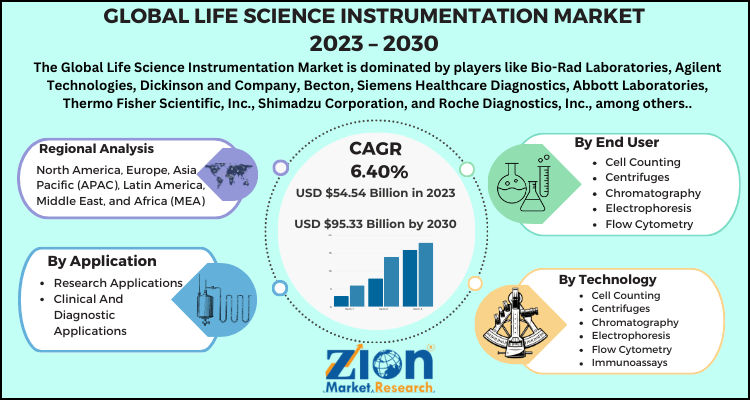
Global Life Science Instrumentation Market: Segmentation
The global life science instrumentation market is classified by application, end user, technology, and geography.
On the basis of technology, the global life science instrumentation market is categorized into cell counting, centrifuges, chromatography, clinical chemistry analyzers, electrophoresis, flow cytometry, immunoassays, liquid handling, lyophilization equipment, microscopy, next-generation sequencing (NGS), PCR, spectroscopy, and other technologies.
Based on the application, the market is segregated into research applications, clinical and diagnostic applications, and others.
On the basis of the end user, the life science instrumentation market is classified into cell counting, centrifuges, chromatography, clinical chemistry analyzers, electrophoresis, flow cytometry, immunoassay, liquid handling, lyophilization, microscopy, and NGS.
Life Science Instrumentation Market : Report Scope
| Report Attributes | Report Details |
|---|---|
| Report Name | Life Science Instrumentation Market Research Report |
| Market Size in 2023 | USD 54.54 Billion |
| Market Forecast in 2032 | USD 95.33 Billion |
| Growth Rate | CAGR of 6.40% |
| Number of Pages | 196 |
| Key Companies Covered | Bio-Rad Laboratories, Agilent Technologies, Dickinson and Company, Becton, Siemens Healthcare Diagnostics, Abbott Laboratories, Thermo Fisher Scientific, Inc., Shimadzu Corporation, and Roche Diagnostics, Inc., among others. |
| Segments Covered | By Application, By End user, By Technology and By Region |
| Regions Covered | North America, Europe, Asia Pacific (APAC), Latin America, Middle East, and Africa (MEA) |
| Base Year | 2023 |
| Historical Year | 2018 - 2022 |
| Forecast Year | 2024 - 2032 |
| Customization Scope | Avail customized purchase options to meet your exact research needs. Request For Customization |
Global Life Science Instrumentation Market: Regional Analysis
Regionally, the global life science instrumentation market is classified into North America, Europe, Asia Pacific, and the Middle East & Africa. At present, North America is expected to dominate the global life science instrumentation market followed by Europe. There is a huge opportunity for the market to develop in the Asia Pacific. The Asia Pacific is anticipated to represent high market growth owing to increase in outsourcing activities in life science division, thus leading to development for the global life science instrumentation market. The life science instrumentation market in Europe is expected to reach its saturation level but has growth prospective for lab automation sector.
Global Life Science Instrumentation Market: Competitive Players
Some of the major market players in the global life science instrumentation market are :
- Bio-Rad Laboratories
- Agilent Technologies
- Dickinson and Company
- Becton
- Siemens Healthcare Diagnostics
- Abbott Laboratories
- Thermo Fisher Scientific, Inc.
- Shimadzu Corporation
- Roche Diagnostics, Inc.
- among others.
The Global Life Science Instrumentation Market is segmented as follows:
By Application
- research applications
- clinical and diagnostic applications
- and others
By End user
- cell counting
- centrifuges
- chromatography
- clinical chemistry analyzers
- electrophoresis
- flow cytometry
- immunoassay
- liquid handling
- lyophilization
- microscopy
- NGS
By Technology
- cell counting
- centrifuges
- chromatography
- clinical chemistry analyzers
- electrophoresis
- flow cytometry
- immunoassays
- liquid handling
- lyophilization equipment
- microscopy
- next-generation sequencing (NGS)
- PCR
- spectroscopy
- other technologies
By Region
- North America
- The U.S.
- Canada
- Mexico
- Europe
- France
- The UK
- Spain
- Germany
- Italy
- Rest of Europe
- Asia Pacific
- China
- Japan
- India
- Australia
- South Korea
- Rest of Asia Pacific
- The Middle East & Africa
- Saudi Arabia
- UAE
- Egypt
- Kuwait
- South Africa
- Rest of the Middle East & Africa
- Latin America
- Brazil
- Argentina
- Rest of Latin America
What Reports Provides
- Full in-depth analysis of the parent market
- Important changes in market dynamics
- Segmentation details of the market
- Former, on-going, and projected market analysis in terms of volume and value
- Assessment of niche industry developments
- Market share analysis
- Key strategies of major players
- Emerging segments and regional markets
- Testimonials to companies in order to fortify their foothold in the market.
Table Of Content

List of Contents
What is the Life Science Instrumentation Market Size?Global Life Science Instrumentation OverviewGlobal Life Science Instrumentation Growth FactorsGlobal Life Science Instrumentation SegmentationLife Science Instrumentation Report ScopeGlobal Life Science Instrumentation Regional AnalysisGlobal Life Science Instrumentation Competitive PlayersFrequentlyAsked Questions
Life science instrumentation includes tools used for biological and medical research. These instruments support analysis, testing, and diagnostics.
The global life science instrumentation market is expected to be driven by the Market expansion is driven by R&D investments, pharmaceutical innovation, and growing demand for advanced analytical tools.
According to study, the global life science instrumentation market size was worth around USD 54.54 Billion in 2023 and is predicted to grow to around USD 95.33 Billion By 2032.
The global life science instrumentation market is expected to grow at a Compound Annual Growth Rate (CAGR) of around CAGR 6.40% during the forecast period from 2024-2032.
The global life science instrumentation industry is projected to be challenged by Challenges include high development costs, long validation cycles, and rapid technological advancements. Budget constraints limit purchases by smaller labs.
The Opportunities include biopharma R&D expansion, lab automation, and growth in genomics and proteomics. Service contracts, AI-enabled analytics, and emerging-market lab builds drive demand will offer significant growth opportunities in the life science instrumentation market.
Microfluidics and lab-on-chip systems; AI-enhanced imaging & data interpretation; connected platforms for remote diagnostics & automation are the emerging trends and innovations impacting the life science instrumentation market.
The global life science instrumentation market is expected to be led by North America during the forecast period.
Some of the prominent players operating in the global life science instrumentation market are; Bio-Rad Laboratories, Agilent Technologies, Dickinson and Company, Becton, Siemens Healthcare Diagnostics, Abbott Laboratories, Thermo Fisher Scientific, Inc., Shimadzu Corporation, and Roche Diagnostics, Inc., among others. and others.
The report explores crucial aspects of the life science instrumentation market, including a detailed discussion of existing growth factors and restraints, while also browsing future growth opportunities and challenges that impact the market.
HappyClients

