
Li-battery Thermal Runaway Sensor Market Size, Share Report 2034

Li-battery Thermal Runaway Sensor Market By Type (Temperature Measurement, CO2 Measurement, and CO Measurement), By Application (Automotive, Consumer Electronics, Electrical Tools, and Others), and By Region - Global and Regional Industry Overview, Market Intelligence, Comprehensive Analysis, Historical Data, and Forecasts 2025 - 2034
| Market Size in 2024 | Market Forecast in 2034 | CAGR (in %) | Base Year |
|---|---|---|---|
| USD 145 Million | USD 514 Million | 13.5% | 2024 |
Li-battery Thermal Runaway Sensor Industry Perspective:
What will be the size of the global Li-battery thermal runaway sensor market during the forecast period?
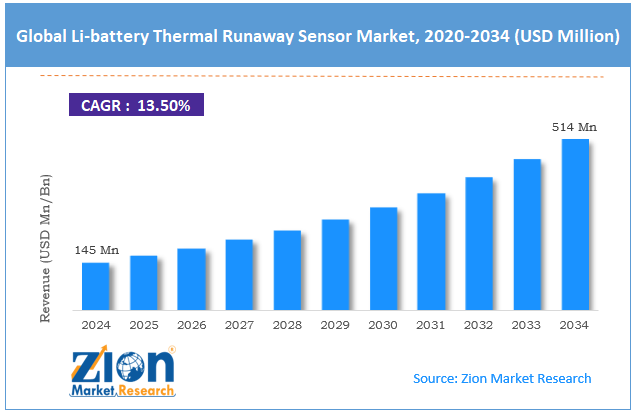
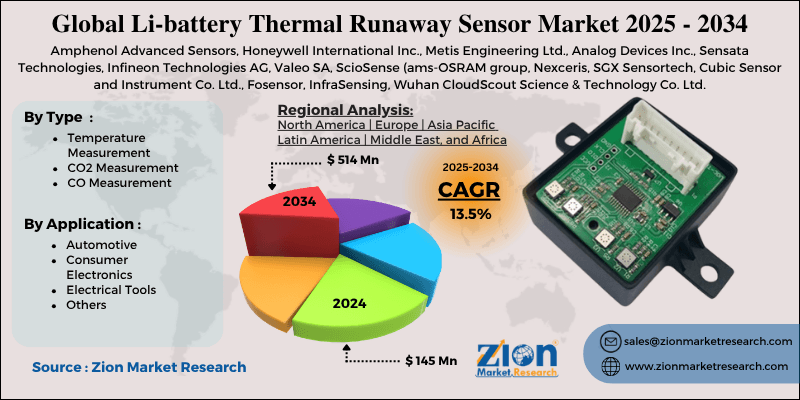
The global Li-battery thermal runaway sensor market size was worth around USD 145 million in 2024 and is predicted to grow to around USD 514 million by 2034, with a compound annual growth rate (CAGR) of roughly 13.5% between 2025 and 2034.
Key Insights
- As per the analysis shared by our research analyst, the global Li-battery thermal runaway sensor market is estimated to grow annually at a CAGR of around 13.5% over the forecast period (2025-2034).
- In terms of revenue, the global Li-battery thermal runaway sensor market size was valued at around USD 145 million in 2024 and is projected to reach USD 514 million by 2034.
- Increasing demand for early fault detection is expected to propel the Li-battery thermal runaway sensor market over the projected period.
- Based on the type, the temperature measurement segment captures the largest market share in 2024 of 54%.
- Based on the application, the automotive application captures the largest revenue share in 2024 of 46%.
- Based on region, the Asia Pacific accounted for the highest market share in the Li-battery thermal runaway sensor market of over 42% in 2024.
Li-battery Thermal Runaway Sensor Market: Overview
A Li-battery thermal runaway sensor is a safety device that detects the early signs of a thermal runaway event, a failure mechanism in which heat generated by an expanding chemical reaction accelerates out of control in a self-sustaining cycle. Early signs detected include off-gas production (CO, hydrogen, VOCs, and others), temperature increase, smoke generation, and pressure increase. These sensors can be integrated into battery packs, electric vehicles, and other energy storage systems and play a key role in the battery management system (BMS), safeguarding these systems by providing early warnings and triggering actions such as cooling, isolating, and switching off.
Li-battery Thermal Runaway Sensor Market: Dynamics
Growth Drivers
Why does the rising battery safety concern drive the Li-battery thermal runaway sensor market?
Growing concerns about battery safety are likely to be a key factor driving growth in the Li-battery thermal-runaway sensor market. Conventional lithium-ion batteries are known to be highly prone to issues such as internal short circuits, operation at elevated temperatures, and other failure pathways that are all associated with the risk of a battery eventually overheating, catching fire or exploding within any device or vehicle, and the visibility of these safety issues in mobile devices, electric vehicles and energy storage applications has risen sharply. This has created a much greater demand for systems that can accurately predict thermal runaway events and has increased the potential market for sensors that monitor battery gas emissions, relative temperature increases, and pressure decreases within the battery pack.
Restraints
Does the high cost of advanced sensor systems impede the Li-battery thermal runaway sensor market?
Advanced sensor systems are costly, and their high price can hold back the Li-battery thermal-runaway sensor market (at least in the short term), based on the published capabilities and specifications of existing products (which inherently raise system cost and complexity). As an example of why cost is high, Honeywell’s Li-ion Tamer for early detection, as referenced above, combines multi-gas detection (VOCs, CO, H, hydrocarbons), distributed sensing nodes, communication modules, and a battery management system, providing a warning 2-30 mins (depending on battery size and chemistry) prior to cell failure or thermal runaway.
A similar sensor is Amphenol's REDTR sensor technology, which simultaneously indicates venting and cell failure within seconds, with the added benefit of a long working life (~20 years). Multi-parameter, high-reliability sensors such as this require high-quality materials, no maintenance, calibration-free architectures, embedded algorithms, and automotive-grade durability, all of which entail additional development, quality control, and production costs. Because these sensors are not just sensors but safety systems, they include not only the sensor itself but also communication hubs, controls, and diagnostic ports, raising the price, perhaps significantly. This means that while safety benefits are significant (30-60 mins of early warning before a cell might enter thermal runaway), the relatively high cost of advanced sensor systems limits their penetration into many cost-sensitive applications (such as low-cost EVs and smaller energy storage systems) that would benefit from early detection.
Opportunities
Why does the increasing investment in battery R&D offer a lucrative opportunity for the Li-battery thermal runaway sensor market?
Growing investment in battery R&D and new product development also represents a substantial growth opportunity for the Li-battery thermal-runaway sensor market. Battery manufacturers, including major electronics giants, automakers, and other tech companies, are investing in next-generation lithium-ion batteries, solid-state batteries, and the latest generation of battery management systems (BMS). R&D into these systems is naturally driving innovation in sensor capabilities and performance, including ultra-high-sensitivity gas sensors, AI-enabled predictive analytics, and multi-parameter sensor arrays capable of detecting thermal runaway at an earlier stage.
Simultaneously, it is helping to reduce the size, cost, and power consumption of these sensors, making them easier to implement across more applications, including cost-effective, mass-market electric vehicles and distributed energy systems. Battery companies are increasingly collaborating with sensor players to produce OEM-specific safety systems that are subsequently sold to OEMs, either automotive or battery.
Challenges
Lack of standardization poses a significant challenge to the Li-battery thermal runaway sensor market
The biggest barrier to the growth of the Li-battery thermal runaway sensor market is the lack of standardization. No global standards exist for detection, response times, detection methods, or the incorporation of sensors into large battery systems. Currently, different sensor manufacturers use very different sensing methods (gas detection, temperature, pressure, multi-parameter), then define their own accuracy and response time, and the OEM has to assess each of these independently. This adds time and cost, and deems the sensors prohibitively complex for cost-sensitive applications. Different regions have different safety requirements, which means multiple regulatory bodies, adding costs to test and sell sensor solutions, creating a lag for battery manufacturers, leading to reluctance among OEMs, and resulting in a scaled-back market. The lack of global standards is preventing the sensor market from scaling.
Li-battery Thermal Runaway Sensor Market: Report Scope
| Report Attributes | Report Details |
|---|---|
| Report Name | Li-battery Thermal Runaway Sensor Market |
| Market Size in 2024 | USD 145 Million |
| Market Forecast in 2034 | USD 514 Mllion |
| Growth Rate | CAGR of 13.5% |
| Number of Pages | 228 |
| Key Companies Covered | Amphenol Advanced Sensors, Honeywell International Inc., Metis Engineering Ltd., Analog Devices Inc., Sensata Technologies, Infineon Technologies AG, Valeo SA, ScioSense (ams-OSRAM group, Nexceris, SGX Sensortech, Cubic Sensor and Instrument Co. Ltd., Fosensor, InfraSensing, Wuhan CloudScout Science & Technology Co. Ltd., Hanwei Electronics Group Corporation, JTHMEMS Technology Co. Ltd., Ruikong Information Technology, Fosen Sensor, Bosch, Continental AG, and others. |
| Segments Covered | By Type, By Application, and By Region |
| Regions Covered | North America, Europe, Asia Pacific (APAC), Latin America, Middle East, and Africa (MEA) |
| Base Year | 2024 |
| Historical Year | 2019 to 2023 |
| Forecast Year | 2025 - 2034 |
| Customization Scope | Avail customized purchase options to meet your exact research needs. Request For Customization |
Li-battery Thermal Runaway Sensor Market: Segmentation
Type Insights
Why does the temperature measurement dominate the Li-battery thermal runaway sensor market?
The temperature measurement segment captures the largest market share in 2024 of 54%. This growth is mainly due to its core function in battery safety monitoring and its relatively low cost. Its position as the first alarm in the battery pack and the BMS reflects the early recognition of the importance of the temperature sensor, and the long-term trend toward the broad applicability of the technology in mass-market electric vehicles, consumer electronics, and electric storage. The relatively low price and integration complexity also enable the device to be adopted in moderately and lower-priced products, particularly in electric vehicles, consumer electronics, and electric energy storage.
Application Insights
Is the automotive application growing at the highest rate in the Li-battery thermal runaway sensor market?
The automotive application captures the largest revenue share in 2024 of 46%. The market growth is driven by the rapid adoption of electric vehicles worldwide and a focus on battery safety and regulatory compliance. As large-scale adoption of EVs rolls out across the world's key automotive markets, the need for level-3 thermal runaway detection integrated into the vehicle (to avoid hazards associated with the failure of high-energy lithium-ion battery packs) has grown substantially. This has driven up demand for temperature, gas, and multi-parameter sensors in battery management systems (BMS).
The need to implement early-warning techniques that detect potential tar or fire events well before cell or pack failure occurs has become a priority for automotive OEMs due to the serious safety and liability issues involved. The potential use of high-energy-density or fast-charge batteries further underscores the need for thermal sensing. It is one of the growing areas, along with the automotive sector, that are driving revenue growth in this market.
Regional Insights
Why does the Asia Pacific lead the Li-battery Thermal Runaway Sensor market?
The Asia Pacific accounted for the largest share in the Li-battery thermal runaway sensor market, at over 42% in 2024. Technological developments and product launches (e.g., next-generation sensors with enhanced sensitivity, faster response times, and multi-parameter detection) from key players such as Amphenol, Honeywell, and new entrants are expected to drive market growth.
For instance, various companies are offering integrated gas and temperature sensors for early-stage thermal runaway prediction, while a few are expanding their portfolios of high-temp thermistors for EV battery safety. Such product introductions provide increased reliability and early fault detection, which are key to attracting investors such as automotive OEMs and Battery makers in the APAC region and, in turn, driving revenue growth.
Li-battery Thermal Runaway Sensor Market: Competitive Analysis
The global Li-battery thermal runaway sensor market is dominated by players like:
- Amphenol Advanced Sensors
- Honeywell International Inc.
- Metis Engineering Ltd.
- Analog Devices Inc.
- Sensata Technologies
- Infineon Technologies AG
- Valeo SA
- ScioSense (ams-OSRAM group
- Nexceris
- SGX Sensortech
- Cubic Sensor and Instrument Co. Ltd.
- Fosensor
- InfraSensing
- Wuhan CloudScout Science & Technology Co. Ltd.
- Hanwei Electronics Group Corporation
- JTHMEMS Technology Co. Ltd.
- Ruikong Information Technology
- Fosen Sensor
- Bosch
- Continental AG
The global Li-battery thermal runaway sensor market is segmented as follows:
By Type
- Temperature Measurement
- CO2 Measurement
- CO Measurement
By Application
- Automotive
- Consumer Electronics
- Electrical Tools
- Others
By Region
- North America
- The U.S.
- Canada
- Mexico
- Europe
- France
- The UK
- Spain
- Germany
- Italy
- Rest of Europe
- Asia Pacific
- China
- Japan
- India
- Australia
- South Korea
- Rest of Asia Pacific
- The Middle East & Africa
- Saudi Arabia
- UAE
- Egypt
- Kuwait
- South Africa
- Rest of the Middle East & Africa
- Latin America
- Brazil
- Argentina
- Rest of Latin America
Table Of Content
Methodology
FrequentlyAsked Questions
A Li-battery thermal runaway sensor is a safety device used to detect the early signs of a thermal runaway event, a failure mechanism in which heat generated by an expanding chemical reaction accelerates out of control in a self-sustaining cycle. Early signs detected include off-gas production (CO, hydrogen, VOCs, and others), temperature increase, smoke generation, and pressure increase.
The Li-battery thermal runaway sensor market is primarily driven by the rapid expansion of electric vehicles and energy storage systems, where high-energy lithium-ion batteries increase the risk of overheating and require advanced safety monitoring. Stringent government safety regulations and standards for battery systems are further accelerating adoption, especially in automotive and industrial applications.
One major issue is the high cost of advanced sensing technologies, especially multi-parameter sensors (temperature, gas, pressure), which can increase the overall cost of battery systems and limit adoption in price-sensitive markets. Another challenge is the lack of standardization across battery designs and safety protocols, making it difficult for sensor manufacturers to develop universally compatible solutions.
Based on the application, the automotive segment is expected to dominate the Li-battery thermal runaway sensor market growth during the projected period.
What are the emerging trends and innovations impacting the Li-battery thermal runaway sensor market?
A key trend is the development of multi-parameter sensing technologies, where sensors combine temperature, gas (CO, CO₂, hydrogen), and pressure detection to enable earlier and more reliable identification of thermal runaway events. Additionally, miniaturization and compact sensor designs are gaining traction, enabling seamless integration into battery packs without compromising performance or space constraints.
According to the report, the global Li-battery thermal runaway sensor market size was worth around USD 145 million in 2024 and is predicted to grow to around USD 514 million by 2034.
The global Li-battery thermal runaway sensor market is expected to grow at a CAGR of 13.5% during the forecast period.
The global Li-battery thermal runaway sensor industry growth is expected to be led by the Asia Pacific over the forecast period.
The global Li-battery thermal runaway sensor market is dominated by players like Amphenol Advanced Sensors, Honeywell International Inc., Metis Engineering Ltd., Analog Devices, Inc., Sensata Technologies, Infineon Technologies AG, Valeo SA, ScioSense (ams-OSRAM group, Nexceris, SGX Sensortech, Cubic Sensor and Instrument Co., Ltd., Fosensor, InfraSensing, Wuhan CloudScout Science & Technology Co., Ltd., Hanwei Electronics Group Corporation, JTHMEMS Technology Co., Ltd., Ruikong Information Technology, Fosen Sensor, Bosch, and Continental AG, among others.
The Li-battery thermal runaway sensor market report covers the geographical market along with a comprehensive competitive landscape analysis. It also includes cash flow analysis, profit ratio analysis, market basket analysis, market attractiveness analysis, sentiment analysis, PESTLE analysis, trend analysis, SWOT analysis, trade area analysis, demand & supply analysis, Porter’s five forces analysis, and value chain analysis.

HappyClients

