
Lab Grown Meat Market Size, Share, Trends, Growth and Forecast 2034

Lab Grown Meat Market By Source (Pork, Poultry, Duck, Seafood, and Others), By End-User (Burgers, Nuggets, Hot Dogs, Meatballs, and Others), By Application (Foodservice Channels, Foot Retail, and Others), and By Region - Global and Regional Industry Overview, Market Intelligence, Comprehensive Analysis, Historical Data, and Forecasts 2026 - 2034
| Market Size in 2025 | Market Forecast in 2034 | CAGR (in %) | Base Year |
|---|---|---|---|
| USD 428.95 Million | USD 7,916.28 Million | 38.24% | 2025 |
Lab Grown Meat Industry Perspective:
What is the anticipated size of the lab grown meat market during the projection period?
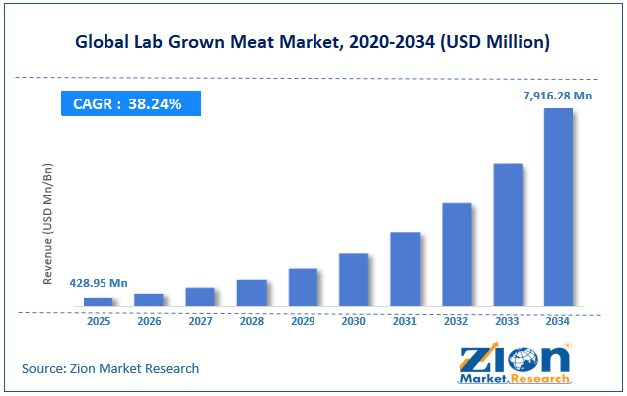
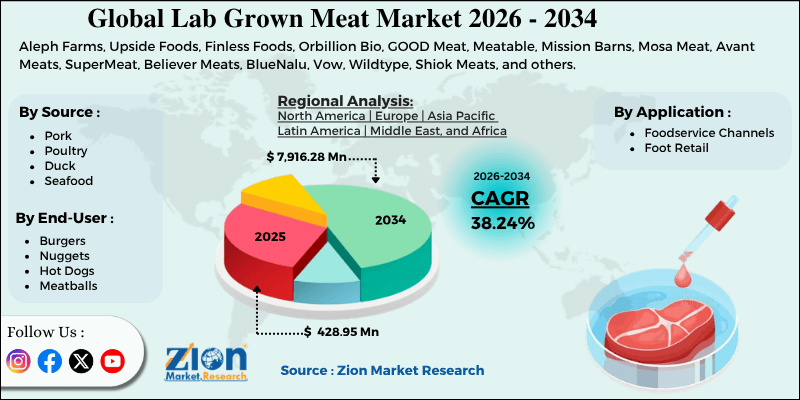
The global lab grown meat market size was worth around USD 428.95 million in 2025 and is predicted to grow to around USD 7,916.28 million by 2034, with a compound annual growth rate (CAGR) of roughly 38.24% between 2026 and 2034.
Key Insights:
- As per the analysis shared by our research analyst, the global lab grown meat market is estimated to grow annually at a CAGR of around 38.24% over the forecast period (2026-2034)
- In terms of revenue, the global lab grown meat market size was valued at around USD 428.95 million in 2025 and is projected to reach USD 7,916.28 million by 2034.
- The lab grown meat market is projected to grow at a significant rate due to the surge in the meat consumption rate worldwide.
- Based on the source, the poultry segment is growing at a high rate and will continue to dominate the global market as per industry projections.
- Based on the end-user, the foodservice channels segment is anticipated to command the largest market share.
- Based on the application, the burgers segment is expected to lead the market growth trends.
- Based on region, North America is projected to dominate the global market during the forecast period.
Lab Grown Meat Market: Overview
Lab-grown meat is a product produced by growing microbial or animal cells in a controlled environment. Lab-grown meat differs from traditional meat, as the latter is obtained from animals raised in farms or the wild. Lab-grown meat is also known as cell-based food item. The production process involves using small cell samples and growing them in a nutrient-rich environment. The next step involves organizing the growing cell samples into fat, muscle, and other tissues. Experts argue that lab-grown meat has less environmental impact.
However, more studies and research are required to confirm the extent of environmental benefits, as producing meat in laboratories is an energy-intensive process. During the forecast period, demand for lab grown meat is expected to be driven by rising meat consumption worldwide. Furthermore, concerns over animal cruelty and negative implications for the animal population may restrict global lab grown meat market growth trends.
Lab Grown Meat Market: Dynamics
Growth Drivers
How will growing meat consumption worldwide influence lab grown meat market growth?
The global lab grown meat market is expected to be driven by a surge in the meat consumption rate worldwide. According to official findings, more than 85% of the world population eats some form of meat. Some of the popular meat types include poultry, pork, and beef. In addition, meat-based cuisines are a part of several cultural diets. For instance, traditional Mongolian cuisine is meat-heavy. Similar instances can be reported in other parts of the world. As the meat consumption rate rises, more investments are expected to shift toward lab-grown meat as traditional meat production methods fail to meet global demand.
Growing focus on sustainable food production to accelerate market expansion
As per environmental research & analysis, current global food supply chains are unsustainable due to their long-term environmental impact. For instance, global food production contributes to over 29.9% of total greenhouse gas emissions. It also utilized 40% of global land, while up to 33.33% of total food production is wasted due to environmental and social factors. Governments and private organizations worldwide are pressing on the need to develop sustainable food production procedures. The US Environmental Protection Agency (EPA) states that sustainable food management can help preserve food for future generations, save money, and reduce greenhouse emissions. Lab-grown meat is an important segment of sustainable food development.
Restraints
Which cost-related factors will limit growth in the lab grown meat industry?
The global lab grown meat market is projected to be restricted due to the high cost of production and resource-intensive procedure. For instance, the average cost of research & development (R&D) associated with lab-grown meat can reach over USD 15 million. In addition, expenses related to facility development, obtaining a license, and commercial-scale production add to the overall expenses.
Opportunities
Ongoing investments in R&D to generate growth opportunities during the forecast period
The global lab grown meat industry is expected to generate growth opportunities due to rising investments supporting research and innovation. In May 2026, SuperMeat, an Israel-based food tech company, received an additional investment of USD 6 million in the first close of its Series A4 round. The company has already secured an investment of USD 3.5 million in December 2025. SuperMeat is expected to target Switzerland as the firm has filed for regulatory approval to commercialize its lab-based chicken across Europe. In January 2026, Tufts University announced its plans to invest USD 2.1 million state grant for the development of an innovation hub for lab-grown foods.
Why will strategic partnerships emerge as novel growth avenues for the lab grown meat market leaders?
The global lab grown meat market is expected to benefit from strategic partnerships undertaken by leading players. This includes collaboration between food retail chains, distributors, lab-grown meat producers, and other stakeholders. For instance, in 2025, Vow, a Sydney-based lab-grown meat producer, announced partnerships with several food retailers to debut its lab-made Japanese quail. The company has partnered with restaurants such as Bottarga and The Lincoln in Melbourne and Kitchen by Mike in Sydney.
Challenges
Regulatory complexities and consumer perception are emerging as prominent challenges
The global lab grown meat industry is projected to be challenged by regulatory complexities and negative public perception. Lab-grown meat remains unapproved for commercial sale in several countries worldwide. For instance, Hungary and Italy have completely banned lab-grown meat cultivation and commercialization. In addition, consumers may have preconceived notions about lab-grown meat as unhealthy. Meat consumers continue to prefer traditional meat, thus challenging industry revenue.
Lab Grown Meat Market: Report Scope
| Report Attributes | Report Details |
|---|---|
| Report Name | Lab Grown Meat Market |
| Market Size in 2025 | USD 428.95 Million |
| Market Forecast in 2034 | USD 7,916.28 Million |
| Growth Rate | CAGR of 38.24% |
| Number of Pages | 229 |
| Key Companies Covered | Aleph Farms, Upside Foods, Finless Foods, Orbillion Bio, GOOD Meat, Meatable, Mission Barns, Mosa Meat, Avant Meats, SuperMeat, Believer Meats, BlueNalu, Vow, Wildtype, Shiok Meats, and others. |
| Segments Covered | By Source, By End-User, By Application, and By Region |
| Regions Covered | North America, Europe, Asia Pacific (APAC), Latin America, Middle East, and Africa (MEA) |
| Base Year | 2025 |
| Historical Year | 2020 - 2024 |
| Forecast Year | 2026 - 2034 |
| Customization Scope | Avail customized purchase options to meet your exact research needs. Request For Customization |
Lab Grown Meat Market: Segmentation
The global lab grown meat market is segmented based on source, end-user, application, and region.
Why will the poultry segment lead the lab grown meat industry revenue during the forecast period?
Based on source, the global market segments are pork, poultry, duck, seafood, and others. In 2025, the highest growth was listed in the poultry segment. It accounted for 48.5% of global revenue and is projected to grow at a CAGR of 26.1% during the forecast period. Production cost of lab-grown poultry is relatively low. In addition, poultry is one of the most popular forms of meat consumed worldwide.
Which will be the fastest-growing end-user during the forecast period in the lab grown meat market?
Based on end-user, the global lab grown meat industry is fragmented into foodservice channels, food retail, and others. According to market research, foodservice channels were the leading revenue generators in 2025, contributing up to 76% of the global revenue. During the forecast period, the food retail segment is expected to offer a CAGR of 28.2% due to growing strategic partnerships between lab-grown meat producers and food retailers.
Which factors drive demand in the burgers segment in the lab grown meat industry?
Based on application, the global market segments are burgers, nuggets, hot dogs, meatballs, and others. In 2025, 41% of the global revenue was generated by the burgers segment. It will continue leading the market with a CAGR of 26%, driven by the rapid expansion of the fast-food industry and the higher popularity of burger-based food items.
Lab Grown Meat Market: Regional Analysis
Why will North America lead the lab grown meat market in the coming years?
The global lab grown meat market is currently led by North America. In 2025, it accounted for 45% of global revenue and is projected to grow at a CAGR of 28.05% during the forecast period. The presence of numerous biotech companies in the US, higher demand for meat, and regulatory approvals for lab-grown meat commercialization are the leading regional market growth generators. The US Food & Drug Administration (FDA) has approved several companies, such as GOOD Meat and UPSIDE Foods, for the sale of lab-grown meat.
Why will Asia-Pacific generate the fastest CAGR in the lab grown meat market during the forecast period?
Asia-Pacific is expected to emerge as the fastest-growing region in the lab grown meat market with a CAGR of 26.9% during the forecast period. In 2025, it accounted for 31.6% of the global revenue. Countries such as Australia and Singapore are leading nations in Asia-Pacific, promoting the production, distribution, and consumption of lab-grown meat. Growing efforts by regional governments to promote sustainable food development and rising meat consumers will aid accelerated regional expansion during the forecast period.
Lab Grown Meat Market: Competitive Analysis
The global lab grown meat market is led by players like:
- Aleph Farms
- Upside Foods
- Finless Foods
- Orbillion Bio
- GOOD Meat
- Meatable
- Mission Barns
- Mosa Meat
- Avant Meats
- SuperMeat
- Believer Meats
- BlueNalu
- Vow
- Wildtype
- Shiok Meats
What are the latest key trends in the lab grown meat market?
Surging regulatory approvals
Lab-grown meat R&D worldwide has been going on for years. However, regulatory approvals governing the production and consumption of lab-grown meat have improved globally. This trend is expected to continue favoring the industry leaders during the forecast period.
Hybrid meat products
Hybrid meat products are developed by combining plant-based ingredients and cultivated cells. Hybrid products can be developed at a lower cost and achieve higher acceptance among end consumers.
The global lab grown meat market is segmented as follows:
By Source
- Pork
- Poultry
- Duck
- Seafood
- Others
By End-User
- Burgers
- Nuggets
- Hot Dogs
- Meatballs
- Others
By Application
- Foodservice Channels
- Foot Retail
- Others
By Region
- North America
- The U.S.
- Canada
- Mexico
- Europe
- France
- The UK
- Spain
- Germany
- Italy
- Rest of Europe
- Asia Pacific
- China
- Japan
- India
- Australia
- South Korea
- Rest of Asia Pacific
- The Middle East & Africa
- Saudi Arabia
- UAE
- Egypt
- Kuwait
- South Africa
- Rest of the Middle East & Africa
- Latin America
- Brazil
- Argentina
- Rest of Latin America
Table Of Content
Methodology
FrequentlyAsked Questions
Lab-grown meat is a product developed by growing microbial cells or animals in a controlled environment.
The global lab grown meat market is expected to be driven by the surge in the meat consumption rate worldwide.
According to study, the global lab grown meat market size was worth around USD 428.95 million in 2025 and is predicted to grow to around USD 7,916.28 million by 2034.
The CAGR value of lab grown meat market is expected to be around 38.24% during 2026-2034.
The global lab grown meat industry is projected to be challenged by regulatory complexities and negative public perception.
Burgers will offer significant growth opportunities in the lab grown meat market.
Surging regulatory approvals and hybrid meat products are the emerging trends and innovations impacting the lab grown meat market.
The global lab grown meat market is currently led by North America.
The global lab grown meat market is led by players like Aleph Farms, Upside Foods, Finless Foods, Orbillion Bio, GOOD Meat, Meatable, Mission Barns, Mosa Meat, Avant Meats, SuperMeat, Believer Meats, BlueNalu, Vow, Wildtype, Shiok Meats, and others.
The report explores crucial aspects of the lab grown meat market, including a detailed discussion of existing growth factors and restraints, while also browsing future growth opportunities and challenges that impact the market.

HappyClients

