
Integrated Facility Management Market Size and Forecast 2034

Integrated Facility Management Market By Type (Hard FM and Soft FM), By End-User (Public/Infrastructure, Commercial, Institutional, Industrial, and Others), and By Region - Global and Regional Industry Overview, Market Intelligence, Comprehensive Analysis, Historical Data, and Forecasts 2025 - 2034
| Market Size in 2024 | Market Forecast in 2034 | CAGR (in %) | Base Year |
|---|---|---|---|
| USD 145 Billion | USD 291 Billion | 7.2% | 2024 |
Integrated Facility Management Industry Perspective:
What will be the size of the global integrated facility management market during the forecast period?
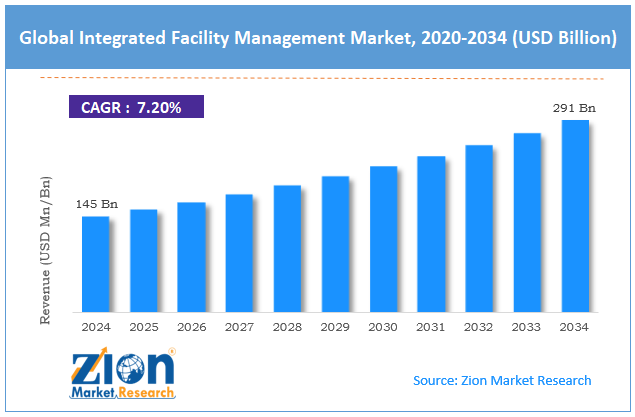
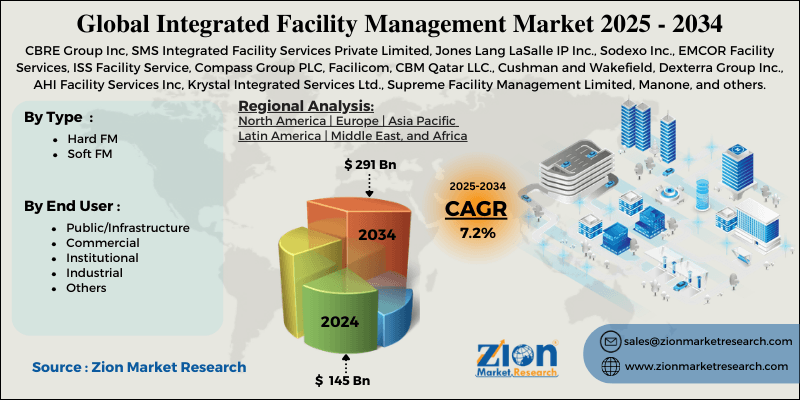
The global integrated facility management market size was worth around USD 145 billion in 2024 and is predicted to grow to around USD 291 billion by 2034, with a compound annual growth rate (CAGR) of roughly 7.2% between 2025 and 2034.
Key Insights
- As per the analysis shared by our research analyst, the global integrated facility management market is estimated to grow annually at a CAGR of around 7.2% over the forecast period (2025-2034).
- In terms of revenue, the global integrated facility management market size was valued at around USD 145 billion in 2024 and is projected to reach USD 291 billion by 2034.
- Expansion of smart & connected infrastructure is expected to drive the integrated facility management market.
- Based on the type, the Hard FM generates the highest market share in 2024.
- Based on the end user, the commercial dominates the industry growth.
- Based on region, North America captures the largest revenue share in 2024.
Integrated Facility Management Market: Overview
Integrated Facility Management (IFM) is defined as a value-based model of integrated facility services in which a number of hard (mechanical, electrical, HVAC maintenance, and energy management) and soft (cleaning, security, space management, catering, and workplace support) facility management functions are provided in an integrated and cost-efficient manner by a single, integrated management system. Through IFM, these services are provided to internal or external clients in a consolidated manner by outsourcing them to an integrated service provider, under an all-in-one service agreement, or through regional or global outsourcing. The aim of IFM is to optimize operational efficiency, costs, and customer service while keeping facilities compliant with relevant requirements, allowing organizations to concentrate on their core business processes. Using the latest technologies, such as IoT (Internet of Things), automation, data analytics, and centralized monitoring platforms, the integrated facility management provider provides its customers with turnkey solutions, such as smooth workflows, predictive maintenance, sustainability enhancements, and facility performance optimization.
Integrated Facility Management Market: Dynamics
Growth Drivers
Why do digital transformation & smart technologies stimulate the expansion of the integrated facility management market?
The digital transformation and smart technology development are two of the main enablers and growth factors of the integrated facility management market, as the adoption of digital solutions enables facility management portfolios to operate with intelligent solutions and provide value-added services to customers and users. The adoption of new solutions reduces equipment operation and maintenance costs, increases efficiency by automating tasks and allowing predictive maintenance, and makes facilities smarter by using digital dashboards and remote access to monitor and control assets and services anytime and from anywhere.
The use of data analytics and digital dashboards for various facilities increases visibility and improves decision-making at every location; automation increases service consistency and quality, reduces the risk of human error, and ensures cleanliness, HVAC, and lighting levels, security, and safety; energy efficiency, sustainability reporting, and the seamless occupant experience are increasing the digital alternatives demanded by the customer. Digital transformation is therefore one of the key drivers of IFM market growth.
Restraints
High initial investment & technology integration challenges are hindering the industry's growth
The high initial cost and the difficulties of integrating technology are still major obstacles to the growth of the integrated facility management industry. To implement technologies such as IoT-enabled sensors, BMS, AI-led analytics, automation platforms, and cloud-based control systems, substantial capital will need to be invested. Investment will be needed in hardware upgrades, licensing new software, customization of systems, cybersecurity infrastructure, and end-user training, all of which can put strain on budgets, especially those of SMEs. Cost barriers to entry, coupled with technical challenges in integrating new digital systems with aging infrastructure, also hamper rapid IFM market growth.
Many buildings use outdated, incompatible systems that cannot be easily integrated to enable seamless data sharing, which would hamper business performance. Transitioning to digitized facilities will disrupt business processes, require high skills and technical expertise for implementation, and increase lead times. High ROI, data security, and system reliability concerns have also delayed decision-making. Thus, despite offering operational efficiency advantages and cost savings in the long term, digital IFM solutions continue to face challenges in rapid industry-level adoption and growth.
Opportunities
Does the launch of an AI solution offer a potential opportunity for the integrated facility management market growth?
The launch of an AI product solution is expected to offer a potential opportunity for the integrated facility management market growth. For instance, in June 2025, Honeywell announced it would introduce Honeywell Connected Solutions, an AI-enabled platform that combines building key application software and technologies into a simple interface that helps improve operations. Verizon Communications Inc. and Vanderbilt University (the first pilot to be interested in the platform, based on the foundation of Honeywell Forge) had been integrating the solution across their buildings. The Connected Solutions platform allows users to operate Honeywell software, systems, and equipment through a single, integrated interface. When the entire campus or a single building is enabled, users can access the collected data and see how key systems are functioning in real time, allowing them to address troubleshooting concerns up front.
Challenges
Why are the talent shortages & skill gaps hampering the integrated facility management industry expansion?
Shortage of talent and skills is becoming a barrier to the growth of the integrated facility management industry, as the industry is undergoing rapid evolution from traditional maintenance services to technology-enabled environment services. Cutting-edge IFM demands a blend of technical skills (HVAC, building automation, electrical engineering, and energy management), digital understanding (IoT, machine learning, data analytics, and building management systems), and soft skills (vendor management, reporting, regulatory compliance, and project management).
However, the right personnel for this integrated skill set are lacking, and firms are finding it challenging to scale their offerings as their facilities are becoming smarter and robotic. Contractors can be overwhelmed by data insights; facility operators will need to manage automated operations and machinery, and will also need to address information security and compliance. The skill and talent crunch in the industry dampens the growth of the IFM industry by delaying the project execution, reducing the quality of service, and also making scalability difficult for big clients and multi-location contracts.
With attrition, a dearth of skills development training, a lack of attractive vocational opportunities, and a negative brand perception in the facility management industry, the industry is struggling to attract new talent. Client expectations will restrain the industry's growth if it doesn't focus on upskilling its people.
Integrated Facility Management Market: Report Scope
| Report Attributes | Report Details |
|---|---|
| Report Name | Integrated Facility Management Market |
| Market Size in 2024 | USD 145 Billion |
| Market Forecast in 2034 | USD 291 Bllion |
| Growth Rate | CAGR of 7.2% |
| Number of Pages | 224 |
| Key Companies Covered | CBRE Group Inc, SMS Integrated Facility Services Private Limited, Jones Lang LaSalle IP Inc., Sodexo Inc., EMCOR Facility Services, ISS Facility Service, Compass Group PLC, Facilicom, CBM Qatar LLC., Cushman and Wakefield, Dexterra Group Inc., AHI Facility Services Inc, Krystal Integrated Services Ltd., Supreme Facility Management Limited, Manone, and others. |
| Segments Covered | By Type, By End User, and By Region |
| Regions Covered | North America, Europe, Asia Pacific (APAC), Latin America, Middle East, and Africa (MEA) |
| Base Year | 2024 |
| Historical Year | 2019 to 2023 |
| Forecast Year | 2025 - 2034 |
| Customization Scope | Avail customized purchase options to meet your exact research needs. Request For Customization |
Integrated Facility Management Market: Segmentation
Type Insights
Why does Hard FM hold the dominant position in the integrated facility management market?
The Hard FM generated the highest market share in 2024. This segment refers to the physical and asset services of the buildings, all of which are essential for their maintenance and safety. The success of this segment is due to the increase in safety requirements of the buildings, which call for alarm services, electrical safety, fire safety, and others. Power consumption is a crucial requirement for the organization's administration, as it increases security needs and fuels the growth of the integrated facility management industry. Large organizations have invested heavily in capital projects, which have contributed significantly to efficient operation and management. Growing number of healthcare and IT companies would strengthen the demand for integrated facility management providers in the upcoming years.
End-User Insights
Why does commercial hold the largest share in the integrated facility management industry?
The commercial dominates the industry growth. This segment discusses management services for offices, hospitals, hotels, schools, and colleges. The increase in the level of safety required is driving the use of these services. Through these services, the corporate sector is investing heavily in better energy management. Technology is increasingly helping these companies to manage their businesses without incurring high costs. We expect a growing number of schools & colleges, hotels, and malls to provide increased business opportunities in developing economies like India, the UAE, and other regions.
Regional Insights
Why does North America lead the integrated facility management market?
North America captures the largest revenue share in 2024. Regional growth has been driven by the region’s mature commercial infrastructure, outsourcing base, and early adoption of new technologies. North America is home to the world’s largest concentration of office buildings, healthcare facilities, educational institutions, retail complexes, and data centers that demand integrated facilities management (IFM) services.
Furthermore, companies in the US and Canada have a proven track record of outsourcing, bundling, and achieving significant cost savings while realizing efficiencies by putting a focus on core business activities. North America is at the forefront of using smart building technologies, like IoT-enabled building management systems, vehicle-to-infrastructure applications, AI-driven predictive maintenance, cloud computing applications, and other integrated FM technologies that help make this change happen. The strong positions of global giants, such as CBRE Group and JLL, in this space provide additional impetus through economies of scale and technological leverage.
Integrated Facility Management Market: Competitive Analysis
The global integrated facility management market is dominated by players like:
- CBRE Group Inc
- SMS Integrated Facility Services Private Limited
- Jones Lang LaSalle IP Inc.
- Sodexo Inc.
- EMCOR Facility Services
- ISS Facility Service
- Compass Group PLC
- Facilicom
- CBM Qatar LLC.
- Cushman and Wakefield
- Dexterra Group Inc.
- AHI Facility Services Inc
- Krystal Integrated Services Ltd.
- Supreme Facility Management Limited
- Manone
The global integrated facility management market is segmented as follows:
By Type
- Hard FM
- Soft FM
By End User
- Public/Infrastructure
- Commercial
- Institutional
- Industrial
- Others
By Region
- North America
- The U.S.
- Canada
- Mexico
- Europe
- France
- The UK
- Spain
- Germany
- Italy
- Rest of Europe
- Asia Pacific
- China
- Japan
- India
- Australia
- South Korea
- Rest of Asia Pacific
- The Middle East & Africa
- Saudi Arabia
- UAE
- Egypt
- Kuwait
- South Africa
- Rest of the Middle East & Africa
- Latin America
- Brazil
- Argentina
- Rest of Latin America
Table Of Content
Methodology
FrequentlyAsked Questions

HappyClients

