
Inferior Vena Cava (IVC) Filter Market Size, Share, Trends, Growth 2034

Inferior Vena Cava (IVC) Filter Market By Product Type (Permanent Inferior Vena Cava Filters and Retrievable Inferior Vena Cava filters), By Material (Ferromagnetic Materials and Non-Ferromagnetic Material), By Application (Prevention of Pulmonary Embolism, Treatment of Venous Thromboembolism, and Others), By End-Users (Ambulatory Surgical Centers, Hospitals, and Emergency Care Centers), and By Region - Global and Regional Industry Overview, Market Intelligence, Comprehensive Analysis, Historical Data, and Forecasts 2026 - 2034
| Market Size in 2025 | Market Forecast in 2034 | CAGR (in %) | Base Year |
|---|---|---|---|
| USD 974.16 Million | USD 2,094.10 Million | 8.87% | 2025 |
Inferior Vena Cava IVC Filter Industry Perspective:
What is the anticipated size of the inferior vena cava IVC filter market during the projection period?
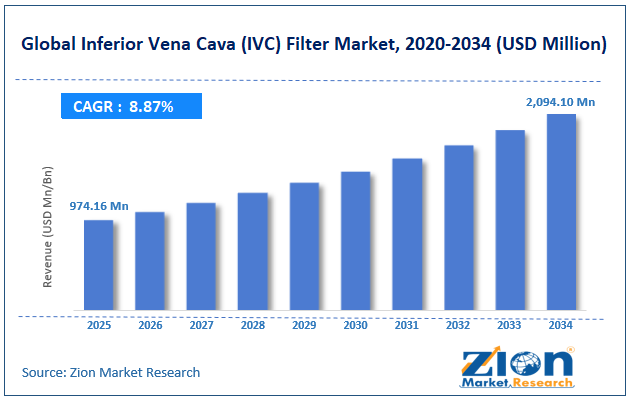
The global inferior vena cava IVC filter market size was worth around USD 974.16 million in 2025 and is predicted to grow to around USD 2,094.10 million by 2034, with a compound annual growth rate (CAGR) of roughly 8.87% between 2026 and 2034.
Key Insights:
- As per the analysis shared by our research analyst, the global inferior vena cava IVC filter market is estimated to grow annually at a CAGR of around 8.87% over the forecast period (2026-2034)
- In terms of revenue, the global inferior vena cava IVC filter market size was valued at around USD 974.16 million in 2025 and is projected to reach USD 2,094.10 million, by 2034.
- The inferior vena cava IVC filter market is projected to grow at a significant rate due to increasing healthcare expenditure, rising prevalence of pulmonary embolism, and technological advancements.
- Based on the product type, the permanent inferior vena cava IVC filters segment is anticipated to generate a CAGR of 7.57% during the forecast period.
- Based on the material, the non-ferromagnetic materials segment is anticipated to command the largest market share.
- Based on the application, prevention of pulmonary embolism is expected to emerge as the fastest-growing segment with a CAGR of 7.65% as demand for preventive care is on the rise.
- Based on the end-users, ambulatory surgical centers are expected to emerge as the fastest-growing segment with a CAGR of 7.31%.
- Based on region, North America is projected to dominate the global market during the forecast period.
Inferior Vena Cava IVC Filter Market: Overview
An inferior vena cava (IVC) filter is a small, cage-like medical device that prevents blood clots from entering the lungs. IVC filters are placed in the body’s largest vein, called the inferior vena cava, and are mostly used during short surgical interventions. IVC filters play a crucial role in treating or preventing pulmonary embolism or deep vein thrombosis (DVT). Additionally, inferior vena cava filters may also be used for patients who are at a high risk of developing DVT in the future. During the forecast period, demand for inferior vena cava filters is expected to grow due to increasing healthcare expenditure, rising prevalence of pulmonary embolism, and technological advancements. However, the inferior vena cava IVC filter market may face growth restrictions due to complication risks, complex retrieval procedures, and competition from alternative solutions.
Impact of the USA-Israel and Iran war on the Inferior Vena Cava IVC Filter Market:
The USA-Israel and Iran war has indirectly affected the raw material supply chain and logistics costs of the inferior vena cava IVC filter market. Healthcare infrastructure in conflict regions is most affected due to shortages of medical supplies, damage to hospital centers, and a lack of sufficient medical professionals. During the forecast period, demand for IVC filters will continue growing as the need for emergency and trauma care intensifies.
Inferior Vena Cava IVC Filter Market: Dynamics
Growth Drivers
How is growing healthcare expenditure expected to support inferior vena cava IVC filter market growth?
The global inferior vena cava IVC filter market is expected to be driven by the growing healthcare expenditure worldwide. Governments and private companies are increasingly investing in expanding access to quality diagnostic centers and hospital facilities. According to Healthcare Dive, US health spending reached up to USD 5.7 trillion in 2025. Emerging economies, including African and Asian nations, registered higher demand for comprehensive medical care. In February 2026, the African Union (AU) announced 100% operationalization of the African Pooled Procurement Mechanism (APPM) as the region shifts toward the "Buy African" initiative. Government initiatives to develop more effective and inclusive national healthcare programs and insurance policies will further support IVC filter-producing companies.
Rising prevalence of cardiovascular diseases to promote market revenue in the long run
Growing prevalence of cardiovascular diseases, especially pulmonary embolism, is one of the strongest market growth drivers. It is a highly common and serious medical condition. According to the Cleveland Clinic, more than 100,000 die in the US due to pulmonary embolism every year. The condition develops when a blood clot from deep vein thrombosis (DVT) travels to the lungs and blocks blood flow. Common risk factors associated with pulmonary embolism include blood clotting disorders, long hospital stay, pregnancy, hormone-based medications, cancer, and sedentary lifestyle. The global inferior vena cava IVC filter market will register high revenue as awareness around cardiovascular conditions improves.
Restraints
Which are the leading restrictions affecting growth in the inferior vena cava IVC filter industry?
The global inferior vena cava IVC filter industry is anticipated to be restricted due to limited applications, complication risks, and higher reliance on patient compliance. IVC filters are recommended only for patients who cannot receive anticoagulation treatment. In addition, IVC filters pose significant risks, such as filter fracture, perforation, and IVC thrombosis. Patients must follow up regularly with medical practitioners to determine when filters can be removed. In case of lack of thorough patient compliance can lead to significant side effects.
Opportunities
What advancements will create growth opportunities for the inferior vena cava IVC filter market players?
The global inferior vena cava IVC filter market is anticipated to generate growth opportunities due to ongoing technological advancements such as minimally invasive placement techniques, improved retrievable filter designs, and advanced imaging technologies. These advancements will enable safer, patient-friendly placement and removal of IVC filters.
In January 2020, Argon Medical Devices, Inc. announced the commercial launch of Single-Loop and Triple-Loop Retrieval Kits in the US market. These kits are designed for percutaneous removal of IVC filters that are no longer required for medical use. Medical professionals can leverage a jugular approach to retrieve the filters. In December 2021, the US Food & Drug Administration (FDA) announced the approval of the industry’s first laser-based device for IVC filter removal. The device, called the Philips CavaClear Laser Sheath, can be used if conventional methods of IVC filter retrieval have failed.
Challenges
High cost and competition from alternate solutions to challenge the inferior vena cava IVC filter industry
The global inferior vena cava IVC filter industry is anticipated to be challenged by the high cost of advanced filters and surgical intervention. In addition, the absence of sufficient medical reimbursement policies and competition from alternative techniques such as mechanical thrombectomy, catheter-directed thrombolysis, and anticoagulant therapy will fragment industry revenue in the long run.
Inferior Vena Cava (IVC) Filter Market: Report Scope
| Report Attributes | Report Details |
|---|---|
| Report Name | Inferior Vena Cava (IVC) Filter Market |
| Market Size in 2025 | USD 974.16 Million |
| Market Forecast in 2034 | USD 2,094.10 Million |
| Growth Rate | CAGR of 8.87% |
| Number of Pages | 227 |
| Key Companies Covered | Boston Scientific Corporation, Becton, Merit Medical Systems, Cook Medical, Nipro Corporation, Dickinson and Company (BD), Lifetech Scientific Corporation, Argon Medical Devices, B. Braun Melsungen AG, Terumo Corporation, Cardinal Health, Philips (Volcano), Braile Biomedica, MicroPort Scientific Corporation, Cordis, ALN Implants, and others. |
| Segments Covered | By Product Type, By Material, By Application, By End-Users, and By Region |
| Regions Covered | North America, Europe, Asia Pacific (APAC), Latin America, Middle East, and Africa (MEA) |
| Base Year | 2025 |
| Historical Year | 2020 - 2024 |
| Forecast Year | 2026 - 2034 |
| Customization Scope | Avail customized purchase options to meet your exact research needs. Request For Customization |
Inferior Vena Cava IVC Filter Market: Segmentation
The global inferior vena cava IVC filter market is segmented based on product type, material, application, end-user, and region.
Why will the retrievable inferior vena cava IVC filters segment lead the inferior vena cava IVC filter industry revenue during the forecast period?
Based on product type, the global market segments are permanent inferior vena cava IVC filters and retrievable inferior vena cava IVC filters. In 2025, the highest growth was listed in the retrievable inferior vena cava IVC filters segment. It accounted for 81% of the global revenue and will continue to lead the market, driven by advancements in placement and retrieval technologies. During the forecast period, the permanent inferior vena cava IVC filters segment is anticipated to generate a CAGR of 7.57%, due to the growing number of high-risk cases.
Which will be the fastest-growing material during the forecast period in the inferior vena cava IVC filter market?
Based on material, the global market is divided into ferromagnetic materials and non-ferromagnetic materials. In 2025, more than 66% of the global revenue was listed in the non-ferromagnetic materials segment. It will continue to lead the market with high CAGR, as non-ferromagnetic materials are more compatible with Magnetic Resonance Imaging (MRI)-based procedures and offer corrosion resistance.
Which factors drive demand in the treatment of venous thromboembolism segment in the inferior vena cava IVC filter industry?
Based on application, the global inferior vena cava IVC filter industry is segmented into prevention of pulmonary embolism, treatment of venous thromboembolism, and others. In 2025, the treatment of venous thromboembolism segment showed the highest growth. It accounted for 62% of the global revenue. Rising prevalence of venous thromboembolism and advancements in diagnostic technologies will drive segmental growth. Prevention of pulmonary embolism is expected to emerge as the fastest-growing segment, with a CAGR of 7.65%, as demand for preventive care rises.
What will be the influence of the ambulatory surgical centers segment on the inferior vena cava IVC filter market?
Based on end-users, the global market divisions are ambulatory surgical centers, hospitals, and emergency care centers. In 2025, hospitals were the leading revenue generators. They controlled over 57% of global revenue. Ambulatory surgical centers are expected to emerge as the fastest-growing segment, with a CAGR of 7.31%, driven by a surge in the number of outpatient procedures and demand for minimally invasive techniques.
Inferior Vena Cava IVC Filter Market: Regional Analysis
Why will North America lead the inferior vena cava IVC market in the coming years?
The global inferior vena cava IVC market is currently led by North America. In 2025, it accounted for 42% of the global revenue and will grow at a CAGR of 7.01% during the forecast period. The presence of a robust healthcare infrastructure, growing medical tourism, and favorable government policies encouraging market research & innovation will drive regional growth. Additionally, rising prevalence of cardiovascular disease and access to medical reimbursements will aid regional growth.
Why will Asia-Pacific generate the fastest CAGR in the inferior vena cava IVC market during the forecast period?
Asia-Pacific is expected to emerge as the fastest-growing region in the inferior vena cava IVC market with a CAGR of 8% during the forecast period. In 2025, it accounted for 21% of the global revenue. Rising populations, growing pressure on healthcare infrastructure, and surging healthcare expenditure will drive regional growth. Expansion of diagnostic capabilities and improved VTE awareness will favor regional players.
Inferior Vena Cava IVC Filter Market: Competitive Analysis
The global inferior vena cava IVC filter market is led by players like:
- Boston Scientific Corporation
- Becton
- Merit Medical Systems
- Cook Medical
- Nipro Corporation
- Dickinson and Company (BD)
- Lifetech Scientific Corporation
- Argon Medical Devices
- B. Braun Melsungen AG
- Terumo Corporation
- Cardinal Health
- Philips (Volcano)
- Braile Biomedica
- MicroPort Scientific Corporation
- Cordis
- ALN Implants
What are the latest key trends in the inferior vena cava IVC filter market?
Automated filter tracking systems
Automated filter tracking systems are gaining attention in the medical world. This is enabled by digitalization across healthcare facilities, especially in the form of electronic medical records (EMRs) and integrated reminders and follow-up solutions.
Demand for minimally invasive placement and retrieval
Continued development of next-generation, minimally invasive placement and retrieval systems is a major market growth trend. It will ensure a safer patient experience and limit complication risks.
The global inferior vena cava IVC filter market is segmented as follows:
By Product Type
- Permanent Inferior Vena Cava Filters
- Retrievable Inferior Vena Cava Filters
By Material
- Ferromagnetic Material
- Non-Ferromagnetic Material
By Application
- Prevention of Pulmonary Embolism
- Treatment of Venous Thromboembolism
- Others
By End-Users
- Ambulatory Surgical Centers
- Hospitals
- Emergency Care Centers
By Region
- North America
- The U.S.
- Canada
- Mexico
- Europe
- France
- The UK
- Spain
- Germany
- Italy
- Rest of Europe
- Asia Pacific
- China
- Japan
- India
- Australia
- South Korea
- Rest of Asia Pacific
- The Middle East & Africa
- Saudi Arabia
- UAE
- Egypt
- Kuwait
- South Africa
- Rest of the Middle East & Africa
- Latin America
- Brazil
- Argentina
- Rest of Latin America
Table Of Content
Methodology
FrequentlyAsked Questions
An inferior vena cava (IVC) filter is a small medical cage-like device that prevents blood clots from entering the lungs.
The global inferior vena cava IVC filter market is expected to be driven by the growing healthcare expenditure worldwide.
According to study, the global inferior vena cava IVC filter market size was worth around USD 974.16 million in 2025 and is predicted to grow to around USD 2,094.10 million by 2034.
The CAGR value of the inferior vena cava IVC filter market is expected to be around 8.87% during 2026-2034.
The global inferior vena cava IVC filter industry is anticipated to be challenged by the high cost of advanced filters and surgical intervention.
Automated filter tracking systems and demand for minimally invasive placement and retrieval are the emerging trends and innovations impacting the inferior vena cava IVC filter market.
The global inferior vena cava IVC filter market has performed well so far and will offer similar trends in the coming years.
North America will contribute notably towards the inferior vena cava IVC filter market value.
The global inferior vena cava IVC filter market is led by players like Boston Scientific Corporation, Becton, Merit Medical Systems, Cook Medical, Nipro Corporation, Dickinson and Company (BD), Lifetech Scientific Corporation, Argon Medical Devices, B. Braun Melsungen AG, Terumo Corporation, Cardinal Health, Philips (Volcano), Braile Biomedica, MicroPort Scientific Corporation, and Cordis, ALN Implants.
The report explores crucial aspects of the inferior vena cava IVC filter market, including a detailed discussion of existing growth factors and restraints, while also browsing future growth opportunities and challenges that impact the market.

List of Contents
Inferior Vena Cava IVC FilterIndustry Perspective:Key Insights:Inferior Vena Cava IVC Filter OverviewInferior Vena Cava IVC Filter DynamicsReport ScopeInferior Vena Cava IVC Filter SegmentationInferior Vena Cava IVC Filter Regional AnalysisInferior Vena Cava IVC Filter Competitive AnalysisWhat are the latest key trends in the inferior vena cava IVC filter market?The global inferior vena cava IVC filter market is segmented as follows:HappyClients

