
Industrial Labels Market Size, Share, Analysis, Trends, Growth, Forecasts, 2032

Industrial Labels Market By Type (Warning/Security Labels, Branding Labels, Weatherproof Labels, Equipment Asset Tags, and Others), By Material (Polymer and Metal), By Label Technology (Bar Codes, Radio Frequency Identification (RFID), and Others), By Printing Technology (Digital Printing, Flexography, Lithography, Screen Printing, and Others), By Mechanism (Glue-Applied, Heat-Shrink, Pressure Sensitive, In-Mold, Heat Transfer, and Others), By End Use (Consumer Durables, Automotive, Chemicals, Construction, Pharmaceuticals, Food & Beverage, Transportation & Logistics, and Others), and By Region: Global Industry Perspective, Comprehensive Analysis and Forecast, 2024-2032
| Market Size in 2023 | Market Forecast in 2032 | CAGR (in %) | Base Year |
|---|---|---|---|
| USD 59.27 Billion | USD 103.17 Billion | 5.7% | 2023 |
Industrial Labels Industry Perspective
What will be the global Industrial Labels market size during the forecast period?
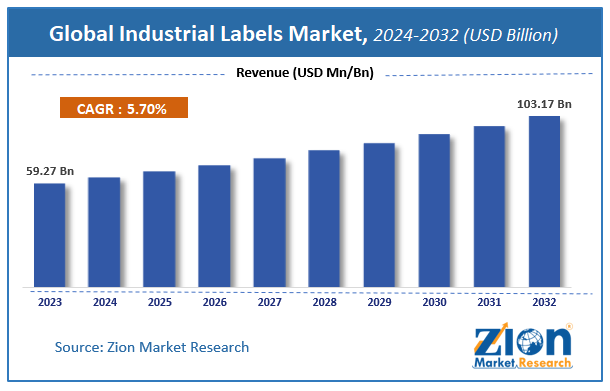
According to Zion Market Research, the global Industrial Labels Market was worth USD 59.27 billion in 2023. The market is forecast to reach USD 103.17 billion by 2032, growing at a compound annual growth rate (CAGR) of 5.7% during the forecast period 2024-2032. The report examines the primary drivers, challenges, and restraints shaping global demand for the Industrial Labels market throughout the forecast period and identifies high-growth opportunities across the industry.
Industrial Labels Market: Overview
Industrial labels have turned into promising media to transfer essential product-related information to end-users. These labels provide information such as product disposal, origin, shelf life, supply chain, and other related information to enhance product visibility. However, industrial labels add elegant features to product attractiveness. Moreover, this label gains an edge over other products in the same category manufactured by competitors. Industrial labels can easily be customized according to shape, range, size, and application in various industries. False information affects the revenue and respective brand image of the company. Hence, it needs to use anti-counterfeiting technologies based on unique codes on labels. This technology will help to tackle the counterfeit issue. It keeps a record for proper tracking of the product.
Key Insights
- As per the analysis shared by our research analyst, the global Industrial Labels market is estimated to grow annually at a CAGR of around 5.7% over the forecast period (2024-2032).
- In terms of revenue, the global Industrial Labels market size was valued at around USD 59.27 billion in 2023 and is projected to reach USD 103.17 billion by 2032.
- The market is driven by regulatory compliance, product traceability requirements, industrial automation, demand for durable labeling solutions in harsh environments, and the need for anti-counterfeiting technologies.
- Based on the Type, the Equipment Asset Tags segment dominated the market due to extensive use in consumer durables and food sectors for identification
- Based on the Material, the Polymer segment held the leading position owing to superior chemical resistance, durability, and cost-effectiveness across industrial applications
- Based on the Label Technology, the Bar Codes segment dominated because of widespread adoption for product identification
- Based on the Printing Technology, the Flexography segment led demand due to its efficiency for high-volume production
- Based on the Mechanism, the Pressure Sensitive segment dominated as a result of fast, flexible application capabilities
- Based on region, North America dominated the global Industrial Labels market with the largest share owing to its extensive industrial network
Industrial Labels Market: Dynamics
Growth Drivers
What factors are accelerating the expansion of the Industrial Labels market?
Widespread adoption of industrial labels across diverse sectors for identification, safety, branding, and compliance is a primary growth driver. The increasing need for accurate product information and anti-counterfeiting technologies, including unique codes and tracking systems, further propels demand as companies seek to protect brand integrity and meet regulatory standards. Expansion of industrial networks, particularly in developing countries, creates additional volume requirements for durable labeling solutions.
Industrial automation, rising focus on product traceability, and the need for labels that perform reliably in harsh environments also contribute significantly. Growing activity in manufacturing, logistics, pharmaceuticals, chemicals, and food & beverage sectors sustains consistent demand for specialized, high-performance labels that support operational efficiency and supply-chain visibility.
Restraints
What factors are limiting the growth of the Industrial Labels market?
The requirement for labels to resist chemicals, extreme temperatures, weather, and mechanical stress increases material and production complexity and cost. Customization demands for varied shapes, sizes, and application methods can raise lead times and expenses, particularly for smaller-volume or highly specialized orders.
Cost pressures in competitive industrial markets and the ongoing risk of counterfeit or inaccurate labeling that can harm brand reputation and compliance status also act as restraints. Ensuring consistent quality and performance across global supply chains remains a persistent operational challenge.
Industrial Labels Market: Segmentation
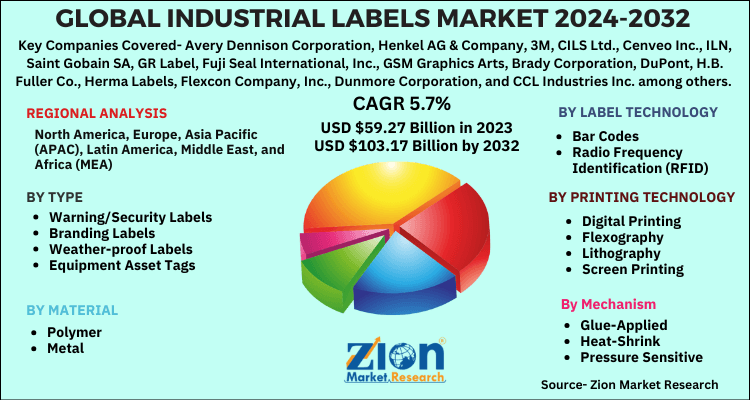
The Industrial Labels market is segmented by type, material, label technology, printing technology, mechanism, end use, and region.
Based on Type Segment, the Industrial Labels market is divided into Warning/Security Labels, Branding Labels, Weather-proof Labels, Equipment Asset Tags, and others. Equipment Asset Tags represent the most dominant subsegment because of their extensive application in consumer durables and food sectors for identification, tracking, maintenance records, and inventory control. This dominance drives market growth by anchoring high-volume demand for durable, permanent labels that support operational efficiency and regulatory compliance. Branding Labels form a strong secondary category, enabling product differentiation, aesthetic appeal, and brand communication across competitive industrial and consumer-facing markets.
Based on Material Segment, the Industrial Labels market is divided into Polymer and Metal. Polymer is the most dominant material due to its excellent chemical resistance, durability, flexibility, weather resistance, and favorable cost-performance balance across a wide range of industrial environments. Its leadership sustains market expansion by meeting the core requirements of harsh-condition applications in chemicals, automotive, and outdoor equipment. Metal labels serve as the second key material for high-temperature, heavy-duty, or permanent asset-identification needs where extreme durability is essential.
Based on Label Technology Segment, the Industrial Labels market is divided into Bar Codes, Radio Frequency Identification (RFID), and others. Bar Codes constitute the most dominant technology because of their proven reliability, low cost, and widespread integration into inventory, logistics, and point-of-use systems across industries. This dominance supports overall market volume and encourages continuous improvement in print quality and scanning performance. RFID represents the fast-growing second technology, enabling real-time tracking, automation, and enhanced supply-chain visibility for higher-value assets and complex logistics operations.
Based on Printing Technology Segment, the Industrial Labels market is divided into Digital Printing, Flexography, Lithography, Screen Printing, and others. Flexography leads the market. Flexography provides high-speed, cost-effective production for large-volume industrial runs, while Digital Printing offers superior flexibility for short runs, variable data, and rapid customization. Together, they drive efficiency and responsiveness, enabling manufacturers to serve both mass-production and specialized industrial labeling needs. Screen Printing and Lithography remain relevant for specific durability or high-quality graphic requirements.
Based on Mechanism Segment, the Industrial Labels market is divided into Glue-Applied, Heat-Shrink, Pressure Sensitive, In-Mold, Heat Transfer, and others. Pressure Sensitive is the most dominant mechanism owing to its ease of application, versatility across surfaces, and suitability for high-speed production lines in packaging and manufacturing. This leadership accelerates market adoption by reducing application complexity and supporting broad industrial use. Heat-Shrink and In-Mold mechanisms provide complementary growth through specialized applications requiring conformability or integration during molding processes.
Based on End Use Segment, the Industrial Labels market is divided into Consumer Durables, Automotive, Chemicals, Construction, Pharmaceuticals, Food & Beverage, Transportation & Logistics, and others. Food & Beverage and Transportation & Logistics hold major shares driven by stringent regulatory labeling mandates, high packaging volumes, and the critical need for traceability and product information. These segments fuel consistent demand and encourage innovation in durable, compliant, and scannable labels. Automotive, Chemicals, and Pharmaceuticals also contribute significantly through requirements for safety, chemical resistance, and asset identification.
Industrial Labels Market: Report Scope
| Report Attributes | Report Details |
|---|---|
| Report Name | Industrial Labels Market |
| Market Size in 2023 | USD 59.27 Billion |
| Market Forecast in 2032 | USD 103.17 Billion |
| Growth Rate | CAGR of 5.7% |
| Number of Pages | 230 |
| Key Companies Covered | Avery Dennison Corporation, Henkel AG & Company, 3M, CILS Ltd., Cenveo Inc., ILN, Saint-Gobain SA, GR Label, Fuji Seal International, Inc., GSM Graphics Arts, Brady Corporation, DuPont, H.B. Fuller Co., Herma Labels, Flexcon Company, Inc., Dunmore Corporation, and CCL Industries Inc., among others. |
| Segments Covered | By Type, By Material, By Label Technology, By Printing Technology, By Mechanism, By End Use, And By Region |
| Regions Covered | North America, Europe, Asia Pacific (APAC), Latin America, Middle East, and Africa (MEA) |
| Base Year | 2023 |
| Historical Year | 2018 - 2022 |
| Forecast Year | 2024 - 2032 |
| Customization Scope | Avail customized purchase options to meet your exact research needs. Request For Customization |
Industrial Labels Market: Regional Analysis
Why will North America continue to dominate the global market during the projection period?
North America accounts for the largest share of the global Industrial Labels market owing to its extensive and mature industrial network spanning manufacturing, automotive, chemicals, pharmaceuticals, and logistics. High levels of automation, strict regulatory compliance requirements, and advanced adoption of labeling and identification technologies sustain strong demand for durable and smart labels. Continuous investment in supply-chain efficiency and product traceability further reinforces the region’s leadership and sets technology and quality standards that influence global market development.
Europe demonstrates solid growth supported by rising consumer and industry awareness of counterfeit products and the consequent demand for secure, traceable labeling solutions. Key countries including Germany, the United Kingdom, France, and Italy drive activity through strong manufacturing bases, stringent chemical and pharmaceutical regulations, and focus on product authenticity and safety.
Asia Pacific is advancing at a faster pace and is positioned to capture an increasing share of the global market. Rapid industrial development, expanding manufacturing capacity, a large young workforce, and growth in automotive, electronics, food & beverage, and logistics sectors in China, India, Japan, and Southeast Asia generate rising demand for both standard and advanced industrial labels. This expansion contributes significantly to overall global volume growth and encourages investment in local production and technology.
Industrial Labels Market: Competitive Players
The global Industrial Labels market is dominated by players:
- Avery Dennison Corporation
- Henkel AG & Company
- 3M
- CILS Ltd.
- Cenveo Inc. ILN
- Saint-Gobain SA
- GR Label
- Fuji Seal International Inc.
- GSM Graphics Arts
- Brady Corporation
- DuPont
- H.B. Fuller Co.
- Herma Labels
- Flexcon Company. Inc.
- Dunmore Corporation
- CCL Industries Inc.
This report segments the Industrial Labels market as follows:
By Type
- Warning/Security Labels
- Branding Labels
- Weather-proof Labels
- Equipment Asset Tags
- Others
By Material
- Polymer
- Metal
By Label Technology
- Bar Codes
- Radio Frequency Identification (RFID)
- Others
By Printing Technology
- Digital Printing
- Flexography
- Lithography
- Screen Printing
- Others
By Mechanism
- Glue-Applied
- Heat-Shrink
- Pressure Sensitive
- In-Mold
- Heat Transfer
- Others
By End Use
- Consumer Durables
- Automotive
- Chemicals
- Construction
- Pharmaceuticals
- Food & Beverage
- Transportation & Logistics
- Others
By Region
- North America
- The U.S.
- Canada
- Mexico
- Europe
- France
- The UK
- Spain
- Germany
- Italy
- Rest of Europe
- Asia Pacific
- China
- Japan
- India
- Australia
- South Korea
- Rest of Asia Pacific
- The Middle East & Africa
- Saudi Arabia
- UAE
- Egypt
- Kuwait
- South Africa
- Rest of the Middle East & Africa
- Latin America
- Brazil
- Argentina
- Rest of Latin America
Table Of Content
Methodology
FrequentlyAsked Questions
Industrial labels provide identification and safety information. They are designed to withstand harsh environments.
The global Industrial Labels market is expected to be driven by the regulatory compliance, product traceability requirements, and industrial automation. Durable labeling solutions for harsh environments support demand.
According to study, the global Industrial Labels market size was worth around USD 59.27 Billion in 2023 and is predicted to grow to around USD 103.17 Billion By 2032.
The global Industrial Labels market is expected to grow at a Compound Annual Growth Rate (CAGR) of around CAGR 5.7% during the forecast period from 2024-2032.
The global Industrial Labels industry is projected to be challenged by Challenges include resistance to chemicals and extreme conditions, customization complexity, and cost pressures.
Which application areas will offer significant growth opportunities in the Industrial Labels market?
The Opportunities include demand from manufacturing and logistics, regulatory labeling needs, smart labels, and growth in asset tracking will offer significant growth opportunities in the Industrial Labels market.
Durable labels resistant to chemicals and extreme conditions; RFID and barcode hybrid labels; compliance-driven and traceability-focused designs are the emerging trends and innovations impacting the Industrial Labels market.
North America accounted for the largest market share for industrial labels owing to the large industrial network.
Some of the prominent players operating in the global Industrial Labels market are; Avery Dennison Corporation, Henkel AG & Company, 3M, CILS Ltd., Cenveo Inc., ILN, Saint Gobain SA, GR Label, Fuji Seal International, Inc., GSM Graphics Arts, Brady Corporation, DuPont, H.B. Fuller Co., Herma Labels, Flexcon Company, Inc., Dunmore Corporation, and CCL Industries Inc. among others. Many companies focus on best-suited business strategies to better serve the customer. TSC Auto ID has introduced a new Industrial Label Printer in series of MX240P and others.
The report explores crucial aspects of the Industrial Labels market, including a detailed discussion of existing growth factors and restraints, while also browsing future growth opportunities and challenges that impact the market.

HappyClients

