
Industrial Fire Sprinklers Market Size, Share, Trends, Growth and Forecast 2034

Industrial Fire Sprinklers Market By Type (Dry Pipe Sprinkler Systems, Wet Pipe Sprinkler Systems, Deluge Sprinkler Systems, and Pre-Action Sprinkler Systems), By Component (Sprinkler Heads, Water Supply Sources, Piping and Fittings, Monitoring and Control Systems, and Control Valves), By Installation Type (New Installations and Retrofit Installations), By End-User (Aerospace, Pharmaceuticals, Automotive, Food and Beverage, and Construction), and By Region - Global and Regional Industry Overview, Market Intelligence, Comprehensive Analysis, Historical Data, and Forecasts 2025 - 2034
| Market Size in 2024 | Market Forecast in 2034 | CAGR (in %) | Base Year |
|---|---|---|---|
| USD 8.6 Billion | USD 19.4 Billion | 8.5% | 2024 |
Industrial Fire Sprinklers Industry Perspective:
What will be the size of the global industrial fire sprinklers market during the forecast period?
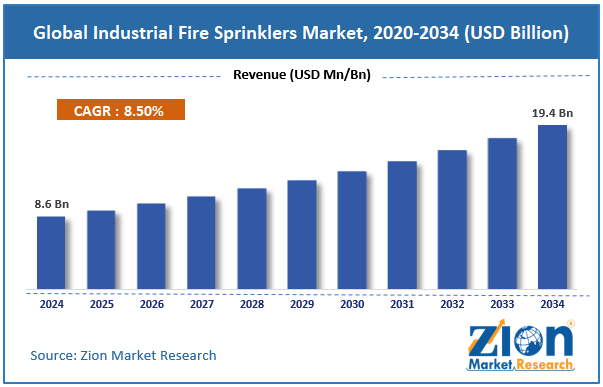
The global industrial fire sprinklers market size was worth around USD 8.6 billion in 2024 and is predicted to grow to around USD 19.4 billion by 2034, with a compound annual growth rate (CAGR) of roughly 8.5% between 2025 and 2034.
Key Insights
- As per the analysis shared by our research analyst, the global industrial fire sprinklers market is estimated to grow annually at a CAGR of around 8.5% over the forecast period (2025-2034).
- In terms of revenue, the global industrial fire sprinklers market size was valued at around USD 8.6 billion in 2024 and is projected to reach USD 19.4 billion by 2034.
- Stringent safety regulations & compliance standards are expected to drive the industrial fire sprinklers market.
- Based on the type, the wet pipe sprinkler systems hold the largest market share in 2024.
- Based on the component, the sprinkler heads dominate the industry growth.
- Based on the installation type, the new installations segment is expected to grow at a substantial rate over the projected period.
- Based on the end-user, the construction industry maintains its prominent market share over the projected period.
- Based on region, the Asia Pacific captures the largest revenue share in 2024.
Industrial Fire Sprinklers Market: Overview
The industrial fire sprinklers market comprises all types of fire sprinklers intended for use in industrial settings, which cover chemical manufacturing and processing plants, fabrication shops, power plants, and distribution centers, as well as refineries, ports, and mines. Industrial installations tend to be more complex and operate on a larger scale, requiring more powerful fire suppression systems to cater for hazards, such as large open spaces, solvent storage tanks, heavy machinery, and flammable liquids, as well as gases. The market can also be broken down into different categories of system, such as wet, dry, deluge, and pre-action sprinklers, along with associated pipe and pump hardware, controls, and test equipment, sensors, and sprinkler nozzles. The market has experienced significant growth due to high levels of assembly plant expansion worldwide, associated industrial growth, the tightening of fire regulations, rising awareness of health and safety issues, and the ability of fire sprinklers to safeguard physical assets and reduce interruptions.
Industrial Fire Sprinklers Market: Dynamics
Growth Drivers
Does the increasing awareness of fire risk and safety drive the industrial fire sprinklers market growth?
The increasing consciousness of risk and safety in the industrial fire sprinkler industry is one of the key market growth factors. The industrial plants, which include manufacturing plants, storage and distribution centers, chemical and refinery plants, and power and energy plants, often put industry people at much greater fire risks relative to general domestic and commercial applications, owing to the presence of inflammable materials, machinery, electrical appliances, and high-temperature equipment in such plants. The growing awareness of the severe consequences associated with fire accidents—such as loss of human life, decreased productivity, property damage, government liabilities, and harm to brand reputation—is motivating companies to implement advanced fire sprinkler systems that can detect early signs of fire and extinguish it while it is still a small spark, thereby significantly reducing operational and financial risks.
Restraints
High initial installation & retrofitting costs are hampering the industry growth
The high costs of initial installations and retrofitting are a major factor restraining the growth of the industrial fire sprinklers market. The requirement for extensive capital investment in installing fire sprinkler systems in industrial applications, including the purchase of sprinkler heads and control valves, the installation of piping networks, pumps, and tanks, the integration of alarm systems, and the hiring of skilled professionals, puts many organizations off buying fire sprinklers. The ownership costs of large industrial setups comprising warehouses, manufacturing plants, processing units, and others are very high, and hence, the costs of installing fire sprinklers are prohibitive.
Retrofitting existing properties and incorporating fire sprinklers is comparatively more expensive, as it includes expenses such as classifying the property, redesigning or modifying the system as per requirements, interfering with existing systems, time costs, compliance costs, and others. The costs of installing fire sprinklers become even higher for SMEs due to their significant budget constraints. This huge capital investment restrains organizations from purchasing fire sprinklers for industrial applications.
Opportunities
How does the rising company's expansion offer a potential opportunity for the industrial fire sprinklers market growth?
The increasing company expansion is expected to offer a potential opportunity for industry growth during the projected period. For instance, in July 2025, OroraTech, a world leader in space-based thermal intelligence, was officially launched in the new regional headquarters in Athens, Greece. The establishment of the new Athens-based regional headquarters was seen as a significant milestone in OroraTech’s ongoing expansion efforts in Greece. OroraTech was awarded a EUR20 million development contract in 2024 to develop and deploy Greece’s first-ever national wildfire monitoring system. The system integrates four dedicated thermal imaging satellites with a robust data processing and alerting system. The contract included local hiring, workforce training, and maintaining a permanent operational office in Athens.
Challenges
Does the skilled labor shortage pose a major challenge to the market growth?
A shortage of skilled labor, which inhibits the progress of the industrial fire sprinklers market by delaying project timelines and escalating labor costs, will hinder the industry's growth. Designing and installing fire sprinkler systems in the industrial fire sprinkler sector is labor-intensive and requires certified installers, as it involves ensuring compliance with rigorous safety standards, performing complicated hydraulic calculations, creating complex system layouts, and integrating sprinkler systems with alarm and suppression infrastructure in high-risk environments such as manufacturing plants, warehouses, and chemical/energy units. Depleted pools of trained fire protection engineers and technicians can increase project time, add to labor costs, and cause delays and compliance issues during retrofitting of older manufacturing facilities. As the industrial fire sprinklers market expands, rapid industrialization will lead to greater demand for customized fire safety infrastructure than readily available personnel to install it, while mature markets will grapple with aging labor pools and insufficient training initiatives.
Industrial Fire Sprinklers Market: Report Scope
| Report Attributes | Report Details |
|---|---|
| Report Name | Industrial Fire Sprinklers Market |
| Market Size in 2024 | USD 8.6 Billion |
| Market Forecast in 2034 | USD 19.4 Bllion |
| Growth Rate | CAGR of 8.5% |
| Number of Pages | 223 |
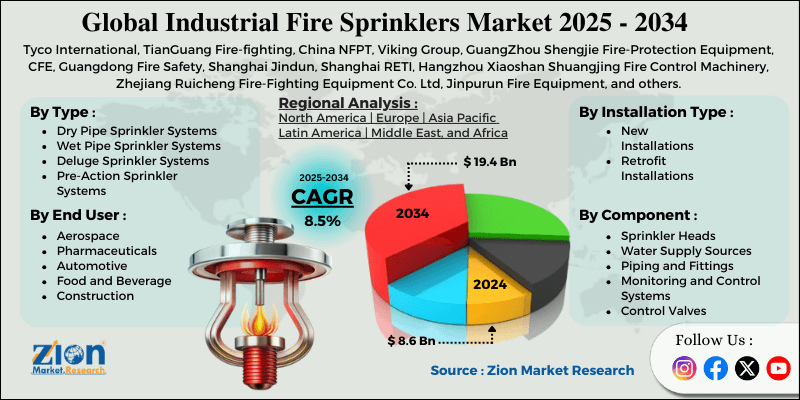
| Key Companies Covered | Tyco International, TianGuang Fire-fighting, China NFPT, Viking Group, GuangZhou Shengjie Fire-Protection Equipment, CFE, Guangdong Fire Safety, Shanghai Jindun, Shanghai RETI, Hangzhou Xiaoshan Shuangjing Fire Control Machinery, Zhejiang Ruicheng Fire-Fighting Equipment Co. Ltd, Jinpurun Fire Equipment, and others. |
| Segments Covered | By Type, By Component, By Installation Type, By End-User, and By Region |
| Regions Covered | North America, Europe, Asia Pacific (APAC), Latin America, Middle East, and Africa (MEA) |
| Base Year | 2024 |
| Historical Year | 2019 to 2023 |
| Forecast Year | 2025 - 2034 |
| Customization Scope | Avail customized purchase options to meet your exact research needs. Request For Customization |
Industrial Fire Sprinklers Market: Segmentation
Type Insights
Why do wet pipe sprinkler systems hold the dominant position in the industrial fire sprinklers market?
The wet pipe sprinkler systems hold the largest market share in 2024. This is due to the fact that wet pipe sprinkler systems are still arguably the most reliable means of sprinkler applications, which, in turn, reduces their cost and thereby encourages a large range of building types and sectors to utilize them. They are kept ‘wet’ and ‘readily available’ at all times owing to the fact that they are designed to be unfailingly reliable and reliable. This feature enables them to deploy instant fire suppression upon fire activation, which is vital for minimizing damage and fatalities. The main advantages associated with wet pipe sprinkler systems are their inherent simplicity and ease of maintenance, compared with systems such as dry-pipe or pre-action systems, which require additional components and complex machinery. The simplicity of such systems results in reduced operating and maintenance costs and makes them particularly attractive to facility owners, for whom saving costs is paramount. The simplicity of these systems makes their retrofitting and installation into new builds very straightforward.
Component Insights
Why do sprinkler heads hold the largest share in the industrial fire sprinklers industry?
The sprinkler heads dominate the industry growth. The main growth drivers are the rise in the number of industrial construction projects, the increase in stringent fire safety control norms, and the need for efficacious early-phase firefighting in high-risk scenarios. Sprinkler heads are a main component of the firefighting mechanism, as they directly sense the heat and start water flow. Growth in revenues is spurred by the increased amount of new warehousing, manufacturing, and logistics structures being built, as well as retrofitting works in old facilities.
Installation Type Insights
Do the new installations grow substantially in the industrial fire sprinklers market?
The new installations segment is expected to grow at a substantial rate over the projected period. The main factors that have contributed to the rise of the market are the rapid pace of industrialization, the increasing development of manufacturing plants, the expansion of warehousing and logistics, and the tightening of fire safety regulations. As new industrial plants and outlets, distribution centers, cold storage warehouses, and processing units are being built, fire sprinkler systems are being incorporated into their designs to ensure future compliance and reduce risk. New industrial structures must have fire protection systems installed due to government and safety authority regulations in each region.
End-User Insights
How does the construction industry maintain its prominent share in the industrial fire sprinklers industry?
The construction industry maintains its prominent market share over the projected period. The growth is due to increased industrial and commercial builds, which in turn boost demand for consistent fire protection systems. As factories, logistics parks, energy plants, structures, and infrastructure are all constructed at a fast rate, fire sprinkler systems must be installed during the initial construction stage to comply with regulations. Wide variation in code compliance by region is resulting in sprinkler requirements for new-build industrials.
Regional Insights
Why does the Asia Pacific lead the industrial fire sprinklers market?
The Asia Pacific captures the largest revenue share in 2024. Growth has been supported by rapid industrialization, growth in manufacturing capacity, and large-scale infrastructure development in countries like China, India, and some Southeast Asian countries. This has led to increased demand for fire protection systems in the form of large-capacity industrial parks, distribution warehouses, power plants, chemical plants, and other processing installations. The tightening of regulations by regional governments has led to a proliferation of new industrial and commercial installations that must include fire sprinkler systems, as well as to the renovation of older installations and the inclusion of fire sprinkler systems in new constructions. The growing e-commerce industry has led to an increased push for high-distribution-capacity warehouses, supported by high-capacity fire sprinkler systems for high-density storage systems. Additionally, rising general awareness regarding man-machine safety systems, along with growing levels of FDI in the manufacturing sector, is further aiding system installations across the Asia Pacific in general.
Industrial Fire Sprinklers Market: Competitive Analysis
The global industrial fire sprinklers market is dominated by players like:
- Tyco International
- TianGuang Fire-fighting
- China NFPT
- Viking Group
- GuangZhou Shengjie Fire-Protection Equipment
- CFE
- Guangdong Fire Safety
- Shanghai Jindun
- Shanghai RETI
- Hangzhou Xiaoshan Shuangjing Fire Control Machinery
- Zhejiang Ruicheng Fire-Fighting Equipment Co. Ltd
- Jinpurun Fire Equipment
The global industrial fire sprinklers market is segmented as follows:
By Type
- Dry Pipe Sprinkler Systems
- Wet Pipe Sprinkler Systems
- Deluge Sprinkler Systems
- Pre-Action Sprinkler Systems
By Component
- Sprinkler Heads
- Water Supply Sources
- Piping and Fittings
- Monitoring and Control Systems
- Control Valves
By Installation Type
- New Installations
- Retrofit Installations
By End-User
- Aerospace
- Pharmaceuticals
- Automotive
- Food and Beverage
- Construction
By Region
- North America
- The U.S.
- Canada
- Mexico
- Europe
- France
- The UK
- Spain
- Germany
- Italy
- Rest of Europe
- Asia Pacific
- China
- Japan
- India
- Australia
- South Korea
- Rest of Asia Pacific
- The Middle East & Africa
- Saudi Arabia
- UAE
- Egypt
- Kuwait
- South Africa
- Rest of the Middle East & Africa
- Latin America
- Brazil
- Argentina
- Rest of Latin America
Table Of Content
Methodology
FrequentlyAsked Questions

HappyClients

