
Global HVAC Air Quality Monitoring Market Size, Share, Trends and Forecast, 2032

HVAC Air Quality Monitoring Market: By Pollutant (Physical, Chemical, Biological), By Product (Stationary, Portable), By Application (Commercial, Industrial, Residential, Institutional) - Global Industry Perspective, Comprehensive Analysis, and Forecast, 2024 - 2032
| Market Size in 2023 | Market Forecast in 2032 | CAGR (in %) | Base Year |
|---|---|---|---|
| USD 4.87 Billion | USD 8.54 Billion | 5.8% | 2023 |
What is HVAC Air Quality Monitoring Market Size?
According to a report from Zion Market Research, the global HVAC Air Quality Monitoring Market was valued at USD 4.87 Billion in 2023 and is projected to hit USD 8.54 Billion by 2032, with a compound annual growth rate (CAGR) of 5.8% during the forecast period 2024-2032. This report explores market strengths, weakness, opportunities, and threats. It also provides valuable insights into the market's growth drivers, challenges, and the future prospects that may emerge in the HVAC Air Quality Monitoring Market industry over the next decade.
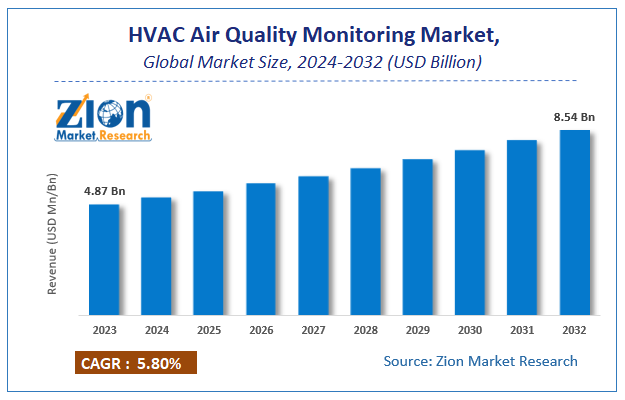
Global HVAC Air Quality Monitoring Market: Overview
The implementation for HVAC air quality monitoring in major developing countries like China, India and Indonesia due to industrialization and urbanization is need of the day. Air quality in these countries is unhealthy and government in these countries is taking initiatives to develop this system in major cities.
Global HVAC Air Quality Monitoring Market: Growth Factors
Due to increase in unhealthy air quality and indoor air pollution (IAP) need for HVAC air quality monitoring market is taking boom in developing countries in Asia like China, India, and Indonesia. Development of green structures on airports, shopping malls, parks, medical facilities is the primary growth factors for implementing HVAC air quality monitoring. Assigning subsidies and promotion given to private and public sectors by government bodies to initiate HVAC air quality monitoring devices are made compulsory.
In coming years it is anticipated that the surge for expanding more environment friendly eco-structures and growing healthcare concern among young population is the key aspect for the HVAC air quality monitoring market to flourish. Nevertheless, technical inhibitions, massive costs of products, and less consciousness about HVAC air quality monitoring among the people are the key inhibitors of the market surge.
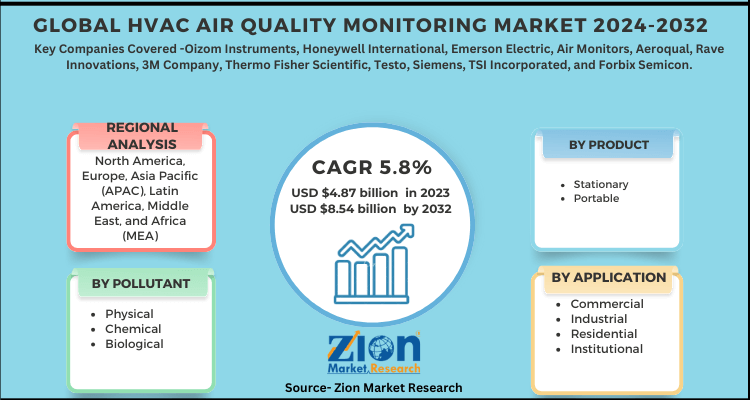
HVAC Air Quality Monitoring Market: Report Scope
| Report Attributes | Report Details |
|---|---|
| Report Name | HVAC Air Quality Monitoring Market |
| Market Size in 2023 | USD 4.87 Billion |
| Market Forecast in 2032 | USD 8.54 Billion |
| Growth Rate | CAGR of 5.8% |
| Number of Pages | 110 |
| Key Companies Covered | Oizom Instruments, Honeywell International, Emerson Electric, Air Monitors, Aeroqual, Rave Innovations, 3M Company, Thermo Fisher Scientific, Testo, Siemens, TSI Incorporated, and Forbix Semicon |
| Segments Covered | By Type, By end-user, and By Region |
| Regions Covered | North America, Europe, Asia Pacific (APAC), Latin America, Middle East, and Africa (MEA) |
| Base Year | 2023 |
| Historical Year | 2018 - 2022 |
| Forecast Year | 2024 - 2032 |
| Customization Scope | Avail customized purchase options to meet your exact research needs. Request For Customization |
Global HVAC Air Quality Monitoring Market: Segmentation
The HVAC Air Quality Monitoring Market can be segmented into product type, pollutant and application. Based on the product type, it is segmented as portable and stationary. On the basis of pollutant, the HVAC air quality monitoring market is classified as chemical, biological and physical. Based on application it’s divided as institutional, industrial, commercial, and residential applications.
Global HVAC Air Quality Monitoring Market: Regional Analysis
Based on the region, the HVAC Air Quality Monitoring Market can be divided in five main regions: North America, Europe, Asia Pacific, Latin America, and the Middle East and Africa. The need for monitoring technique for air quality and concern about the HVAC products will derive European countries towards HVAC air quality monitoring market.
Asia pacific will demonstrate huge expansions in the HVAC air quality monitoring as huge focus of the government and private authorities on getting rid of the problems arising as a result industrial particle pollutants along with the need for monitoring ambient air quality.
The Middle East and Africa are likely to contribute lucratively towards HVAC air quality monitoring market size, owing to government efforts for manufacturing indoor quality monitoring goods to be immensely used in buildings across smart cities.
North America and Latin American markets have immense growth prospects and are expected to contribute massively towards the HVAC air quality monitoring market earnings in the coming decade.
Global HVAC Air Quality Monitoring Market: Competitive Players
Few of the key participants in HVAC air quality monitoring industry are:
- Oizom Instruments
- Honeywell International
- Emerson Electric
- Air Monitors
- Aeroqual
- Rave Innovations
- 3M Company
- Thermo Fisher Scientific
- Testo
- Siemens
- TSI Incorporated
- Forbix Semicon
- among others.
The global HVAC Air Quality Monitoring Market is segmented as follows:
By Pollutant
- Physical
- Chemical
- Biological
By Product
- Stationary
- Portable
By Application
- Commercial
- Industrial
- Residential
- Institutional
By Region
- North America
- The U.S.
- Canada
- Mexico
- Europe
- France
- The UK
- Spain
- Germany
- Italy
- Rest of Europe
- Asia Pacific
- China
- Japan
- India
- Australia
- South Korea
- Rest of Asia Pacific
- The Middle East & Africa
- Saudi Arabia
- UAE
- Egypt
- Kuwait
- South Africa
- Rest of the Middle East & Africa
- Latin America
- Brazil
- Argentina
- Rest of Latin America
Table Of Content
Methodology
FrequentlyAsked Questions
HVAC air quality monitoring measures indoor air conditions. It helps maintain healthy and safe indoor environments
The global HVAC Air Quality Monitoring market is expected to be driven by the indoor air quality concerns, green building standards, and smart HVAC adoption. Use in commercial and residential buildings supports expansion.
According to study, the global HVAC Air Quality Monitoring market size was worth around USD 4.87 Billion in 2023 and is predicted to grow to around USD 8.54 Billion By 2032.
The global HVAC Air Quality Monitoring market is expected to grow at a Compound Annual Growth Rate (CAGR) of around CAGR 5.8% during the forecast period from 2024-2032.
The global HVAC Air Quality Monitoring industry is projected to be challenged by Challenges include calibration accuracy, system integration issues, and cost sensitivity.
The Opportunities include indoor air quality awareness, smart building adoption, regulatory compliance, and post-pandemic health focus will offer significant growth opportunities in the HVAC Air Quality Monitoring market.
Real-time IAQ sensors with IoT connectivity; AI-based ventilation optimization; growing adoption in smart and green buildings are the emerging trends and innovations impacting the HVAC Air Quality Monitoring market.
The global HVAC Air Quality Monitoring market is expected to be led by North America during the forecast period.
Some of the prominent players operating in the global HVAC Air Quality Monitoring market are; Oizom Instruments, Honeywell International, Emerson Electric, Air Monitors, Aeroqual, Rave Innovations, 3M Company, Thermo Fisher Scientific, Testo, Siemens, TSI Incorporated, and Forbix Semicon and others.
The report explores crucial aspects of the HVAC Air Quality Monitoring market, including a detailed discussion of existing growth factors and restraints, while also browsing future growth opportunities and challenges that impact the market.

HappyClients

